The Elder Scrolls: Betrayal of the Second Era vs Too Many Bones in 2026: Which Chip Theory RPG?
Three-session sandbox campaign or one-night tyrant run? The real differences in table space, character building, solo flow, expansions, and value.


AI-assisted research and drafting in Margo’s voice · reviewed by Robert Pruitt · how this guide was made
Last editorial refresh: 2026-07-15 Gold-standard QA: true 9 sources reviewed Affiliate links checked during gold-standard pass

The short answer
Buy Too Many Bones if you want compact one-night adventures, strongly defined Gearlocs, faster reset, and repeatable solo mastery. Buy The Elder Scrolls if you want a freeform three-act campaign, dungeon and world exploration, mix-and-match class lines, and a larger evolving build. Owning both makes sense only if those two calendar shapes both occur in your life.
Decision map
Choose in thirty seconds
Repeatable solo and one-night arcs
Freeform premium mini-campaign
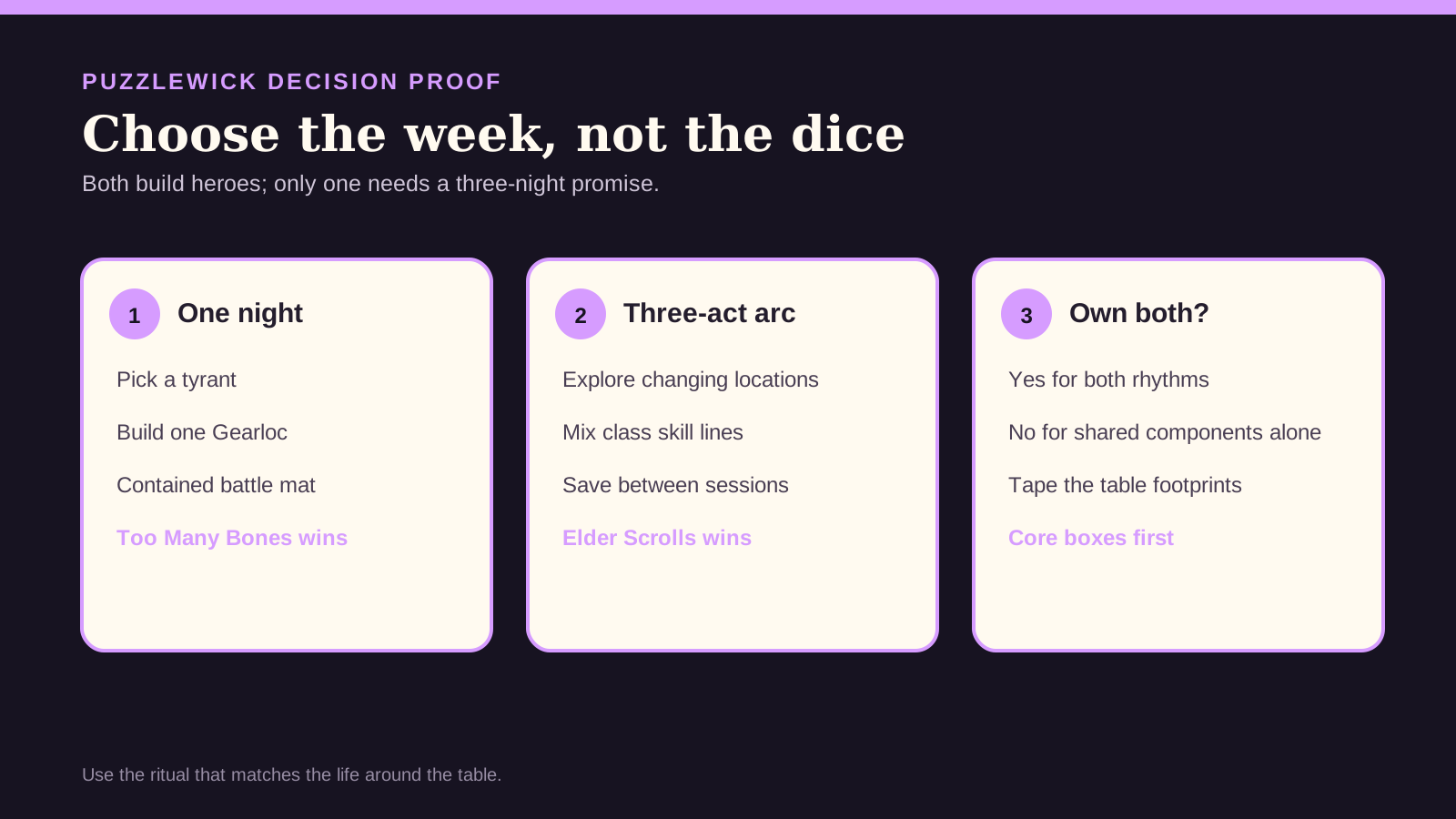
The record says these games share materials, combat ancestry, and a publisher, then diverge almost everywhere that matters. Too Many Bones builds a whole adventure toward one Tyrant, usually in one sitting. Betrayal of the Second Era builds a hero across three acts, saves between them, and gives exploration physical space. Current owners call Elder Scrolls “TMB 2.0” as shorthand, then spend entire threads explaining why the experiences are not replacements. Here is the clean ledger.
Start here, then go deeper
You are in the right cabinet.
 ◇ Universe HubThe Elder Scrolls: the whole buying pathThe Elder Scrolls universe is for players who want to bring Tamriel to the table without mistaking a giant pledge manager for a...
 ✦ Topic PathBoard Game Buying Guides: compare the whole shelfStart with the decision, not the shelf. These guides compare the games, editions, expansions, player counts, and costs people...Buying GuideElder Scrolls BOTSE Buying Guide: What to Buy in 2026The complete 2026 BOTSE guide: core, every expansion, pledge tiers, solo play, storage, first builds and the honest $845 verdict.
Should you buy Elder Scrolls or Too Many Bones?
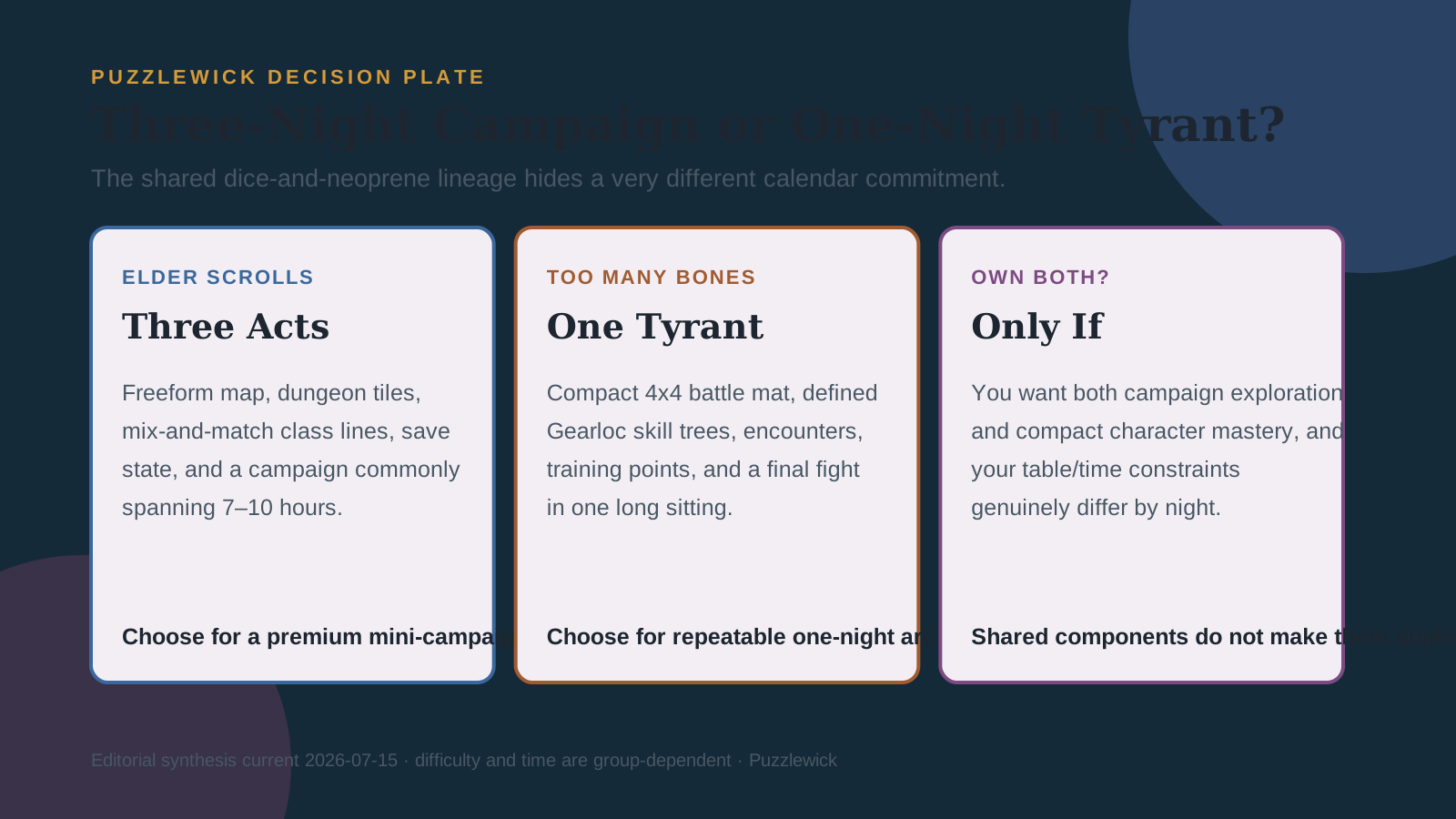
Recent June 2026 comparison threads converge on the same split. Elder Scrolls is larger, more freeform, more rules-heavy, and easier to describe as a dungeon-campaign experience. Too Many Bones is more compact, quicker to reset, and built around learning the boundaries of a highly specific Gearloc.
A typical Elder Scrolls campaign spans three acts and roughly 7–10 hours for many groups. A TMB run builds toward one Tyrant in an evening or long afternoon. If your table disappears after dinner, TMB wins before the first die is rolled. If you want to save a character and return to a world over three nights, Elder Scrolls earns the footprint.
What does Elder Scrolls change?
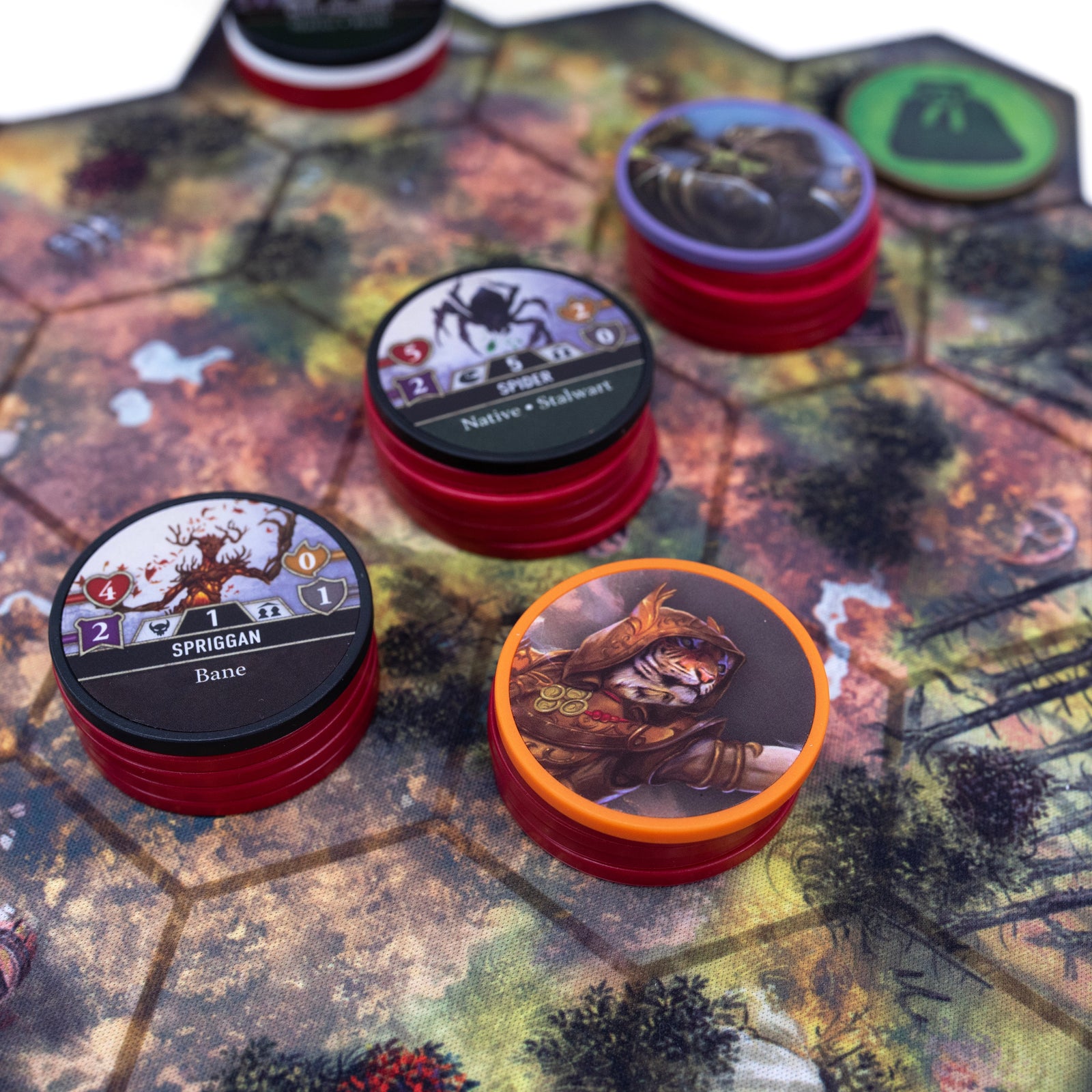
Betrayal of the Second Era takes Chip Theory’s chips, dice, neoprene, and tactical positioning into a broader adventure structure. Characters combine ancestry, class, and skill lines rather than arriving as one fixed puzzle. The overworld chooses where an act goes; dungeons unfold on tiles; equipment and skills build across the campaign.
The freedom is the appeal and the rules burden. More systems interact, the table expands, and by act two a strong build can feel nearly complete. Owners sometimes report rushing the final act once the character engine peaks. That is a useful warning: the game’s pleasure is development and discovery, not only the last boss.
What does Too Many Bones preserve?
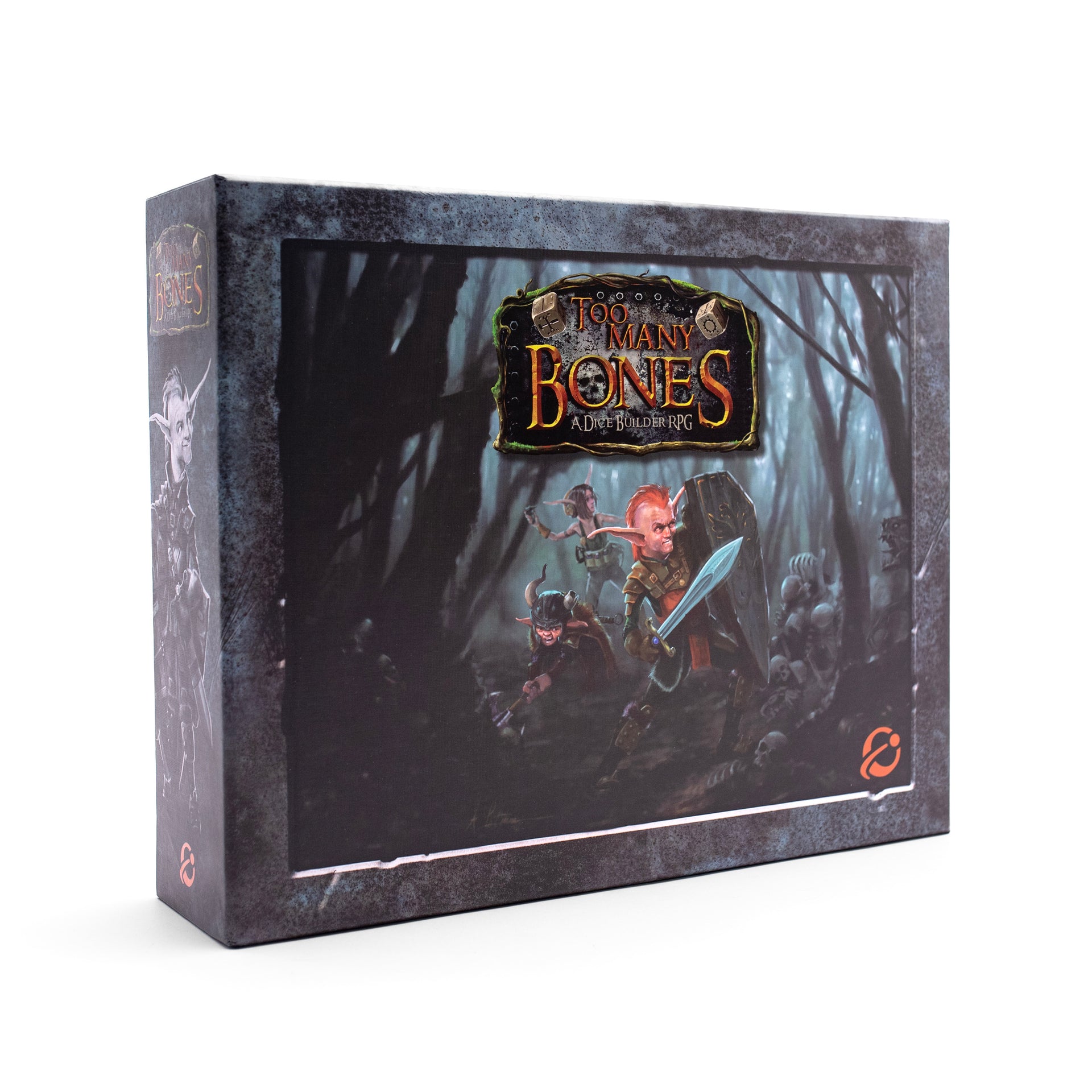
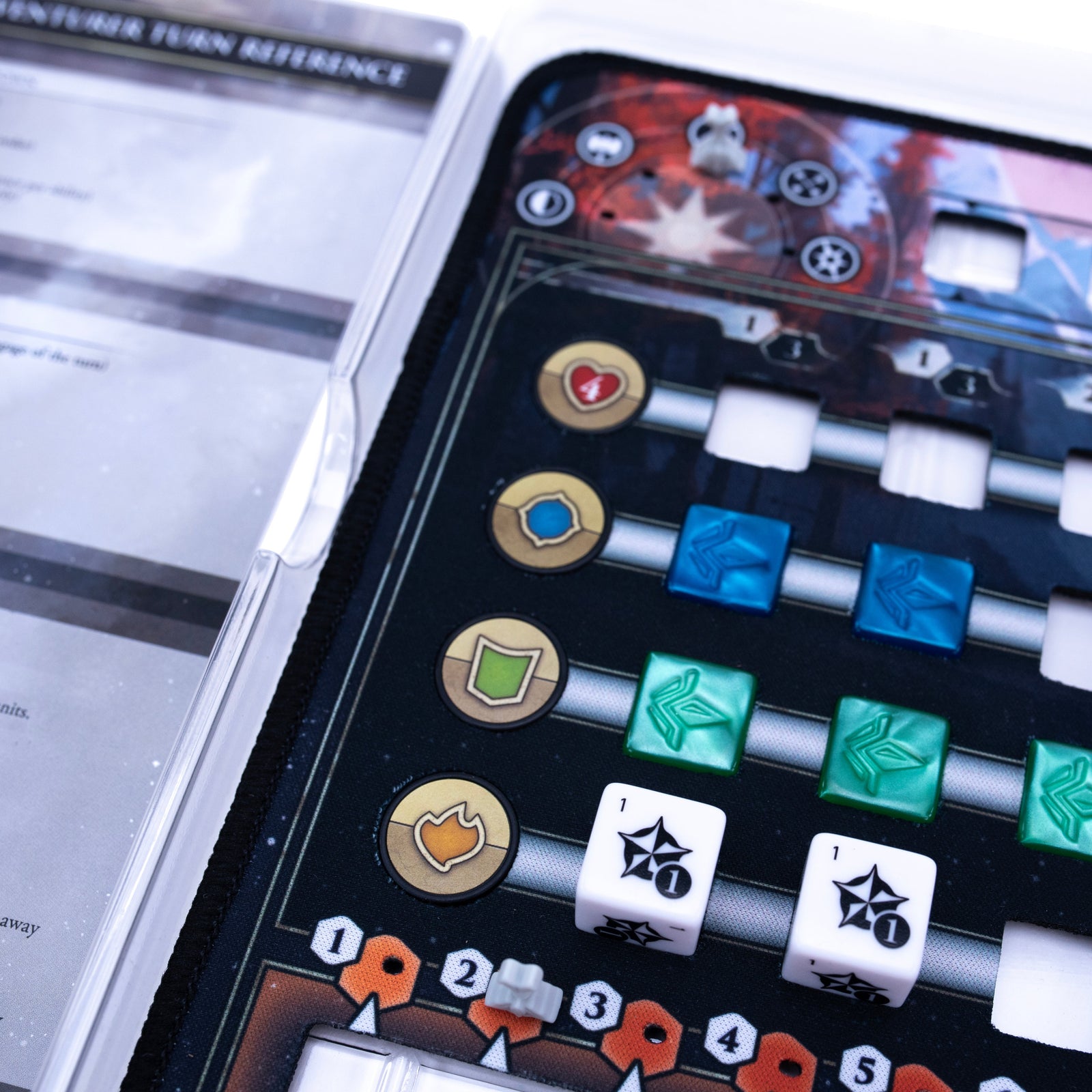
Too Many Bones keeps its adventure abstract. Encounter cards advance the day count, Training Points improve stats or unlock skill dice, and the 4x4 battle mat compresses combat into a positional puzzle. Each Gearloc has a strong mechanical identity: Picket tanks, Boomer manages explosives, Patches heals, Tantrum turns anger into a resource.
That definition is why repeat play works. You are not only trying new builds; you are learning a character’s grammar. Misses often produce bones, which fuel a Backup Plan rather than becoming dead results. The system makes failure material.
The official core currently lists four Gearlocs, seven Tyrants, 64 skill dice, and the complete battle/encounter loop. It does not need an expansion to function.
Elder Scrolls asks what hero you can build. Too Many Bones asks how well you understand this Gearloc.
Which game fits your table and return rhythm?
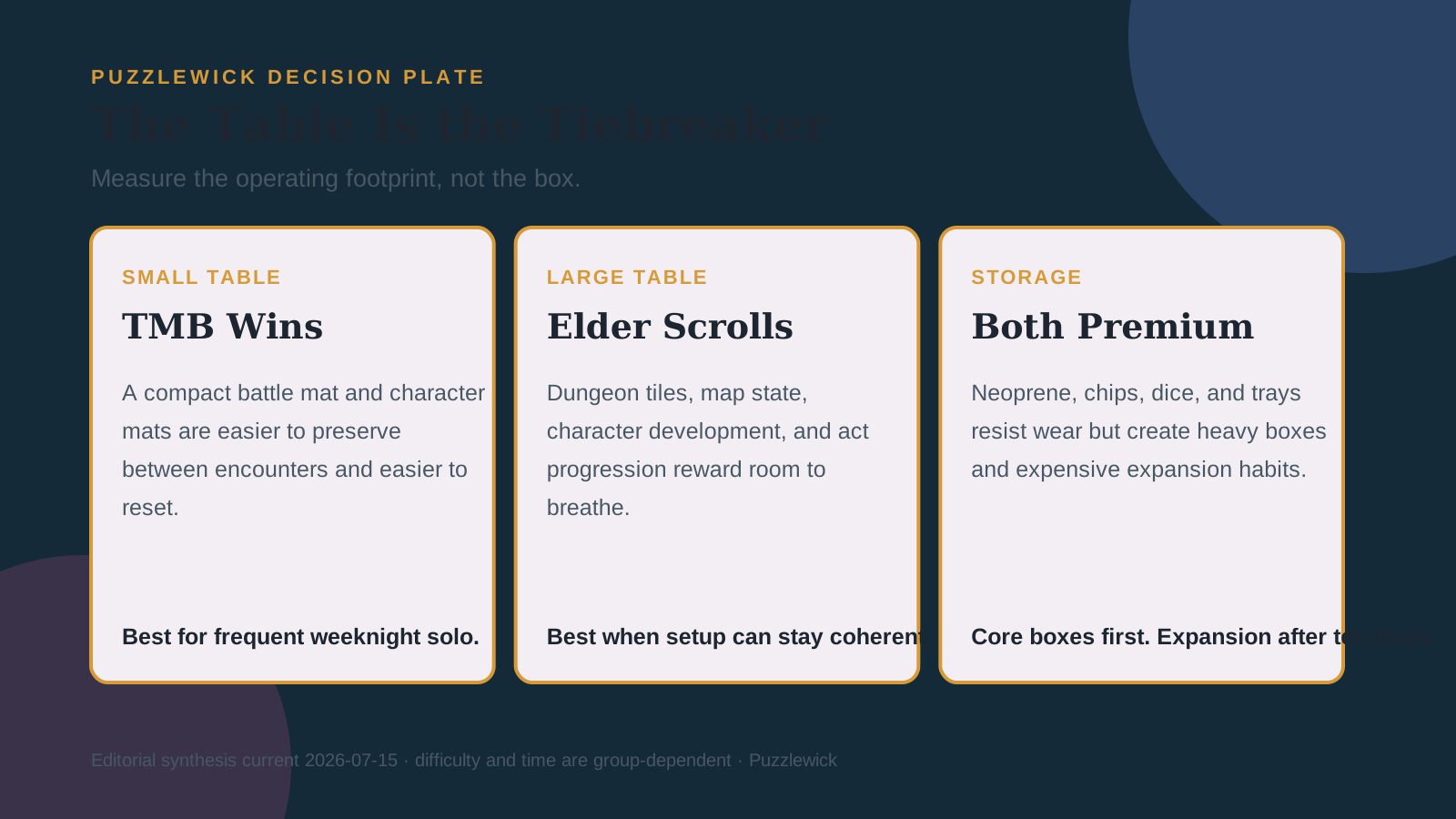
TMB wins the small-table contest. The battle mat is fixed, character areas are defined, and each run resets. Elder Scrolls needs world/dungeon state, larger character development, and a campaign save. Its save system is good, but saving is still work.
For Elder Scrolls, put each hero’s active cards, dice, and development note into a separate document wallet. Photograph the dungeon and write the exact next objective. For TMB, store each Gearloc as a complete kit and keep the Baddie stacks separated by point value. In both cases, build trays around what enters play together rather than component material.
Current June and July 2026 owner comparisons consistently separate them by space and rhythm. Betrayal is praised as the freer, more exploratory evolution, but owners call out a larger table and longer commitment. Too Many Bones keeps the combat mat compact and its one-night tyrant structure easier to revisit. That makes owning both defensible only when you want both rhythms, not because one is an automatic ‘2.0’ replacement.
Does the shared combat make them redundant?
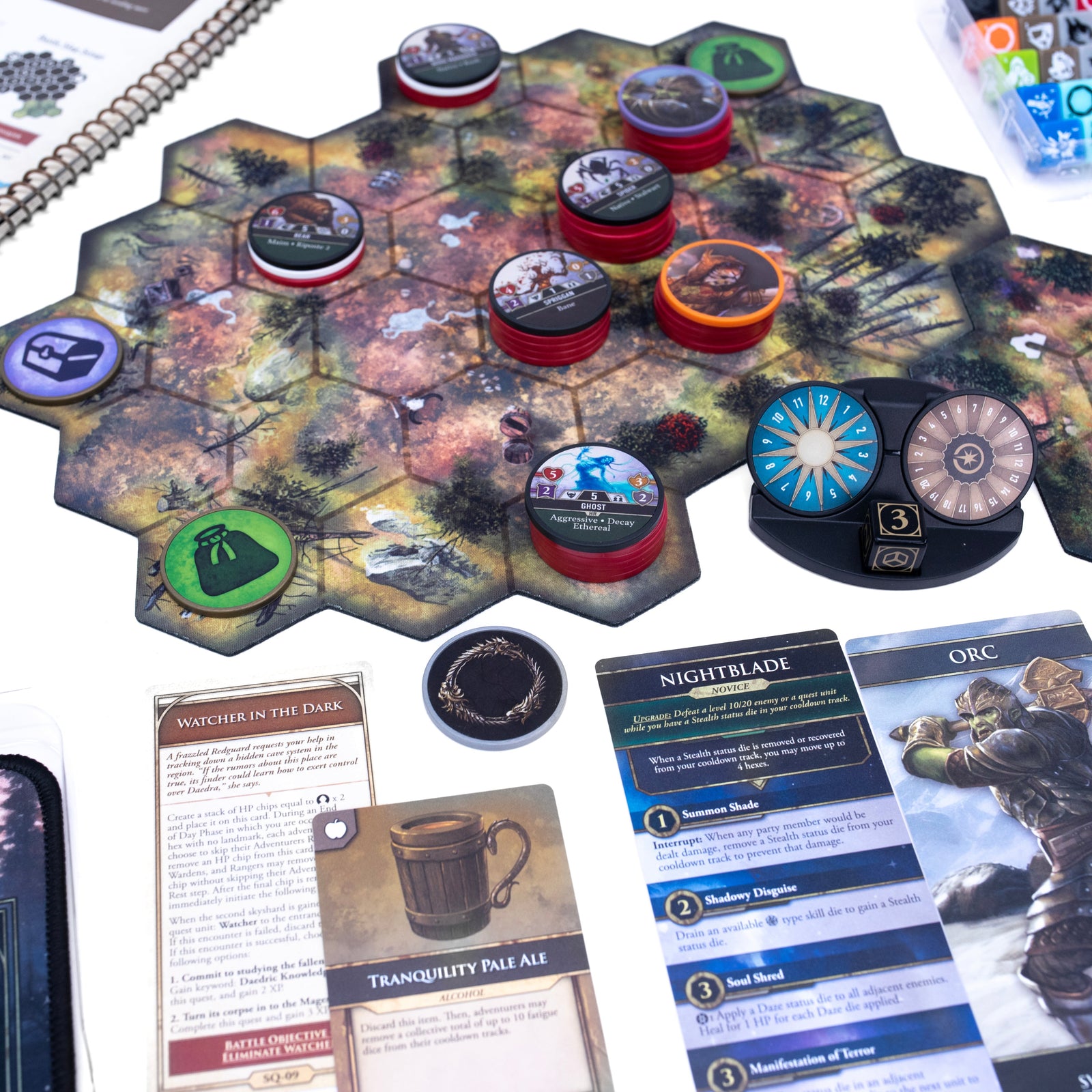
No. Both use attack/defense dice, chips, and tactical positions, but encounter context and character development change the feeling. TMB’s 4x4 mat is a tight arena where turn order, lanes, and skill-die timing dominate. Elder Scrolls gives fights a location inside exploration, more variable builds, and more environmental context.
If what you love is Chip Theory tactility and dice-building, overlap is real. If what you love is the arc, they separate cleanly. TMB is a repeatable character-and-Tyrant puzzle. Elder Scrolls is a premium adventure campaign with TMB-like DNA.
How should strategy evolve from first run to expert play?
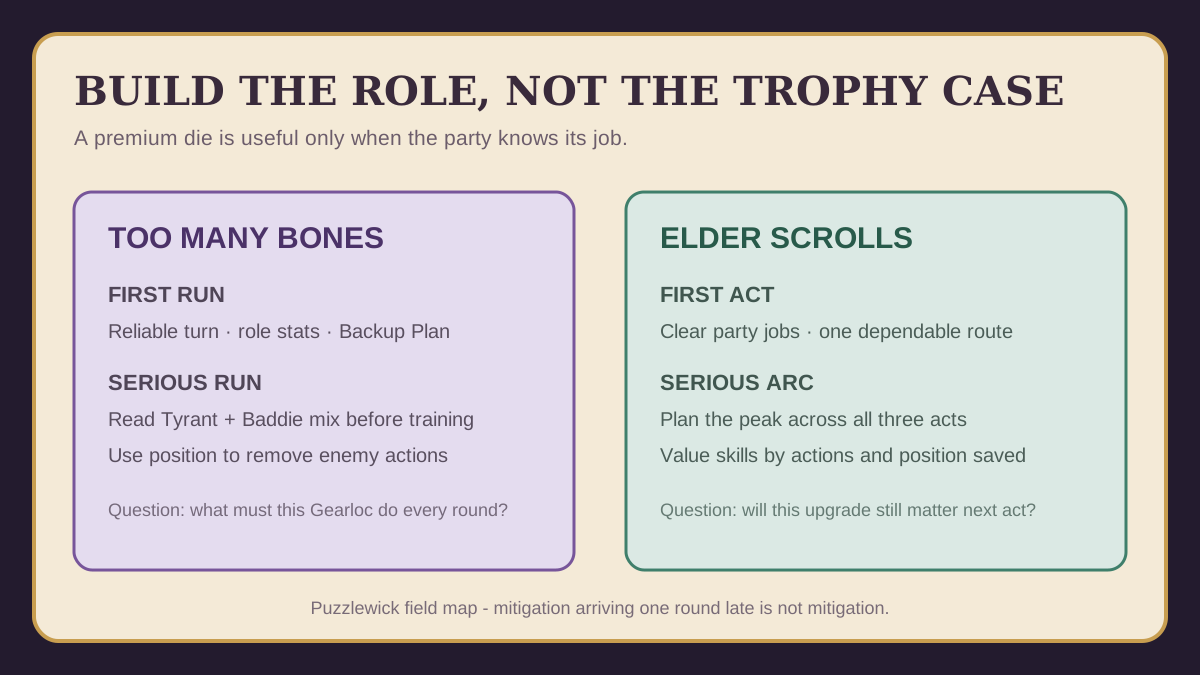
Too Many Bones, first run: learn one Gearloc’s reliable turn before chasing the clever skill dice. Increase the stats that let the character execute its role, understand how misses feed the Backup Plan, and treat initiative position as part of the build. The first goal is a repeatable contribution every round.
Too Many Bones, serious play: read the Tyrant and likely Baddie mix before spending Training Points. Build for the encounter schedule, not an abstract end-state. Preserve flexible dice or Backup Plan access for the round where positioning, recovery, or control matters more than raw attack. On the 4x4 mat, one square of movement can remove an enemy turn; damage is not the only useful output.
Elder Scrolls, first campaign: choose a clear party job for each hero and resist buying every attractive skill line. Use the first act to prove resource generation, movement, defense, and one dependable damage or control route. Record why each major upgrade was chosen so the second session does not reopen the entire build debate.
Elder Scrolls, serious play: plan across the three-act arc. A build that peaks early can make later rewards feel redundant, while a build that waits too long can turn the middle act into recovery. Evaluate a skill by the actions, dice, or positioning it saves across several encounters. In both games, premium components cannot rescue a party whose roles overlap and whose scarce mitigation arrives one round late.
Which one belongs on a normal weeknight?
Too Many Bones is the stronger appliance game. Choose a Gearloc, choose a tyrant, assemble the encounter deck, and finish the arc in one long evening. The compact battle mat keeps every position legible, and repeated plays turn a Gearloc’s odd dice into a language. It is still rules-dense, but the state dies with the session; there is no campaign to preserve between Tuesdays.
Betrayal of the Second Era is the stronger short-campaign ritual. A three-act adventure can span several nights, locations change the play structure, and class lines let the same ancestry grow differently. Its best moments come from remembering why the party traveled somewhere and allowing a build to evolve across the arc. The price is table footprint, save-state care, and more rules recovery after a missed week.
For a shared household table, buy Too Many Bones first unless everyone actively wants to reserve multiple sessions. For a dedicated table or a group that schedules campaigns reliably, Elder Scrolls can become the richer home. Owning both makes sense when you want a contained tactical run and a roaming adventure; owning both because they use premium chips and dice is expensive duplication.
What should you buy first?
For Too Many Bones, buy the current smaller-box core, not an ambiguous older marketplace edition. Current owner discussion notes Amazon can combine old and new listings; the newer compact box and current rules are the safer target. Add one Gearloc only after playing the four core characters. Age of Tyranny adds campaign continuity and useful early encounters, but it is not required.
For Elder Scrolls, buy the core and play a complete three-act campaign before adding Valenwood, Summerset, or the larger 2026 content wave. The core already has enough build combinations to expose whether freeform development is the feature you wanted.
If buying both, start TMB first. Its shorter loop will teach the shared material language without asking you to maintain a campaign.
The picks
Some links below are affiliate links — as an Amazon Associate, Puzzlewick earns from qualifying purchases, at no extra cost to you. It never changes a pick.
Too Many Bones, Current Compact Core
Defined Gearlocs, compact combat, and one-Tyrant adventures make this the more frequently tabled system for many owners. It belongs here for repeatable solo and one-night arcs, not because every table needs it. The ownership catch is expensive character ecosystem and rules keywords.
- Compact battle mat
- Distinct characters
- High replayability
- Expensive character ecosystem
- Rules keywords
The Elder Scrolls: Betrayal of the Second Era
A three-act adventure with mixable builds, exploration, dungeons, and a credible save system. It belongs here for freeform premium mini-campaign, not because every table needs it. The ownership catch is large footprint and more rules.
- Flexible builds
- Strong core content
- Campaign exploration
- Large footprint
- More rules
At a glance
| Question | Elder Scrolls | Too Many Bones | Winner |
|---|---|---|---|
| Campaign shape | 3 acts, roughly 7–10 hours | One tyrant arc, usually one session | Calendar decides |
| Table | Large map + dungeon + hero areas | Compact 4x4 battle mat | TMB |
| Characters | Race + class/skill-line mixing | Defined Gearloc skill trees | ES flexibility / TMB identity |
| Exploration | World and dungeon progression | Encounter-card journey | Elder Scrolls |
| Solo recovery | Good save state between acts | Reset after one run | TMB simplicity |
| Core sufficiency | Very high | High; extra Gearlocs add variety | Both |
Questions, answered
Is Elder Scrolls Betrayal of the Second Era just Too Many Bones 2.0?
No. It shares dice, chips, neoprene, and combat ancestry, but adds world exploration, dungeon tiles, mix-and-match character lines, and a three-act campaign. Too Many Bones remains more compact and more character-defined.
Which is better solo, Elder Scrolls or Too Many Bones?
Too Many Bones is easier to table repeatedly and reset in one night. Elder Scrolls is better when you want to maintain a character across a short campaign and have room for a larger setup.
Do I need expansions for either game?
No. Both core boxes are complete. Play at least ten sessions or one full Elder Scrolls campaign before adding content.
Which game takes more table space?
The Elder Scrolls. Its world, dungeon, and character-development areas make it a larger operating game. Too Many Bones centers on a compact 4x4 battle mat.
Is it worth owning both?
Yes only if you value both calendar shapes: repeatable one-night Tyrant runs and a three-session freeform campaign. If you want only one, time and table space are stronger tiebreakers than component quality.
Which game is easier to teach to someone who has never played a Chip Theory game?
Too Many Bones has the smaller operating footprint, but each Gearloc still has a personal rules vocabulary. Elder Scrolls uses more systems and takes longer to teach. Start with Too Many Bones and one patient Gearloc if approachability is the deciding factor.
Margo's verdict
Too Many Bones is the better repeatable game night. Elder Scrolls is the better compact campaign.
Research ledger 9 sources · reviewed true
Specifications, rules, current product information, community experience, and contrary evidence were checked against the sources below. Commercial links are kept separate from editorial evidence.
- chiptheorygames.comchiptheorygames.com/products/the-elder-scrolls-betrayal-of-the-second-era
- chiptheorygames.comchiptheorygames.com/products/too-many-bones
- chiptheorygames.comchiptheorygames.com/blogs/buyers-guides/too-many-bones-buyers-guide
- reddit.comreddit.com/r/boardgames/comments/1uc4f9v/elder_scrolls_vs_too_many_bones
- reddit.comreddit.com/r/soloboardgaming/comments/1ufq77n/elder_scrolls_vs_too_many_bones_reason_to_own_both
- reddit.comreddit.com/r/boardgames/comments/1uckc4c/the_elder_scrolls_betrayal_of_the_second_era
- reddit.comreddit.com/r/toomanybones/comments/1r79qwa/there_are_2_box_variations_on_amazon_which_one
- boardgamegeek.comboardgamegeek.com/boardgame/356080/the-elder-scrolls-betrayal-of-the-second-era
- boardgamequest.comboardgamequest.com/the-elder-scrolls-betrayal-of-the-second-era-review

Let me check that before we say it.

Keep exploring
The next smart rabbit holes.
◇ Universe HubThe Elder Scrolls: the whole buying pathThe Elder Scrolls universe is for players who want to bring Tamriel to the table without mistaking a giant pledge manager for a...✦ Topic PathBoard Game Buying Guides: compare the whole shelfStart with the decision, not the shelf. These guides compare the games, editions, expansions, player counts, and costs people...Buying GuideElder Scrolls BOTSE Buying Guide: What to Buy in 2026The complete 2026 BOTSE guide: core, every expansion, pledge tiers, solo play, storage, first builds and the honest $845 verdict.