Sky Team Complete Guide: How to Land, Communicate, and Know When Turbulence Is Worth It
Sky Team reviewed with setup, landing strategy, communication rules, scenario order, common crashes, and a clear verdict on whether Turbulence is worth buying.


AI-assisted research and drafting in Imani’s voice · reviewed by Robert Pruitt · how this guide was made
Last editorial refresh: 2026-08-13 Gold-standard QA: 2026-08-10 9 sources reviewed Affiliate links checked during gold-standard pass

The short answer
Sky Team is worth buying for two players who enjoy cooperative puzzles and can treat silence as part of the game. Buy the base game first and learn its airports before adding Turbulence. The expansion is worth it only after the cockpit begins feeling readable; it adds fresh constraints rather than fixing an incomplete game. The most important strategy is to place dice in an order that preserves options for your partner, not to chase a perfect roll.
Decision map
Choose in thirty seconds
It is complete, replayable, and teaches the cockpit through a strong difficulty curve.
Worthwhile for fluent pairs; unnecessary while the base airports still feel difficult.
The game rewards learning how the same person plans and communicates.
The restricted communication is the design, not a rule to work around.
Buy Sky Team before Turbulence. The base box already delivers the complete idea and enough airports to reveal whether you and your partner enjoy its restricted communication. Add the expansion when landing has become a readable puzzle rather than a cockpit emergency.
This guide uses the official base and Turbulence rules, current product information, and recurring owner discussions about tension, relaxation, quarterbacking, difficulty, and replay value. It teaches the board as a sequence of obligations: stabilize the plane, control speed, align the axis, manage traffic and systems, and preserve useful placements for the other seat.
Imani calls it relationship telemetry with dice. She is not entirely joking.
Start here, then go deeper
You are in the right cabinet.
 ✦ Topic PathBoard Game Buying Guides: compare the whole shelfStart with the decision, not the shelf. These guides compare the games, editions, expansions, player counts, and costs people...
 ComparisonThe Best 2-Player Board Games of 2026, RankedFifteen duels for two, sorted into hard tiers — the forever-game, the silent co-op, the giant-killers under twenty bucks, and the honest...
 Best OfBest Cooperative Board Games, Ranked (2026)Okay but have you SEEN what people are saying about cooperative games right now? Sixteen absolute bangers, ranked — from the gateway that...
Who should buy Sky Team?
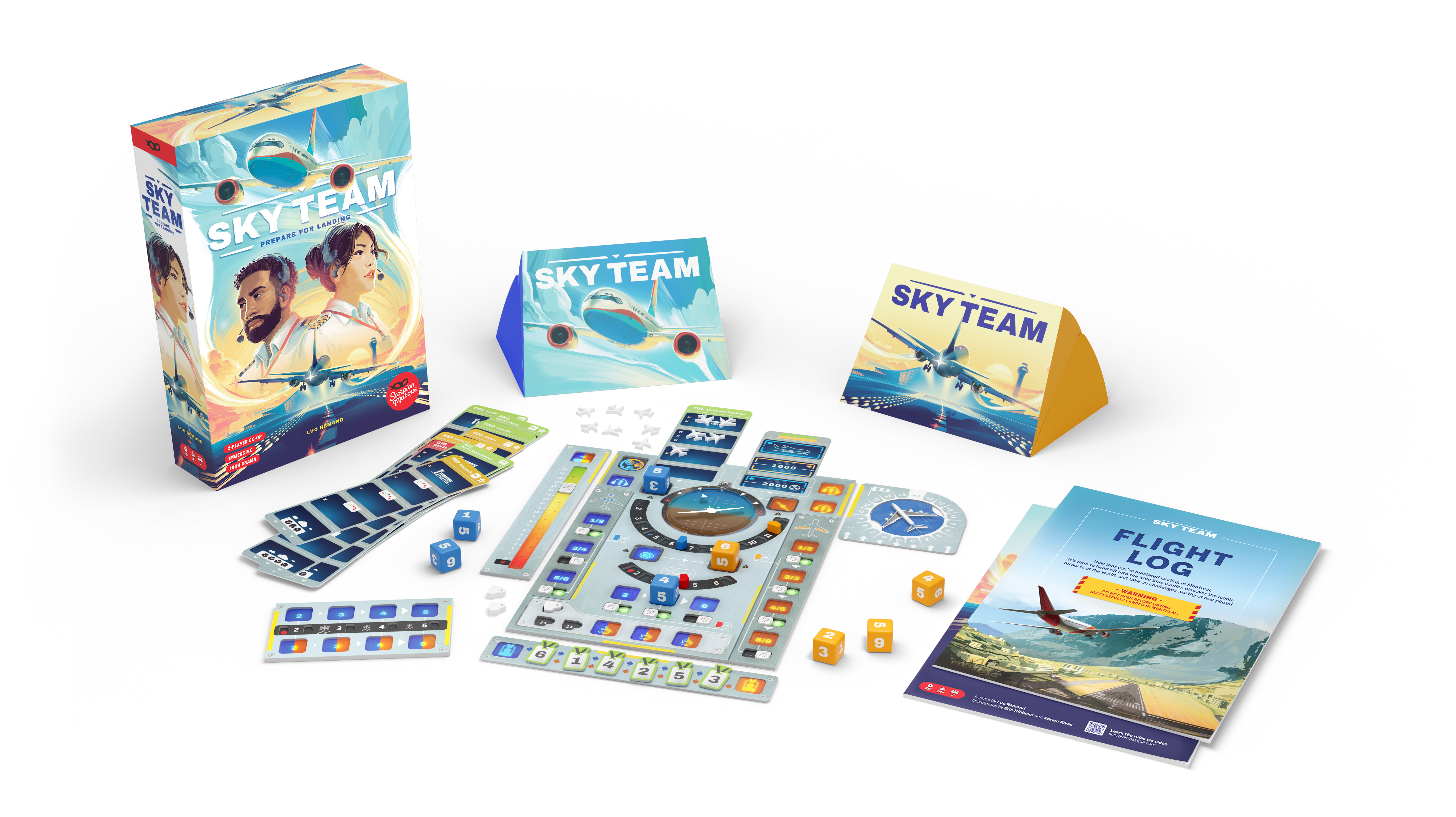
Sky Team is for exactly two players who like compact cooperative puzzles, repeated attempts, and the strange intimacy of solving under communication limits. It is superb for couples and regular gaming partners because each landing becomes a shared vocabulary. It is a poor fit if either player hates dice, wants constant table talk, or feels personally blamed when a cooperative plan fails.
The box contains a substantial sequence of airports and modules, so do not buy Turbulence on day one. The base game already teaches traffic, kerosene, wind, ice, and asymmetric pilot abilities. Your first purchase should be the plane, not the weather report.
Sky Team is for exactly two players who like compact cooperative puzzles, repeated attempts, and the strange intimacy of solving under communication limits.
How does a round actually work?
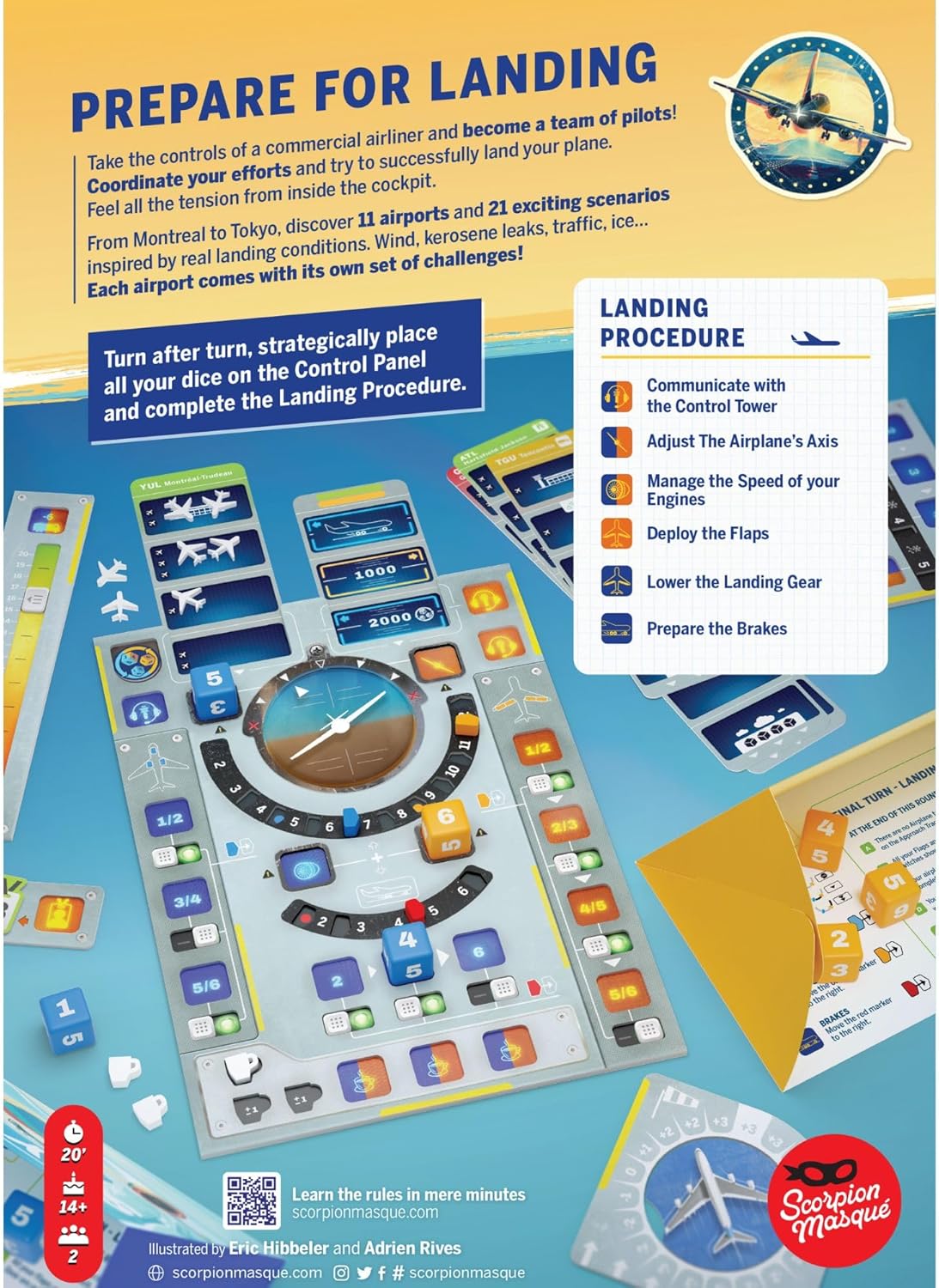
Each pilot rolls four dice behind a screen. Once both are rolled, conversation stops: partners alternate placing one die at a time into cockpit spaces. Blue and orange dice must jointly keep the axis balanced and the engines in a safe band; those two systems require attention every round. Other dice clear traffic by matching radio numbers, extend flaps and landing gear, or concentrate coffee into modifiers.
After all eight dice are placed, resolve the board, descend one altitude step, and advance toward the airport according to engine speed. The team wins only by arriving with traffic cleared, the plane level, landing gear and flaps properly deployed, and speed under control. The design is communication through preparation: discuss priorities before rolling, then read each other’s placements.
Before rolling, discuss priorities.
What is the correct priority order for a safe landing?
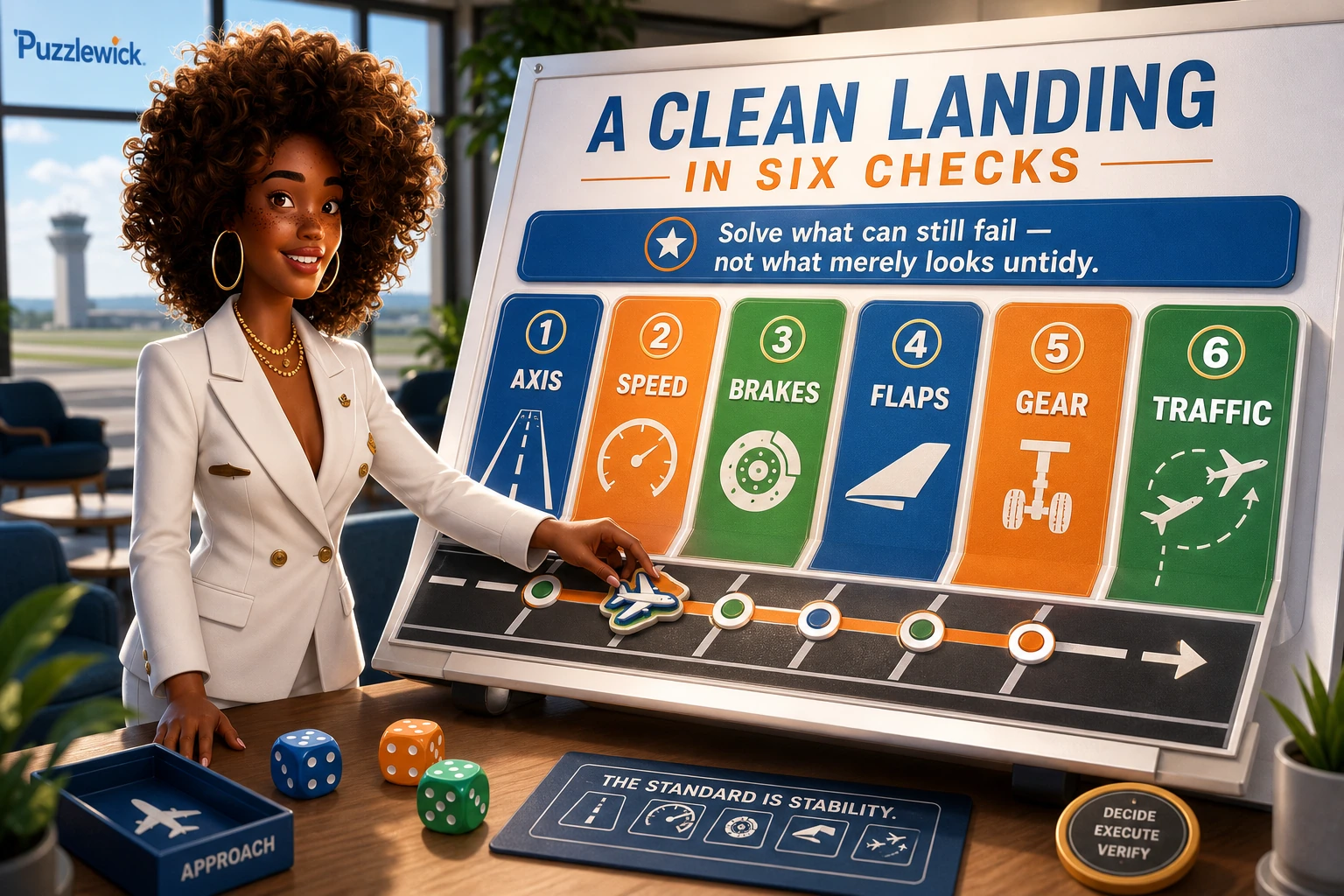
Imani’s approach briefing: solve what can still fail, not what merely looks untidy. Axis and engines demand attention every round; traffic can become immediately fatal; gear, flaps, and brakes are deadlines. That hierarchy is the cockpit.
Axis and engines are mandatory every round, so they frame everything else.
How do partners communicate when talking is forbidden?

The placement itself is the message. Committing a constrained die early can warn your partner; leaving a flexible space open can invite them to solve the dangerous instrument. The strongest pairs do not communicate more. They waste fewer placements saying the same thing.
Placements are sentences.
What are the most common beginner crashes?
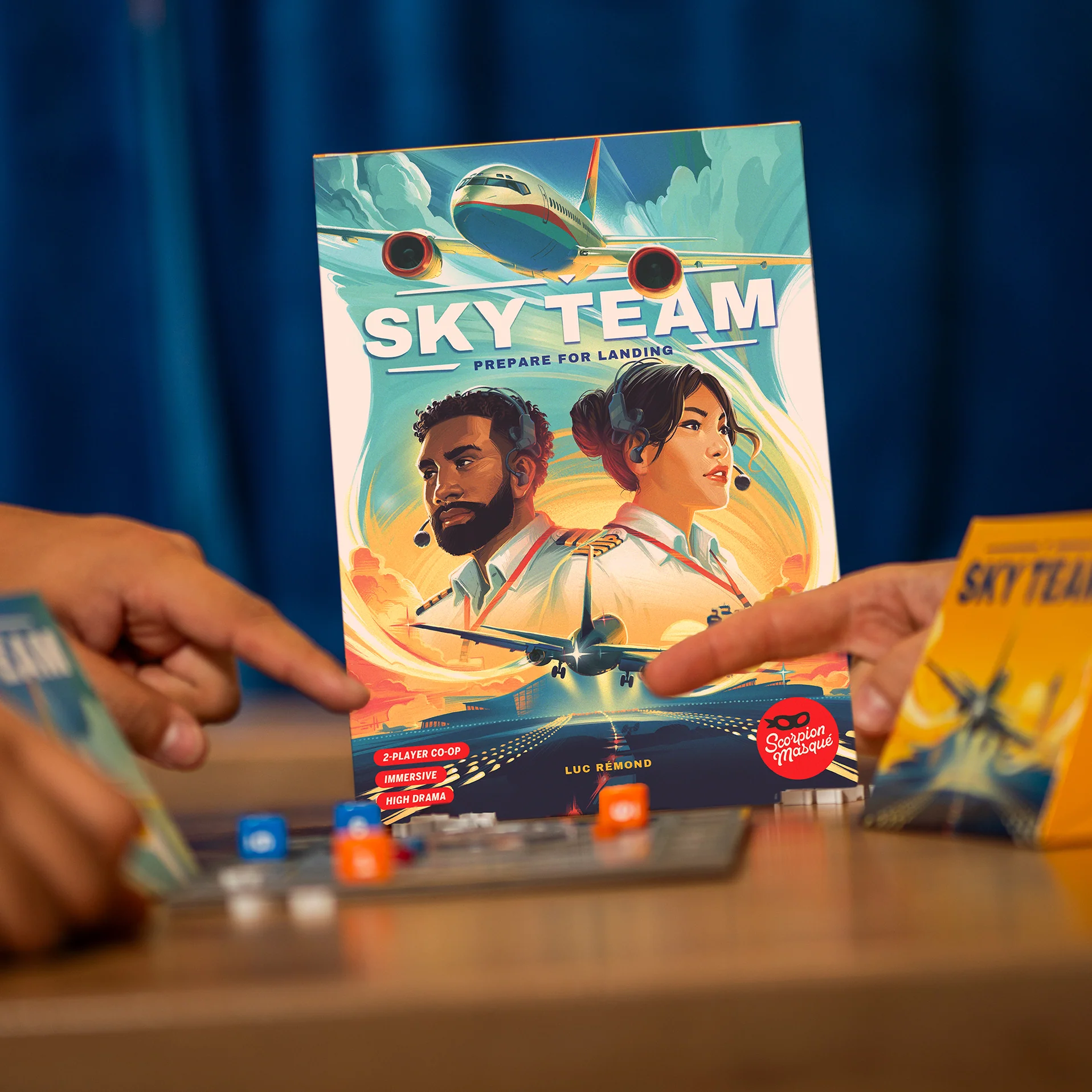
The first crash is treating gear and flaps as “later” until later has no legal die. The second is balancing the axis with two perfect dice while traffic remains untouched. The third is spending coffee to improve a merely comfortable action, leaving no flexibility for the final placement. The fourth is forgetting that engine totals determine movement, so an otherwise tidy cockpit overshoots the airport.
A fifth mistake is emotional: narrating the postmortem as one player’s error. Reconstruct the sequence instead. Ask which earlier placement removed the rescue route. Most final-die disasters began two actions earlier, when a flexible space was consumed or a deadline was ignored.
The first crash is treating gear and flaps as “later” until later has no legal die.
When should you open the extra scenarios and modules?
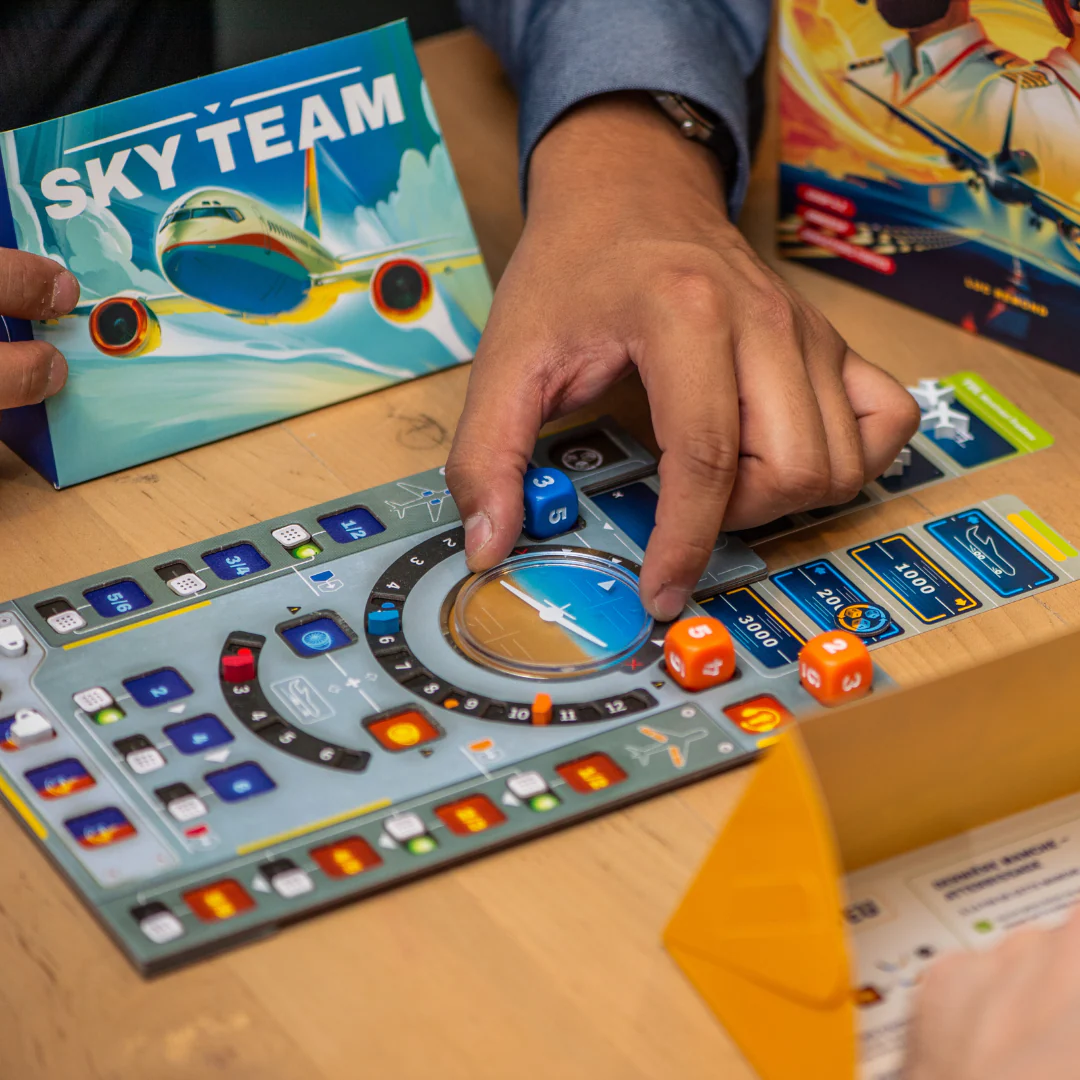
Play the introductory airports until both partners can land without constantly rereading the cockpit. Then add one concept at a time. Modules are not just difficulty knobs; they change the rhythm of what must be solved. Wind changes movement math, ice pressures brakes, kerosene creates a shared resource countdown, and asymmetric abilities change who can absorb which burden.
Do not select scenarios only by the number printed beside them. Pick the module your pair is curious about, read its one-page rule together, and run the airport twice. A first attempt teaches the new system; the second reveals whether you actually like it.
Play the introductory airports until both partners can land without constantly rereading the cockpit.
Is the Turbulence expansion worth it?

Turbulence earns its place after the base campaign is fluent because its modules change priorities rather than rescue a tired game. If the original cockpit still produces crashes and delighted accusations, congratulations: the expansion can remain safely on the runway.
Turbulence is worth buying when your pair has become fluent enough that base airports feel like variations on a solved checklist.
How do you make Sky Team more fun for a new partner?
Set up the first airport before inviting them over. Sit side by side or at a slight angle so both can read every dial. Teach the cockpit without screens, run one practice round with open dice, then reset and play correctly. During the debrief, celebrate the piece of communication that worked before discussing the crash.
If analysis anxiety appears, agree on a pre-roll checklist: axis, traffic, speed, deadline. That gives the silent phase a shared foundation. Stop after two or three attempts, even after a near miss. Sky Team is best when the next landing feels irresistible, not when the eighth retry turns partnership into shift work.
Set up the first airport before inviting them over.
What does advanced Sky Team play look like?
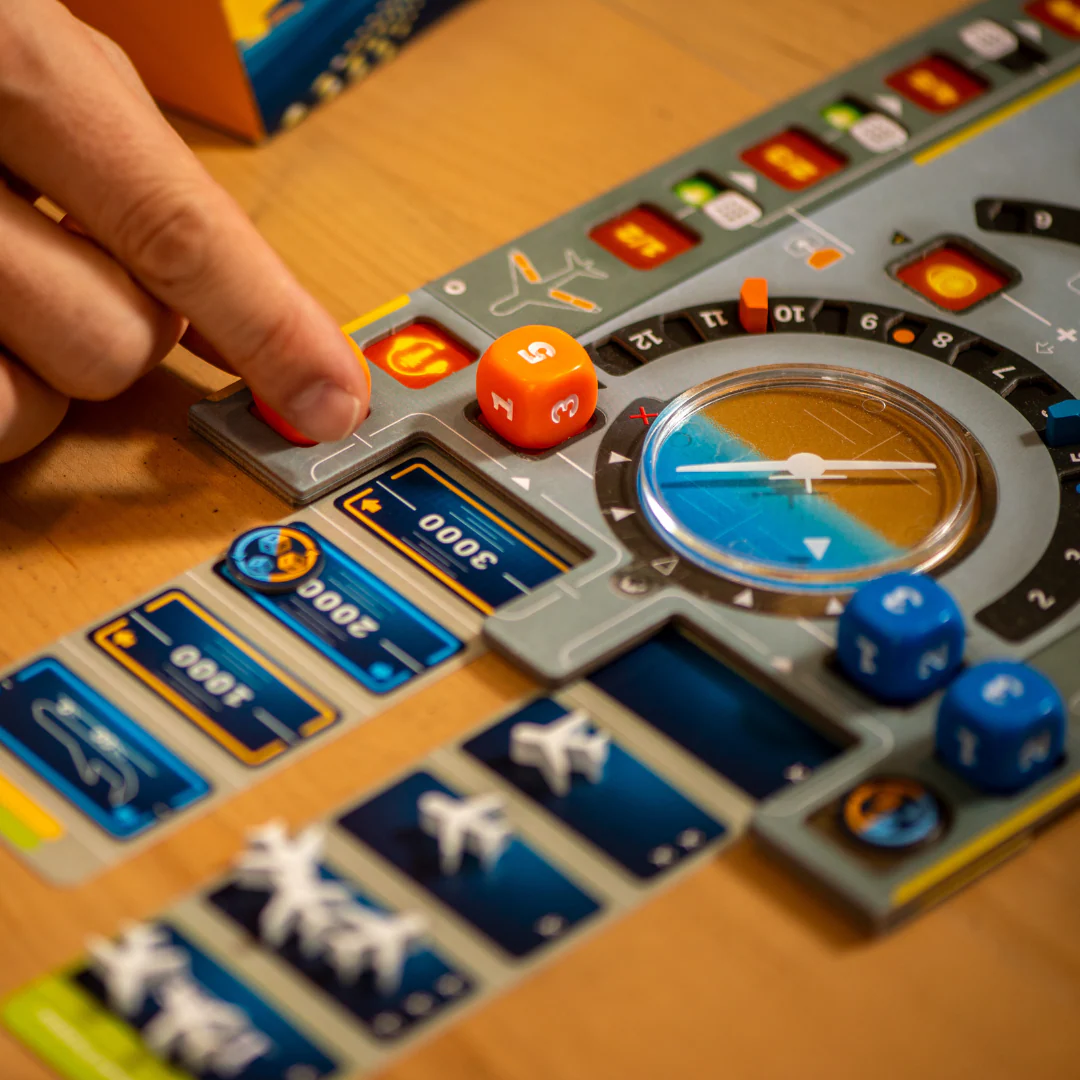
Advanced pairs stop treating instruments as separate chores and begin pricing flexibility. A six that can satisfy axis, engine, or a permanent switch should not be committed before a more constrained die. Coffee is not merely a modifier; it is stored option value. Radio is not housekeeping; it can determine which engine total is safe because traffic and movement share a deadline.
Before rolling, divide actions into forced, flexible, and deferrable. After rolling, place forced dice early when they reveal useful information and flexible dice late when they preserve rescue routes. Watch placement order as carefully as value. A partner who fills a low axis slot with a medium die may be asking you to keep your high die for engines. None of this requires a secret code. It is the natural language of scarcity, and it is why the same cockpit can remain compelling after both players know every printed rule.
Advanced pairs stop treating instruments as separate chores and begin pricing flexibility.
The picks
Some links below are affiliate links — as an Amazon Associate, Puzzlewick earns from qualifying purchases, at no extra cost to you. It never changes a pick.

 2 photos
 Sky Team
A silent cooperative landing puzzle with escalating airports and a superb amount of game in a small box.
- Best for a recurring two-player pair.
- A silent cooperative landing puzzle with escalating airports and a superb amount of game in a small box.
- The base box is the complete first purchase.
 2 photos
 Sky Team: Turbulence
Fresh conditions and equipment for pairs that already speak through dice placement.
- Best after the base airports feel familiar.
- Fresh conditions and equipment for pairs that already speak through dice placement.
- Do not buy it to fix a dislike of silence or dice.
At a glance
| Question | Base game | Turbulence |
|---|---|---|
| First purchase? | Yes | No |
| Best for | Learning the cockpit and your partner | Fluent pairs wanting new constraints |
| Difficulty | Broad progression | More demanding variations |
| Value | Excellent standalone box | Excellent only when base content is being used |
Questions, answered
Can you talk in Sky Team?
You may discuss strategy before rolling. After dice are rolled, strategic communication stops until the round ends.
Is Sky Team replayable?
Yes. The base box includes multiple airports and modules, and the dice plus partner inference keep repeated landings variable.
Is Turbulence required?
No. Buy it after you have explored the base scenarios and want new constraints.
Is Sky Team relaxing?
For some pairs, yes; for others the silence and deadlines feel tense. The fit depends more on partnership style than complexity.
Can Sky Team players talk?
Discuss the plan before rolling. After the dice are rolled, the rules restrict tactical communication; placement order and cockpit state become the language.
Is Turbulence a standalone game?
No. Turbulence expands Sky Team and should follow confident play with the base airports.
Imani's verdict
Sky Team is a remarkable two-player purchase because its real component is the person across from you. Learn the cockpit as a landing order, communicate through timing rather than invented codes, and debrief sequences instead of blaming a final die. Buy the base game first. Add Turbulence only after your shared cockpit language is already making the included airports sing.
Research ledger 9 sources · reviewed 2026-08-10
Specifications, rules, current product information, community experience, and contrary evidence were checked against the sources below. Commercial links are kept separate from editorial evidence.
- scorpionmasque.comscorpionmasque.com/en/sky-team
- scorpionmasque.comscorpionmasque.com/sites/scorpionmasque.com/files/st-ex_rules_en_21aug2024.pdf
- boardgamegeek.comboardgamegeek.com/boardgame/373106/sky-team
- reddit.comreddit.com/r/boardgames/comments/1tj5fpw/sky_team_boardgame_question
- reddit.comreddit.com/r/boardgames/comments/1u31l94/sky_team_a_game_that_always_relaxes_us_in_a
- reddit.comreddit.com/r/boardgames/comments/1qdff6p/sky_team_surprised_me_with_how_much_tension_it
- reddit.comreddit.com/r/boardgames/search/?q=sky%20team%20strategy
- boardgamearena.comboardgamearena.com/gamepanel?game=skyteam
- scorpionmasque.comscorpionmasque.com/en/sky-team-turbulence

Okay but have you seen what everyone’s saying about this?

Keep exploring
The next smart rabbit holes.
✦ Topic PathBoard Game Buying Guides: compare the whole shelfStart with the decision, not the shelf. These guides compare the games, editions, expansions, player counts, and costs people...ComparisonThe Best 2-Player Board Games of 2026, RankedFifteen duels for two, sorted into hard tiers — the forever-game, the silent co-op, the giant-killers under twenty bucks, and the honest...Best OfBest Cooperative Board Games, Ranked (2026)Okay but have you SEEN what people are saying about cooperative games right now? Sixteen absolute bangers, ranked — from the gateway that...