Masterclass
Frosthaven
A two-year winter you survive together — this is your full initiation into Frosthaven, the most-funded board game in history, from your first card to your last sealed box. Welcome to the outpost, merc.
Frosthaven (Cephalofair Games, designed by Isaac Childres) is a colossal 1–4 player cooperative tactical-combat campaign — a 138-scenario branching legacy story where four mercenaries slay monsters and rebuild a snowbound frontier town. It's the fully standalone sequel to Gloomhaven, so you do NOT need Gloomhaven to play; every turn you pick two ability cards from your hand, play the top action of one and the bottom of the other, with no dice — combat randomness comes from a small attack-modifier deck. Beginners should start with the Drifter class, keep difficulty at default, run a free companion app, and play Scenario 0 first; the real skill is managing your dwindling hand of cards, because running out of cards — not hitting zero HP — is what kills you.

Written and reviewed by Robert Pruitt · how this guide was made
Source review: 2026-08-10 · 17 references checked · research library
- The DojoWhite belt
- The MonasteryGreen belt
- The Mountain RetreatBrown belt
- The Grand HallRed belt
- The Campfire of MastersBlack belt
Start here, then go deeper
You are in the right cabinet.
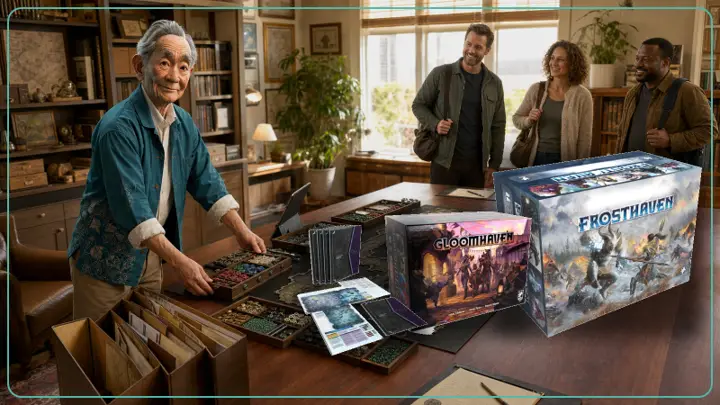 ✦ Universe HubGloomhaven and Frosthaven: the whole buying pathKenji and Robert turn two famously enormous campaign boxes into a room people want to revisit. Start with the fifteen-minute host...
 ♛ Topic PathGrail Board Games: compare the whole shelfA grail earns its space only when the experience survives the price, setup, storage, and group commitment. These are expensive-game...
 MasterclassDungeons & DragonsA complete, magazine-grade initiation into Dungeons & Dragons on the 2024 rules — from your very first d20 roll to hosting your own table...
Verified how-to video
Learn the table before the first campaign night
Open the rules at full-table scale. The creator is credited, the player stays on this page, and the embed loads only when you press play.

What Is Frosthaven, and Why 2026 Is the Year to Cross the Threshold


Pull up a chair to the campfire, initiate — this isn't a game you finish in a night, it's a winter we survive together. Don't fret about being slow or losing your first scenario; we've all wiped, we all kept our gold, and we all came back for more. Every Haven group needs a fourth body in the snow, and you just became ours. Welcome to the outpost, merc — bring snacks.
Frosthaven is less a board game than a winter you survive together. Designed by Isaac Childres for Cephalofair Games and released in 2022–2023, it's a cooperative tactical-combat campaign for 1–4 players, roughly 1–2 hours per scenario, spanning a 138-scenario branching story. It is the standalone sequel to Gloomhaven — the game that sat atop BoardGameGeek's #1 ranking for years and whose Kickstarter became the most-funded board game in history (~$13M, 83,000+ backers), a number this community quotes the way a congregation quotes scripture, because it proves the devotion is real.
Here is the first thing every newcomer needs to hear: you do NOT need Gloomhaven first. Frosthaven is fully standalone, with its own classes, story, and rules. The lore is a slow-burn legacy: a dying outpost at the frozen edge of the empire, cut off by snowdrifts half the year, beset by yeti-like Algox warriors, Lurkers boiling up from the northern sea, and machines that wander the wastes. You play mercenaries at the end of their rope who stay to rebuild it — and over 200–300 real hours, that fiction becomes your group's fiction.
Why cross the threshold in 2026? Three things are fresh. The digital adaptation hit Steam and Epic in Early Access (July 2025), so a wave of players are discovering Frosthaven through the video game and craving the tabletop original. Gloomhaven Second Edition (2025) reshuffled the on-ramp conversation — GH2e is now the polished entry, with Frosthaven framed as the heavier, advanced campaign. And the quality-of-life products that didn't exist at launch — Play Surface Books, the Removable Sticker Set, Solo Scenarios — are finally in retail.
Now, your entry. Each player picks one of six starting classes. Pick what you love — but if you want the gentlest welcome, grab the Drifter (complexity 1/5, tough, flexible) or the Banner Spear (2/5). The base box runs roughly $180–$250.


You do not need to play Gloomhaven first. You need a big table, a Drifter, and people you like enough to freeze with.
- Confirm you don't need Gloomhaven — Frosthaven is fully standalone. Clear a BIG table and a shelf you can dedicate for months.
- Buy the base box (2nd printing) — it's everything: 17 classes, 138 scenarios, the outpost, all components. Nothing else is required.
- Each player picks ONE of the six starting classes. New players: take the Drifter (1/5) or Banner Spear (2/5); avoid Blinkblade and Geminate (both 5/5).
- Watch the official Gaming Rules! how-to-play videos linked from Cephalofair's player page — the fastest way to learn correctly.
- Set up a free companion app (Gloomhaven Secretariat or X-Haven Assistant) before you ever sit down.
- Read your class mat and starting hand: every card has a top action, a bottom action, and an initiative number.
Speak the Tongue of the North
A few words that mark you as someone who's been around the campfire: FH / GH / JOTL — Frosthaven / Gloomhaven / Jaws of the Lion. The outpost phase — the between-scenario town turn where you build, craft, and sometimes get raided at night. Prosperity — your town's growth track, the slow dopamine drip that keeps a two-year campaign alive. Sealed box / envelope — legacy content you tear open at a milestone; opening one is a ceremony, spoiling one is treason.
Crashing Tide Is NOT an Expansion
You'll see 'Crashing Tide' talked about like a product to buy. It isn't. Crashing Tide is an unlockable CLASS inside the base box (it can play three cards a turn via its Overwhelming Wave mechanic). There is no standalone Crashing Tide product — don't pay extra expecting one.
Should a Brand-New Gamer Start HERE?
Honestly? Usually not as your very first heavy game. Frosthaven's starting classes are the most complex in the series, and many stores steer newcomers to Jaws of the Lion or Gloomhaven Second Edition first. But if you're already comfortable with big rulebooks — or you fell in love through the video game — you can absolutely start here. Pick what you love.
Where the Veterans Point Newcomers
The room is unanimous on one thing: the nervous newcomer worried they'll slow the group down is exactly who this community wants. A Haven group isn't hunting for a fourth optimizer. It's looking for a fourth friend to survive the winter with.

Building Your Mercenary: Deck-Craft, the Enchantress, and the Lowest 'Ready' Bar


The secret of this game isn't your health bar, initiate — it's your hand. Learn which card to burn and when, and you'll start surviving; we'll show you the rest. And when you've earned a little gold, carry it to the Enchantress and put a sticker on your favorite card — it's permanent, it's yours, and yes, start with +1 movement.
The craft in Frosthaven is build-craft, deck-craft, and town-craft — all permanent, all yours. Your mercenary is a tiny hand-managed deck, often just ~10–12 ability cards. Read your class mat and build your level-1 hand to your class's hand-size limit. Every card has a top action and a bottom action plus an initiative number, and mastery is the art of the loss: knowing which card to burn for a game-winning action and when, balancing your rest cadence, and reading your Attack Modifier Deck (the AMD) like a probability poet.
The lowest acceptable ready bar is genuinely low. You do not need to memorize the rulebook. You need to know: pick two cards, play one top and one bottom, lowest initiative goes first, and — the thing beginners forget — you can always fall back on a default Attack 2 (top) or Move 2 (bottom) from any card. You're never truly stuck. That's ready. Everything else you learn at the table.
Then comes the deeper layer: enhancements. You carry hard-won gold to the Enchantress and apply a permanent sticker to a card — +1 move, an element, a jump, a target. Because it can never be removed, the community has produced enhancement calculators, optimization guides, and genuinely heated holy wars over whether +1 movement on your bread-and-butter card is the correct first buy. (It usually is.)
There's a thriving hobby tier, too. People paint the Frosthaven minis — a real step up from Gloomhaven's, the community agrees — swap standees for figures, 3D-print organizers, and obsess over Folded Space and Laserox inserts, because taming the box is half the hobby. The emotional truth, as the veterans put it: in Frosthaven you don't just play a character — you build one, sticker by sticker and one gold piece at a time, and none of it resets.


You don't play the deck you're dealt. You build it — and the character becomes truly yours.
- Build your level-1 hand to your class's hand-size limit; read every card's top action, bottom action, and initiative.
- Practice the default fallback — Move 2 (bottom) and Attack 2 (top) from any card — so you never feel stuck.
- Run your OWN attack-modifier deck so you learn the feel of the +1/×2/null swings.
- Play a couple of your class's Solo Scenarios (or one merc solo) to learn the deck deeply between group nights.
- Save your first real gold for an enhancement at the Enchantress — start with +1 movement on a card you play every scenario.
- Decide as a group: sleeve or not? (Many DON'T, because cards get stickered in the legacy campaign.) Settle it before scenario one.
The Craftsman's Vocabulary
Burning a card / a loss — playing a card for its powerful one-time 'loss' action, gone for the whole scenario; 'Should I burn for this?' is the eternal agonized question. The AMD — your personal Attack Modifier Deck of +1/−1/×2/null cards. BBE / Brutal-Bottom-Loss — squeezing every drop from a card: top action one, bottom (often loss) the other. Enhancing / the Enchantress — paying gold to slap a permanent sticker on an ability card.
Your First Permanent Enhancement
Committing gold to a sticker you can never remove is a rite of passage. It's the shift from 'playing the cards you got' to 'building the character you want' — the moment your mercenary stops being a starting class and starts being yours.
Master the Art of the Loss
Don't burn powerful loss cards early — every loss permanently shortens your scenario. Ration them and lean on rechargeable discard actions. The pros map their hand as a budget: roughly how many rounds until I MUST rest? Spend a loss only when the payoff clearly shortens the fight.
The Highest-Impact Upgrades
A storage insert (Laserox Frostbox or Folded Space) turns 20-minute setups into a few minutes — the single best purchase after the box. Pair it with the Play Surface Books to replace fiddly map tiles for all 138 scenarios, and you've slain the game's biggest complaint.

How a Turn Actually Works: The Core Loop, the Exhaustion Clock, and the Honor of the Hand


One rule above all others, initiate: tell us what you're trying to do, never your exact numbers — no card titles, no initiatives. That isn't gatekeeping, it's the very thing that keeps Frosthaven a team game. And losing a scenario costs you nothing but pride — you keep the gold, you keep the XP — so manage your own deck honestly and go ahead and push your luck.
Here's how a turn actually works, honestly. A scenario plays in rounds. Each round, all players secretly pick two cards from hand, monsters reveal their ability cards, then everyone acts in initiative order — lowest number goes first. On your turn you do two actions: the top of one card and the bottom of the other, and you choose which card gives which. No dice — when you attack, you flip one card from your AMD (×0, ×2, +1, miss) to adjust the damage.
The heart of the game is the truth the veterans repeat: it's not your health bar that kills you, it's your hand. Cards you play go to your discard or lost pile. You rest to recover your discard — a short rest loses a random card; a long rest (initiative 99, your whole turn) lets you choose which to lose and heals 2. When you have no cards left, you're exhausted — out of the scenario. Managing that decline, not your HP, is the game.
The etiquette here is baked into the mechanics. Before each round, read every monster's revealed card — their move and attack are public — and position so the most dangerous enemy can't reach you, or can only hit once. And the table's most sacred rule: no quarterbacking. You may say your intent ('I'm going to kill the Living Bones and generate fire') but you may never name a card's exact number, initiative, or title. The rules forbid it, and so does your table's honor — that single restriction is what keeps everyone solving the puzzle together, as equals.
Win by hitting the scenario's specific goal — kill all enemies, reach a tile, protect or destroy an objective. Identify the win condition first and don't over-fight when you should be sprinting. Then read the matching section book entry for the story and rewards. And remember the most freeing rule in the game: a wipe costs you nothing but pride. You keep your gold and XP. Losing is just Tuesday.


It's not your health bar that kills you, it's your hand.
- Each round: secretly pick two cards, choose one for its initiative number, then act in initiative order (lowest first).
- On your turn, play the TOP of one card and the BOTTOM of the other — you decide which half from which card.
- Read every monster's revealed ability card BEFORE you commit, and position to dodge or limit their hits.
- Manage your rest cadence: prefer a long rest (choose the lost card) over a short rest (random loss) when you can spare the turn.
- Identify the scenario's win condition first — kill, reach, or protect — and don't over-fight a race scenario.
- Watch your exhaustion clock: when you're out of cards you're done, so don't burn yourself dry chasing one more kill.
The Language of the Fight
Exhausted — out of cards (or at zero HP); your merc is removed from the scenario, said with grim acceptance. Long rest / short rest — the two ways to recover your discard. Null — the zero/'miss' modifier card; 'drew the null' is the community's shared heartbreak. Scenario lock / 'we wiped' — failing when everyone exhausts, said without shame, because you keep your gold and XP.
No Quarterbacking — The Mechanic Is the Manners
Say your INTENT, never your numbers. 'I'll try to kill the archer' is allowed; naming your card, its value, or your initiative is not. The communication rule literally exists to neuter the alpha gamer — over-talking causes paralysis and steals other people's turns. Less talk, more intent.
Read the Room Before You Move
The enemies' revealed card tells you their move and attack THIS round — it's public information. Most early losses aren't bad luck; they're someone who didn't read the monster cards and walked into three attacks they could have dodged. Position first, swing second.
Lowering Difficulty Is Not Cheating
The game scales −1 to +3 on purpose. A group that drops difficulty or party size to learn is playing it RIGHT, not failing. New groups should stay at default or one notch below — the first couple of real scenarios are genuinely tough, and fun comes first.

Hanging With the Pros: Element Chains, Party Synergy, and the Line You Never Cross


You want to run with the veterans, initiate? Then think in elements — if a teammate's big play needs Fire next round, you GENERATE it this round; coordinating who infuses and who consumes is the whole heart of party synergy. And here's the line you never cross to win: the moment you start running someone else's turn for them, you've stopped playing Frosthaven. Bench the quarterback. Always.
This is where you learn to hang with the pros — and where the game draws its brightest moral line.
The pro edge starts with elements. Many actions generate Fire / Ice / Air / Earth / Light / Dark infusions that sit strong, wane to waning, then go inert over rounds; other actions consume them for bonus effects. Chaining these is core advanced play, and coordinating who infuses and who consumes is the heart of party synergy — call out the elements you generate and need. Party composition matters more than raw power: aim for front-line durability, ranged damage, control/summons, and support. Drifter + Banner Spear + a ranged class is a friendly learning trio.
The deep edge is sequencing: plan your two cards as a unit (one usually supplies the big top action, the other your movement bottom — but always check if swapping is better), set up multi-character combos, and manage your exhaustion clock to the last round. The masters pilot the 5/5 puzzle-box classes — Blinkblade, Geminate (two 7-card decks, universally invoked as 'the hardest class'), unlocked classes like Crashing Tide — and play up at +1 difficulty or higher with masteries.
Now the bright line. Every co-op game has its win-at-all-costs jerk archetype, and in Haven it has a name: the quarterback, the alpha gamer — the player who tries to run everyone else's turn 'optimally.' It is the cardinal sin of co-op Haven play. The no-numbers communication rule exists specifically to neuter it: you may share intent, never exact cards. Veterans say it plainly — if you ever feel me running your turn for you, call it out. The other edges of the code: manage your own deck (leeching off a teammate's bookkeeping breaks the tension), respect the element economy (consuming the Fire someone was saving, without a word, is a low-key betrayal), and honor the burn (never pressure a teammate to burn a card for your plan — every loss shortens their scenario, and that's their call).
The pros aren't the players with the highest damage. They're the ones who solve the puzzle with you, out loud, as equals — and never optimize you into a spectator.


Quarterbacking is the cardinal sin. The no-numbers rule isn't a quirk — it's the whole game protecting itself.
- Plan your two cards as a unit, then test the swap: would top-from-the-other-card and bottom-from-this-one hit harder?
- Think one round ahead on elements: generate the Fire/Ice your teammate's big play will consume next turn.
- Build a balanced party — tank, ranged damage, control/summons, support — over four copies of 'the strong class.'
- Call out the elements you generate AND the ones you need, every round, so nobody consumes a teammate's saved infusion.
- When you're ready to level up, pilot a 5/5 class (Blinkblade, Geminate) or push to +1 difficulty with masteries.
- Police yourself for quarterbacking: share intent, never numbers, and let teammates solve their own piece.
The Element Economy Is Your Force Multiplier
Treating elements as flavor leaves enormous damage and utility on the table. Generating the RIGHT element and then consuming it at the right moment is where class power lives. The advanced move is cross-character: one merc infuses on a low-initiative turn so a teammate can consume on a high-initiative turn the same round.
Bench the Quarterback
The win-at-all-costs archetype here is the alpha gamer who runs everyone's turn. The code is explicit: communicate the PLAN, not the play-by-play; manage your OWN discards, rests, and modifier deck; never pressure a teammate to burn for your scheme; and never consume the element they were saving. Honor the burn — every loss is their call, not yours.
The Veteran's Shorthand
Quarterbacking / the alpha gamer — one player trying to run everyone's turn; the cardinal sin. The Geminate — the dual-form 5/5 starting class with two 7-card decks, 'the hardest class'; picking it is a flex and a warning. Enhancing — permanent card stickers that spawn spreadsheets and holy wars. Prosperity — the town track the long-game optimizers obsess over.
Party Size Is a Difficulty Dial
Scenario level scales to party size and level. Fewer characters means a lower scenario level — so a calm 2-character run can be GENTLER to learn on than a chaotic 4-player table. Use this: if a scenario is wrecking you, a smaller, tighter party is a legitimate strategic answer, not a retreat.

The Unwritten Code: Sealed Boxes, the Two-Year Handshake, and the Found Family of the Wastes


This is a standing appointment now, initiate — same table, same group, for as long as it takes, and that's the best part of the whole thing. You'll remember the night you opened your first sealed box in stunned silence and the night you barely survived a wipe, and you'll remember them WITH us. Commit to the campaign and you don't just get a game group — you get the people you'll have froze in the wastes with. Welcome to the fold.
Frosthaven is a two-year handshake. You cannot drift through 200-plus hours and dozens of sessions with three other people and stay strangers — the campaign turns a game night into a standing appointment, and the standing appointment turns into found family.
The unwritten code is real, and most of it protects that bond. Don't open the box for them — if your group hasn't earned a milestone, the contents of that envelope do not exist; reading ahead is the one thing that can't be undone. Spoiler discipline is sacred: never reveal a locked class, sealed box, or story beat to anyone behind you — tag it, hide it, take it to an opt-in spoiler channel. And the deepest one: commit to the campaign. Don't bail mid-arc — a Haven group is a standing appointment, and ghosting leaves a mercenary-sized hole in the story.
The rites of passage chart your whole journey. Your first scenario win — proof you finally understand the card-management pressure. Your first wipe — learning that losing costs nothing but pride, where the fear of failure dies. Drawing the null on a game-deciding attack — initiation by heartbreak, and every veteran has the story. Retiring your first character via their personal quest — the bittersweet graduation that earns you the right to crack open a sealed class box. Opening your first sealed box — the table goes quiet, someone tears the seal, and new rules flood in: the legacy game's holiest moment. And, someday, finishing the full campaign — two years, hundreds of hours, one box finally beaten, a shared accomplishment your group carries for the rest of your lives.
Underneath the ironic groaning — 'Frosthaven might have been a mistake,' 'the setup takes longer than the scenario and we wouldn't have it any other way' — is total sincerity. As the veterans say it: Frosthaven isn't about winning. It's about the people you froze in the wastes with. The newcomer nervous they'll slow the group down is exactly who this community wants — because a Haven group isn't looking for a fourth optimizer. It's looking for a fourth friend to survive the winter with. That's you now. Welcome to the fold.


Frosthaven isn't about winning. It's about the people you froze in the wastes with.
- Volunteer (or appoint) a 'campaign keeper' to run setup, read story aloud, track the calendar, and own the box between sessions.
- Decide as a group BEFORE scenario one whether you're using the Removable Sticker Set — apply it before any permanent sticker goes down.
- Read story and section text with a little theater, and pause on choices so the group actually deliberates.
- Pre-stage the next scenario before game night so you start fighting, not sorting.
- Protect the campaign state: store the box flat, photograph the map and sheets occasionally, and never spoil what's ahead.
- Host with northern coziness — a hot cocoa bar, mulled cider, and a no-mess snack zone away from the legacy components.
The Unwritten Code of the Outpost
Don't open the box for them — unearned content doesn't exist. Spoiler discipline is sacred; tag or hide everything ahead of slower groups. Whoever owns the insert runs setup, and EVERYBODY helps tear down — the person who packs the box alone every week quietly resents you. And commit to the campaign: ghosting the table leaves a mercenary-sized hole in the story.
The Rites That Make You One of Us
First win (you understand the pressure). First wipe (the fear of failure dies). Drawing the null on a game-decider (initiation by heartbreak). Retiring your first merc via their personal quest (the graduation that earns you a sealed class box). Opening your first sealed box (the holiest moment). Finishing the campaign (the badge you carry for life).
The Soul of the Thing
You're mercenaries at the end of your rope, holding a dying outpost at the frozen edge of the empire — Algox in the mountains, Lurkers in the sea, machines in the wastes — and you stay anyway. Every building you raise and box you open permanently rewrites the world; Frosthaven REMEMBERS what you do to it. The setup is legendary, the rulebook is a running bit, and 'why do I do this to myself' is said with total love. That's the soul: ironic groaning over total devotion.
Host the Outpost Right
A 'campaign keeper' who loves logistics drives the app, runs the Outpost Phase efficiently (many groups resolve shopping and leveling between sessions), and reads story with flavor. Onboard new mid-campaign players gently: hand them a forgiving Drifter, recap the story so the stakes land, and let them retire-and-unlock into something spicier later.
Snacks for the Frozen North
Lean into the winter setting: a hot cocoa bar with marshmallows and a 'spike it' option, mulled cider simmering so the room smells like the outpost, and a 'foraged herbs' grazing board nodding to the herb-gathering resource. Keep one-handed food (pretzels, stew in mugs) and a strict no-mess zone near the legacy components — bowls and napkins only.
The Armory — what to buy first
Everything you need to begin, ranked. Honest picks; affiliate links support the cabinet.
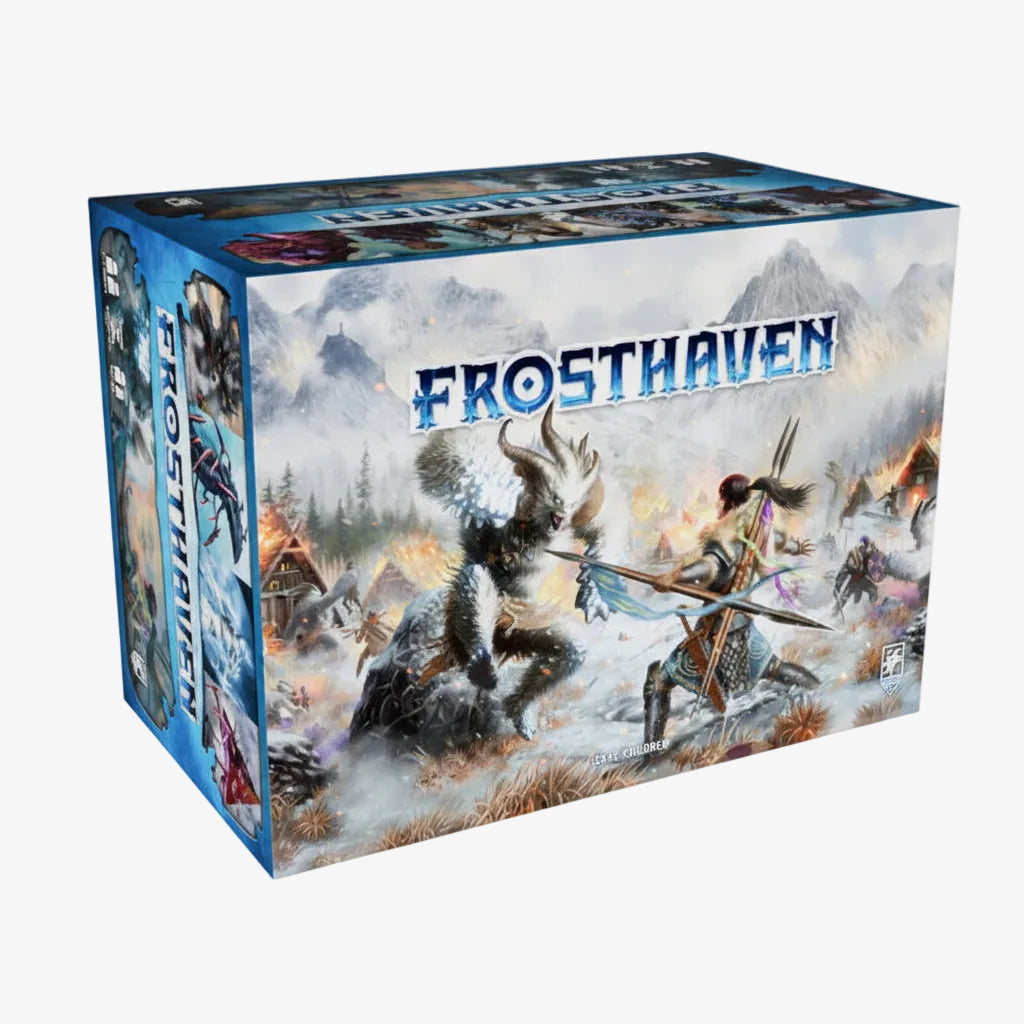 1 Official Cephalofair Games product/marketing photograph. © Cephalofair Games and credited original artists. Image source ↗
 Cephalofair Games · Everyone — this is the complete, standalone campaign and the only thing you actually need
Frosthaven (base game, 2nd printing)
This is everything: 17 classes (6 at the start), 138 scenarios, the full Outpost Phase, 20+ enemy types, 100+ items, and a sprawling legacy campaign you live inside for a year or two. It's the fully standalone sequel to Gloomhaven — you do not need Gloomhaven to play. The card-driven combat is a genuine masterclass; the setup is a beast. Buy it, clear a table, and don't look back.
Keeper: The grail of the cooperative-campaign genre. Price floats $180–$250 depending on printing and retailer — quote a live store before you buy.
- The complete experience — nothing else is required to play
- A masterclass blend of long-term strategy and short-term tactics
- Standalone: no Gloomhaven needed
- Setup and teardown are a legendary chore without accessories
- Starting classes are the most complex in the series
The catch: Don't punch and unbag the whole box at once; sort components as the rulebook tells you to, scenario by scenario.
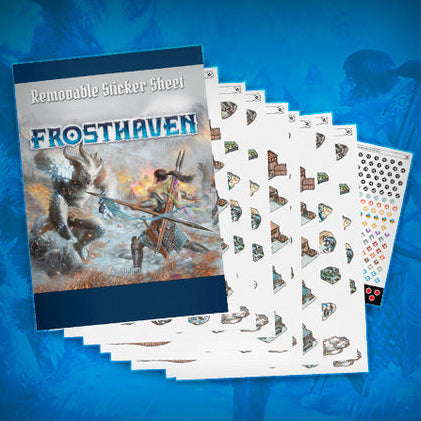 5 Official Cephalofair Games product/marketing photograph. © Cephalofair Games and credited original artists. Image source ↗
 Cephalofair Games · Players who want to reset, replay, or resell the campaign later
Frosthaven: Removable Sticker Set
Vinyl, non-transferring stickers that replace the campaign's permanent stickers, letting you reset, replay, or resell later without destroying components. Perfect if you're sticker-shy about committing to a legacy game — apply it before the first permanent sticker goes down. (A few sheets, like the flowchart, still can't be fully reset.)
Keeper: Decide as a group whether you're going permanent or removable BEFORE anyone sticks anything — this is a one-way door.
- Lets you reset, replay, or resell the campaign
- Non-transferring vinyl — won't damage components
- Great peace of mind for a legacy box
- Must be applied before any permanent sticker goes down
- A few sheets still can't be fully reset
The catch: Runs about $20–$28; verify availability at a third-party retailer, as publisher-direct stock has been spotty.
 6
6 Cephalofair Games · Learning a class deeply between group nights, or solo players
Frosthaven: Solo Scenarios
A set of class-specific solo challenge scenarios — ideal for learning a class inside-out between group sessions, or for solo players running one or two mercenaries. It's the quietest, most personal way to fall in love with a deck's puzzle-box before you bring it to the table.
Keeper: A lovely 'monastery' tool: pure, meditative deck-craft away from the chaos of a four-player table.
- Teaches a class deeply, one merc at a time
- Great for solo play or between-session practice
- Inexpensive add-on
- Niche — most value comes once you've picked a class to master
The catch: You'll get the most from these after you've chosen a class you want to truly master, not on day one.
Questions from the road
Do I need to play Gloomhaven before Frosthaven?
No. Frosthaven is a fully standalone game with its own classes, story, and rules. It's a sequel in setting, not a requirement. (You can optionally import old Gloomhaven characters via crossover sheets, but that's a bonus, not a prerequisite.)
Should a brand-new board gamer start with Frosthaven in 2026?
Usually not as the very first step. Frosthaven's starting classes are the most complex in the series, and many stores steer newcomers to Gloomhaven: Jaws of the Lion or Gloomhaven Second Edition (2025) first, then graduate to Frosthaven. If you're already comfortable with heavy games — or you discovered it through the video game — you can absolutely start here.
How long is the full campaign?
Enormous. There are 138 scenarios in the book (you'll branch through roughly 70–100 of them), at about 1–2 hours each plus outpost time. Most groups spend a year or two of regular sessions on a single campaign — community estimates land around 200–300 hours.
How does a turn actually work?
Pick two cards from your hand, choose one for its initiative number, then on your turn do the top action of one card and the bottom action of the other. There are no dice — attacks use a small attack-modifier card deck (×0, ×2, +1, miss). Lowest initiative acts first.
What's the difference between Frosthaven and Gloomhaven?
Frosthaven keeps the card-combat engine but adds the Outpost Phase (build and defend the town), a lumber/metal/hide/herb resource economy, crafting and alchemy, a summer/winter seasonal calendar, and more intricate 'puzzle-box' classes. It's deeper and heavier — not a friendlier on-ramp.
Is Crashing Tide a separate expansion?
No. Crashing Tide is one of the unlockable classes inside the base box (it can play three cards in a turn via its Overwhelming Wave mechanic). There is no standalone 'Crashing Tide' product — don't pay extra expecting one.
Do I need a companion app?
It's not strictly required, but nearly every reviewer recommends one. Free apps like Gloomhaven Secretariat or X-Haven Assistant handle monster stats, the attack-modifier and loot decks, and the entire outpost, removing most of the bookkeeping. Treat it as part of the game.
What's the best starting class for a beginner?
The Drifter — complexity 1/5, high health, a large flexible hand. The Banner Spear (2/5) is the next-easiest. Avoid the Blinkblade and Geminate (both 5/5) until you know the system; their timing and dual-form mechanics overwhelm new players.
Can I play Frosthaven solo or with two players?
Yes. One player can run two (or more) characters, and there's an official Solo Scenarios set for single-character challenges. Scenario difficulty scales to party size, so smaller parties aren't punished — a calm 2-character run can actually be a gentler way to learn.
Does playing destroy the components — can I reset or resell it?
The base campaign uses permanent stickers and sealed envelopes/boxes. Buy the Removable Sticker Set (~$20–$28) if you want to reset, replay, or resell later — apply it before the first permanent sticker goes down. A few sheets, like the flowchart, still can't be fully reset.
How long should Gloomhaven or Frosthaven setup take?
A practiced group with labeled storage, divided jobs and an optional app can reach roughly five to fifteen minutes. New groups should expect longer while learning where components live.
What is the best free app for Gloomhaven or Frosthaven?
X-Haven Assistant is the most common lightweight recommendation. Gloomhaven Secretariat and Full Stack provide broader browser or campaign workflows. Try the one whose interface your whole group can verify.
 ✶ The graduation
 I have carried a lot of boxes home over the years, initiate, and only a handful earn a permanent shelf — Frosthaven is one of them. Don't let the weight scare you: the people who love this game best are not the optimizers, they're the ones who showed up every week, lost a few scenarios, kept their gold, and laughed when they drew the null. You don't need to be good yet. You need to clear a table, grab a Drifter, set up the app, and survive Scenario 0 with people you like. The campaign will do the rest — sticker by sticker, box by box, winter by winter, it becomes your group's story and yours to keep for life. Pull up a chair to the campfire. You're one of us now. Welcome to Frosthaven.
— Keeper, Keep the best pieces close. You'll know them when your hand reaches for them first.
 The Keeper · why it earned a shelf
If it didn't earn a shelf, it isn't here.
Found your footing? Send this to someone starting out.

Keep exploring
The next smart rabbit holes.
✦ Universe HubGloomhaven and Frosthaven: the whole buying pathKenji and Robert turn two famously enormous campaign boxes into a room people want to revisit. Start with the fifteen-minute host...♛ Topic PathGrail Board Games: compare the whole shelfA grail earns its space only when the experience survives the price, setup, storage, and group commitment. These are expensive-game...MasterclassDungeons & DragonsA complete, magazine-grade initiation into Dungeons & Dragons on the 2024 rules — from your very first d20 roll to hosting your own table...Sources & further reading
- cephalofair.com/pages/frosthaven
- cephalofair.com/blogs/blog/official-frosthaven-tutorial-resources-page-now-available
- cephalofair.com/products/frosthaven-bundles
- cephalofair.com/collections/board-games/frosthaven
- cephalofairgames.github.io/frosthaven-faq
- pikdonker.github.io/frosthaven-rule-book
- gameslikefinder.com/article/frosthaven-starting-classes
- techraptor.net/tabletop/guides/frosthaven-all-advanced-classes-guide
- www.fairgamestore.com/blogs/articles/where-should-you-start-gloomhaven-frosthaven-or-gl
- boardgamegeek.com/thread/2926153/spoiler-etiquette
- gloomtactics.blogspot.com/2020/07/blog-post.html
- gloomtactics.blogspot.com/2020/08/gloomhaven-enhancement-guide.html
- www.meeplemountain.com/articles/benching-the-quarterback-how-to-deal-with-alpha-players-in-co-op-games
- cephalofair.com/collections/board-games/accessory
- www.reddit.com/r/Gloomhaven/comments/1t7498d/speed_up_battle_setup
- www.reddit.com/r/Gloomhaven/comments/1uv0h7r/is_the_frosthaven_compainon_app_worth_it
- www.reddit.com/r/Gloomhaven/comments/1u8rc8t/new_to_inperson_gloomhaven_suggestions