Buying Guide · Updated 2026-10-18
How to Play Gundam: Your First Deck, Then Freedom Ascension


AI-assisted research, writing and editorial QA under Robert’s direction. Our process
The short answer
Start with a ready-to-play Gundam deck, not a booster box. Each player needs a 50-card main deck and a separate 10-card Resource Deck. Freedom Ascension adds cards to build with; its English SC01 Deck Build Box is a construction kit, not a prepared starter. Learn two games first, then buy for a specific deck or a deliberate collecting goal.
Sources checked 2026-10-17 · 19 sources & review details · Review overdue; time-sensitive facts need rechecking.

At a glance
| Your situation | What fits | Before you buy |
|---|---|---|
| Two beginners | Two prepared decks | Each side needs its own complete play materials |
| One player joining a friend | One prepared deck | Your friend supplies the other side |
| SEED Destiny with planned customization | Destiny Ignition ST09 | Extra cards do not prove tournament strength |
| Build from an English construction pool | SC01 English: 125 reprints + 4 GD05 packs | Not a fixed starter or complete four-copy library |
| Collect or open Freedom Ascension | Exact GD05 product after offer qualification | No named card or treatment guaranteed |
| Experienced player repairing a list | A specific card selected from a game log | Another random display does not target that problem |
The exciting purchase is the enormous mobile suit on the box. The useful purchase is the one that lets you and a friend actually play.
Kenji’s orbital training room starts with that distinction. This is researched guidance, not a claim of personal tournament testing: a first-game route, a practical upgrade notebook and a clear explanation of what Freedom Ascension does—and does not—buy you.
Start here, then go deeper
You are in the right cabinet.
 ✧ Universe HubAnime & New-Wave TCGs: the whole buying pathBeyond Magic and Pokémon, a new wave of trading card games has gone mainstream — One Piece, Yu-Gi-Oh!, Dragon Ball, Digimon, Weiss...
 🂠 Topic PathTrading Card Games: compare the whole shelfStart with the game and community you want, then buy the smallest product that lets you test it properly. These guides separate...
 Buying GuideGundam Card Game Starter Decks ST05–ST08 Ranked in 2026Gundam ST05–ST08 decks, explained with exact box identity, expansion order, beginner-to-expert strategy, hosting and solo reality,...
Buy the first evening, not the biggest box

For two beginners starting from nothing, buy two prepared decks. If your opponent already has a deck, you only need your own complete side. Check the exact language and product code; a collector display, loose reprint stack or attractive storage box is not the same purchase.
Destiny Ignition ST09 is the fuller SEED Destiny entry: Bandai lists a prepared 50-card deck, 10 resources, 22 extra cards, two tokens, six damage-counter dice, a rule/playsheet and a bonus pack. Those extra cards give you deliberate changes to explore after learning the supplied configuration. They do not establish tournament strength.
Raging Onslaught ST12 is the more focused red/purple close-combat route, featuring Epyon. Silent Barrage ST13 is green/red with bit-and-funnel units such as Qubeley. Choose a recognizable theme and a style you want to learn; we have not run controlled matches proving one starter stronger.
The closing shop separates these current choices from older Celestial Drive and Flash of Radiance options, optional sealed openings and storage. It is a menu, not a recommendation to buy every starter.
Put the right cards on the table
The official play guide specifies exactly 50 main-deck cards and 10 Resource Deck cards, up to two colors in the main deck and up to four copies of the same card number. The four main card types are Unit, Pilot, Command and Base. Gundam does not ask you to buy a separate One Piece-style Leader.
Use the included playsheet to keep the main deck, Resource Deck, resources, shields, Battle Area, Base and Trash separate. Set six cards from the main deck face down as shields. Bandai’s starting arrangement includes an EX Base; the second player also gets an EX Resource. Follow the supplied current setup sheet for the full opening procedure rather than importing another card game’s habits.
Units occupy the Battle Area, with at most six deployed. A Unit may pair with one Pilot. You may have only one Base deployed. Keep damage counters beside the affected Unit so damage does not disappear into memory when you move cards.
Avoid the first shopping mistake: a premium mat helps organize a table but is not required to make the starter playable. Keep the paper playsheet until you know which zones you actually want on a permanent mat.
Level is permission; cost is payment
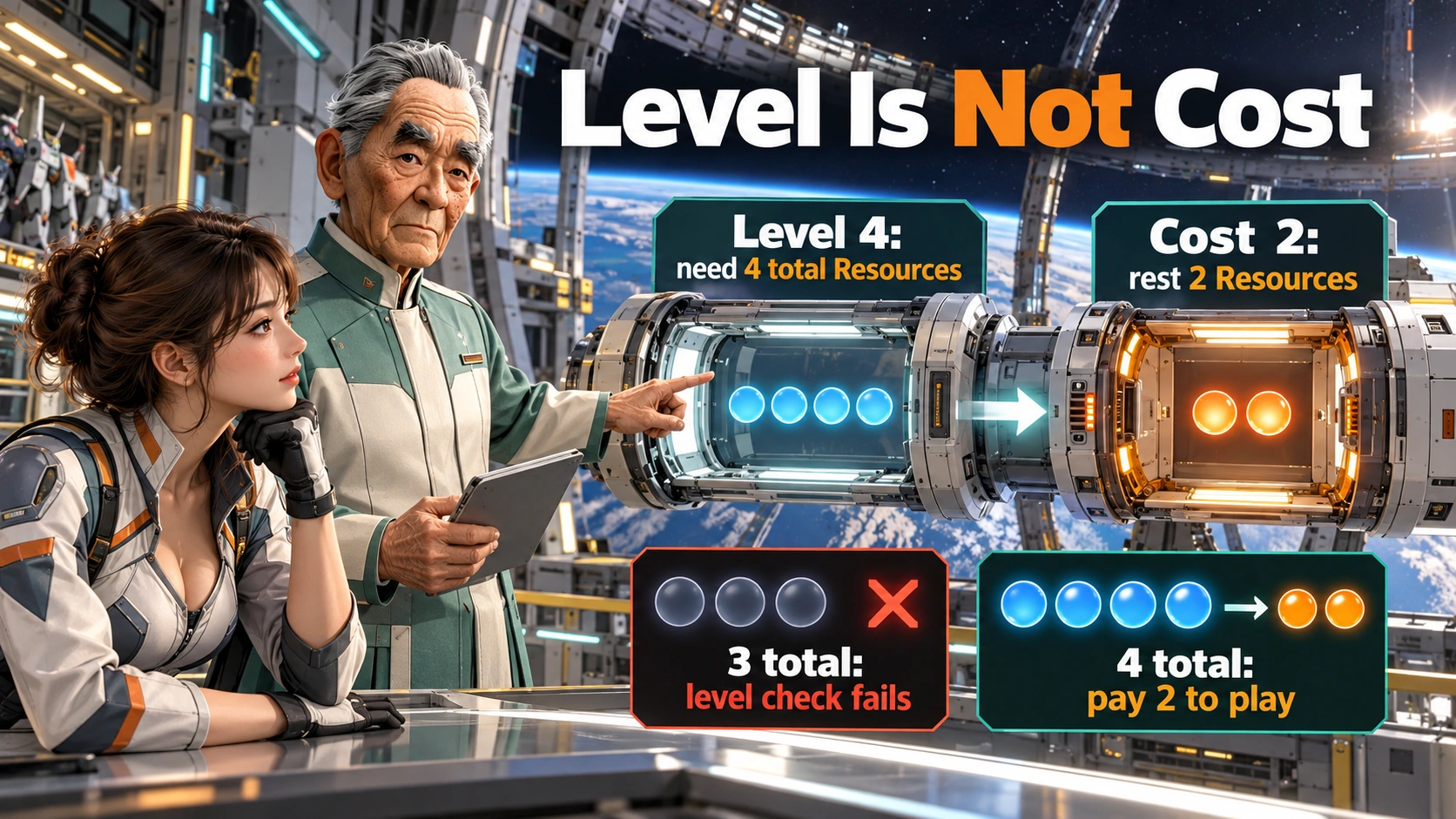
These two numbers solve different questions. Your total number of Resources must meet a card’s level. Then you rest the number of Resources required by its cost. Having enough active resources to pay is not permission to ignore the level requirement.
Bandai’s own teaching example is a level-four card costing two. With four total Resources, you meet the level check; you rest two to pay. With only three Resources, leaving all three active does not make that card playable.
Say both checks out loud during your first game: “I have the level; I can pay the cost.” Before committing the rest of the turn, ask what the remaining active Resources could still pay for. That habit matters more than memorizing a complicated combo on day one.
Record whether a stranded card failed its level check or simply cost too much alongside your other actions. Those are different deck-building problems, and buying a rarer version of the same card fixes neither.
A Pilot is not automatically a link
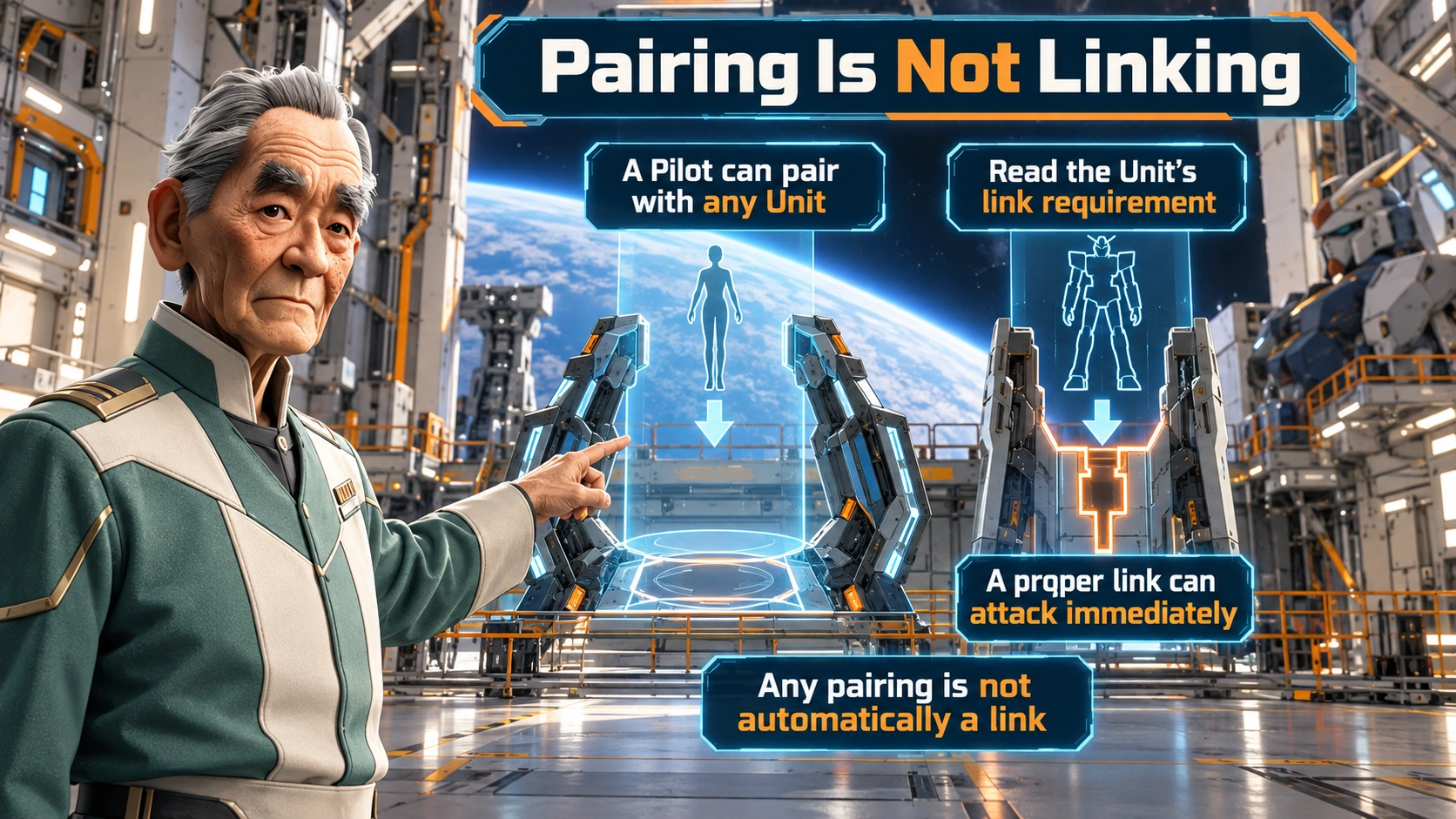


A Pilot can pair with any Unit and supplies the printed AP/HP bonuses and ability. A Link Unit requires the stated link conditions to be fulfilled. Do not assume that a famous pilot, a matching color or any paired Pilot grants every link benefit.
Normally a Unit cannot attack on its deployment turn. Bandai explains that a properly linked Unit can attack immediately on that turn. In a teaching game, read the relevant condition together before treating a freshly deployed suit as an attacker.
For the next game, choose one pairing from the actual deck list. Explain what the Pilot adds even without linking, then what becomes possible when the printed requirement is satisfied. This makes a real card interaction easier to retain than a wall of keywords.
When upgrading, count both halves of a pairing. Adding another expensive Unit without enough suitable Pilots may make your favorite turn less reliable. We are proposing a test to run, not claiming a measured consistency percentage.
A worked ST12 link: Epyon ST12-001 asks for Zechs Merquise. Milliardo Peacecraft ST12-011 explicitly says its name is also treated as Zechs Merquise. With seven total active Resources and no other relevant effect, Epyon’s level 7 / cost 6 and Milliardo’s level 5 / cost 1 can fit the same turn: six plus one spent. The Pilot supplies +3 AP / +1 HP; the printed 5 AP / 5 HP Unit becomes 8 AP / 6 HP while paired. Read both cards rather than assuming that any Pilot creates this link.
Play two teaching games before changing the deck
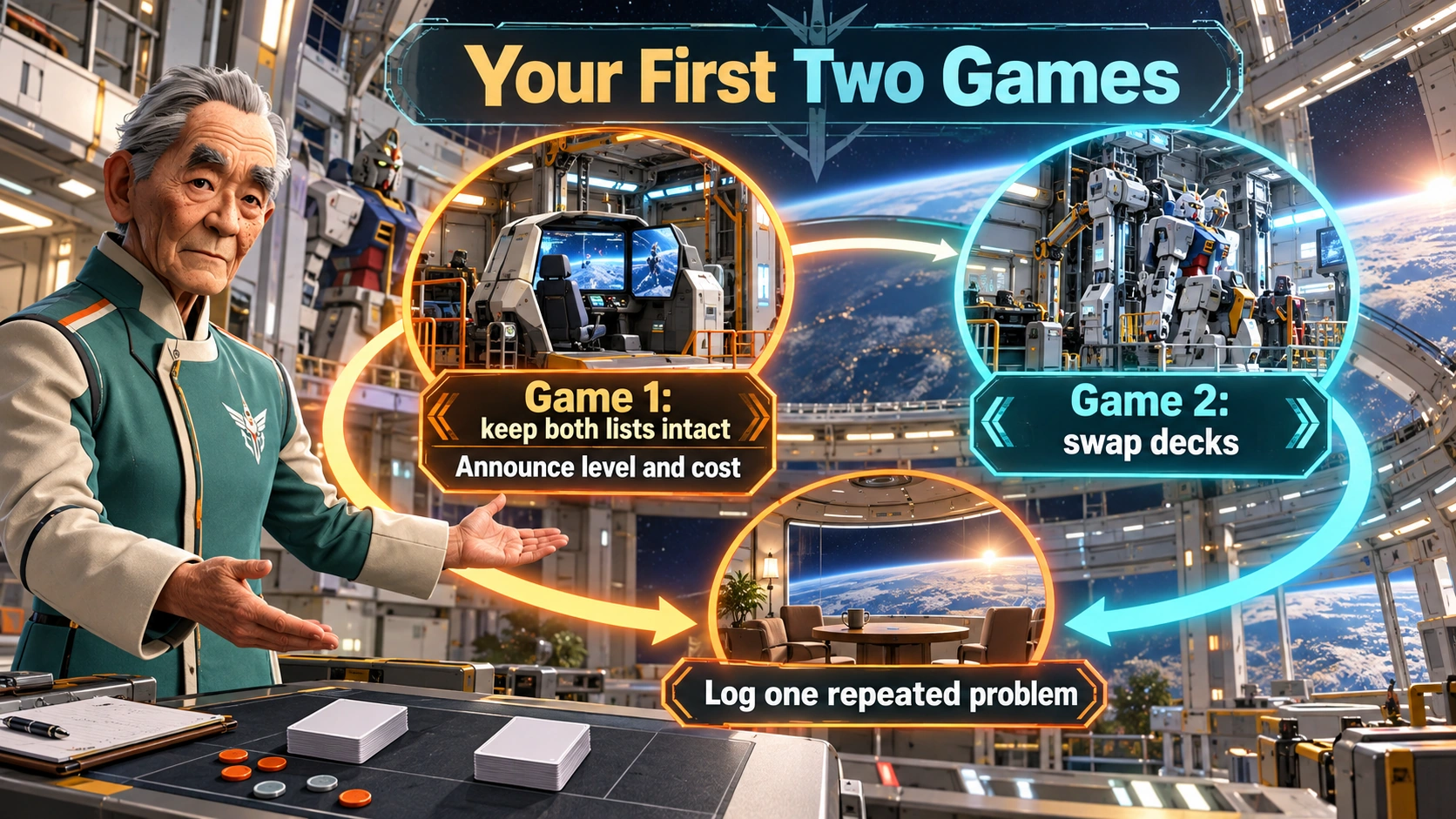
The turn spine is Start → Draw → Resource → Main → End. The official guide describes readying rested cards, drawing, adding a Resource, then playing cards, using applicable abilities and attacking during Main. Use the current rule/playsheet for opening-turn exceptions and the full battle procedure.
Game one: leave both starter lists intact. Announce level and cost, identify paired versus properly linked Units and keep counters legible. Pause at unfamiliar card text. The goal is a game both players can explain, not the fastest possible win.
Game two: swap decks. Notice which decisions felt awkward from the other side: an attack that left no useful defense, a Pilot without a suitable Unit, or a high-level hand that did nothing early. Do not change ten cards between games and then guess what caused the difference.
The official victory conditions are battle damage to an opponent with no cards in their shield area, or the opponent having no cards in their deck. Removing the last shield is not itself the same statement as dealing the finishing battle damage. Keep the exact card text and battle sequence in view.
Where Freedom Ascension fits in October
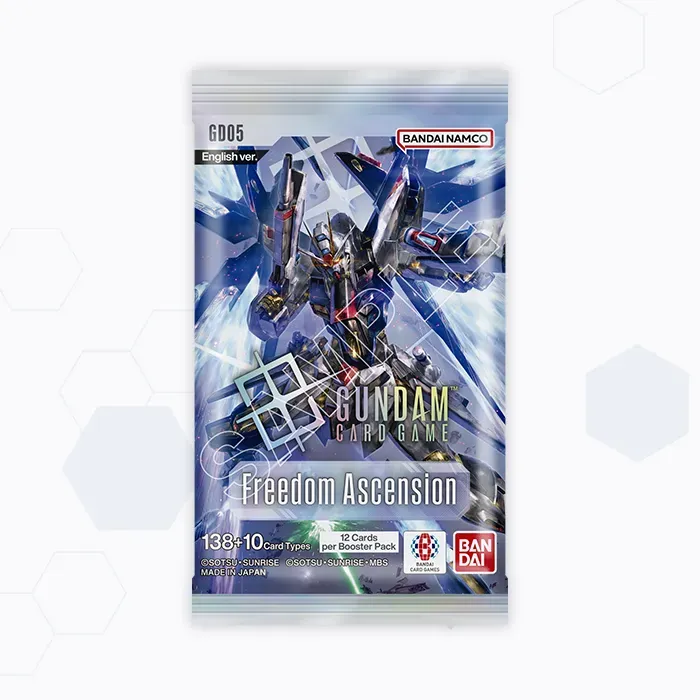 Official product marketing: Bandai. Rights remain with their owners. Image source ↗
 Freedom Ascension GD05 is the first-anniversary booster release, already released in the US on July 24, 2026. Strike Freedom comes from SEED Destiny; the set also features series including Mobile Fighter G Gundam, Endless Waltz and Char’s Counterattack. The English page lists 12 cards per pack.
This is new deck material and collectible art, not a promise that opening a display builds the deck you want. Link Rares are a parallel treatment; they are not a separate format, a substitute for linking conditions or proof of better gameplay text.
As of this check, Stardust Trails GD06 is the next scheduled US booster release on October 30. Do not buy July’s product because a stale headline calls it the upcoming set. Wait for GD06 only if its actual card pool or featured series is your reason—not because another release guarantees older boxes become cheaper.
We checked exact GD05 and English SC01 Amazon pages but did not qualify those offers for the recommendation shelf. Their official product references remain useful. A visible purchase button alone is not our endorsement, and we will not send you to an older set under the new set’s name.
These cards will be included as parallel cards of cards featured in this set — Bandai, on Link Rares
SC01: four English packs, eight Japanese packs
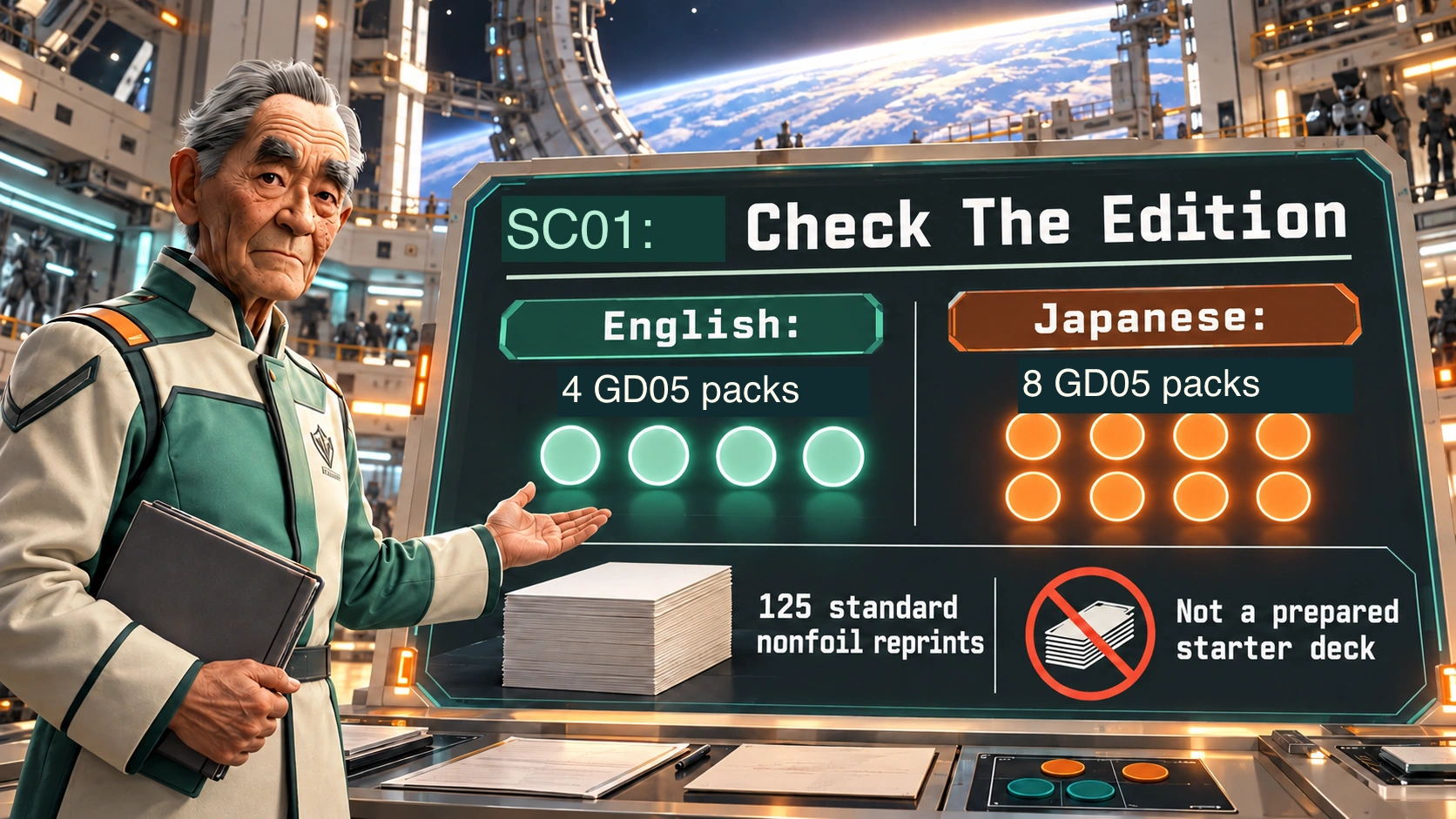
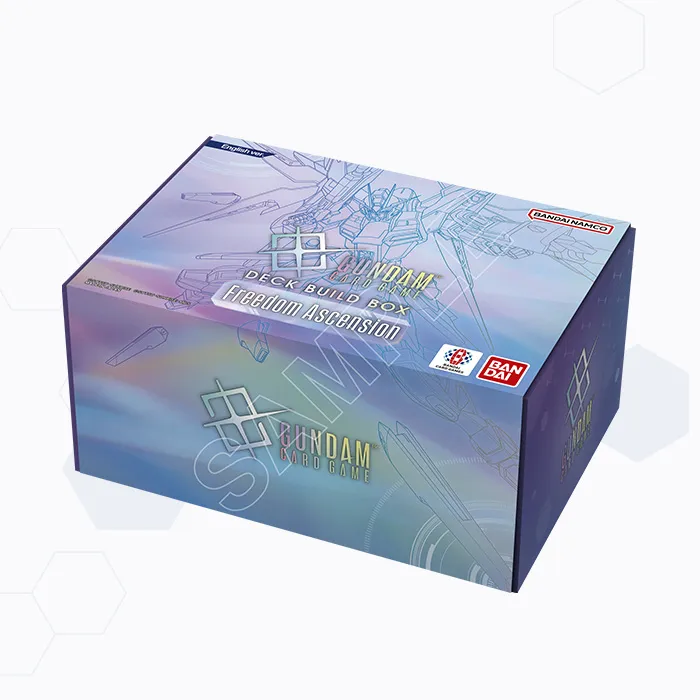 Official product marketing: Bandai. Rights remain with their owners. Image source ↗
 The English Deck Build Box Freedom Ascension SC01 contains 125 standard nonfoil reprints: 25 cards in each of five colors. Bandai also lists four GD05 packs, 10 Resource Cards, two Token Cards, a half storage box, rule/playsheet, paper damage counter and a bonus pack containing one of three exclusive-illustration EX Bases.
It is a construction kit. You choose a two-color build; you are not receiving a fixed prepared starter, all desired four-copy playsets or every bonus design. If you already own a deck, compare the exact reprints you need with the contents before buying another box.
Bandai’s Japanese Custom Deck Box SC01 instead lists eight GD05 packs and two playsheets alongside its construction contents. The shared SC01 code and English words on the artwork do not make these regional products interchangeable. An eight-pack import must not be described as the four-pack English edition.
Before checkout: match the listing’s language, sealed unit, pack count and complete contents. A listing for a loose 125-card brick may omit boosters, bonus contents and storage. If the seller’s description and picture disagree, clarify before buying rather than treating the larger number as a bargain.
What the creators establish—and what they do not
AVAULT’s July 23 SC01 opening and construction video demonstrates the four-pack English product and several beginner color-pair routes. The full transcript was reviewed. Its recommendation to buy two boxes deserves a second question: which exact missing cards would the second box solve? A targeted purchase may duplicate less.
AVAULT promotes its own Sky Blaster accessories and memberships. That is a disclosure to retain, not independent evidence that an accessory is best or officially licensed. Its beginner builds are not presented here as measured tournament-winning lists.
TriloG Studio’s July 26 release-week discussion is useful for the distinction between complete SC01 products and loose construction cards. It contains affiliate promotion and historical market opinions. We do not carry its release-week prices, forecasts or opening results forward as current facts.
Wren Melburn’s July 27 TCGplayer card discussion supplies independent card ideas to check against Bandai’s actual card text. We have not copied its ranking or its mistaken film attribution for Strike Freedom. None of these sources establishes a current universal best deck. An October 15 Ryan Kai Gaming casual-match listing was found, but only its metadata was read; no match analysis is claimed.
For experienced players: improve one lost turn
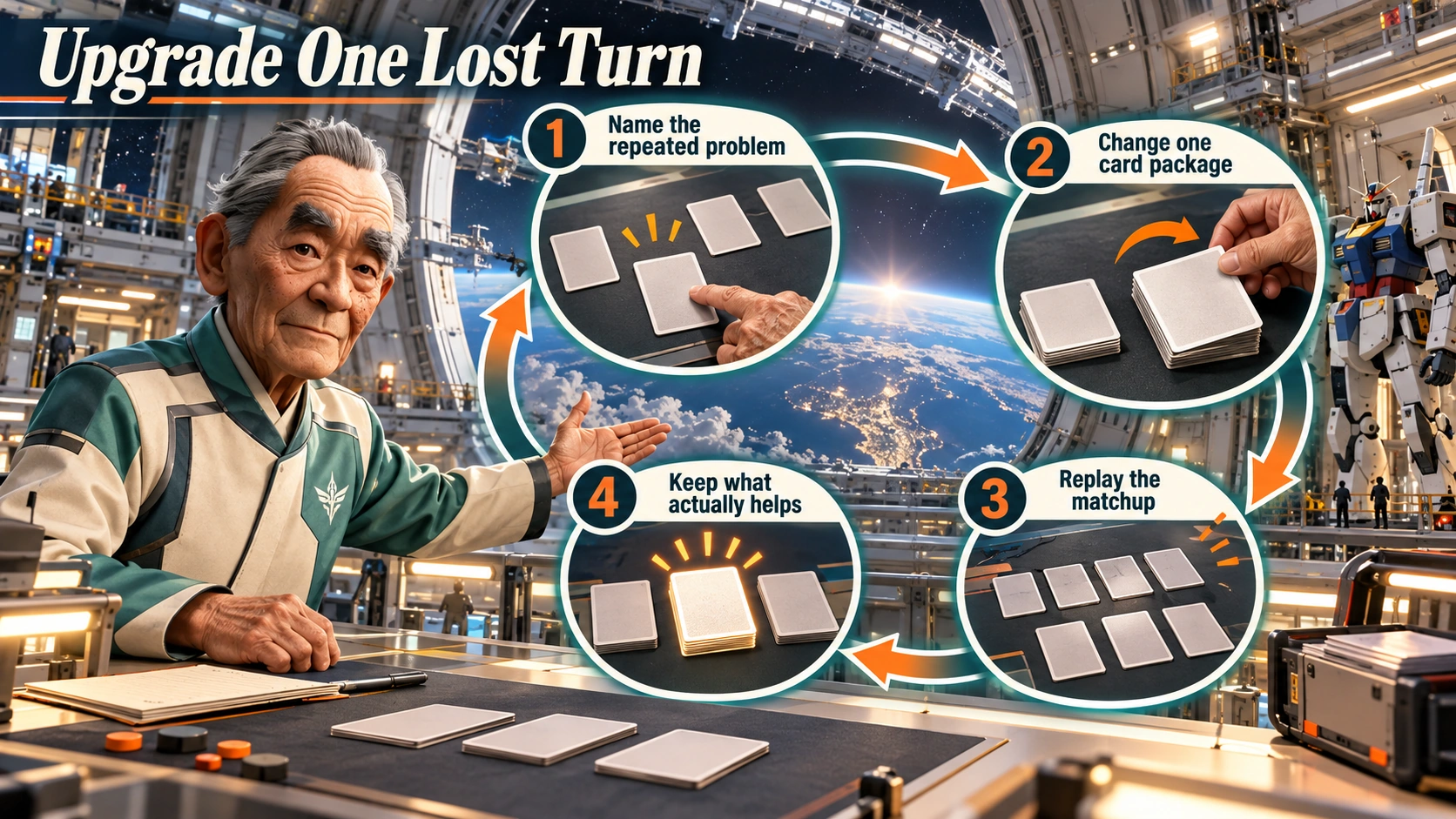

After a session, write down the turn your plan stopped working. Were you short of level, short of spendable Resources, missing a Pilot, stuck with the wrong pairing or unable to keep a useful Unit on the board? “My deck needs more powerful cards” is too vague to guide a purchase.
Keep an unchanged list beside a proposed version. Change one package for a specific reason, then replay the matchup. Track early playable cards, useful links and stranded high-level cards without pretending a handful of games is a statistically stable win rate.
For a pairing-heavy plan, compare Unit and Pilot availability together. For a resource-intensive turn, write the sequence and the Resources left after each action. For board pressure, ask what attacking commits and what the opponent can punish—not simply how many Units you can deploy.
Once you can name the missing card, compare an exact single and its treatment before buying random packs. The Steel Requiem display and Phantom Aria single pack belong in the shop as deliberately older-set openings, not automatic upgrades or Freedom Ascension substitutes. Choose their card pool or opening experience on purpose.
Budget the cards in Trash, too: the pictured Banshee’s two activated abilities each say to exile four cards. The same four cards cannot pay both costs. Choose which effect solves the current battle before spending that shared supply; do not treat two visible abilities as two free upgrades.
Collect the suit, not a promised return
A box opening and ownership of a particular foil are different goals. A parallel treatment can be the reason you collect without making it necessary for your deck. Check the exact card number, version and condition; do not infer a foil finish from attractive digital art alone.
Set an opening limit before the first pack. We do not promise a specific rare, a complete set, profit or a pull rate that Bandai has not established for the exact product. A display is a fixed amount of opening entertainment, not a substitute for a known list.
The MGEX 1/100 Strike Freedom model is a separate, optional collector’s project connected to the same SEED Destiny mobile suit. It is an assembly kit—not a Gundam Card Game expansion, not a finished painted statue, and not the different Mighty Strike Freedom kit. Buy it because you want the build and display, never because it improves the deck.
Bandai’s marketing photography shows the assembled result. Allow time, workspace and appropriate assembly tools; those are separate from the card-game starter decision. Skip this premium detour if your priority is simply playing cards with a friend.
Premium storage should solve a collection problem
A 24-pocket album gives four adjacent compartments across a row, a useful match for organizing four-copy playsets by card number. The purple Gamegenic Zip-Up Album is the selected variant, not a red picture with a purple button. Its stated 480-card capacity is a manufacturer specification; we have not independently filled or drop-tested it.
A large Games’ Lair 600+ chest earns its space when several main decks, separate Resource Decks, tokens and counters need organizing. It is empty storage, not six complete Gundam decks in a box. The maker’s capacity depends on sleeves and arrangement; do not treat the nominal number as a guarantee for every divider and accessory combination.
These are the two explicitly generic premium exceptions. They solve distinct jobs—playset archive and multi-deck organization—and are not licensed Gundam products. A small starter collection does not need both. Count what you actually carry and measure your own sleeved stack before buying a large chest.
Official Bandai sleeves, cases and the Gundam 00 mat remain the first licensed accessory research leads. We did not qualify a current exact purchase route for them in this pass. Unofficial zone mats are not silently upgraded to official merchandise to fill the shop.
The next purchase should have a sentence behind it
“I need a second complete side so my friend can play.” “I need a specific Pilot for the pairing I am testing.” “I want one bounded opening from this exact set.” Those are useful shopping reasons. “A newer number must be better” is not.
Begin with a prepared deck, play both sides, then identify the next job. Keep a working collection working. The links below are exact named routes with their limits; a reference-only product is deliberately not disguised as an available recommendation.
The picks
Some links below are affiliate links — as an Amazon Associate, Puzzlewick earns from qualifying purchases, at no extra cost to you. It never changes a pick.
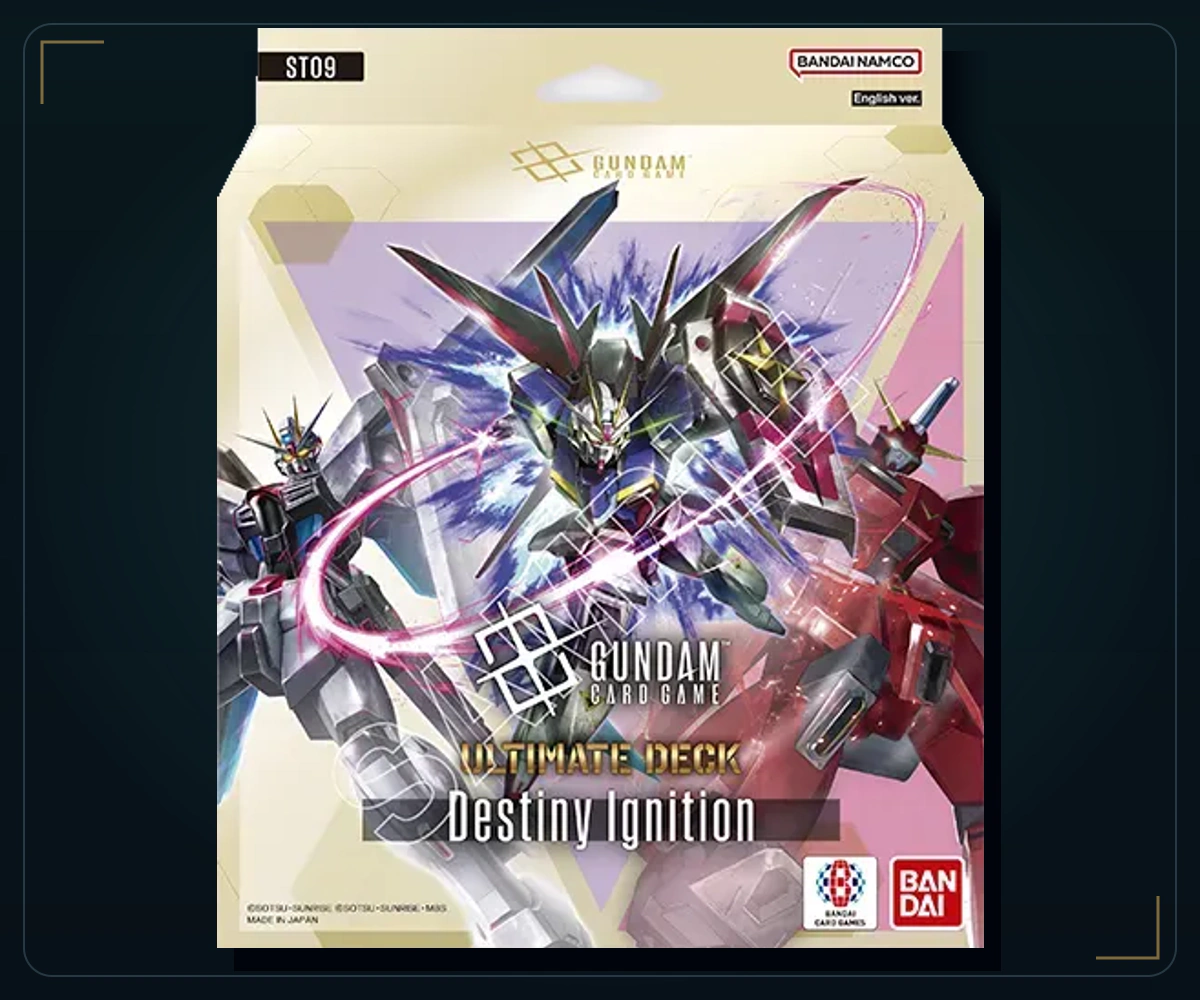
Gundam Destiny Ignition ST09 — English Ultimate Deck
A prepared fifty-card side plus the maker-listed extra cards and dice gives a beginner a coherent starting point and deliberate changes to explore later.
- A fuller SEED Destiny first purchase
- One player’s side, not a two-player pair. Extra cards do not prove tournament strength.

Gundam Raging Onslaught ST12 — English Starter Deck
The red/purple prepared deck is the focused starting route for a reader who wants Epyon and an aggressive close-combat theme.
- A close-combat Epyon introduction
- One prepared side; another player needs their own. No comparative win-rate or hands-on power claim.
Questions, answered
Can two people play from one Gundam starter deck?
One ordinary starter supplies one player’s prepared side. Two new players normally need two complete sides; buying a booster display does not supply two prepared decks.
Is Freedom Ascension SC01 a ready-made starter?
No. The English Deck Build Box contains a 125-card construction pool, four GD05 packs and listed supporting materials. It is not a fixed prepared starter or a complete four-copy collection.
How many cards are in the Gundam Resource Deck?
The official play guide specifies 10 Resource Deck cards, separate from the exactly 50-card main deck. The main deck may use up to two colors and four copies of the same card number.
Kenji's verdict
Buy a complete first game. Learn level, cost and genuine links. Then choose a specific upgrade, a bounded opening or a collector project—without pretending they are the same purchase.
Research ledger 19 sources · reviewed 2026-10-17
Specifications, rules, current product information, community experience, and contrary evidence were checked against the sources below. Commercial links are kept separate from editorial evidence.
- Bandai: official English play guidegundam-gcg.com/en/welcome/playguide.php
- Bandai: Freedom Ascension GD05gundam-gcg.com/en/products/gd05.html
- Bandai: English SC01 Deck Build Boxgundam-gcg.com/en/products/deck-build-box.html
- Bandai: Japanese SC01 Custom Deck Boxgundam-gcg.com/jp/products/custom-deck-box.html
- Bandai: Stardust Trails GD06gundam-gcg.com/en/products/gd06.html
- Bandai: Destiny Ignition ST09gundam-gcg.com/en/products/st09.html
- Bandai: Raging Onslaught ST12gundam-gcg.com/en/products/st12.html
- Bandai: Silent Barrage ST13gundam-gcg.com/en/products/st13.html
- AVAULT: SC01 opening and construction, July 23, 2026youtube.com/watch?v=c-tvkLVHha0
- TriloG Studio: SC01 release-week discussion, July 26, 2026youtube.com/watch?v=I5cQtz-WBRc
- Wren Melburn: TCGplayer Freedom Ascension card analysis, July 27, 2026tcgplayer.com/content/article/The-10-Cards-You-Need-From-Freedom-Ascension/a9cee279-7b45-493b-bcfd-aa903fc4d28c
- Bandai: official ST12 English card listgundam-gcg.com/en/cards/?package=616012
- Bandai: Celestial Drive ST07gundam-gcg.com/en/products/st07.html
- Bandai: Flash of Radiance ST08gundam-gcg.com/en/products/st08.html
- Bandai: Steel Requiem GD03gundam-gcg.com/en/products/gd03.html
- Bandai: Phantom Aria GD04gundam-gcg.com/en/products/gd04.html
- Bandai Hobby: MGEX1/100StrikeFreedom,2022kitbandai-hobby.net/item/01_4230
- Gamegenic: Zip-Up Album24-Pocketgamegenic.com/product/zip-up-album-24-pocket
- Gamegenic: Games Lair600+Convertiblegamegenic.com/product/games-lair-600-convertible/?attribute_pa_color=black
Every object has a lineage. Let me tell you its story.


Keep exploring
The next smart rabbit holes.
✧ Universe HubAnime & New-Wave TCGs: the whole buying pathBeyond Magic and Pokémon, a new wave of trading card games has gone mainstream — One Piece, Yu-Gi-Oh!, Dragon Ball, Digimon, Weiss...🂠 Topic PathTrading Card Games: compare the whole shelfStart with the game and community you want, then buy the smallest product that lets you test it properly. These guides separate...Buying GuideGundam Card Game Starter Decks ST05–ST08 Ranked in 2026Gundam ST05–ST08 decks, explained with exact box identity, expansion order, beginner-to-expert strategy, hosting and solo reality,...