Buying Guide · Updated 2026-10-21
Union Arena: Pick Your Anime, Build Your First Deck


AI-assisted research, writing and editorial QA under Robert’s direction. Our process
The short answer
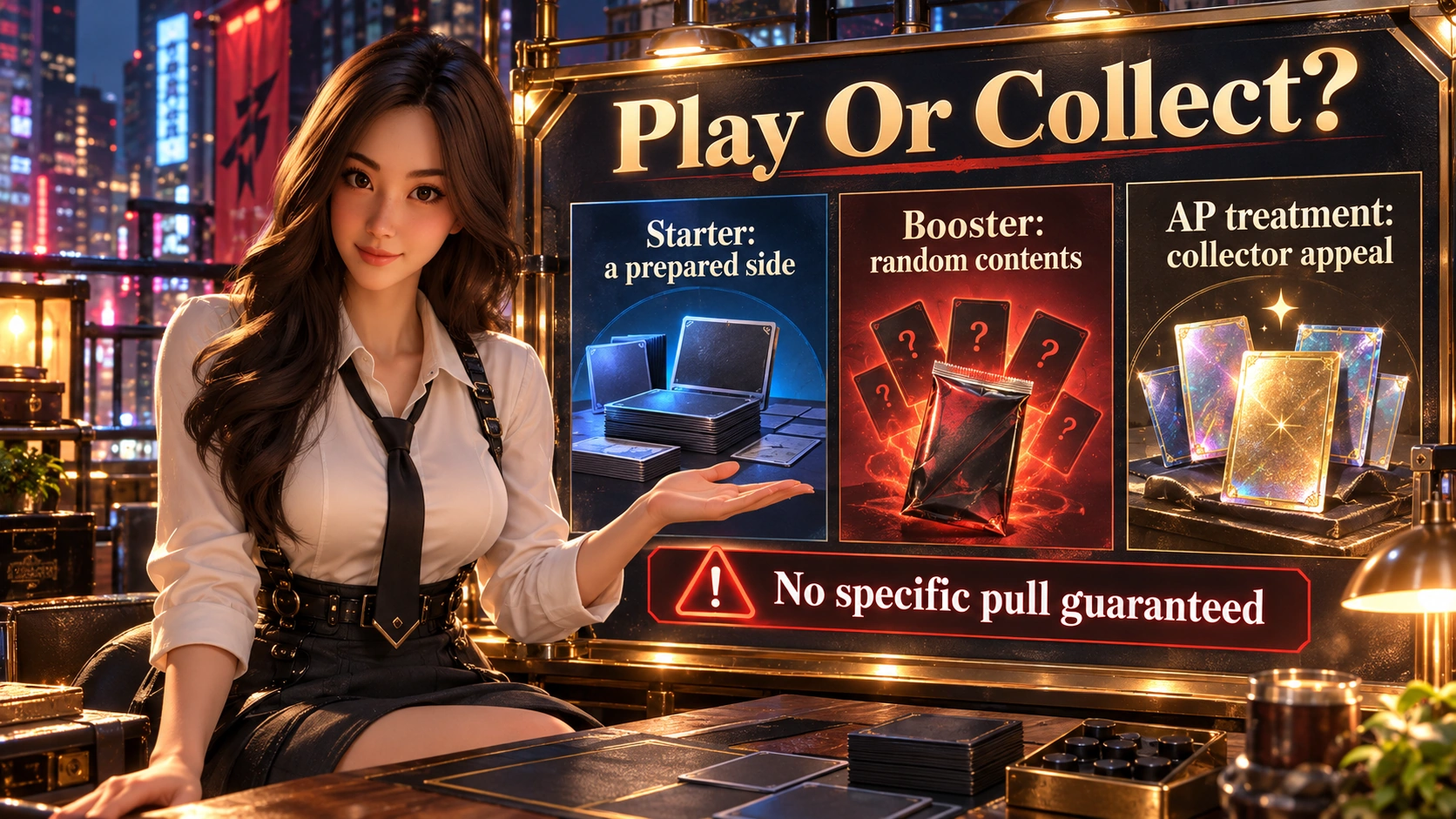
Start Union Arena with a complete English starter for each new player. Choose an anime you genuinely want to replay, then learn action points and energy before upgrading. Chainsaw Man's UE22BT boosters are a deck-building and collecting route, not a ready-to-play replacement. Keep title codes, language and the exact pack-versus-display unit clear before spending.
Sources checked 2026-10-18 · 7 sources & review details

At a glance
| Goal | Purchase path | Avoid |
|---|---|---|
| Two beginners at home | Two complete English starter decks | Assuming one 50-card starter supplies both players |
| Join a friend who already plays | One complete legal side | Buying a booster display without a deck plan |
| Build Chainsaw Man | A specific legal list and exact-title cards | Expecting random UE22BT contents to guarantee every needed copy |
| Open sealed product | Verified English set and clearly stated unit | Confusing a single pack, display and seller-made lot |
| Collect Action Point treatments | Treat the chase as collecting | Assuming a premium AP illustration gives a gameplay advantage |
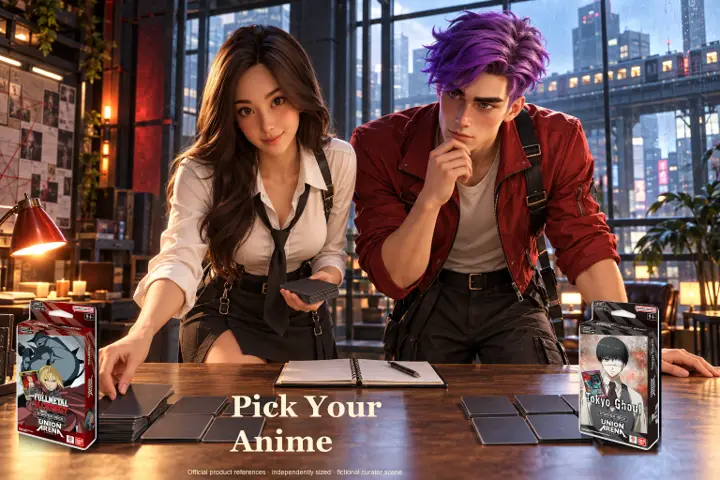
One friend wants alchemists. Another wants demon hunters. Union Arena lets those fans share a rules system without pretending every character belongs in the same deck.
Yumi starts with an evening you can actually play. Dax handles the upgrade temptation: which cards solve a problem, which boxes offer random possibilities, and which beautiful treatments are simply for collecting.
Start here, then go deeper
You are in the right cabinet.
 ✧ Universe HubAnime & New-Wave TCGs: the whole buying pathBeyond Magic and Pokémon, a new wave of trading card games has gone mainstream — One Piece, Yu-Gi-Oh!, Dragon Ball, Digimon, Weiss...
 🂠 Topic PathTrading Card Games: compare the whole shelfStart with the game and community you want, then buy the smallest product that lets you test it properly. These guides separate...
 Buying GuideYu-Gi-Oh! Magnificent Monsters vs Rarity Collection 5 vs Glorious Gallery: Which 2026 Box Should You Buy?Magnificent Monsters brings six anime generations into one 18-card collector box. Yumi separates the nostalgia, the rarities, the...
Choose the title you will want to play twice
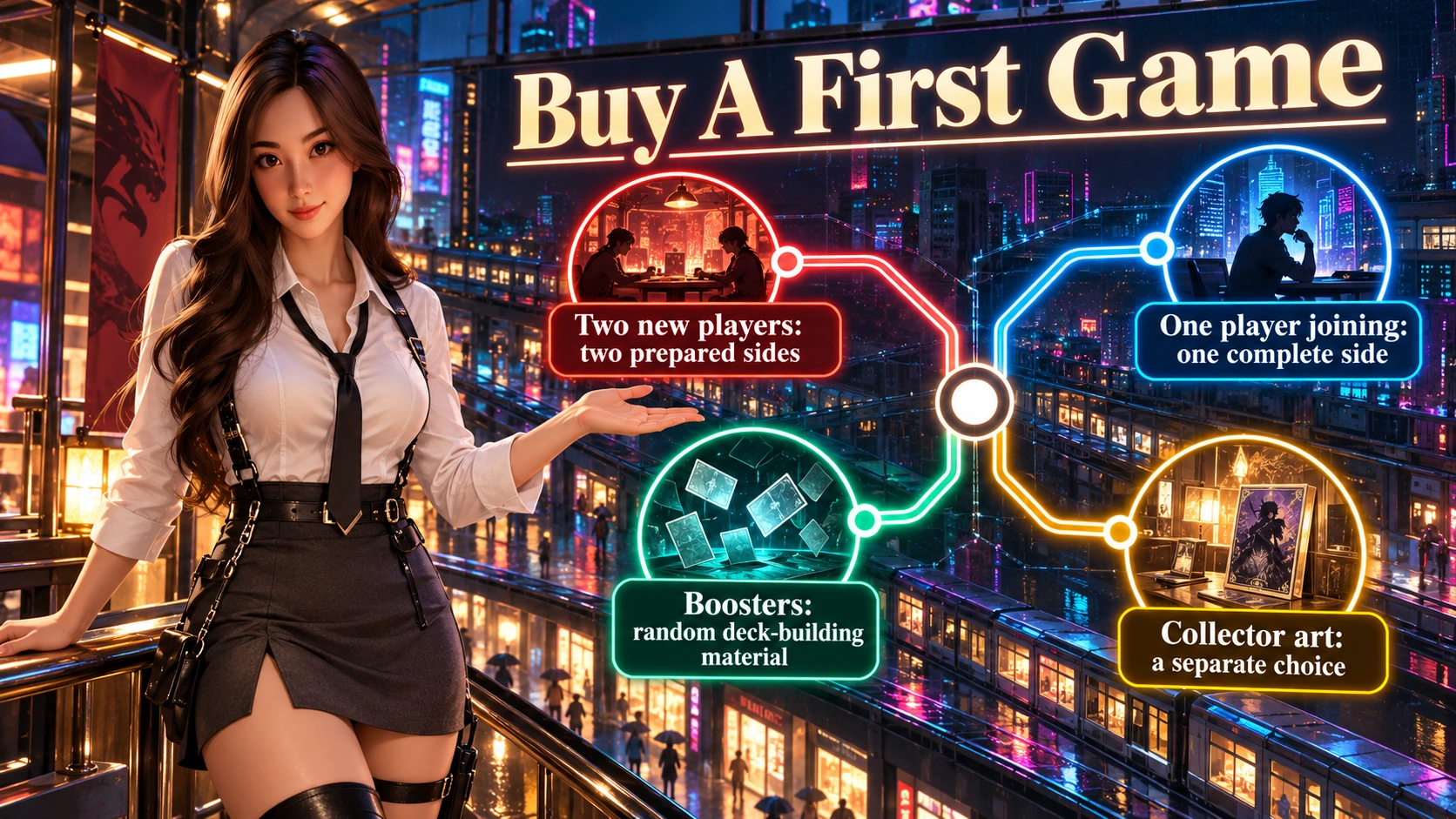
A first deck does two jobs: it supplies a complete side and makes you want another game. The second job is why a favorite anime is a sensible starting criterion. Repetition teaches energy placement and attack timing more reliably than buying a supposedly optimal deck you never unpack.
English starters from different titles can face each other under the shared system. That does not mean their cards can be freely merged. The official rules use title codes to define deck construction. A deck normally contains exactly 50 cards from its permitted source title, with the stated copy and trigger restrictions, plus three Action Point cards.
For two new players, buy two complete sides. They can be the same title or different ones. Keep the first lists intact so you can tell a rules problem from a deck-building problem. A booster box adds a collection of random cards; it does not promise a coherent teaching pair.
We do not rank every anime starter by a fabricated October win rate. The useful first comparison is personal and practical: recognizable characters, readable language, an actual complete product, and a plausible matching-title upgrade pool.
Premium purchases come later. A well-protected box of unplayed cards is still not a first game.
“Each Booster Pack contains 12 cards.” — Bandai. Source linked in the research ledger.
English, Japanese, pack or display: read all four words
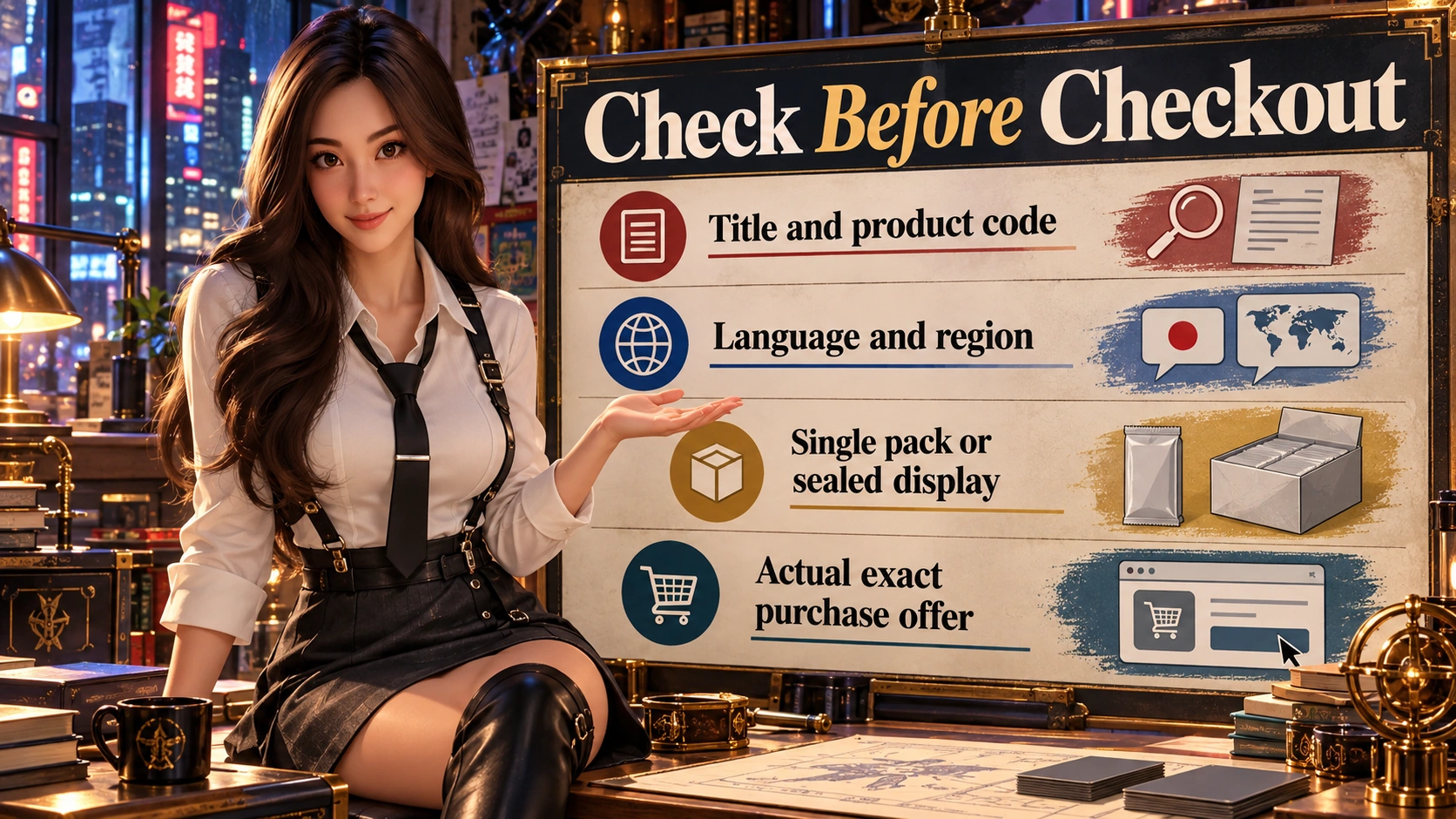
Check the product code and the selected listing details, not just the search photograph. The North American and Japanese lines can use different codes and release schedules. A merchant result with familiar art is not enough to establish the correct language or tournament region.
The North American language policy page identifies the English version for US and Canadian official play. Its dated policy is not a reason to make sweeping claims about every region's newest releases. If you attend events elsewhere, use that region's current official rules and ask the organizer about the exact version.
Similarly, a pack is not a display. A listing can use a box illustration while selling one pack, and a seller-created lot is not the publisher's sealed product. We exclude mystery repacks and seller-assembled decks from the recommended route.
For each purchase, match four things: title, language, product code and retail unit. Then check that a real purchase offer is present. An existing product page without an offer is neither proof of stock nor proof that a different listing is an equivalent replacement.
Our exact merchant buttons name the product they open. A Chainsaw Man photograph must not quietly send you to a Fullmetal Alchemist booster because the latter happened to be easier to find.
The first five minutes: action points are not energy
Set up the deck, hand, life area, energy line, front line and three Action Point cards using the official manual. Each player begins with seven cards in hand and seven life cards, with the permitted mulligan. First turns have special draw and AP limits; keep that reference visible instead of teaching the later-game allowance from turn one.
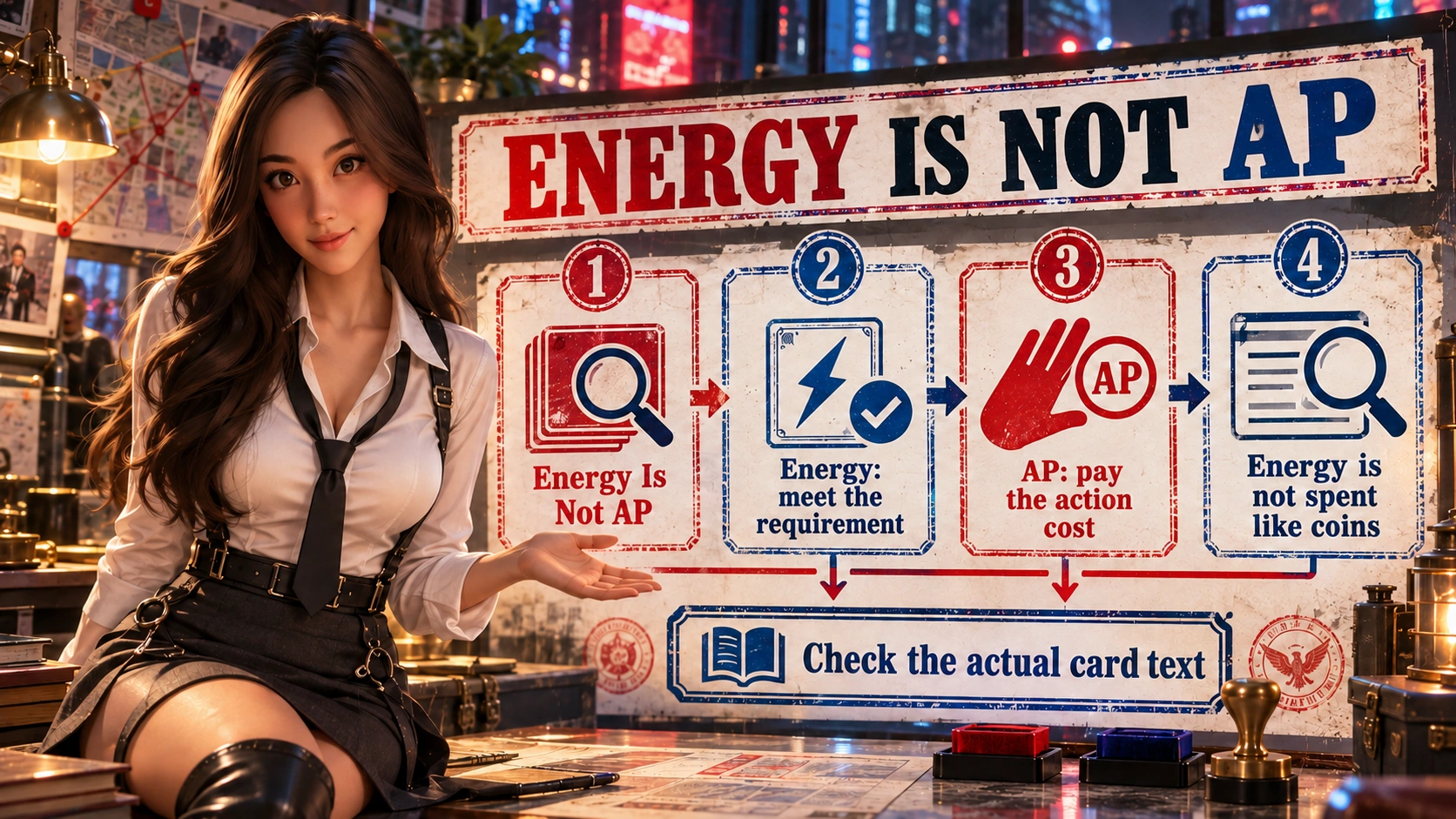
Energy checks what you may play. Action points pay the action cost. Energy is generated by eligible cards in the energy line. You do not spend that energy as if it were a pile of coins. Rest the required AP cards when paying an AP cost, and meet the card's color and energy requirement.
Demonstrate with an actual card in the starter. Ask the learner to identify its energy requirement, its AP cost and where the necessary energy is coming from. If those answers are clear, much of the game's apparent complexity becomes manageable.
The energy line and front line each have capacity limits. Characters placed in the energy line are not simply attacking from there; attackers normally come from the active front line. Movement and specific abilities determine how a character changes roles.
For the first teaching game, announce one reason for every placement. 'This supports next turn's color requirement' is more useful than a long speech about a future combo the learner cannot yet execute.
Read two actual cards: the pictured Makima CSM-1-018 has a purple energy requirement of zero and an AP cost of one. The pictured alternate Makima CSM-1-024 needs five purple energy but still costs one AP. Five is a permission threshold, not five spent AP. Their different numbers also mean these are different cards, not merely two illustrations of one copy.
Attack with a reason, then respect the trigger
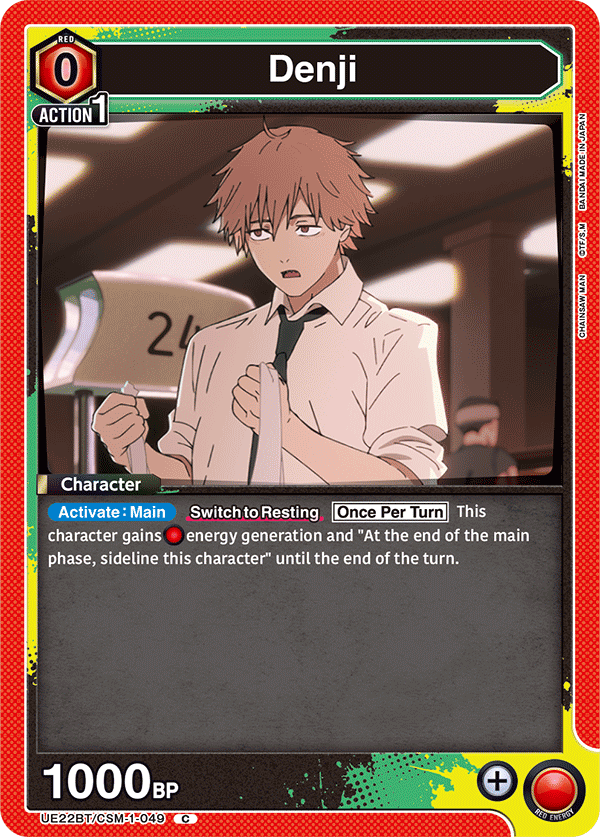 Released product/component image: Bandai. All printed artist, preview and copyright markings retained.Publisher source ↗
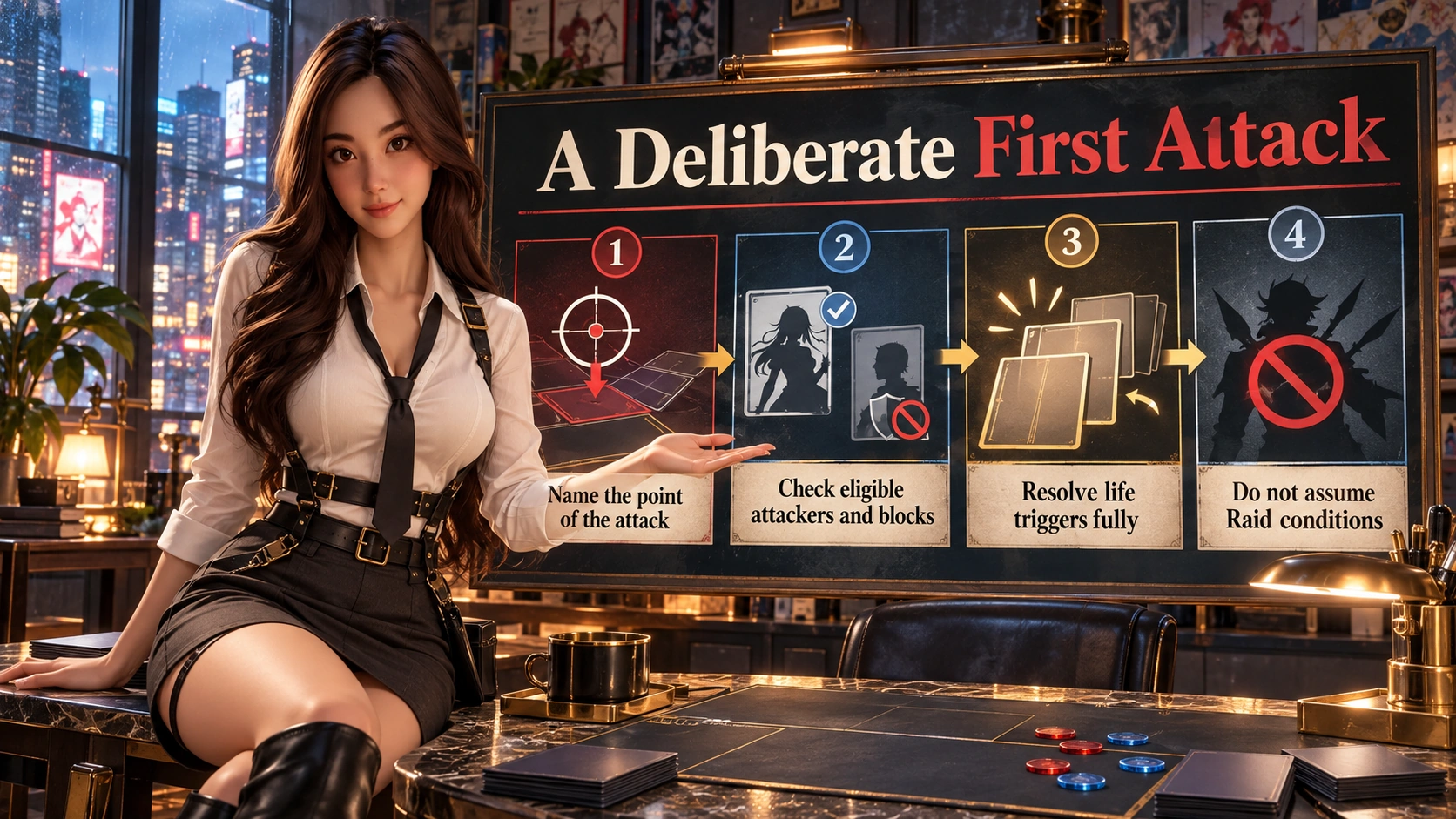
Normal attacks use an eligible active front-line character, resting it as part of the attack. They are not another AP payment. Read how the defender can block and how battle power resolves before deciding a larger number automatically means an unrestricted attack on any opposing character.
In a character battle, equal battle power favors the attacker. A smaller attacking character losing the comparison is not a blanket rule that every losing attacker is sidelined; resolve the actual combat rule and any relevant abilities.
When life is damaged, resolve the triggered effects in the proper sequence. Do not announce victory while an unresolved life trigger can still change the situation. Equally, do not play cards during the attack phase as though it were an unrestricted main phase.
Teach Raid as a specific permission, not a synonym for stacking any two attractive characters. The matching name or affinity, required energy and AP cost matter. A correctly performed Raid can change activation and attack timing; playing that card normally does not grant every benefit of a Raid you did not perform.
Beginner exercise: before attacking, name the point of the attack. Is it testing a block, forcing an unfavorable exchange, or pushing life while another attacker remains? One articulated reason is enough. After the game, identify a single attack you would reorder.
That habit scales into advanced play without requiring you to buy a more expensive card first.
Chainsaw Man UE22BT: the real box, not an imaginary starter
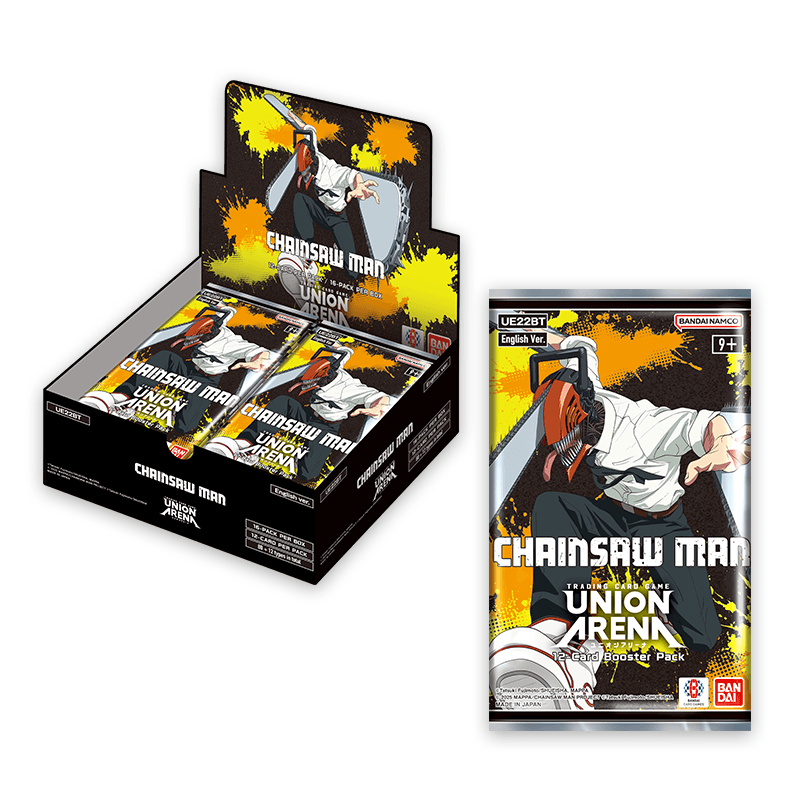 Released product/component image: Bandai. All printed artist, preview and copyright markings retained.Publisher source ↗
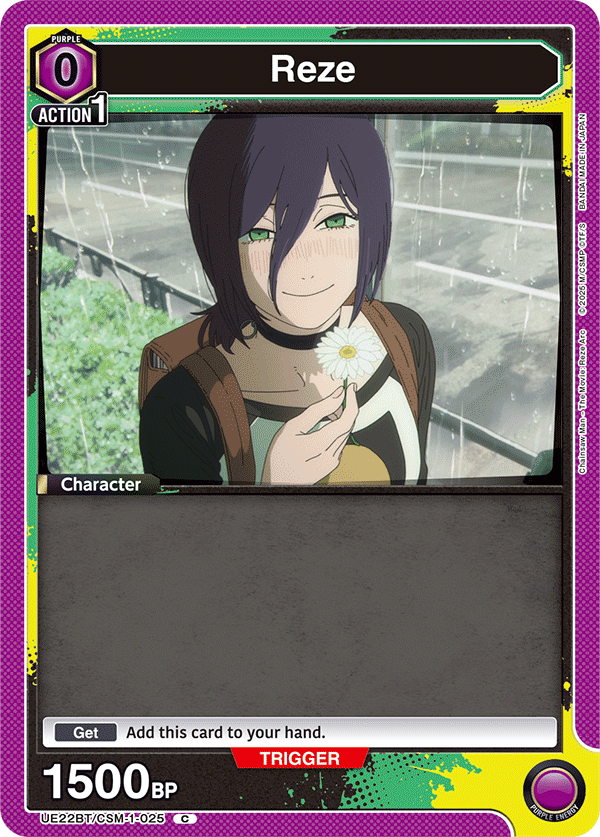 Released product/component image: Bandai. All printed artist, preview and copyright markings retained.Publisher source ↗
Bandai's English Chainsaw Man UE22BT released on 31 July 2026, after its July release-event window. It is not an upcoming July preorder just because an old retailer label still says presale.
The set includes 12 cards per booster pack and combines familiar characters with Reze Arc material. Bandai distinguishes the normal card range, alternative treatments and Action Point offerings. Its collector examples include stamped signature treatments and a separate serial-numbered hand-signed AP chase. Those are different descriptions; neither supplies a published pull-rate calculation for this article.
A display's bonus and a random pack's contents also need separate reading. The official page describes a box-topper pool. It does not promise the specific character or premium treatment you prefer. Photographed previews are examples, with their publisher preview marks retained.
For an opening night, choose a budget and understand the exact sealed unit. For constructing a deck, begin with a legal list and identify the copies it needs. Random opening can be enjoyable, but it is a poor guarantee of completing a precise list.
During our bounded US Amazon checks, we did not establish an exact English UE22BT purchase offer. The set and card previews can still be researched and shown as official references. They must not acquire a fake Amazon ASIN or a button to a different anime.
Makima's appeal: an engine you have to sequence
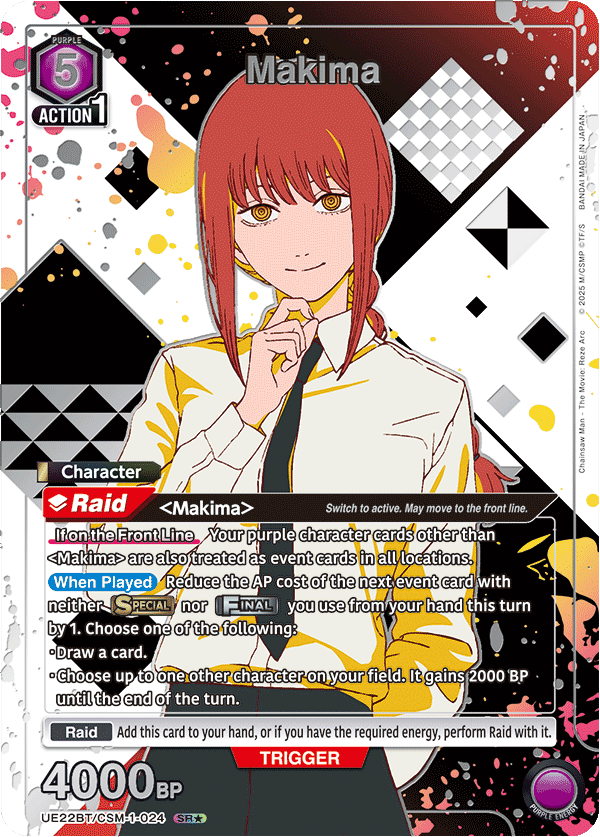 Released product/component image: Bandai. All printed artist, preview and copyright markings retained.Publisher source ↗
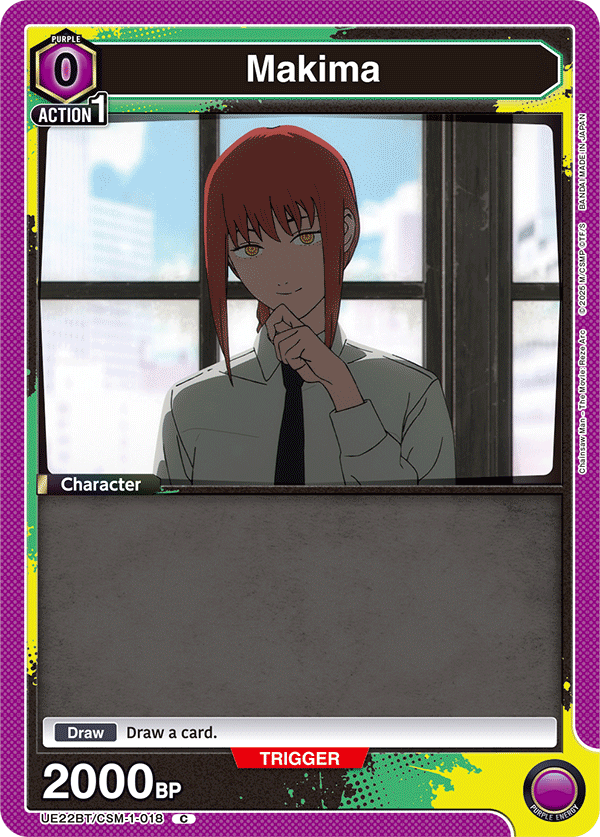 Released product/component image: Bandai. All printed artist, preview and copyright markings retained.Publisher source ↗
In GG Haven's 29 July 2026 Purple Makima deck guide, Carryion presents a midrange/combo approach built around recurring resources, drawing and developing pressure. The useful lesson is that the deck's pieces have an order; it is not simply a row of individually powerful characters.
That video predates this article by several months. We use it as a dated deck-building perspective, not proof of October tournament dominance. Any specific interaction needs the current English card text, current restriction list and a legal list before you reproduce it.
A useful veteran exercise: lay out the next turn before making the first play. Identify the AP needed for the sequence, the colors supplied by the energy line, what has to be in hand and what the line accomplishes if the opponent removes an important piece.
Then write a fallback. Can you develop a legal board without the recurrence target? Can you use a less ambitious line and retain a defensive option? A combo that only functions when every part survives is a different purchase proposition from a reliable prepared starter.
Carryion also identifies limitations, including pressure on sequencing and removal options. Keep those caveats attached to the recommendation. 'Interesting for a player who likes recursive decisions' is supported; 'the best deck in the format' is not established by one July profile.
Yumi's beginner route remains intact starters first. Dax's advanced route is a tested list hypothesis with a fallback, not a reflex purchase of the largest sealed quantity.
One card-text checkpoint: Makima CSM-1-024 treats your other purple characters as event cards in all locations while she is on the front line. Her When Played effect reduces the AP cost of the next event from hand with neither a Special nor Final trigger by one for that turn, then offers its printed draw-or-power choice. Read every qualifier: putting a Makima elsewhere, using the wrong trigger type or assuming the discount lasts forever breaks the proposed line. This is a card-text explanation, not a claim that we tested a tournament list.
Upgrade the problem you can describe
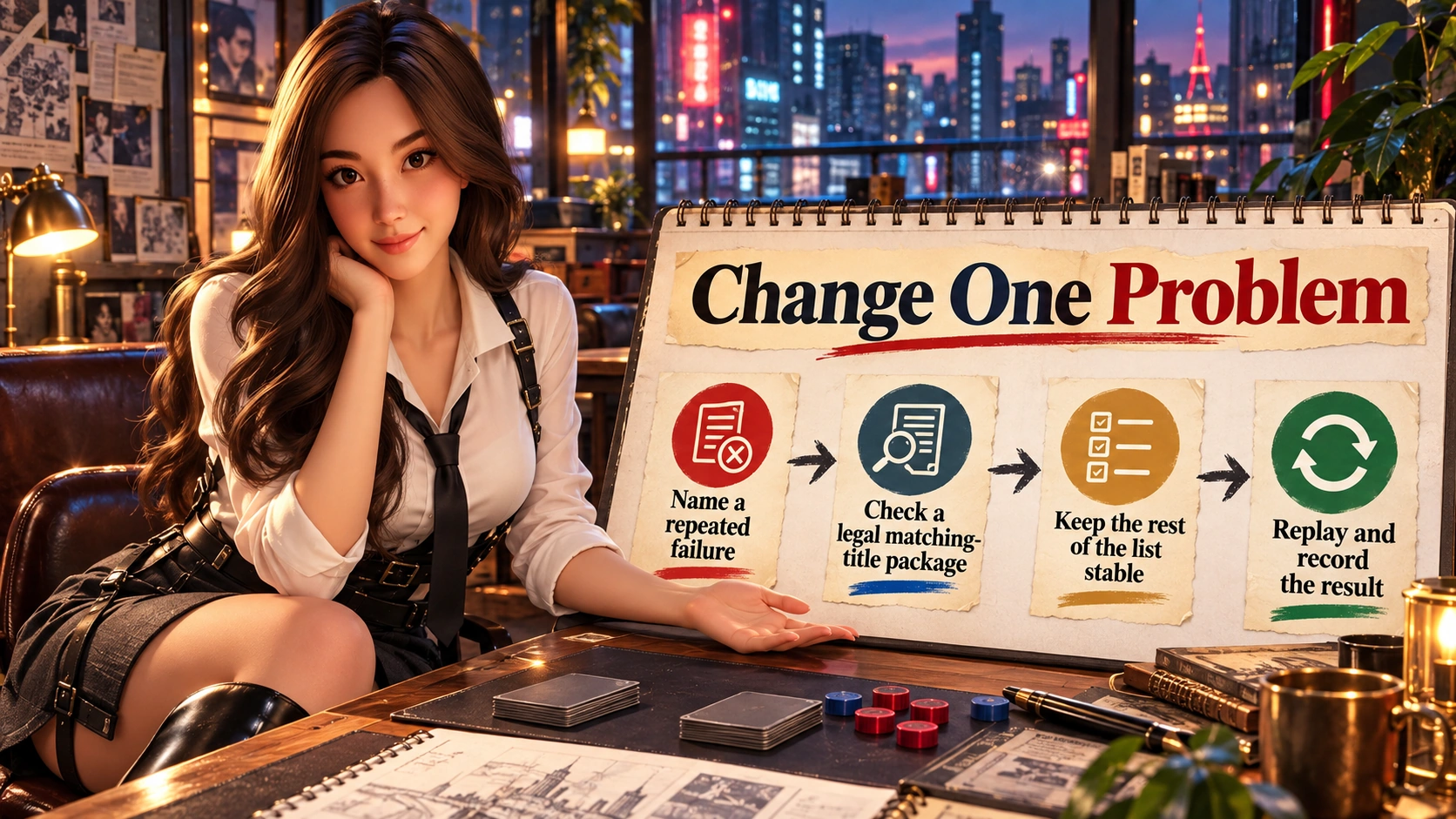
After two teaching games, name one repeated problem. Perhaps the energy line cannot support the hand, the list has too few early plays, or the attack order keeps wasting a useful effect. Those diagnoses point toward different changes.
Compare a small card package, keep the rest of the list stable and replay the matchup. Record what changed. This is an editorial practice method, not a claim that we measured a particular win-rate improvement.
Use Bandai's current North American restriction page before an official event. The page checked for this research specifies restrictions effective 17 April 2026 and also records a prior removal. Its existence matters even when your chosen title has no listed change: card legality is not permanently settled by a product release.
Do not turn the most expensive illustration into the default upgrade. An alternate treatment of the same card number normally remains the same card for construction limits. Paying more for art can be a satisfying collector choice without adding power.
If you are trying to build a particular list, distinguish guaranteed contents from random possibilities. The button beneath a card preview names its containing product only when that relationship is supported, and the caption says when the exact treatment is not guaranteed.
A collector's shelf with separate jobs
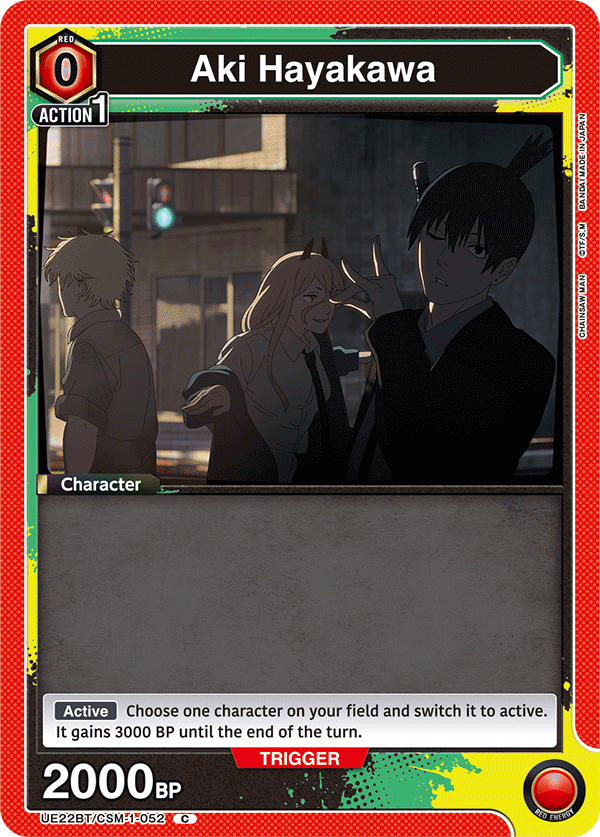 Released product/component image: Bandai. All printed artist, preview and copyright markings retained.Publisher source ↗
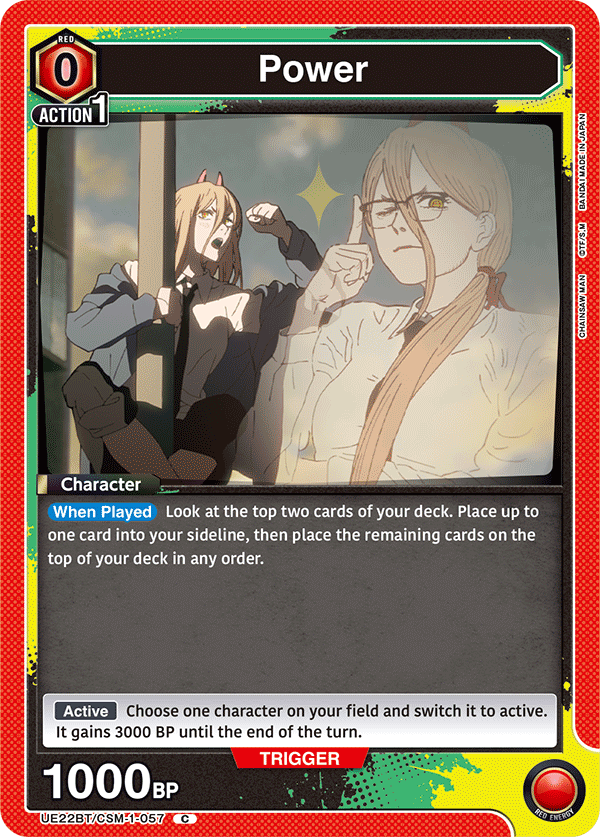 Released product/component image: Bandai. All printed artist, preview and copyright markings retained.Publisher source ↗
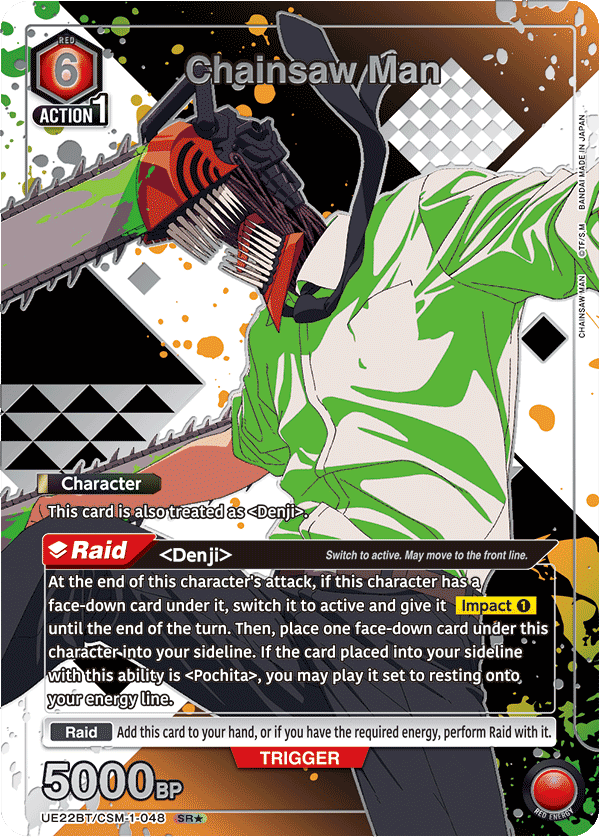 Released product/component image: Bandai. All printed artist, preview and copyright markings retained.Publisher source ↗
Arrange your purchases in three groups: a complete side to play, matching-title cards to develop it, and optional collection care. That keeps the attractive sealed display from obscuring the fact that you still need a functioning deck.
A large premium chest can make sense for several separate anime decks, three AP cards per side, tokens and a testing pool. Check the maker's supported card capacity with your actual sleeve thickness and any smaller boxes you plan to put inside. An empty chest does not include those decks or internal cases unless the exact product says so.
A playset archive has a different job. A larger-pocket zip album can help keep multiple copies visible, while a deck chest organizes prepared sides. Neither should be described as officially anime-licensed unless it actually is. A neutral premium exception needs a specific capacity or protection reason.
A licensed mat is worth considering when the exact art, dimensions and purchase offer are verified. An unofficial print with a familiar character is not automatically an authorized accessory. We would rather show an honest gap than repeat the same generic black mat under every anime.
Buy one playable plan and protect what you own. Add a collector display when opening or displaying it is itself the pleasure, with no promise of particular pulls or investment returns.
Your next evening is the real test
Before the rematch, make sure both sides are complete, in the intended language and legal for the way you are playing. Keep the current rule reference and the individual card text available. Read the first-turn exceptions instead of improvising them from memory.
Swap decks if both players are comfortable. That reveals whether a frustrating position came from the list, the matchup or the decisions. It also gives each fan a chance to understand what the other anime's engine is trying to accomplish.
Finish with one note each: a confusing rule, a repeated resource problem or an interaction worth testing. Turn that note into the next improvement. You will have a more useful buying list than 'whatever booster is trending.'
The starting purchase: one complete side per new player. The advanced purchase: a specific, verified improvement to a legal plan. The collector purchase: an optional pleasure with clear random-content limits. Union Arena is much easier to shop when those three jobs stay separate.
The picks
Some links below are affiliate links — as an Amazon Associate, Puzzlewick earns from qualifying purchases, at no extra cost to you. It never changes a pick.
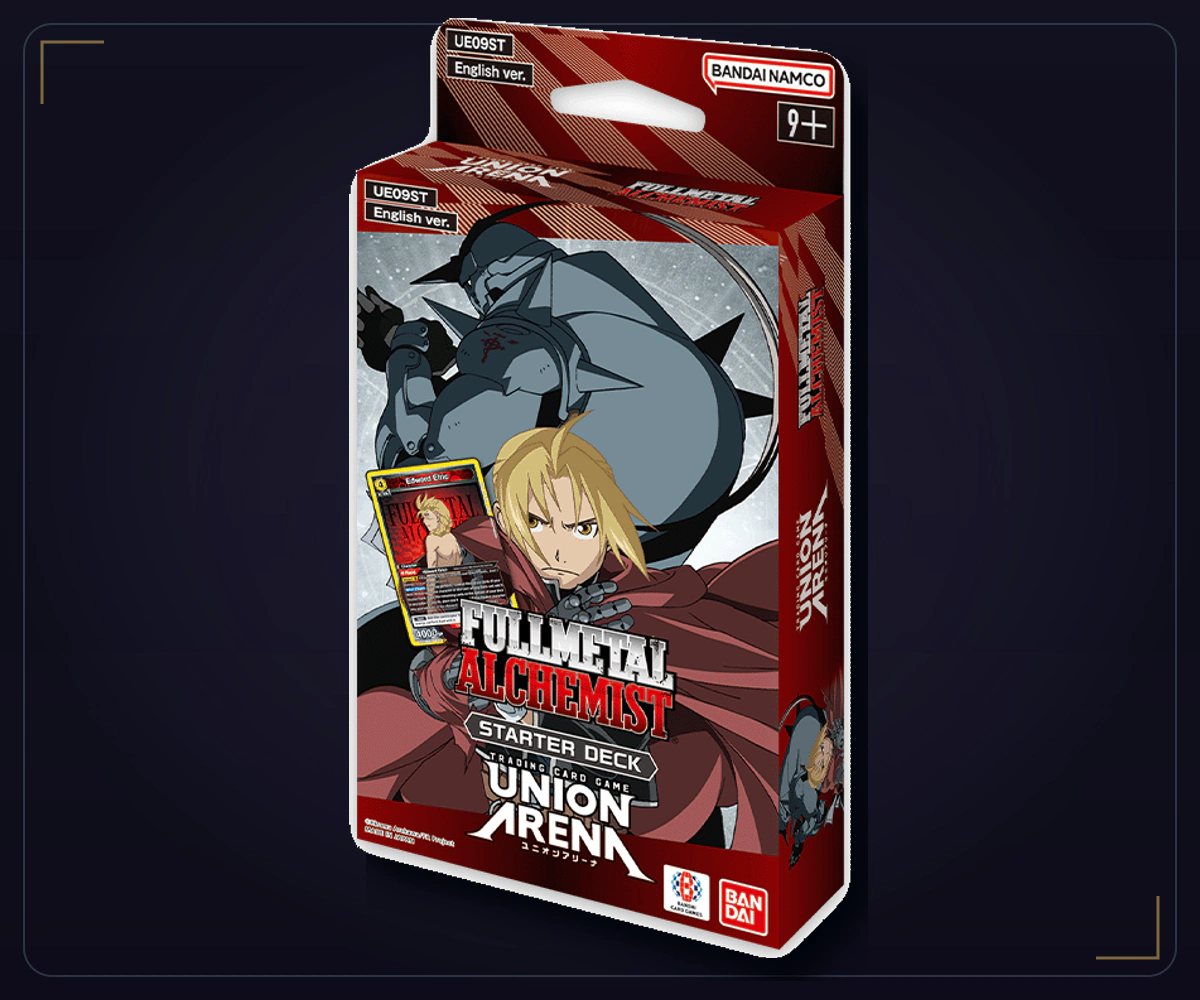
Union Arena Fullmetal Alchemist UE09ST — English Starter Deck
The English UE09ST prepared fifty-card deck and three Action Point cards let a Fullmetal Alchemist fan begin with a coherent side rather than random packs.
- A ready-to-learn Fullmetal Alchemist side
- One player’s side, not a two-player kit. Check local language/event policy; this does not supply Chainsaw Man cards or establish competitive tier strength.
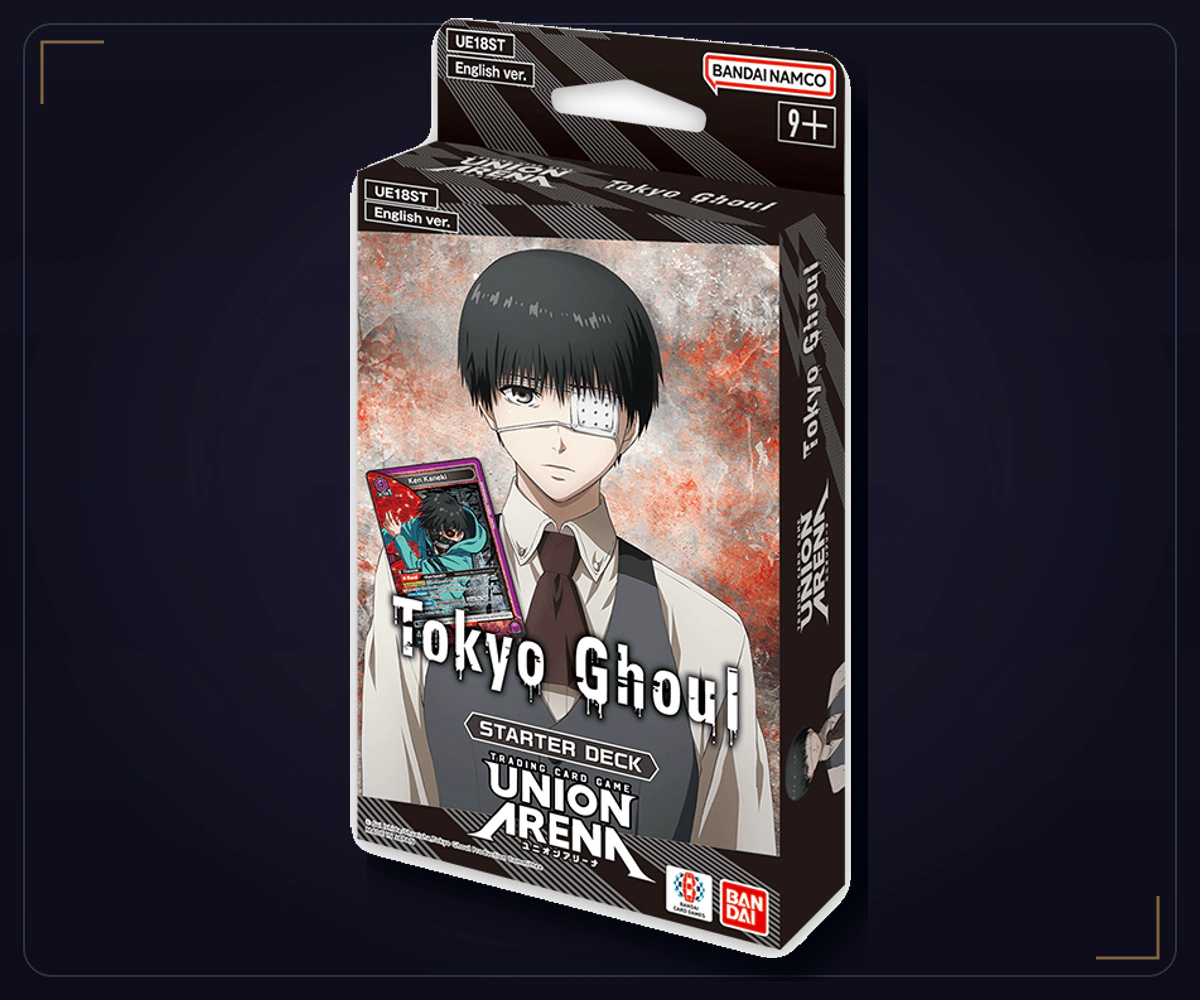
Union Arena Tokyo Ghoul UE18ST — English Starter Deck
The English UE18ST starter gives a Tokyo Ghoul fan a prepared fifty-card side and three Action Point cards, a different character-led learning route.
- A ready-to-learn Tokyo Ghoul side
- One prepared side only. Your opponent needs their own deck; it is not the UE22BT Chainsaw Man release, a booster display or a guarantee of a particular tournament result.
Questions, answered
Can different anime decks play against each other?
Yes, they use Union Arena's shared system. That does not make cards from unrelated title codes freely interchangeable inside one legal deck.
Is a Chainsaw Man booster display a prepared starter?
No. UE22BT is a booster product with random contents. A prepared deck and a specific constructed list are different purchase routes.
Do expensive Action Point illustrations make the deck stronger?
A premium treatment is a collector choice, not automatic additional rules power. Follow the actual card number, text and construction restrictions.
Yumi's verdict
Choose a favorite anime in a complete English starter, learn the AP and energy system, then upgrade a specific problem. Treat Chainsaw Man sealed opening and premium AP collecting as separate decisions with honest offer and random-content limits.
Research ledger 7 sources · reviewed 2026-10-20
Specifications, rules, current product information, community experience, and contrary evidence were checked against the sources below. Commercial links are kept separate from editorial evidence.
- Bandai: Union Arena rules and manualunionarena-tcg.com/na/rules
- Bandai: English Chainsaw Man UE22BTunionarena-tcg.com/na/products/boosters/csm-1.php
- Bandai: language and region policyunionarena-tcg.com/na/rules/region-card.php
- Bandai: North American card restrictionsunionarena-tcg.com/na/rules/limited.php
- GG Haven / Carryion: Purple Makima guide, 29 July 2026youtube.com/watch?v=47ZH9f3QHfo
- Bandai: exact Union Arena Fullmetal Alchemist UE09ST — English Starter Deck specificationunionarena-tcg.com/na/products/decks/fma-1.php
- Bandai: exact Union Arena Tokyo Ghoul UE18ST — English Starter Deck specificationunionarena-tcg.com/na/products/decks/tkg-1.php

Come in, take your shoes off — let me show you something.


Keep exploring
The next smart rabbit holes.
✧ Universe HubAnime & New-Wave TCGs: the whole buying pathBeyond Magic and Pokémon, a new wave of trading card games has gone mainstream — One Piece, Yu-Gi-Oh!, Dragon Ball, Digimon, Weiss...🂠 Topic PathTrading Card Games: compare the whole shelfStart with the game and community you want, then buy the smallest product that lets you test it properly. These guides separate...Buying GuideYu-Gi-Oh! Magnificent Monsters vs Rarity Collection 5 vs Glorious Gallery: Which 2026 Box Should You Buy?Magnificent Monsters brings six anime generations into one 18-card collector box. Yumi separates the nostalgia, the rarities, the...