Japanese Puzzle Boxes Explained: Karakuri, Yosegi & Himitsu-bako
A wooden box from Hakone that whispers secrets back — open it only if you're patient enough to listen. Three beautiful words: 寄木細工 (yosegi, the mosaic that hides the seam), からくり (karakuri, the clever mechanism), 秘密箱 (himitsu-bako, the box itself). By the time your tea cools, you'll know them like old friends. ❀

AI-assisted curator persona · research and editorial responsibility: Robert Pruitt · how this guide was made
Last editorial refresh: 2026-06-13 Gold-standard QA: 2026-07-17 22 sources reviewed Affiliate links checked during gold-standard pass

The short answer
A Japanese puzzle box (himitsu-bako, 秘密箱, "secret box") is a traditional wooden box from Hakone, Japan, that opens only through a hidden sequence of sliding moves rather than a lock or hinge. Three words describe what you are holding: yosegi (寄木細工) is the intricate marquetry mosaic on the surface, karakuri (からくり) is the hidden mechanism inside, and himitsu-bako is the box itself — so a karakuri box and a himitsu-bako are the same object described by its trick versus its secrecy. For your first one, buy a genuine Hakone box rated 4-to-12 steps in the $40-$90 range (OKA CRAFT or a Karakuri Creation Group mini); save the 50-to-1,536-step artisan pieces for once you are charmed for life.
Decision map
Choose in thirty seconds
The perfect first box
The most affordable taste of true Karakuri wit
Stepping up to a proper puzzle
Come in, come in — leave the cold at the door. ❀ You have arrived at the parlour where I keep the most enchanting little objects in all of puzzling, and oh, I have been hoping someone would ask. A Japanese puzzle box isn't something you open the way you'd open a gift. It's a conversation — your fingertips speaking with a craftsman who passed away decades ago, conducted entirely through wood that has learned to hide its own seam so completely you almost can't find it.
The syllables might flutter like cherry blossoms at first — himitsu-bako, yosegi, karakuri, Hakone, sun, n-ary — but I promise you, by the time your tea cools, every one of them will nestle into your heart like a name you've always known. The short version: 箱根 (Hakone) is the hot-spring town at the foot of Mount Fuji where these boxes were born; 寄木細工 (yosegi) is the dazzling geometric mosaic skin made from slivers of natural, undyed wood; からくり (karakuri) is the cleverness hidden underneath; and 秘密箱 (himitsu-bako) is simply "secret box," the whole precious thing.
What makes my heart sing — and what I cannot wait to share with you — is that these are heirlooms you can actually afford to love right now. A genuine Hakone box that took a master to design can rest in your palm for the price of a nice dinner. And should you fall as hard as I did, there is a whole rabbit-hole of artisan pieces waiting at the bottom — boxes that bloom open in 1,536 moves, boxes released once a year in a lottery, boxes that tell a tiny story as they unfold in your hands. Sit. Let me show you everything. (´。• ᵕ •。`)
Start here, then go deeper
You are in the right cabinet.
 ❖ Topic PathMechanical Puzzles: compare the whole shelfThe right mechanical puzzle matches the solver's patience, not simply the maker's difficulty number. These guides translate...
 ReviewKarakuri Egg Puzzle Box by Akio Kamei: The Japanese Artisan Grail That Collectors Camp ForOne hour of pure mechanical poetry. A cherry-wood egg that whispers its secrets if you listen.
 Buying GuideSiebenstein-Spiele Wooden Puzzle Boxes: Difficulty Levels & Starter GuideFrom German laser-cut craft to puzzles that reward patience over brute force—a curator's roadmap for choosing your first Siebenstein box.
What exactly is a Japanese puzzle box — and why three names?
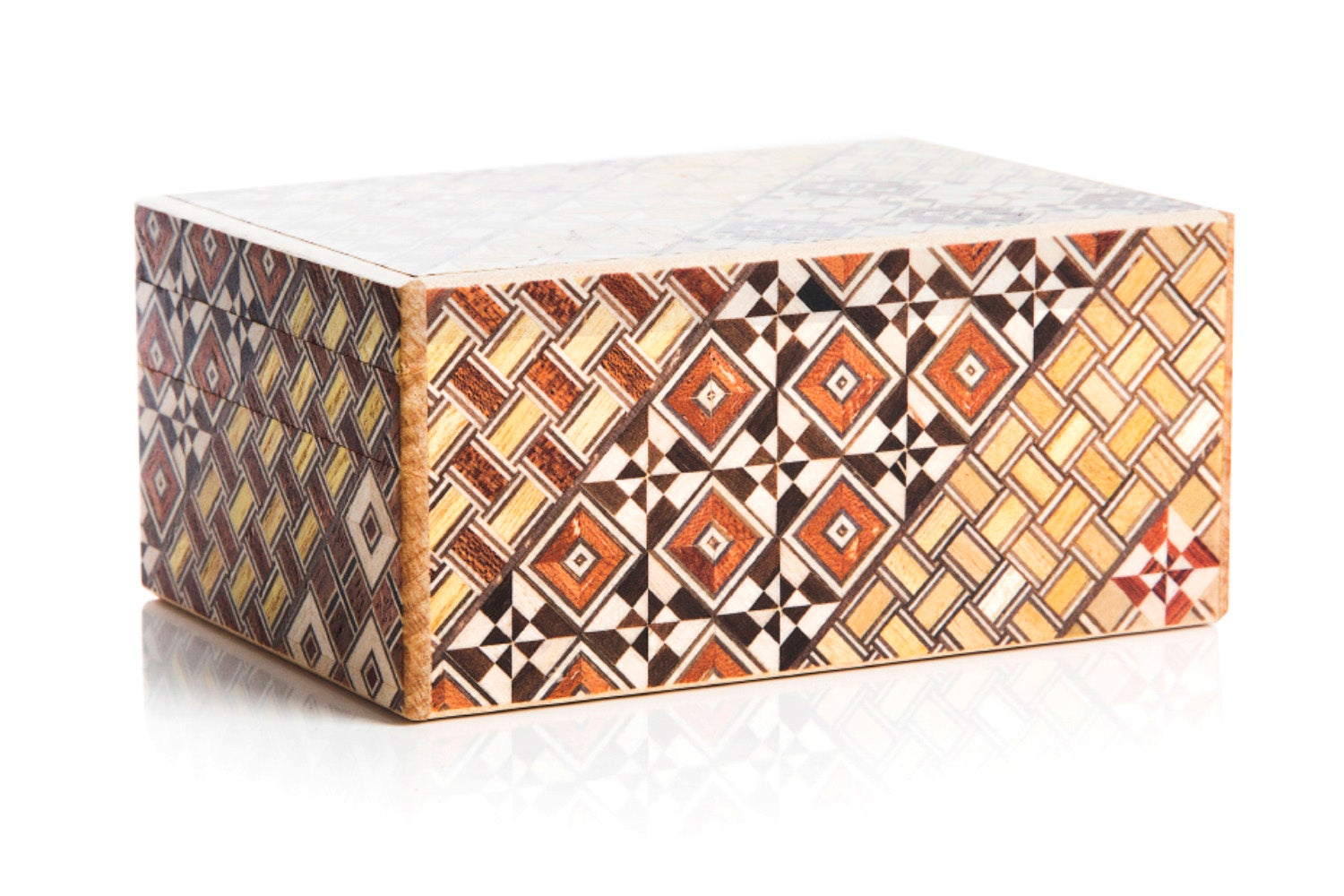
Let me settle the vocabulary first, because once it clicks, everything downstream becomes easy and lovely.
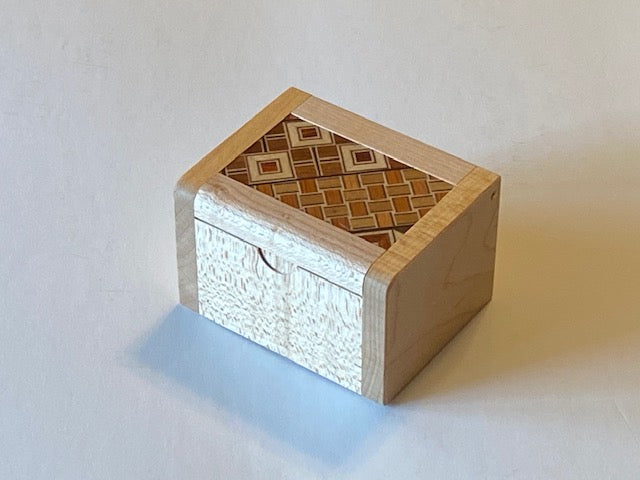
A himitsu-bako (秘密箱) literally means "secret box." It is a wooden box with no visible lock, no hinge, and no obvious lid — yet it opens, reliably and repeatably, once you discover the correct sequence of sliding panel moves. The seam is hidden inside the marquetry pattern, so the box looks like a solid decorative block until it suddenly, satisfyingly, is not.
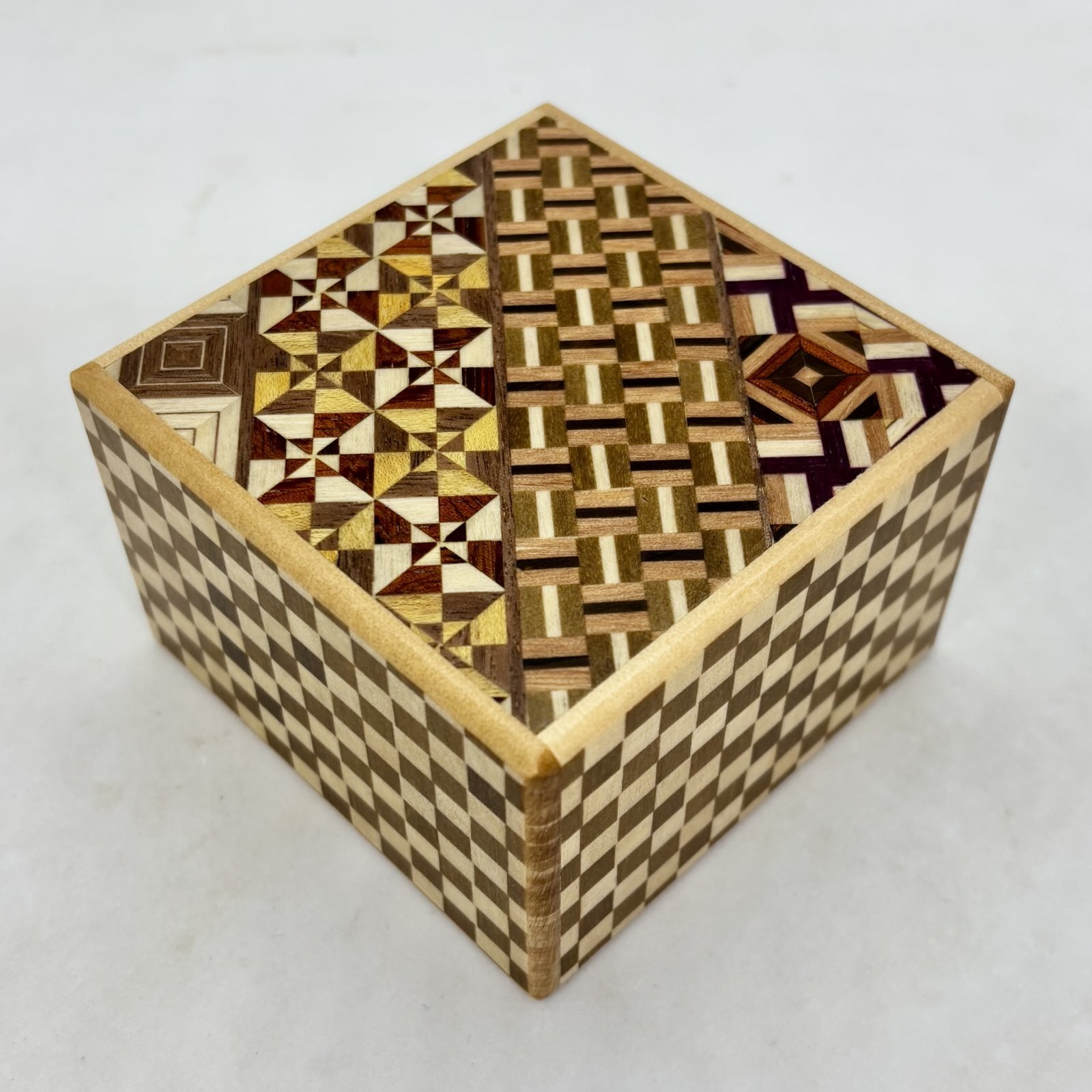
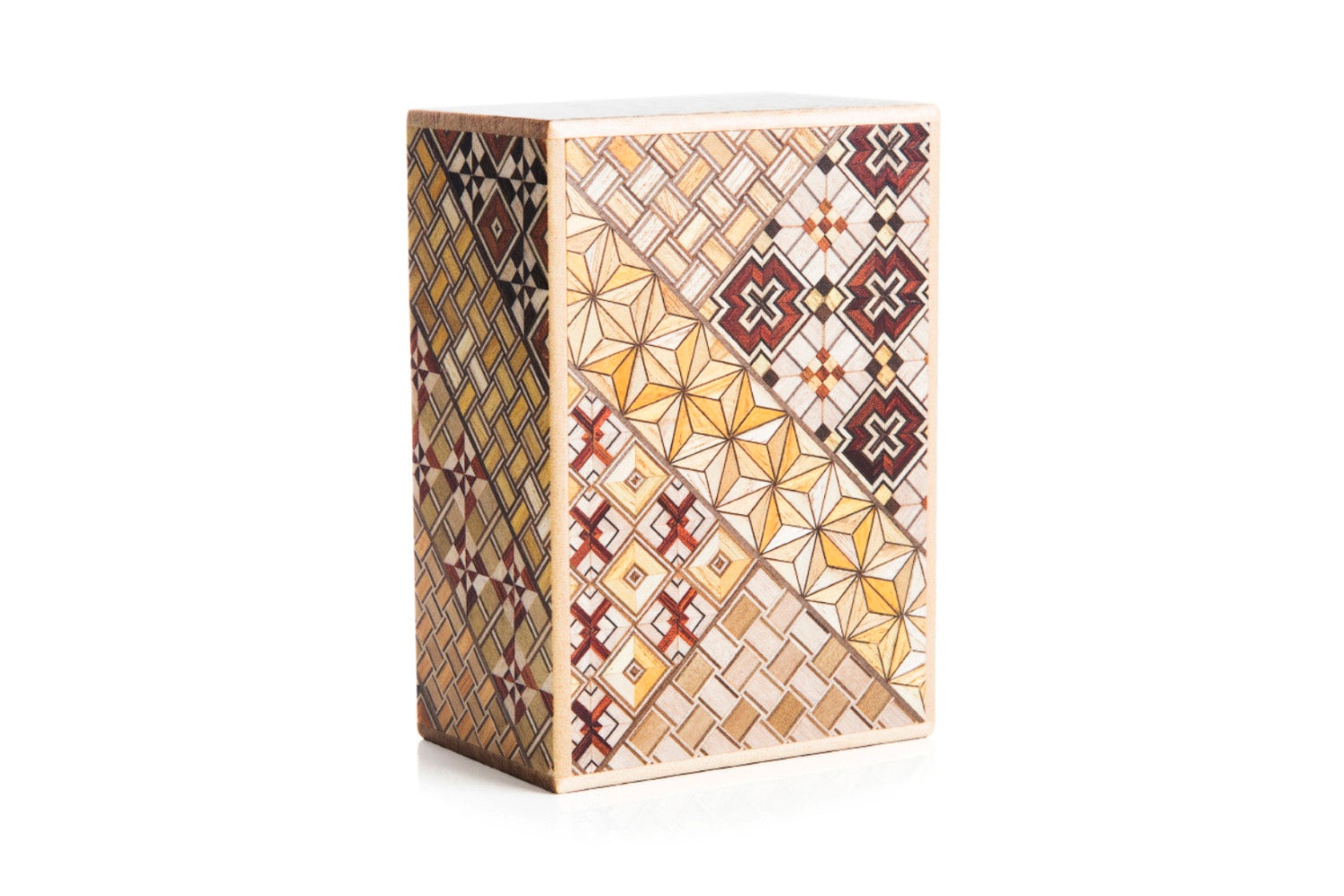
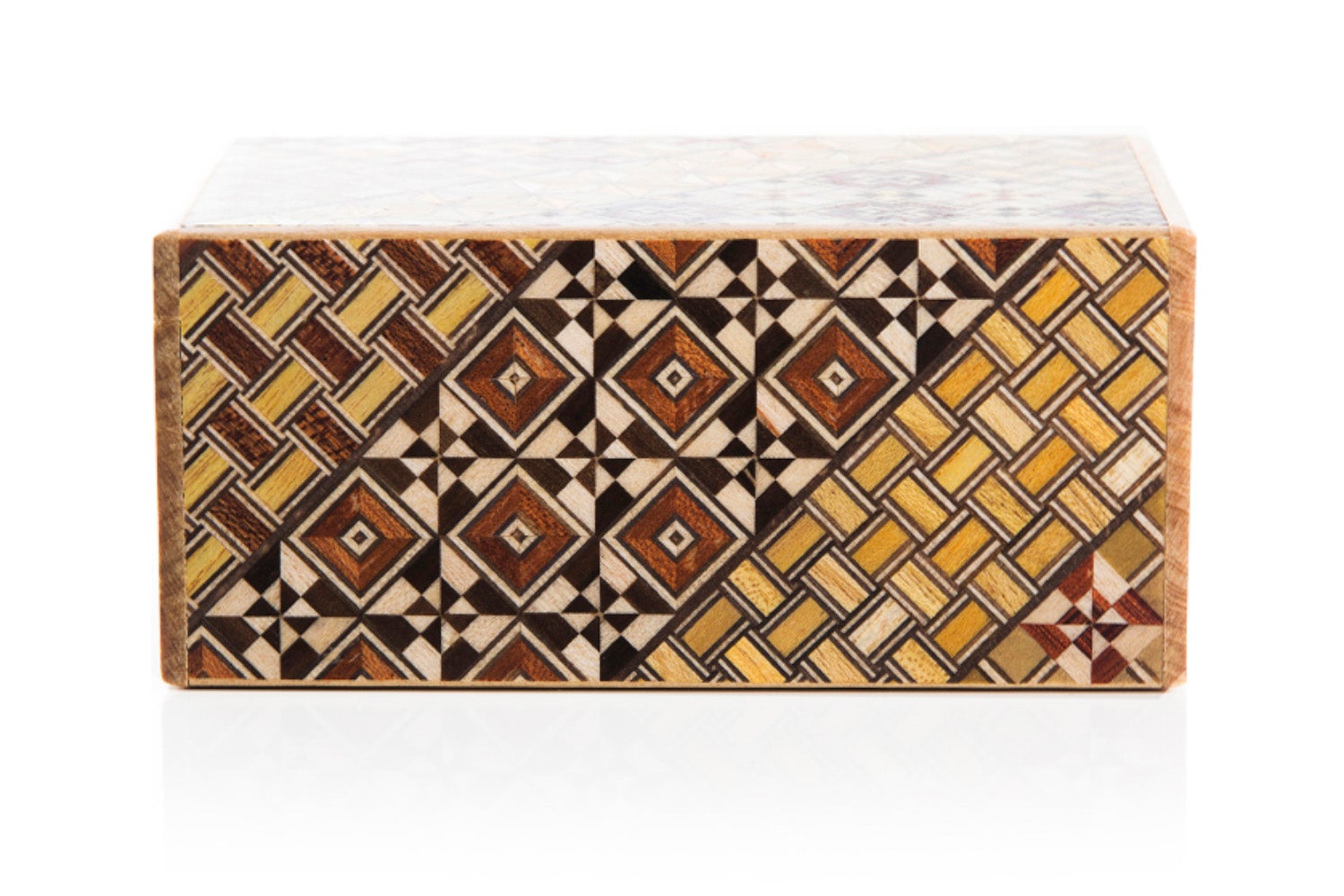
The surface decoration is yosegi (寄木細工, yosegi-zaiku) — Hakone's signature marquetry. Tiny rods of naturally different-coloured woods (no stain, no dye — that is the point of pride) are glued into a bundle whose cross-section forms a geometric motif, then that bundle is shaved into paper-thin sheets and applied to the box. So the mosaic you see is not painted on; it is the end-grain of dozens of assembled woods. (Izumiya / yosegijapan.com, japanesepuzzlebox.jp)
The hidden trick itself is karakuri (からくり) — an old Japanese word for "mechanism" or "contraption." Master Akio Kamei coined the modern phrase karakuri box ("trick box") to capture a newer, more inventive style that goes beyond the traditional slide-only secret box. (Boxes and Booze)
So here is the gracious way to hold it in your mind: a karakuri box and a himitsu-bako are the same physical object, described from two angles — himitsu emphasises the secrecy, karakuri emphasises the cleverness of the mechanism — and yosegi is the beautiful dress it wears. A traditional Hakone box is almost always all three at once.
You do not open a himitsu-bako. You are introduced to it — and it decides, move by move, whether to let you in.
Where did these little wonders come from? A Hakone bedtime story
Pour a little more tea; this part is my favourite to tell.
Hakone is a mountain hot-spring town near Mount Fuji that became, over centuries, the woodworking and souvenir district of Japan — a place travellers passed through and wanted to bring something home from. Craftspeople there refined the yosegi marquetry technique and the interlocking-puzzle tradition into something uniquely Hakone. (Karakuri Creation Group — about)
The secret box as we know it took shape in the late 19th century. Around the 1870s, Hakone craftsmen — the name Okawa Ryujiro (also rendered Takagoro Okawa) recurs in the histories — began marrying the yosegi skin to a hidden sliding mechanism, creating the himitsu-bako as a clever keepsake in which a traveller could tuck away valuables. (Japan Truly guide, Karakuri Creation Group)
For a long while these were charming souvenirs — beautiful, but bounded by tradition. Then, in the early 1980s, a master named Akio Kamei began designing novel secret-opening boxes, reviving an artform that was quietly dying and pushing it somewhere new — boxes with theme, narrative, and surprising mechanisms. To make sure that creative spirit outlived any one craftsman, he gathered fellow artisans into the Karakuri Creation Group around the turn of the millennium (the formal Karakuri Club followed, established 2005). They have held the global standard for inventive, gorgeous puzzle boxes ever since, in the shadow of Mount Fuji. (Boxes and Booze — Kamei, Boxes and Booze — KCG, Karakuri Creation Group)
How do you actually open one? Reading the move-count system

Here is the kindest thing about himitsu-bako: the difficulty is printed right on the label, as a step count (sometimes "moves"). Each "step" is one slide of one panel. A 5-step box is opened with five slides; a 27-step box needs twenty-seven, in the correct order; and the legendary monsters run into the hundreds and beyond.
The everyday range you will shop within is friendly:
- 2–5 steps — playful, near-instant; wonderful for children and gifts.
- 7–12 steps — the classic "first real box" feeling; a few minutes of delighted fiddling.
- 18–27 steps — a proper little puzzle; you will want to learn the rhythm.
- 50–72 steps — collector territory; the seam hides well and the sequence must be remembered.
- 100+ steps — artisan showpieces. The current crown belongs to the Karakuri Creation Group's 1,536-step mechanism (more on that beauty below). (vanishingincmagic.com, Japan Truly)
Two sizing words to know while you shop. Boxes are measured in sun (寸), a traditional Japanese unit of about 3 cm — so a "5 sun" box is roughly 15 cm on its long side, a "1 sun" box is a tiny ~3 cm jewel. And "mame" (豆, "bean") marks the miniature boxes — astonishingly, an 18-step mechanism can be packed into a box just 43 × 30 × 27 mm. (japanesepuzzlebox.jp 5-sun, japanesepuzzlebox.jp 1-sun mame)
The motion itself is meditative: you press a face, feel a panel give a few millimetres, slide it, and that unlocks the next panel — a cascade, each move earning the one after it, until the lid floats free and reveals the little felt-lined chamber within.
Each move earns the next. That is the whole gentle philosophy of the box, and very nearly a philosophy for living.
The Karakuri Creation Group: an annual ritual worth understanding
If the souvenir box is the welcoming front porch of this hobby, the Karakuri Creation Group (KCG) is the candlelit inner room — and I would be a poor hostess not to walk you in.
The KCG is a collective of Hakone artisans — Akio Kamei, Hiroshi Iwahara, Hideaki Kawashima, Hiroshi Iwahara, Daiki Arimura and others — who design original, limited-run karakuri boxes that go far beyond the traditional slide. Their pieces tell stories: a box shaped like an egg, a mushroom, a die, a church, a light bulb that "lights" as it opens. The group keeps, in collectors' words, the "global standard for high quality, innovative and beautiful puzzle boxes." (Boxes and Booze — KCG)
The part that makes hearts race is the Karakuri Club membership. For an annual fee (around 12,500 yen, roughly $120, with a small first-year surcharge that includes the Karakuri Art Works book), members receive a mystery holiday box each year — its design unknown until it arrives — and gain entry to lotteries for new limited-edition releases throughout the year. Worldwide shipping is included. Winning a lottery slot lets you buy that limited box; not winning means you wait, and yearn, and try again. (Puzzle Ramblings / fivesinatras.com, Karakuri Creation Group)
The annual Christmas/holiday boxes are famous for selling out within a month, and members come back year after year. One collector affectionately calls it "another crack habit" — said, of course, with the deepest fondness. (Search summary, Karakuri Creation Group culture)
Why do prices swing from $30 to over $1,000?
A perfectly fair question to ask before you spend, and I will answer it plainly while the tea steeps.
The low end (~$30–$90) is the traditional Hakone himitsu-bako: machine-assisted-but-hand-finished, naturally-coloured yosegi, 4–27 steps, made in the established workshops (OKA CRAFT's Hiroyuki Oka, Izumiya, Hakone Maruyama, and the souvenir shops of Hakone-Yumoto and Gora). A genuine, lovely, real box lives here. Hakone shop prices run from about ¥2,000 for the smallest up to ¥30,000+ for larger pieces. (japanesepuzzlebox.jp, JOC Japan Travel, Hakone Maruyama)
The middle (~$90–$300) is where the Karakuri Creation Group's standard designs sit — original, story-driven, limited-run boxes by named artists. You are paying for invention and a signature, not just step-count. (Puzzle Box World, Kubiya Games)
The top ($600–$1,500+) is the rarefied air of mathematically-derived showpieces and tiny limited editions: Hiroshi Iwahara's Super CUBI family and his Quaternary Box, whose surface yosegi literally spells the formula for its own solution. These are signed, numbered, and often sold by lottery. (Kubiya Games — Quaternary Box, Karakuri Creation Group — Quaternary)
So the price ladder is really three things stacked: tradition at the bottom, artistry and rarity in the middle, and mathematical bravura plus limited supply at the top. None is "better" — they are different pleasures, and a happy collection holds boxes from all three. ❀
Yumi's hand-picked boxes, from first-timer to grail
And now the part I have been saving, like the prettiest sweet for last. ❀ Below are boxes I would actually press into a guest's hands, arranged so there is something for every budget and every stage of falling-in-love. Each is a real, verified piece from a trusted seller; prices are as listed at time of writing and, with the artisan boxes especially, do come and go (so many are sold out the moment they appear — that is the nature of the craft). Find the full picks, comparison table, and FAQ just below.
What experienced tables keep reporting
Recurring owner patterns, synthesized in Puzzlewick's words. Follow each evidence trail to read the original discussion.
Karakuri are not 'just' anything: even at their least compelling, they are beautiful examples of woodworking.
everyone will recognize that Karakuri boxes are of amazing quality.
The Karakuri Creation Group of puzzle box artisans are beloved for their fanciful secret opening boxes, which are often quite magical.
Read the evidence: Boxes and Booze — Karakuri Creation Group
His work is prized for its novelty, beauty and ingenuity.
The picks
Some links below are affiliate links — as an Amazon Associate, Puzzlewick earns from qualifying purchases, at no extra cost to you. It never changes a pick.
 4 photos
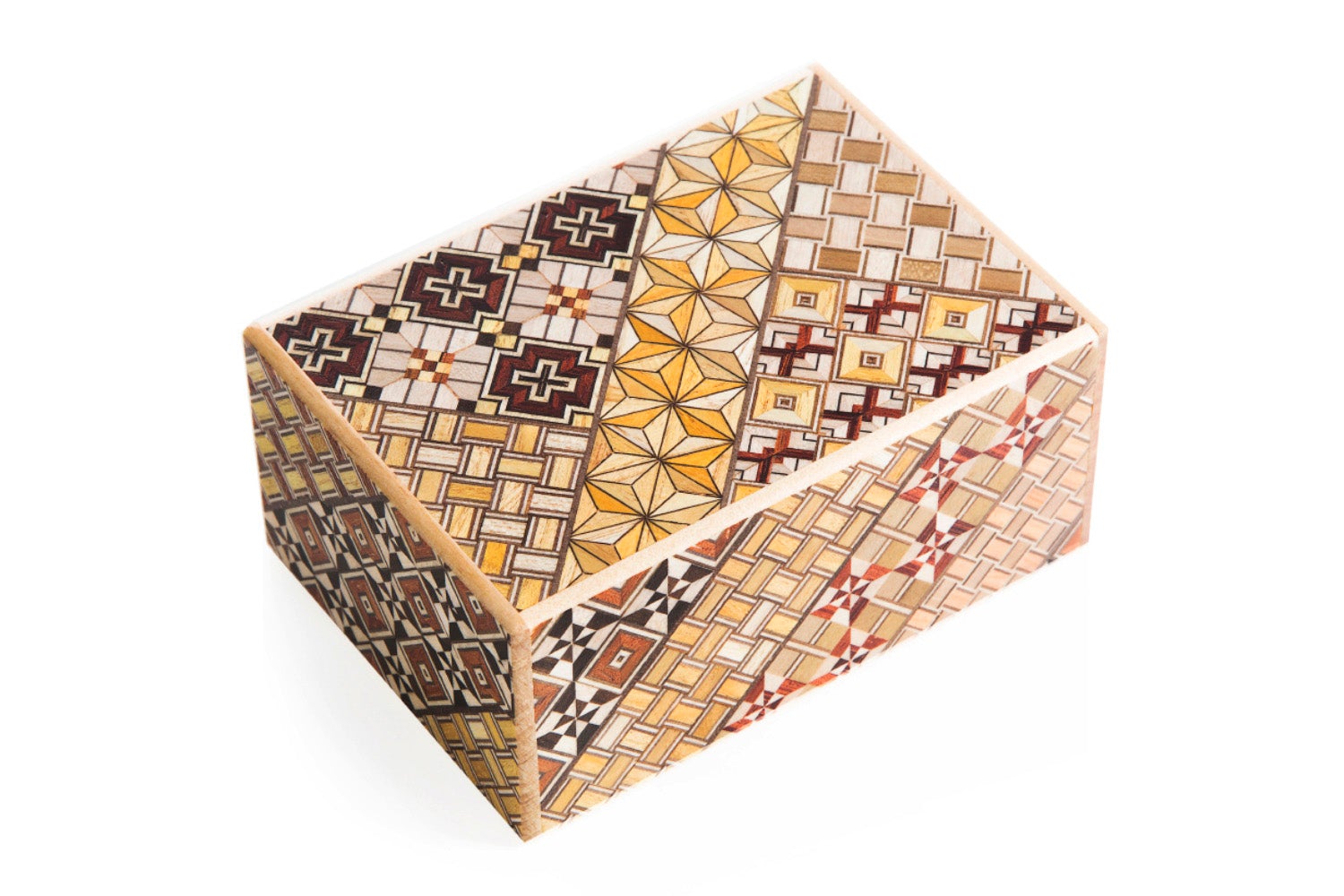
 Japanese Secret Puzzle Box 4 sun 10 steps - Himitsu Bako
If you let me choose for you, treasured guest, it would be this. A 4-sun box (about 12 cm) is just the right size to cradle in two hands, ten steps is enough to feel clever without ever feeling stuck, and the natural yosegi is genuine Hakone marquetry. It solves in one happy sitting and then holds a secret note forever. The most universally lovable box on this whole tray. ❀
- Ideal 10-step difficulty — satisfying, never frustrating
- Generous 4-sun size sits beautifully in the hand
- Genuine natural-wood yosegi, co-branded with a named master
- Slightly pricier than a bare souvenir box
- Stock comes and goes
 2 photos
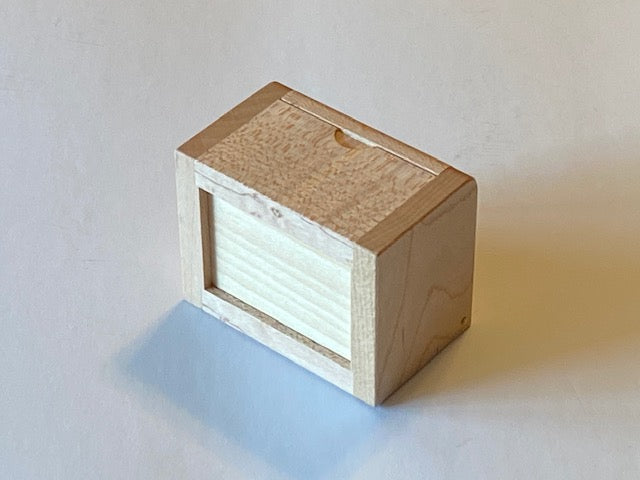
 Karakuri Fake (Trap) Japanese Puzzle Box
Oh, this one is cheeky. A single step — "but this box will not open like you think!" A genuine Karakuri Creation Group design at the friendliest possible price, it is the boxes' sense of humour distilled into one little gotcha. The ideal way to meet the group's playfulness before you commit to a pricier piece. A delight to spring on a confident friend. (。•̀ᴗ-)✧
- Authentic Karakuri Creation Group design
- Lowest-cost entry to the artisan world
- A genuinely funny, surprising single-move trick
- Only one step — a joke, not a long puzzle
- Small and simple by design
 4 photos
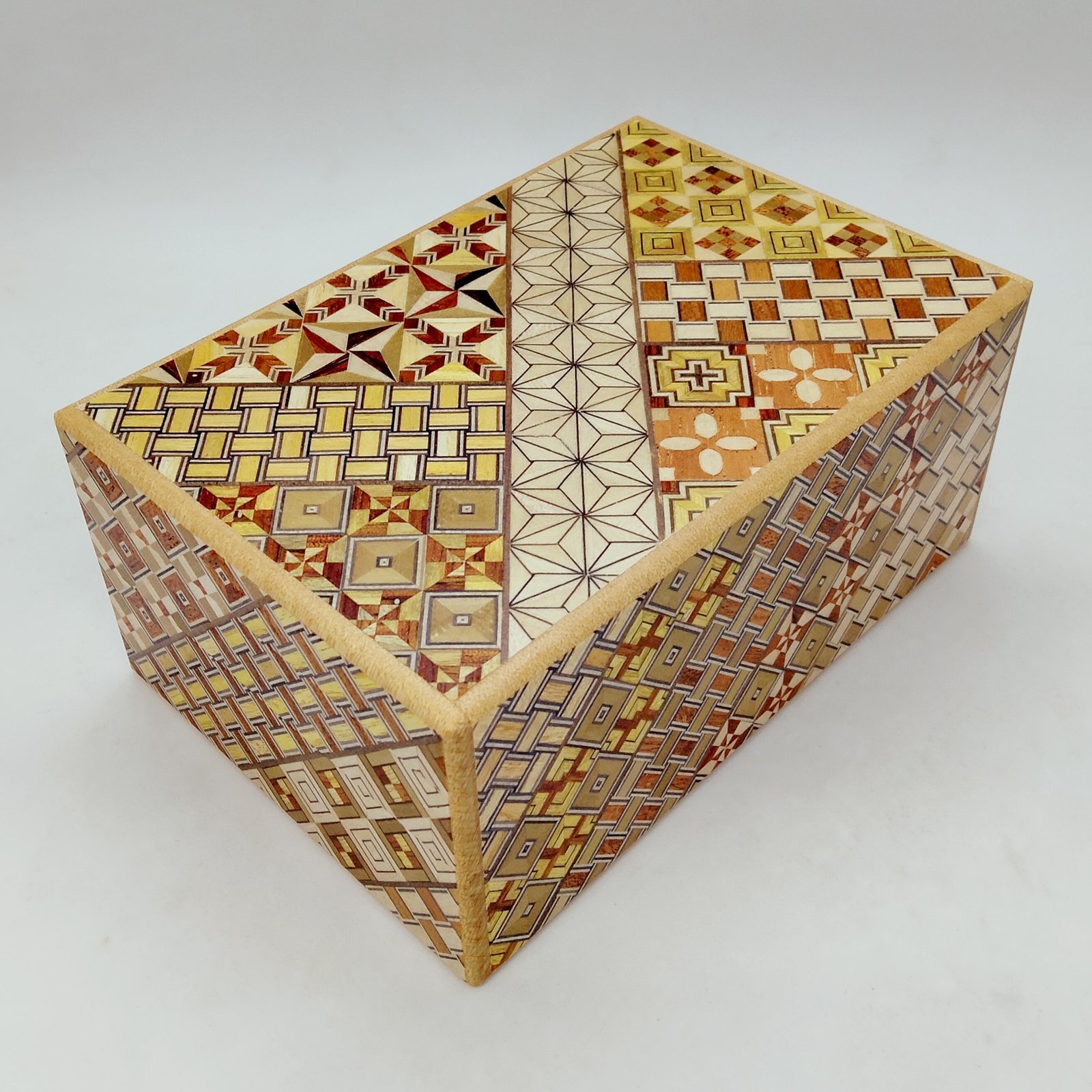
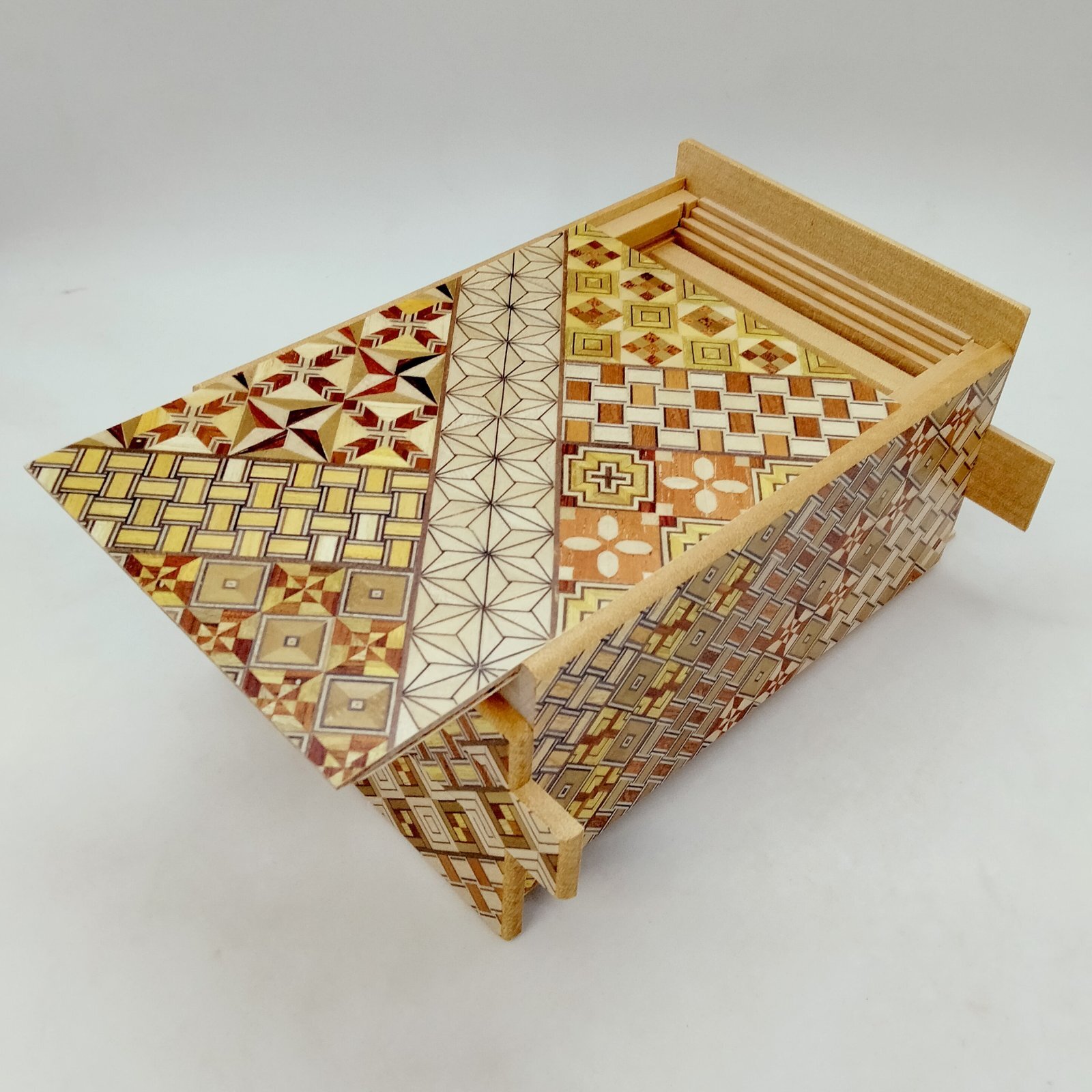
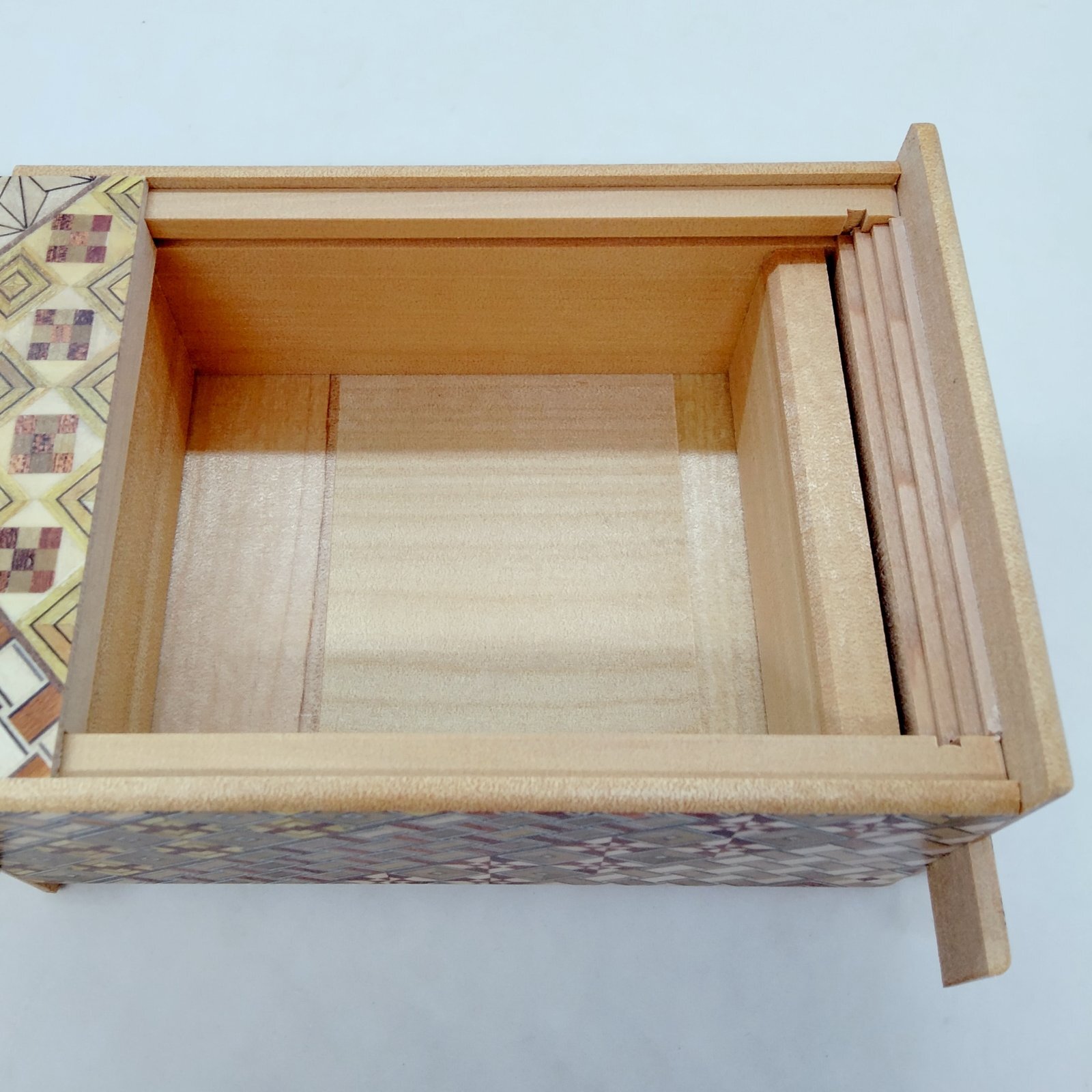
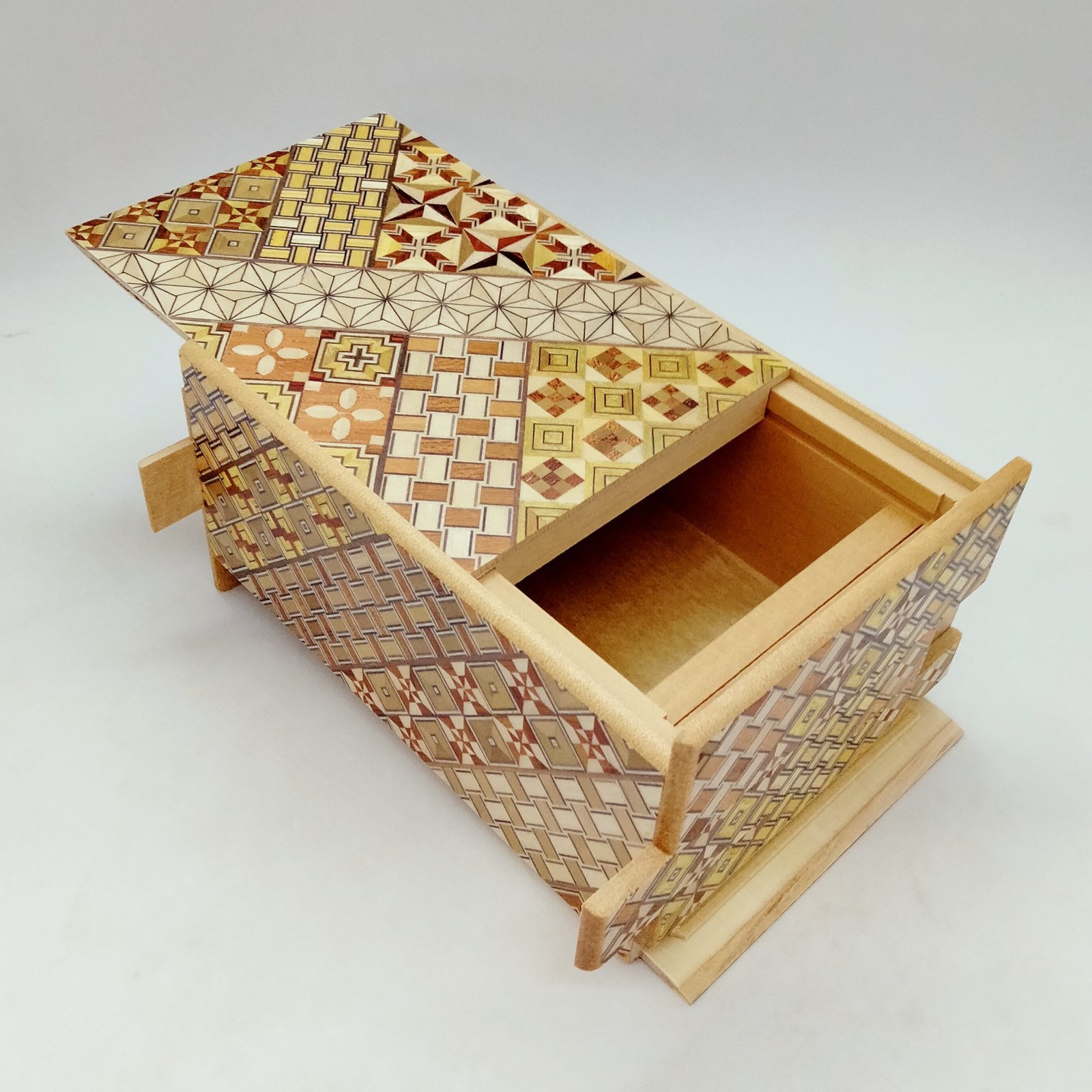
 27 steps Yosegi 5 sun Japanese puzzle box Himitsu-bako
When your first box no longer surprises you, come back for this one. A full 5-sun (15 cm) box with four moving panels and two slide keys across 27 steps — long enough that you will want to learn its rhythm, large enough to display proudly. This is the box that turns a curious dabbler into someone who collects. The yosegi is exquisite and the size makes the marquetry sing. ❀
- Meaty 27-step sequence with slide keys
- Substantial 5-sun display size
- Master-made traditional construction
- A real jump in price from beginner boxes
- Limited workshop stock
 4 photos
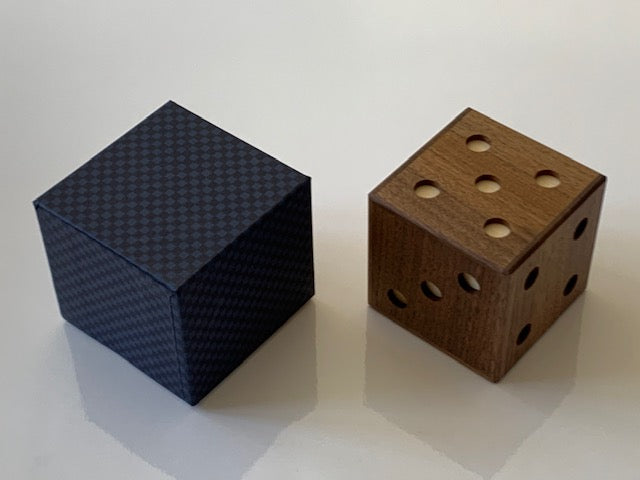
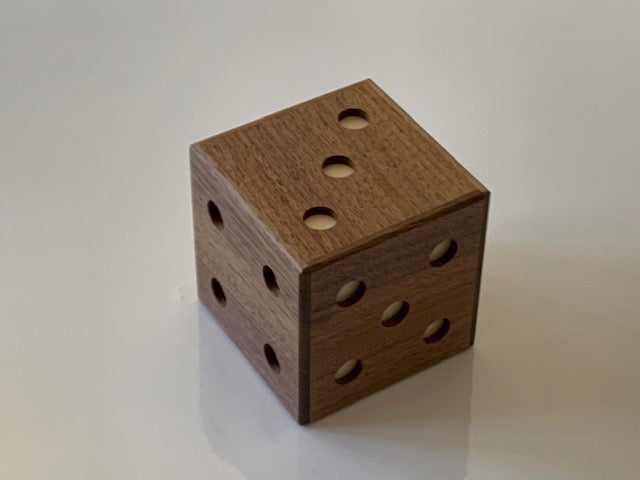
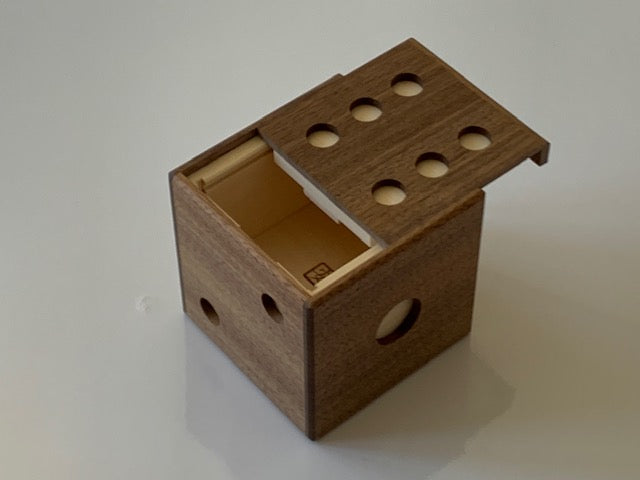
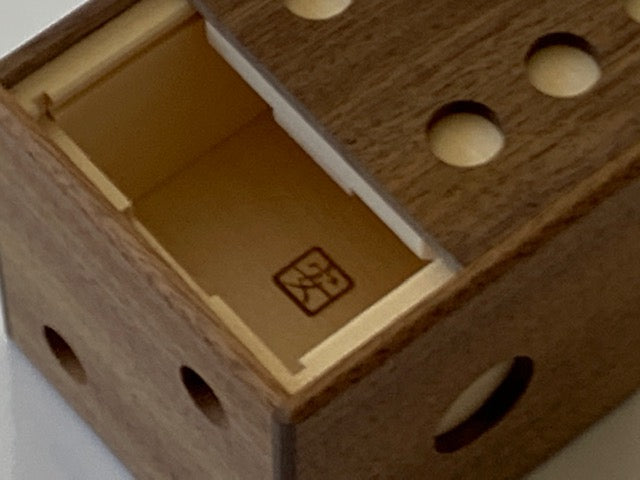
 Dice Japanese Trick Box by Akio Kamei
To hold an Akio Kamei design is to hold the hand that revived this entire artform. His Dice box looks like an oversized die and opens with the founder's signature wit and grace — story, surprise, and impeccable woodwork in one tidy cube. If you want a single box that means something about the craft's modern history, let it be a Kamei. A centrepiece for any parlour. ❀
- Designed by the founder of the Karakuri Creation Group
- Playful, recognisable die form
- Carries genuine art-historical significance
- Mid-tier collector pricing
- Frequently on/off stock — limited runs
At a glance
| box | maker | moves | price | best for |
|---|---|---|---|---|
| Karakuri Fake (Trap) | Karakuri Creation Group | 1 | $47.95 | Cheapest authentic Karakuri / a witty gotcha |
| The knock box (5 steps Yosegi/Ichimatsu) | Hiroyuki Oka (OKA CRAFT) | 5 | $89.90 | Gifts, kids, all-ages first solve |
| Japanese Secret Puzzle Box 4 sun 10 steps | Kubiya / Kenji Nakazato | 10 | $84.00 | The ideal first box |
| Church Puzzle Box | Hiroshi Iwahara (KCG) | — | $139.95 | Story-driven sculptural Karakuri |
| Dice Trick Box | Akio Kamei (KCG) | — | $164.95 | A piece by the founder |
| 27 steps Yosegi 5 sun | Hiroyuki Oka (OKA CRAFT) | 27 | $186.90 | Stepping up to a proper puzzle |
| Super CUBI 324 Step (Muku, Ltd.) | Hiroshi Iwahara (KCG) | 324 | $1,448 | Serious collector's showpiece |
| Quaternary Box (1,536 Step) | Hiroshi Iwahara (KCG) | 1,536 | $1,448 | The world-record grail |
Questions, answered
What is the difference between a himitsu-bako, a karakuri box, and a yosegi box?
They describe the same family of object from different angles. Himitsu-bako (秘密箱, "secret box") names the box by its secrecy; karakuri (からくり) names it by its hidden mechanism; and yosegi (寄木細工) is the geometric marquetry decorating the surface. A traditional Hakone box is usually all three at once — a yosegi-skinned himitsu-bako whose karakuri you must solve. The term "karakuri box" was popularised by master Akio Kamei for the more inventive modern style.
How do Japanese puzzle boxes open?
By a sequence of small sliding moves, not a lock or hinge. You press and slide hidden panels in a specific order; each correct move releases the next, until the lid slides free and reveals a storage chamber inside. The seam is concealed within the marquetry, so the box looks solid until solved. The sequence is reversible — to close and re-lock it, you run the moves backwards.
What does the 'step' or 'move' count mean, and how hard is it really?
Each step is one slide of one panel. A 5-step box needs five slides; a 27-step box needs twenty-seven in the right order. Beginners are happiest at 4–12 steps (minutes of fun). 18–27 steps is a proper little puzzle; 50–72 steps is collector territory; and 100+ is artisan showpiece territory. The world record is 1,536 steps, held by the Karakuri Creation Group's Quaternary Box.
What does 'sun' mean when sizing a puzzle box?
Sun (寸) is a traditional Japanese unit of roughly 3 cm. So a 5-sun box is about 15 cm on its longest side, and a 1-sun box is a tiny ~3 cm jewel. You will also see 'mame' (豆, 'bean') for miniatures — remarkably, an 18-step mechanism fits in a mame box just 43 × 30 × 27 mm.
Where are real Japanese puzzle boxes made, and how do I avoid fakes?
Genuine himitsu-bako come from Hakone, Japan — the hot-spring district near Mount Fuji — from workshops like OKA CRAFT (Hiroyuki Oka), Izumiya, Hakone Maruyama, and the Karakuri Creation Group. True yosegi uses naturally-coloured woods; if you see garish dyed colours or printed-paper veneer, it is a mass-market lookalike, not a real Hakone box.
Why are some boxes $30 and others over $1,000?
Three tiers. Traditional Hakone souvenir/keepsake boxes (4–27 steps) run roughly $30–$90 and are genuine, lovely starter pieces. Karakuri Creation Group standard designs — original, story-driven, signed, limited-run — sit around $90–$300. And mathematically-derived grails like Hiroshi Iwahara's Super CUBI and Quaternary Box run $600–$1,500+, reflecting extreme complexity, signatures, and tiny limited supply.
What is the Karakuri Creation Group, and should I join the club?
The Karakuri Creation Group is a collective of Hakone artisans (Akio Kamei, Hiroshi Iwahara, Hideaki Kawashima, Daiki Arimura and others) making original, limited-run karakuri boxes. Club membership (around 12,500 yen / ~$120 a year) sends you a mystery holiday box annually and gives lottery access to new limited releases, with worldwide shipping. Join for the once-a-year ritual and thrill — but you do not need membership to buy KCG boxes, which trusted retailers stock outright. Start by buying a couple of boxes first.
What is the most complicated Japanese puzzle box ever made?
Hiroshi Iwahara's Quaternary Box of the Karakuri Creation Group, which opens in 1,536 carefully-ordered moves — the recorded record. It uses a base-4 (quaternary) mechanism, and its surface yosegi (by Eiji Shinoda) encodes the solving formula 2 × 4⁴ × 3. It descends from his 'King Cubi,' designed for the 2010 International Puzzle Party.
How should I care for a wooden puzzle box?
Keep it out of direct sun and away from radiators and humidity swings — it is solid natural wood with millimetre tolerances. In humid weather panels may stiffen; in dry weather they loosen and glide. Never force a panel that resists; wait for a drier or more humid day instead. An occasional light wipe with a dry cloth is all the cleaning it needs — no oils or polish on the yosegi.
Yumi's verdict
And so we come to the bottom of the pot, dear guest. ❀ Here is what I would leave you with: do not agonise over the perfect first box — simply choose a genuine Hakone himitsu-bako in the 4-to-12-step range, somewhere between $40 and $90, and let it teach you with its own quiet patience. Tuck a little note inside, slide it shut, and hand it to someone you love. Whether you stop there with one lovely keepsake or tumble all the way down to a 1,536-step Iwahara grail, you have joined a 150-year-old conversation between hand and wood that began in the shadow of Mount Fuji — and you are so very welcome in it. The door to the parlour stays open; come back anytime and tell me which box you chose. いってらっしゃい — go gently, and enjoy. (´。• ᵕ •。`) ❀
Research ledger 22 sources · reviewed 2026-07-17
Specifications, rules, current product information, community experience, and contrary evidence were checked against the sources below. Commercial links are kept separate from editorial evidence.
- karakuri.gr.jpkarakuri.gr.jp/en/about-kgc
- karakuri.gr.jpkarakuri.gr.jp/en/craftsman/kcg
- karakuri.gr.jpkarakuri.gr.jp/en/products/rf-79
- boxesandbooze.comboxesandbooze.com/akio-kamei
- boxesandbooze.comboxesandbooze.com/karakuri-creation-group
- fivesinatras.comfivesinatras.com/2020/09/11/karakuri-creation-group
- japanesepuzzlebox.jpjapanesepuzzlebox.jp/product/334
- japanesepuzzlebox.jpjapanesepuzzlebox.jp/product/98
- japanesepuzzlebox.jpjapanesepuzzlebox.jp/product/83
- kubiyagames.comkubiyagames.com/products/japanese-secret-puzzle-box-4-sun-10-steps-himitsu-bako
- kubiyagames.comkubiyagames.com/products/quaternary-box-1-536-step-karakuri-puzzle-box
- kubiyagames.comkubiyagames.com/collections/karakuri-puzzle-boxes
- puzzleboxworld.compuzzleboxworld.com/collections/karakuri-trick-boxes
- puzzleboxworld.compuzzleboxworld.com/products/karakuri-fake-trap-japanese-puzzle-box
- samuraistore.comsamuraistore.com/products/yosegi-hk007
- yosegijapan.comyosegijapan.com/whats-yosegi
- yosegijapan.comyosegijapan.com/japanese-puzzle-box
- jocjapantravel.comjocjapantravel.com/kanto-kanagawa-hakone-himitsu-bako
- hakonemaruyama.comhakonemaruyama.com
- vanishingincmagic.comvanishingincmagic.com/puzzles-and-brainteasers/articles/what-is-a-japanese-puzzle-box
- shop.japantruly.comshop.japantruly.com/blogs/learn/japanese-puzzle-boxes
- market.cubicdissection.commarket.cubicdissection.com/search/?category_slug=puzzle-boxes
Come in, take your shoes off — let me show you something.
Keep exploring
The next smart rabbit holes.
❖ Topic PathMechanical Puzzles: compare the whole shelfThe right mechanical puzzle matches the solver's patience, not simply the maker's difficulty number. These guides translate...ReviewKarakuri Egg Puzzle Box by Akio Kamei: The Japanese Artisan Grail That Collectors Camp ForOne hour of pure mechanical poetry. A cherry-wood egg that whispers its secrets if you listen.Buying GuideSiebenstein-Spiele Wooden Puzzle Boxes: Difficulty Levels & Starter GuideFrom German laser-cut craft to puzzles that reward patience over brute force—a curator's roadmap for choosing your first Siebenstein box.