How to Solve a Japanese Puzzle Box: A Beginner's Guide (2026)
Come sit and stay awhile—let me show you the himitsu-bako, these Hakone secret boxes that wait so gently for your patient hands to learn their quiet language.

AI-assisted curator persona · research and editorial responsibility: Robert Pruitt · how this guide was made
Last editorial refresh: 2026-06-13 Gold-standard QA: 2026-07-17 22 sources reviewed Affiliate links checked during gold-standard pass

The short answer
A Japanese puzzle box — a himitsu-bako, or 'secret box' — is a small wooden box from the Hakone region of Japan that has no visible hinge, lock, or latch. It opens only when you slide a hidden sequence of its panels in the correct order and direction. The mechanism is purely mechanical and made of wood: the box's faces are not solid but are thin sliding panels held in place by internal wooden keys and tongues. Sliding the first correct panel a few millimetres unlocks a second panel, which unlocks a third, and so on around the box until the lid finally slides free. Boxes are rated by 'steps' — the number of moves needed — commonly 7, 10, 12, 21, 27, or even 54 and beyond. To solve one, you handle it gently and hunt for the single panel that has a little 'play,' slide it fully to its stop, then look for the next loosened panel and repeat. The cardinal rule is to never force anything: if a panel resists, it is simply not its turn. To close the box, you reverse the exact sequence. Most boxes ship with a solution sheet, so you are never truly stranded.
Decision map
Choose in thirty seconds
The ideal first box — palm-sized, genuinely solvable in an evening
An authentic Hakone-direct first box at a gentle price (~¥4,180)
A beautiful step up once 7 steps feels easy
Come in, come in — set down your coat and let me pour you something warm. On the table between us sits a small wooden block, no larger than your palm, its surface a glittering mosaic of honey, walnut, and pale gold. It looks like a finished thing, a little jewel with nowhere to go. And yet it is a door. Somewhere inside that geometry is a hollow room waiting for a ring, a folded note, a single pressed flower — and the only key is your own patience.
These are himitsu-bako, the 'secret boxes' of Hakone, and I have watched so many guests meet their very first one. Almost all of them do the same thing: they turn it over twice, press a corner, and look up at me a little embarrassed, certain they're about to break it. So let me tell you the very first secret — you are not going to break it, and you are not behind. The box was made to be discovered slowly. It rewards the quiet hand, not the strong one.
In the pages ahead, I will introduce you properly. We will learn what these boxes are and where they come from — the Edo-era carpenters of Hakone, the dazzling yosegi marquetry that dresses them, the way artisans count their difficulty in 'steps.' Then I will teach you the method itself: how the sliding panels actually move, how to find that elusive first move by feel, how to work your way around the box, how to close it again, and the one thing you must never do. We will choose you a first box together, and I will name you a few of the great living makers whose hands you will come to recognize.
There is no clock here. Settle in by the lamplight, take the box in both hands, and let us begin to listen to it together.
Start here, then go deeper
You are in the right cabinet.
 ⌂ Topic PathFamily and Gateway Games: compare the whole shelfA good family game gets everyone playing quickly without becoming disposable after three nights. These guides prioritize clear...
 ReviewKarakuri Egg Puzzle Box by Akio Kamei: The Japanese Artisan Grail That Collectors Camp ForOne hour of pure mechanical poetry. A cherry-wood egg that whispers its secrets if you listen.
 Beginner's GuideJapanese Puzzle Boxes Explained: Karakuri, Yosegi & Himitsu-bakoA wooden box from Hakone that whispers secrets back — open it only if you're patient enough to listen. Three beautiful words: 寄木細工...
What exactly is a himitsu-bako, and where does it come from?
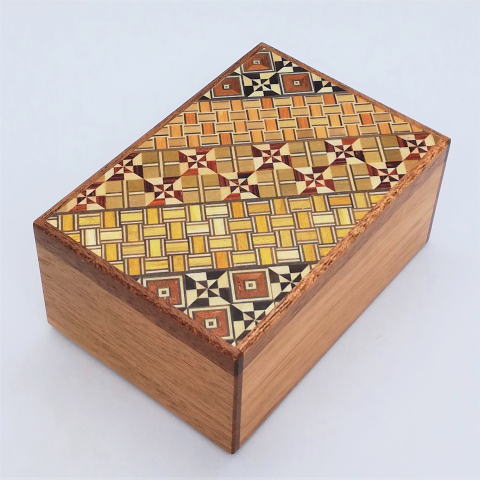
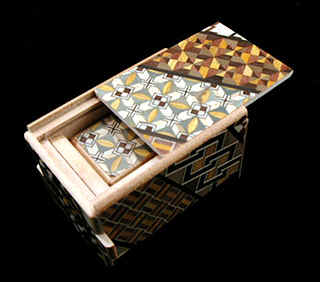
Before we open anything, let me set the box in its proper light — because half the pleasure of solving one is knowing whose tradition you are holding.
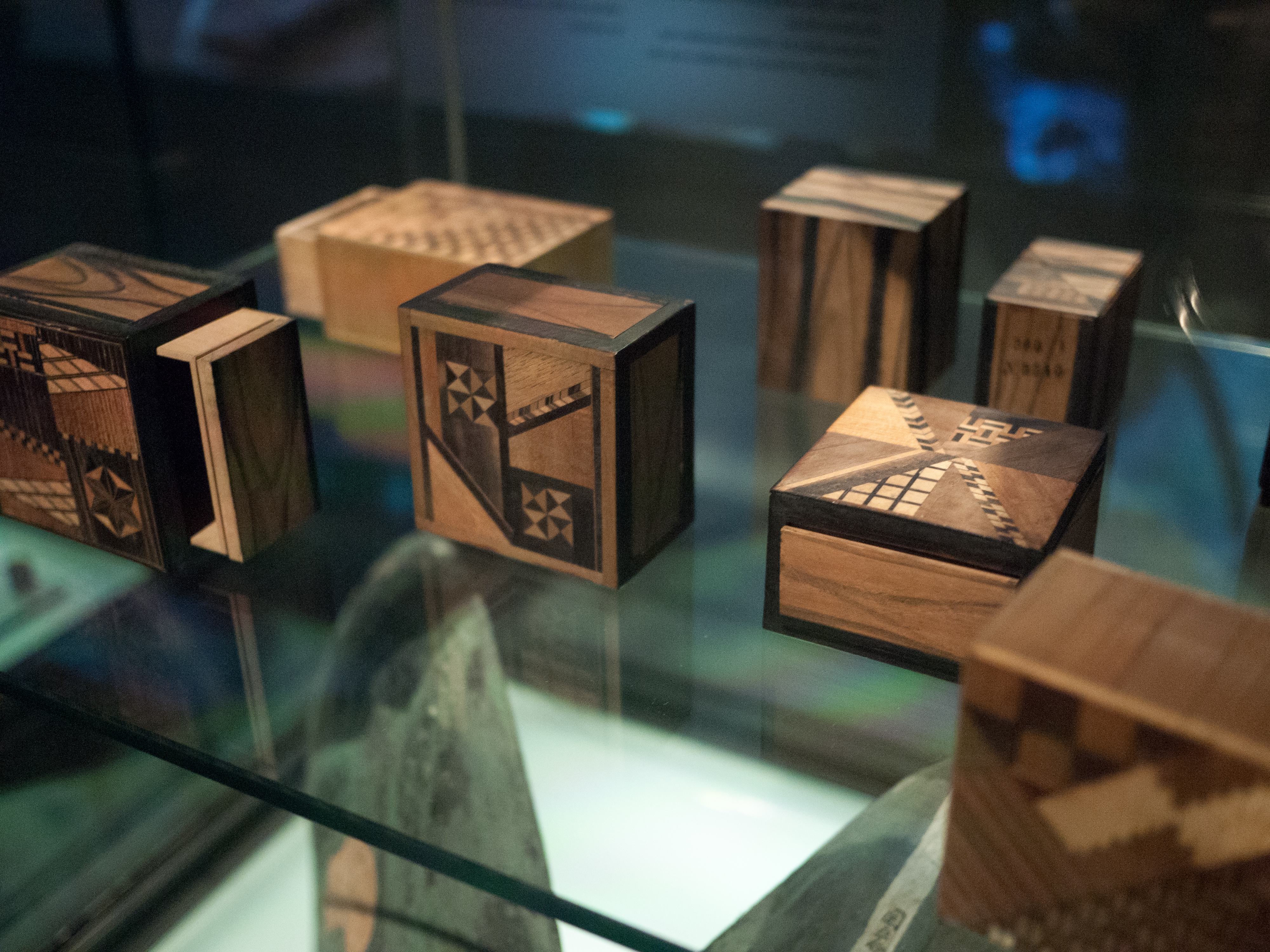
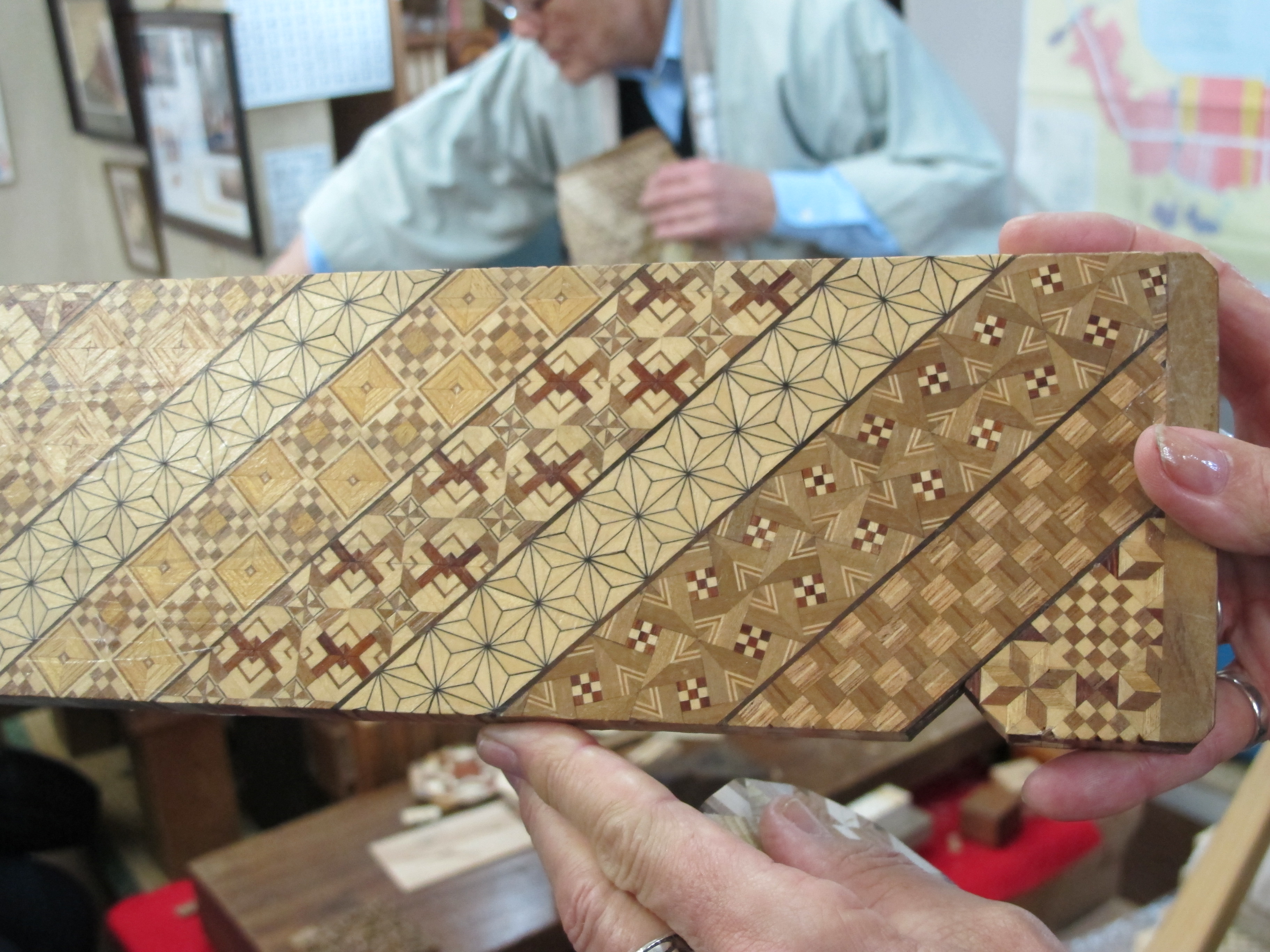
A himitsu-bako (秘密箱) literally means 'secret box.' It is a wooden box, usually a tidy rectangular block, that conceals a storage compartment behind its own faces. There are no metal hinges, no springs, no keyholes. What looks like a solid side is in fact a thin sliding panel, and the box opens only when you move a specific series of these panels in the right order and direction. When the final panel slides, the lid lifts away and the hidden chamber is revealed.
The craft was born in Hakone, a hot-spring resort town in the mountains south of Tokyo, in the Odawara district of Kanagawa. The marquetry technique that dresses the boxes — yosegi-zaiku — was developed in the late Edo period by a Hatajuku carpenter named Nihei Ishikawa (1790–1850). The secret-box mechanism itself came later: most accounts credit a craftsman named Okawa Ryugoro (also written Takagoro Okawa) with creating the first true himitsu-bako in the 1870s–1890s, as a clever keepsake to sell to the travelers and pilgrims passing through. The form was refined through the Meiji period (1868–1912) into the boxes we recognize today. There is, charmingly, no original master drawing of these mechanisms — they were passed hand to hand, workshop to workshop, which is part of why each maker's boxes have their own personality.
A few words you will meet again and again:
- Sun (寸) — the traditional Japanese unit used to size these boxes. One sun is roughly 3 cm (about 1.2 inches). A '4 sun' box is about 4 sun on its longest side — a comfortable palm-sized box. Larger sun numbers mean larger boxes (and usually room for more elaborate mechanisms).
- Steps (回) — the number of distinct moves required to open the box. This is the box's difficulty rating, and you will see it printed right in the name.
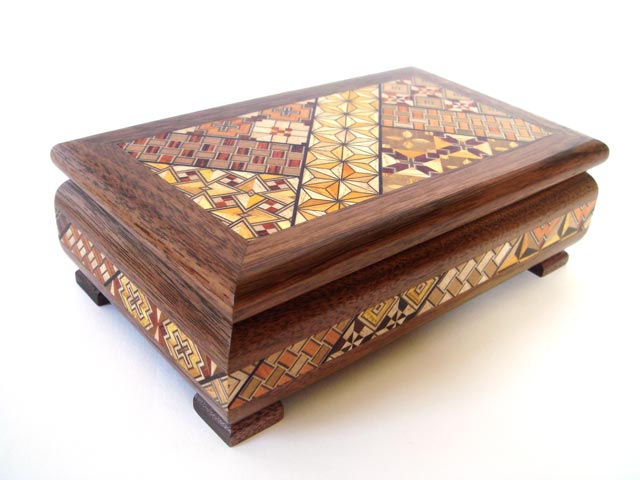
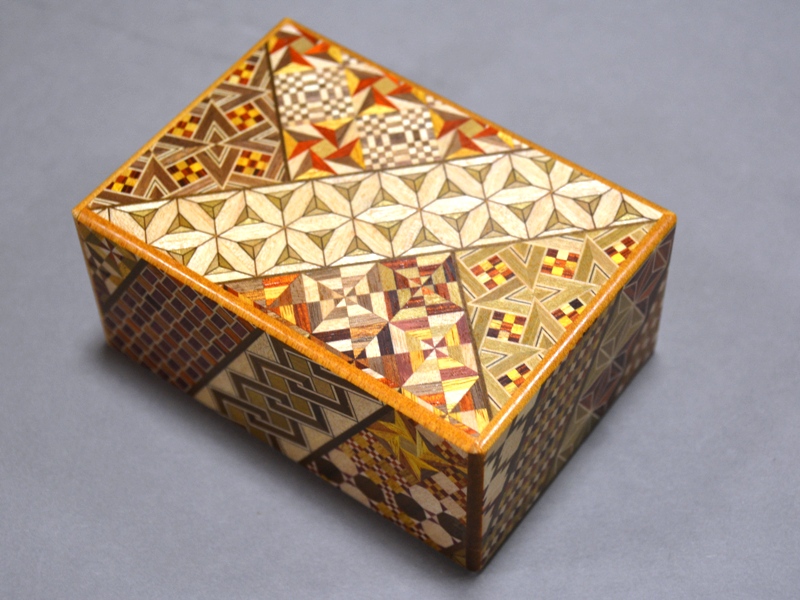
- Yosegi-zaiku — the mosaic woodwork on the surface, which we will admire properly in a moment.
So the object in your hands is, quite literally, a small piece of nineteenth-century Hakone — a souvenir tradition that grew into one of the world's most beloved puzzle forms. Hold it a moment, and feel how old that idea is.
What looks like a solid wooden side is in truth a thin sliding door — the whole box is a sequence of quiet little doors waiting their turn.
How does the sliding-panel mechanism actually work?
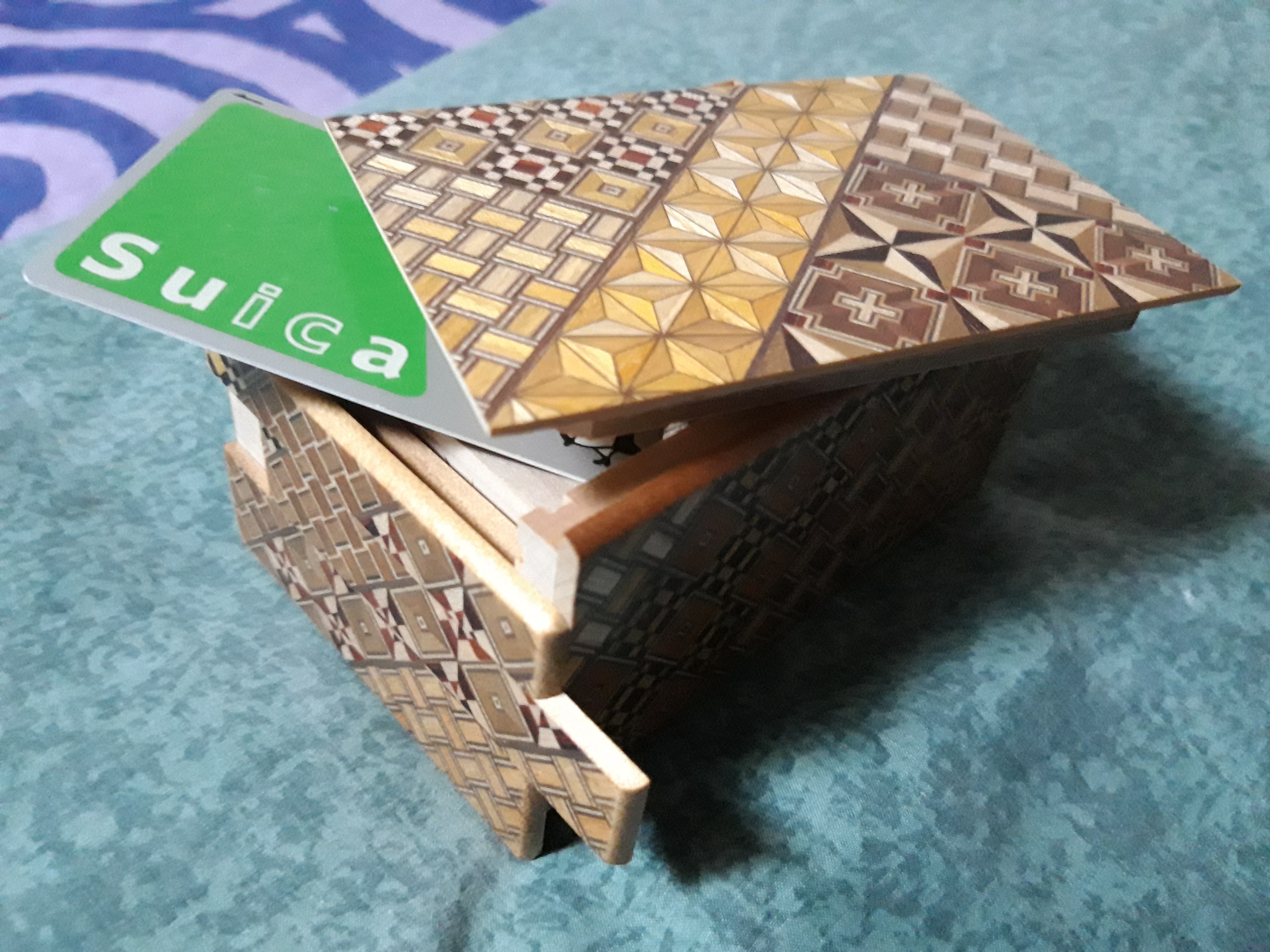
Let me lift the curtain on the cleverness, because once you understand why the box opens, finding the how becomes far less mysterious.
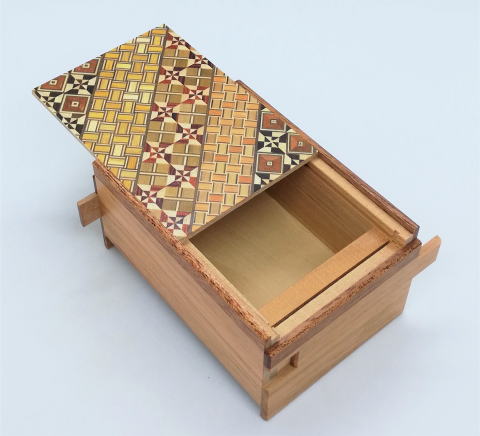
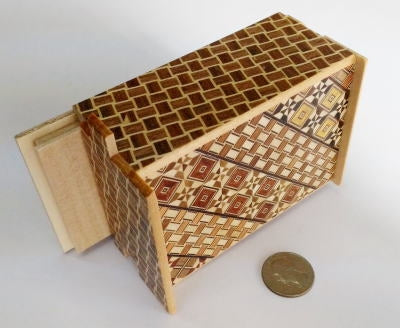
Picture the box as a wooden shell whose six faces are not glued shut. Instead, certain faces — or strips of faces — are panels that ride in grooves, like tiny drawers laid flat against the surface. Each panel is held in its closed position by an internal wooden key or tongue: a small projecting piece of wood that blocks it from sliding. So long as that key is in the way, the panel cannot move.
Here is the elegant part. Sliding one panel does not merely move that panel — it also shifts the key that was blocking the next panel out of the way. The maker OKA describes it plainly: the top panel cannot move unless the side panel moves first. So the box is a chain of dependencies. Move panel A, and panel B becomes free. Move panel B, and panel C becomes free. Each move quietly unlocks the next, all through interlocking wood — there is not a single piece of metal inside.
This is why the boxes are counted in steps. A '7-step' box requires seven of these dependent moves; a '54-step' box requires fifty-four, often doubling back across the same face several times in different directions. The panels typically slide in one of a few simple ways:
- A long side panel slides left or right.
- An end panel slides up or down.
- The top (lid) slides off last, once everything blocking it has cleared.
A crucial consequence of this chain design: every move must be completed to its full stop. If you slide a panel only halfway, the key it was supposed to release stays half-blocking the next panel, and you will be stuck — not because you chose wrong, but because you did not finish. Makers warn about exactly this: an incomplete move quietly halts the whole sequence.
The movements themselves are small — often just 3 to 5 millimetres, sometimes less. They should feel smooth, like a well-fitted drawer in summer: a gentle, gliding give, never a grind. That smoothness is your guide. The box is, in a sense, always whispering which panel is ready. Our job is simply to listen with our fingertips.
Understand this chain, and you have understood the soul of the himitsu-bako. Everything else is patience.
Each move does double duty — it slides one panel aside and, in the same breath, frees the next. The box unlocks itself, one quiet step at a time.
How do you find the very first move?
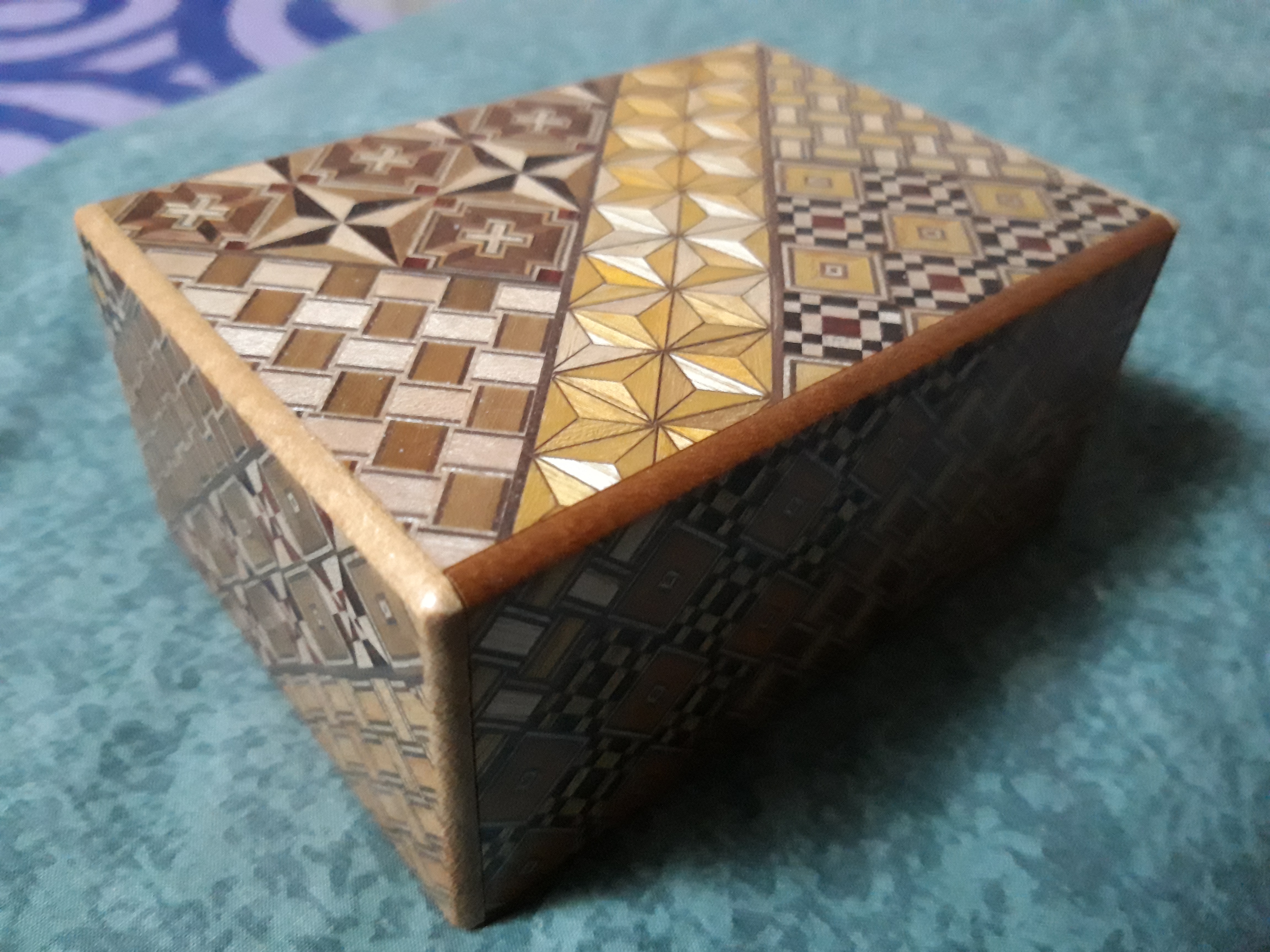
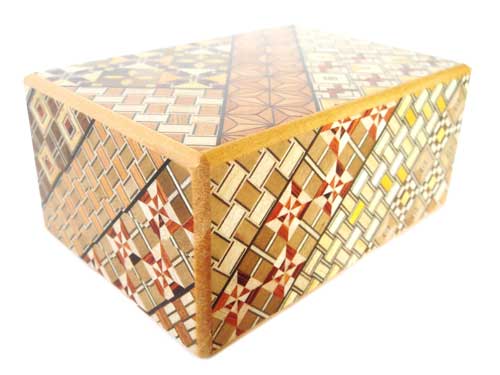
Now we come to the threshold — and I will be honest with you, because the makers and collectors all are: finding the first move is usually the hardest part of the entire puzzle. One seasoned guide calls it 'literally a process of elimination, and also, quite often, the most difficult part of the puzzling process.' Take heart, though — once the first panel yields, the rest tend to follow like a held breath finally let go.
Here is how I teach a nervous first-timer to find it.
1. Sit under good light. Tilt the box slowly beneath a lamp and look along every edge. You are searching for the faint seams that reveal where one panel meets the next. The yosegi pattern can hide them beautifully, so let the light rake across the surface at an angle — a sliding panel often catches the light just slightly differently from its neighbor.
2. Hold the box loosely and press gently on each face in turn. Don't grip it in a fist; cradle it. With a soft thumb, give each panel the lightest nudge in the directions it could travel — a side panel left, then right; an end panel up, then down. You are not trying to force a result. You are feeling for the one panel that has a tiny bit of play — a whisper of give the others don't have.
3. Work from the outside in. If any piece sits slightly proud or feels like a removable cap, try that first. Then move methodically across the faces. Many boxes begin with a long side panel that slides a few millimetres, or a small corner piece — but resist memorizing 'rules' for where it starts; makers deliberately vary it, and half the joy is the genuine hunt.
4. When you feel give, follow it gently and fully. The moment a panel begins to glide, let it travel all the way to its natural stop. That faint click of arrival — soft, wooden, satisfying — is the box telling you that you have taken Step One. Pause and savor it. You have just been let into the foyer.
A gentle reassurance for the anxious hand: the correct first move never requires strength. If you find yourself straining, you have either chosen the wrong panel or the wrong direction. Set it down, breathe, and begin the survey again. The first move hides, but it does not resist. It is simply waiting to be noticed.
The first move hides, but it does not resist. Find the panel with a whisper of play, follow it all the way home, and the box has opened its door to you.
What is a calm, systematic method for solving the rest?
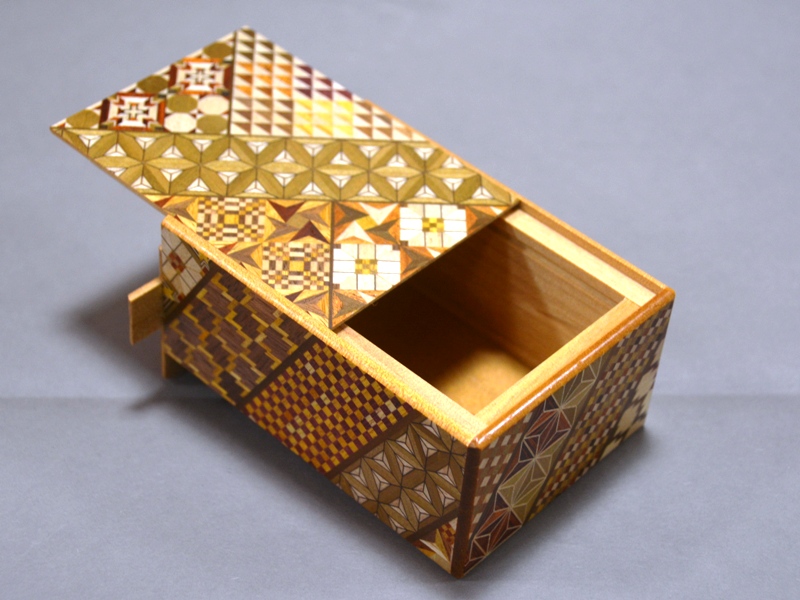
You have your first move. The foyer is open. Now we walk through the house — and the secret to never getting lost is to be methodical rather than frantic. Let me give you a rhythm you can trust.
Re-survey after every single move. This is the heart of the method. Each completed move frees a new panel somewhere on the box — but you do not yet know where. So after every step, pause and gently re-test the faces, just as you did to find the first move. The newly-freed panel will now have that telltale play. Solving a himitsu-bako is really just finding the first move over and over, each time on a slightly changed box.
Move in a deliberate order so you don't miss a face. I like to go around the box the same way each time — say, long-side, long-side, end, end, top — testing each in both directions. A consistent circuit means you never overlook the one panel that just came loose.
Keep a record as you go. Note each move out loud or on paper: 'right side slides left, top slides toward me, left end slides down.' Some guests simply film it on their phone. This is not cheating — it is how you will close the box again, and it turns a frustrating dead-end into a map you can retrace.
Let the resistance teach you. When a panel won't move, that is information, not failure. It almost always means one of two things: the previous move wasn't completed to its full stop, or you're testing a panel whose turn hasn't come yet. Return to the last panel you moved and confirm it traveled all the way — makers specifically advise this when you feel stuck.
Expect direction changes and back-tracking. On longer boxes (21, 27, 54 steps), the same face may need to slide one way, then later slide back, then a third panel moves. The sequence is not always a tidy march in one direction. If the count in the box's name is, say, twelve, you know to expect twelve distinct completed moves before the lid frees — a quiet progress bar to measure yourself against.
And if you truly stall — walk away. Set the box on the shelf, make a cup of tea, return in an hour. Fresh eyes find the loosened panel that tired ones slid right past. There is no penalty here for slowness. The box has waited a hundred years; it can wait for your tea.
Work this gentle circuit — move, re-survey, record, repeat — and even a stranger to the craft will feel the lid loosen under their hands. When it finally lifts away and you glimpse that little inner chamber for the first time, I promise you will grin like a child. Everyone does.
Solving the whole box is really just finding the first move again and again — each time on a box you've quietly changed by one panel.
What should you never do — and how do you care for the wood?
Every gracious craft has its courtesies, and the himitsu-bako asks only a few of you. Honor these and your box will outlive us both; ignore them and a hundred-year tradition can crack in your palm. Let me be motherly for a moment.
Never, ever force a panel. This is the one inviolable rule. The boxes are precision-cut to fractions of a millimetre, and the locking keys are slender wood. A correct move always slides smoothly with a gentle, even pressure. If a panel resists, it is simply not its turn — forcing it can snap an internal tongue, and a broken key means a box that will never open or close properly again. When in doubt, do less, not more.
Don't pry, lever, or use tools. No coins in the seams, no knife blades, no 'just a little' twist with a screwdriver. The whole pleasure is in the hands; a tool only does damage.
Don't yank the lid. The top panel comes free only when everything blocking it has cleared. If the lid won't lift, you have a move left to find — go back and re-survey, don't pull.
Mind the humidity and temperature. Because the mechanism is entirely wood, it breathes with the seasons. In humid summer weather the wood swells and panels slide stiffly; in dry winter air they loosen. If your box suddenly feels tight, it is usually the weather, not a fault — let it acclimate to the room rather than forcing the swollen panels. Keep the box away from direct sun, radiators, damp basements, and bathrooms.
Clean it kindly. A soft, dry cloth is all it ever needs — a gentle wipe to lift dust from the yosegi. Never use water, oils, polishes, or chemical cleaners; they can stain the marquetry, raise the grain, or seep into the seams and swell the mechanism. The natural urethane or wax finish the maker applied is doing its job already.
Store it closed and empty of stress. Leave the box assembled and closed when not in use, ideally in its gift box or a drawer, out of crushing weight's way.
Think of it as a small wooden guest in your home — it likes a stable room, a soft touch, and to never be hurried. Treat it so, and it will keep its secret faithfully for the next pair of curious hands, long after ours.
A correct move always glides. If you are straining, the box is not being stubborn — it is telling you, politely, that this is not the one.
How do you close and reset the box again?
Opening the box is only half the dance — and to my mind, closing it is the more satisfying half, because by then your hands already know the steps. Here is the lovely simplicity of it: to close a himitsu-bako, you reverse the exact sequence you used to open it.
Every move you made has a mirror. If the last thing you did to open the box was slide the lid toward you, then the first thing you do to close it is slide the lid back into place. Then you walk backward through your moves: the panel you slid last-but-one returns first, the one before that returns next, and so on, until the very first panel you ever moved is the very last one you slide home. When that final panel seats with its soft wooden click, the box is sealed again — seamless, secret, giving no hint of the room within.
This is precisely why I asked you to keep a record as you opened it. With your noted sequence (or your little phone video) in hand, closing is almost meditative — you simply read it from the bottom up. Without a record, closing can be every bit as much a puzzle as opening was, which is its own kind of fun if you're in the mood, but a genuine snag if you just want it shut.
A few graces for a clean close:
- Reverse direction, too, not just order. A panel you slid left to open must slide right to close. Mirror the whole motion.
- Finish each move to its stop, exactly as when opening — a half-seated panel will block the next one from returning, just the same.
- Never force the closing, either. If a panel won't go back, you've likely missed a step in the reversal or skipped one out of order. Re-survey, find the panel with play, and let it guide you.
- If you lose your thread entirely, gently re-open and re-close slowly. Run the open sequence once more, this time noting every move with care, then immediately reverse it. The box will forgive you; it has infinite patience.
And here is a small delight to send you off with: once you have opened and closed your first box a few times, the sequence settles into your fingers like a melody. You will be able to do it almost without looking — a little flurry of slides, a click, and there it is, sealed. To a watching friend it looks like quiet magic. To you, by then, it simply feels like home.
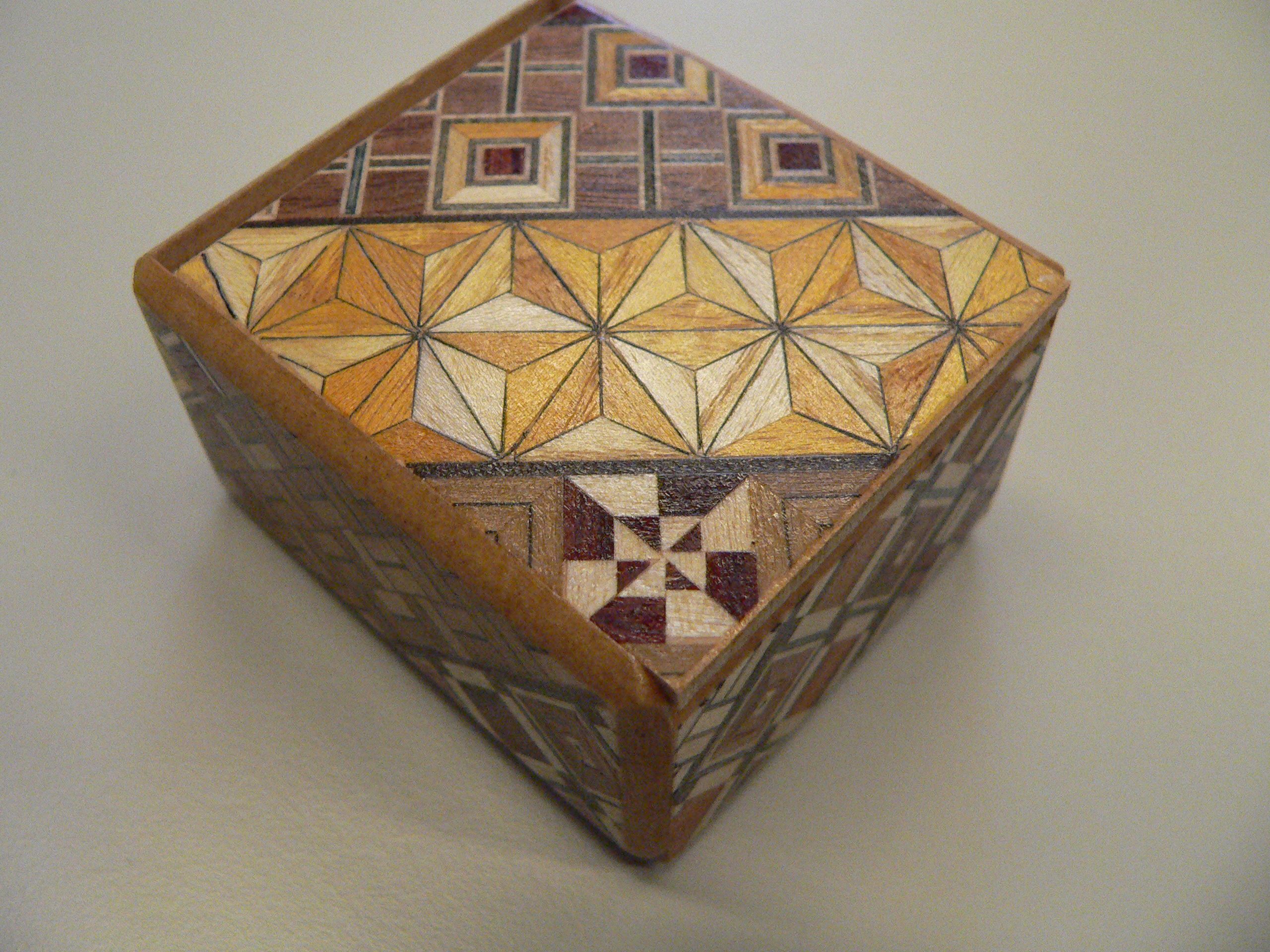
To close the box, you simply walk your moves backward — last step first, first step last — until the final panel clicks home and the secret is sealed again.
How do you choose your first box — and who are the great makers?
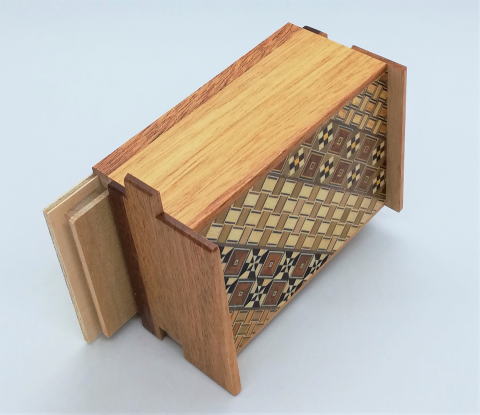
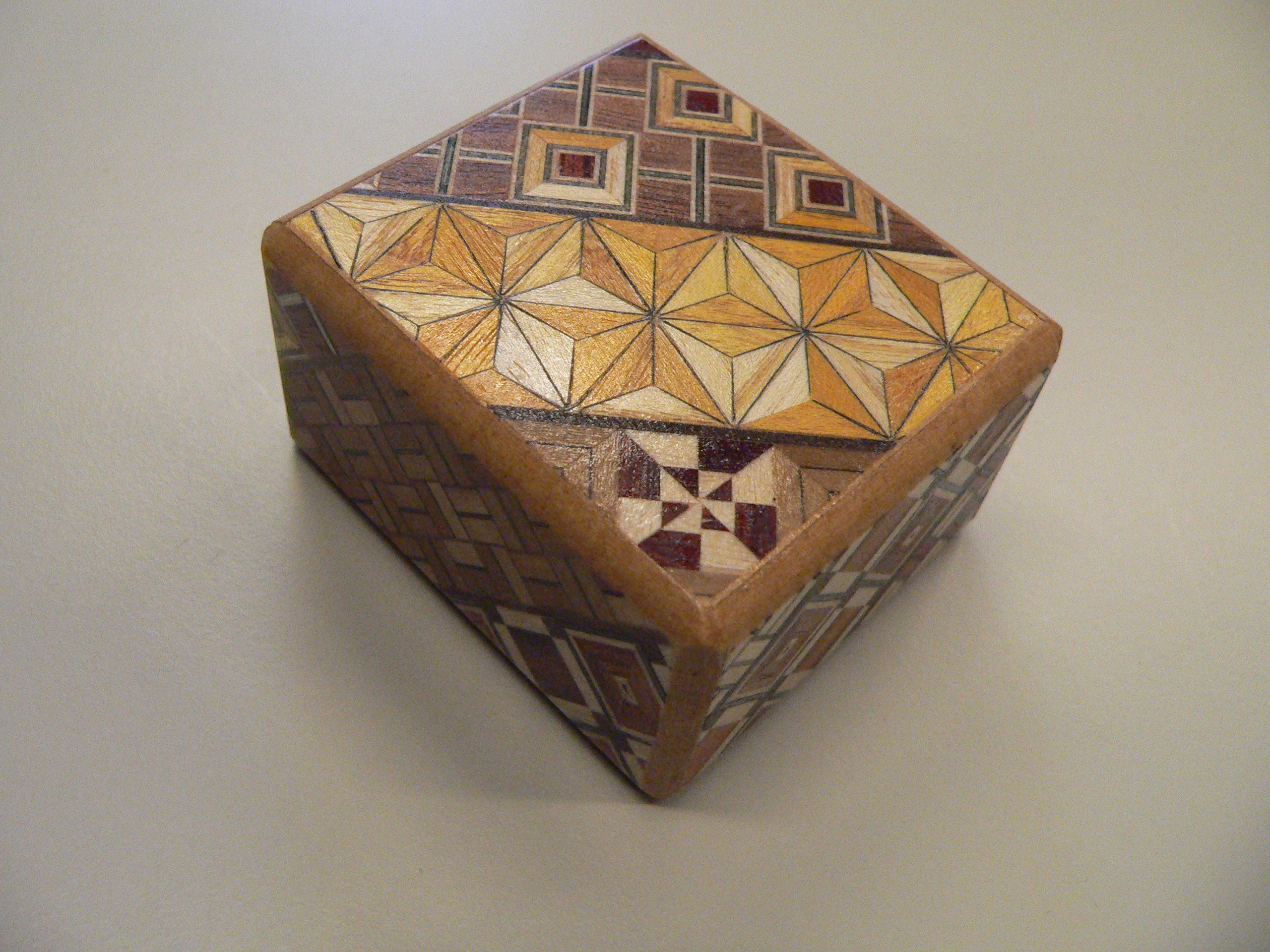
Now for the happiest task of all: choosing the box that will be yours. Let me guide you as I would a dear friend, by skill and by feel.
Choose your difficulty by step count. This is your single best guide as a beginner:
- 4 to 7 steps — the perfect first box. Gentle, genuinely solvable in an evening, and forgiving while you learn the feel of sliding panels. I send nearly every newcomer here.
- 10 to 14 steps — a confident second box, or a first box for someone who loves a bit of a challenge. Enough back-tracking to feel clever, not enough to despair.
- 21, 27, 54+ steps — for later, once the rhythm lives in your hands. These are wonderful, but a 54-step box as your first can frustrate rather than delight. Grow into them.
Choose your size by 'sun.' A 4 sun box (palm-sized, ~12 cm) is the classic sweet spot — large enough to handle comfortably and read the panel seams. A 2 sun box is adorably small and a touch fiddlier for big fingers; lovely once you have some practice.
Buy one with a solution sheet. Reputable boxes from Hakone retailers include the opening sequence in the box. Keep it sealed in an envelope if you want the full challenge — but it is a kind safety net to own.
Where to buy, and from whom. For traditional yosegi himitsu-bako, look to dedicated houses: Puzzle Master (Canada), Puzzle Box World, and Hakone-direct workshops like OKA Craft (the maker Hiroyuki Oka) and IZUMIYA. These sell authentic Odawara/Hakone-made boxes, not imitations.
And now, the names worth knowing — the living lineage of this craft:
- Akio Kamei is the towering figure. Beginning in the early 1980s, he single-handedly revived the dying Hakone art, and in 2000 he founded the Karakuri Creation Group, coining the very term karakuri box ('trick box'). His pieces — the Apple, the Coffee Cup, the Spring Box — tell little stories and are prized worldwide for novelty, beauty, and ingenuity.
- The Karakuri Creation Group (KCG) is the artisan collective Kamei built, based near Mount Fuji. Its members include Hiroshi Iwahara, Yoshiyuki Ninomiya, Osamu Kasho, Yasuaki Kikuchi, Yoh Kakuda, Hideaki Kawashima, Daiki Arimura, and others. A KCG box is a step beyond a traditional himitsu-bako — these makers weave in physics, magnets, and counter-intuitive surprises — and the group's 'Small Box' series is a celebrated, beginner-friendly entry into their world.
So here is my parting recommendation, plainly: begin with a 4 sun, 7-step Hakone yosegi box, solution sheet tucked in its envelope. It is beautiful, affordable, authentic, and exactly hard enough to make you feel wonderfully clever when the lid finally slides free. From there, the whole secret world opens — one quiet panel at a time. Welcome to it, dear guest. I am so glad you came.
Begin with a 4 sun, 7-step Hakone yosegi box and its solution tucked away in an envelope — beautiful, authentic, and exactly hard enough to make you feel wonderfully clever.
From the rabbit hole
Real voices from players, reviewers, and the communities who know these games best.
collector“Not only a craftsman awes you with the intricate work behind the opening sequence and complex fine details in the mechanism, but also with the beautiful and eye-candy inlaid work that is used, which is a true art form.”
Gabriel Fernandes' Puzzle Collection
collector“Discovering the first steps can be a bit tricky, but after that you'll be more familiarized with the process and the next ones will follow in no time.”
Gabriel Fernandes' Puzzle Collection
guide“Finding the first movable piece is literally a process of elimination but is also, quite often, the most difficult part of the puzzling process.”
YouGoJapan — How to Open a Japanese Puzzle Box
maker“The top panel cannot move unless the side panel moves first.”
OKA Craft (Hiroyuki Oka), workshop diary
maker“Please note that it may be broken if you push the face by main force.”
Hakone Maruyama — How to Open the Box
retailer“If a panel doesn't slide easily, it's likely not the correct step, or the alignment is off — never force a panel to move.”
Kubiya Games — Stuck on a Japanese Puzzle Box?
The picks
Some links below are affiliate links — as an Amazon Associate, Puzzlewick earns from qualifying purchases, at no extra cost to you. It never changes a pick.
 3 photos
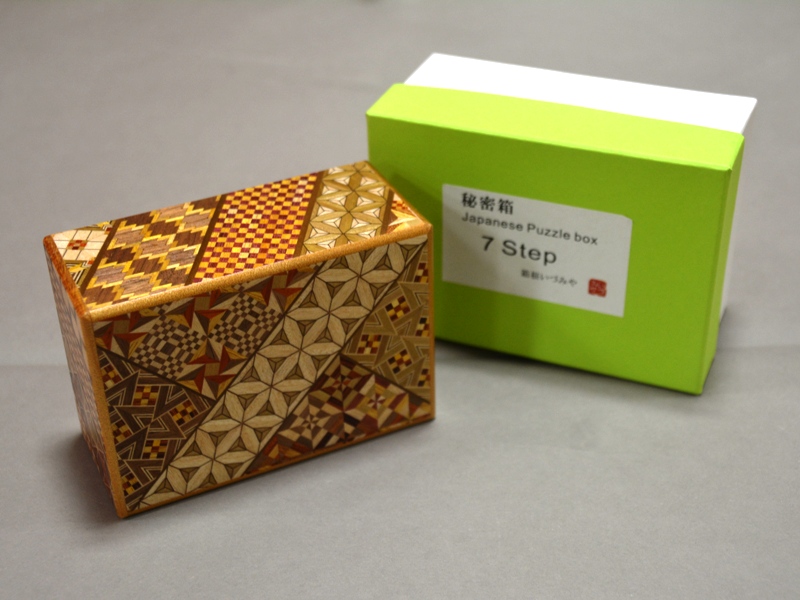
 4 Sun 7 Step Koyosegi Japanese Puzzle Box
If you buy one box on this list, make it this one. At 4 sun it sits comfortably in the hand and the seams are easy to read, while seven steps is the gentlest 'real' difficulty — enough to feel the magic of the chain mechanism without ever despairing. It's authentic koyosegi marquetry made in Odawara/Hakone, and it ships with a solution sheet so you're never truly stuck. This is the box I'd hand a nervous beginner.
- Beginner-perfect 7-step difficulty
- Comfortable 4 sun (palm-sized) format
- Authentic Hakone/Odawara koyosegi, includes solution
- Solid but not the cheapest entry point
- A confident puzzler may solve it fairly quickly
 2 photos
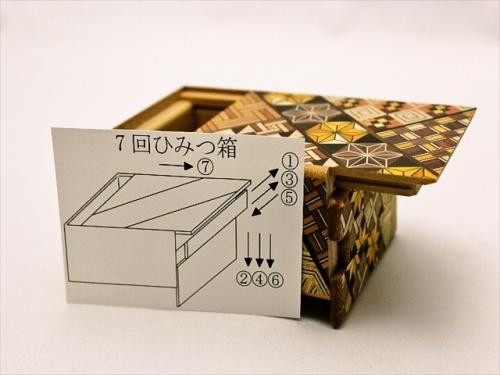
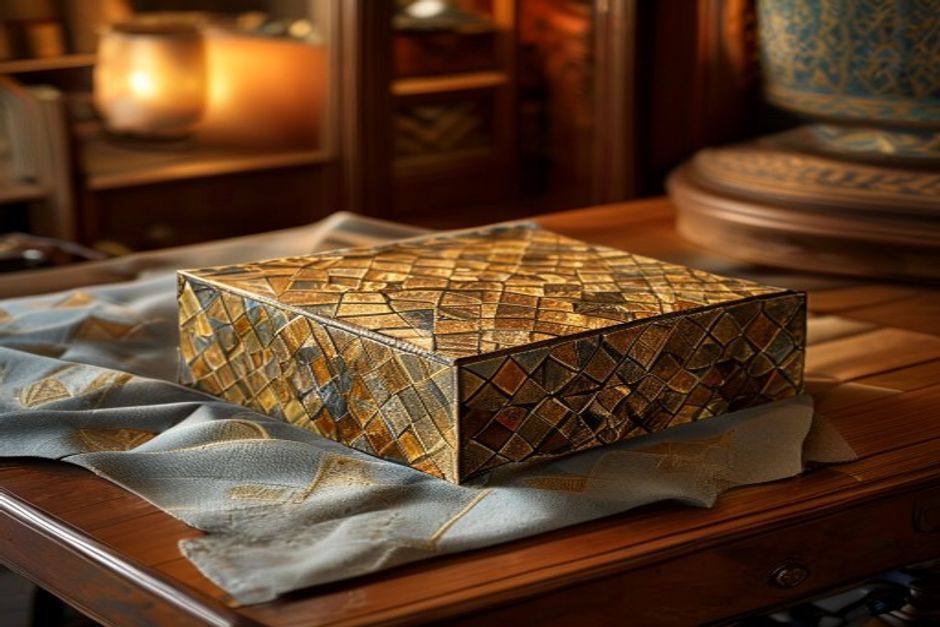
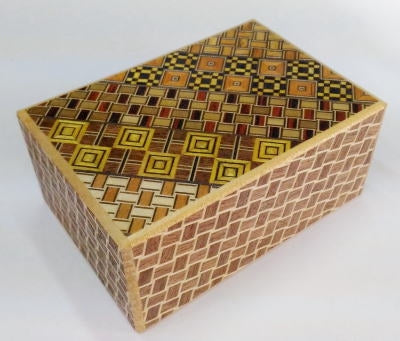
 KIRO Hakone Marquetry Traditional Yosegi Puzzle Box, Size 4, 7 Steps
A traditional 7-step box from a Hakone workshop, listed around ¥4,180 (roughly US$28–30, though it ships from Japan and stock comes and goes). The yosegi here is the real Edo-rooted mosaic, and at size 4 it's a friendly, solvable starter. Because it's sold direct from Japan, availability fluctuates — but when in stock it's one of the most affordable ways to own a genuine Hakone secret box.
- Authentic Hakone-made traditional yosegi
- Very approachable ~¥4,180 price point
- Beginner-friendly 7-step mechanism
- Frequently out of stock
- Ships from Japan; USD price varies with exchange rate and shipping
 3 photos
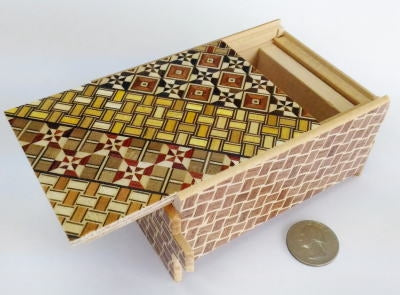
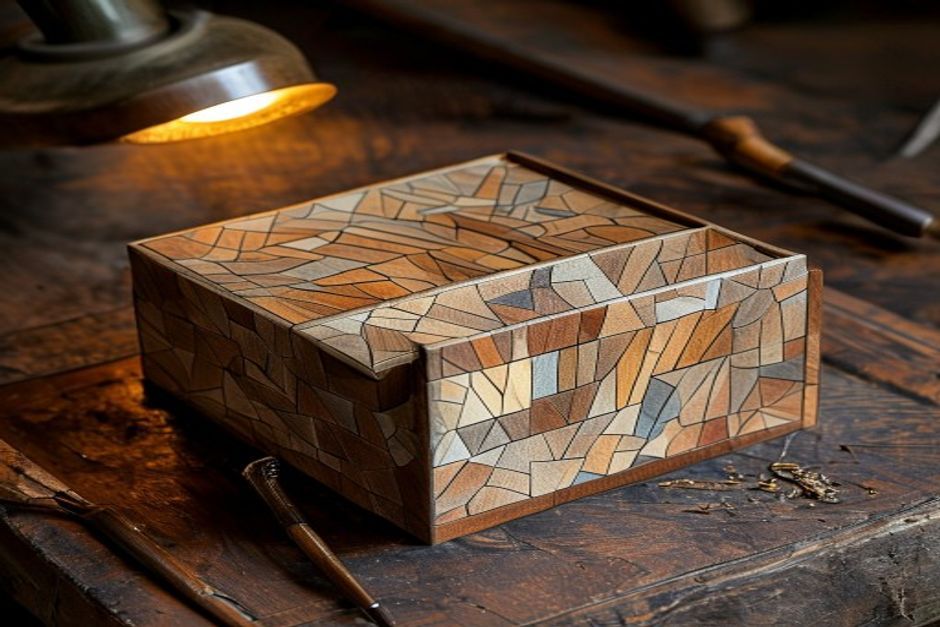
 4 Sun 10 Step Yosegi Kuzushi Japanese Puzzle Box
A moderate 10-step box dressed in yosegi inlay on the top and bottom with a kuzushi pattern down the sides — a genuinely handsome piece (4.75 x 3.5 x 2.3 in) that arrives in a gift box and includes opening instructions. Ten steps adds just enough back-tracking to make the solve feel earned without overwhelming a newer puzzler. A lovely 'second box,' or a first box for the bolder beginner.
- Striking yosegi-plus-kuzushi decoration
- Satisfying 10-step difficulty with a solution included
- Arrives gift-boxed with a quality urethane finish
- Price not always listed; confirm at checkout
- Slightly too brisk for an absolute first-timer who wants the gentlest start
 4 photos
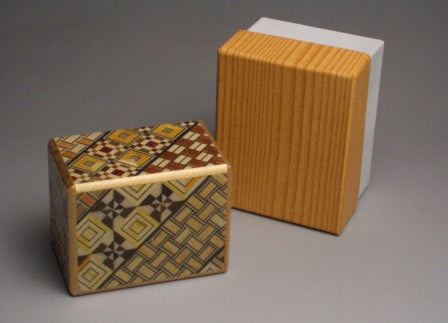
 OKA Craft 4 Sun 12 Step Himitsu-bako (Yosegi)
OKA Craft is the workshop of craftsman Hiroyuki Oka, who makes traditional himitsu-bako in the Hakone tradition and ships worldwide. This 4 sun, 12-step box uses three moving panels and two slide keys, with every internal gimmick made of wood for that gentle, warm movement — and it includes a solution sheet and gift box. Buying maker-direct means you're supporting the living craft and getting a piece stamped by the hand that made it.
- Made and signed by a named Hakone craftsman (Hiroyuki Oka)
- All-wood internal mechanism with a smooth, warm action
- Includes solution sheet and gift box; ships worldwide
- 12 steps is a notch above true-beginner level
- Stock is batch-made and limited; specific models rotate
 2 photos
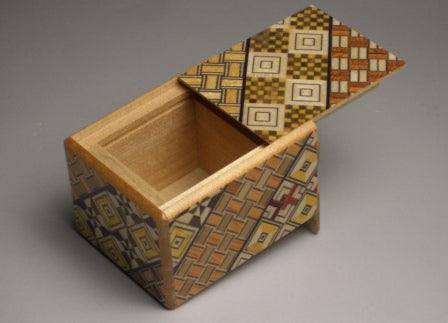
 2 Sun 7 Step Koyosegi Japanese Puzzle Box
A pocket-sized 2 sun box (about 2.4 in long) with the same friendly 7-step mechanism in the smaller format, rated around 2.5/5 difficulty and made in Odawara/Hakone with a solution included. The compact size makes it a charming gift and a lower-commitment way to try the hobby — just know the smaller panels can be a touch fiddlier for larger fingers than a 4 sun box.
- Compact, charming, and very giftable
- Beginner-friendly 7 steps with a solution included
- Authentic Hakone/Odawara koyosegi
- Small panels are slightly fiddlier to read and grip
- Less presence on a shelf than a 4 sun box
 3 photos
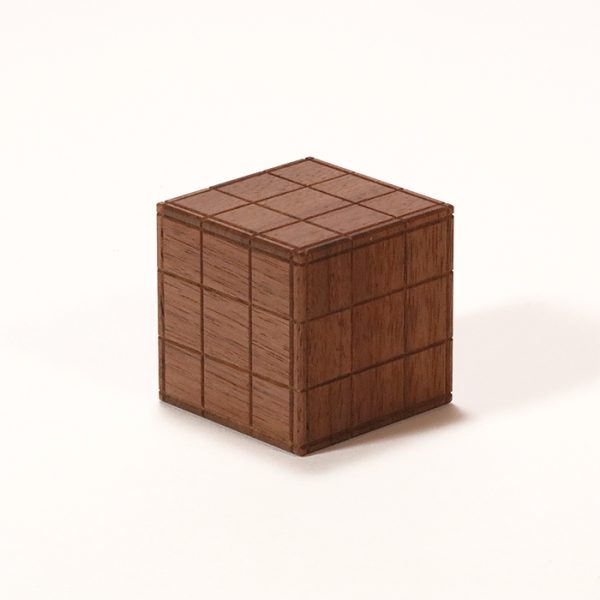
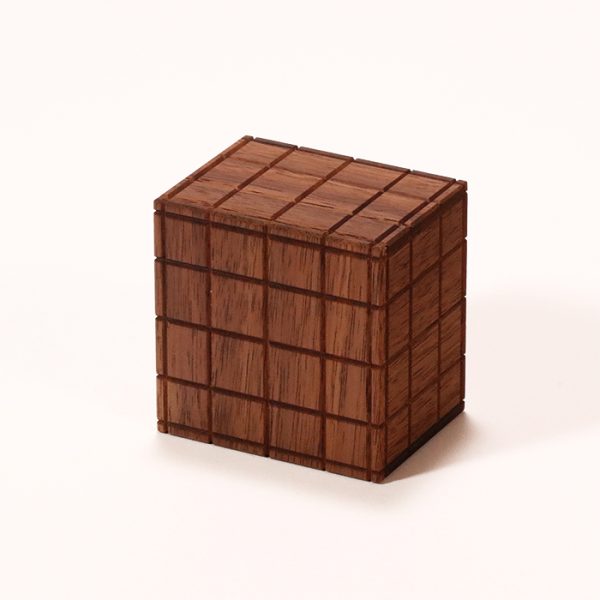
 Karakuri Creation Group 'Small Box' Series
Once the traditional himitsu-bako has charmed you, the Karakuri Creation Group's celebrated 'Small Box' series is the gentlest way into the modern karakuri world — boxes that take a traditional sliding-panel feel and add a little contemporary surprise. These are artisan pieces from the collective Akio Kamei founded in 2000, made near Mount Fuji. Prices and availability vary by release and member, so treat this as an aspirational next step rather than an off-the-shelf grab.
- Entry point to the renowned Karakuri Creation Group
- Designed to be approachable for newer solvers
- True collectible artisan craft with a famous lineage
- Availability is limited and release-dependent
- Pricing varies; often bought via the Karakuri Club or specialist retailers
At a glance
| box | maker | steps | price | best for |
|---|---|---|---|---|
| 4 Sun 7 Step Koyosegi | Hakone/Odawara (Puzzle Master) | 7 | ~$95.99 | The ideal first box |
| KIRO Yosegi Size 4, 7 Steps | Nozawa (Hakone) | 7 | ~¥4,180 (~$28–30) | Affordable Hakone-direct starter |
| 4 Sun 10 Step Yosegi Kuzushi | Hakone/Odawara (Puzzle Box World) | 10 | ~$100 (confirm) | Handsome step-up second box |
| 4 Sun 12 Step Himitsu-bako | Hiroyuki Oka — OKA Craft | 12 | ~ (maker-direct) | Named-craftsman, all-wood action |
| 2 Sun 7 Step Koyosegi | Hakone/Odawara (Puzzle Master) | 7 | ~ (entry-level) | Small, giftable taste of the craft |
| Karakuri 'Small Box' Series | Karakuri Creation Group | varies | ~ (release-dependent) | Gateway to modern karakuri art |
Questions, answered
What is a Japanese puzzle box?
It is a small wooden box from the Hakone region of Japan that has no visible hinge, lock, or latch, and opens only when you slide a hidden sequence of its panels in the correct order and direction. The faces of the box are actually thin sliding panels held shut by internal wooden keys. It's used to conceal a small keepsake — and it doubles as a beautiful puzzle. The traditional name is himitsu-bako, meaning 'secret box.'
How do you open a Japanese puzzle box?
First, examine the box under good light and gently test each face for a panel with a little 'play.' Slide that first panel fully to its stop — this unlocks a second panel. Re-test the faces, find the newly-freed panel, slide it home, and repeat. Each move unlocks the next until the lid finally slides off. Move gently, finish every move completely, and never force a panel that resists.
What is a himitsu-bako?
Himitsu-bako (秘密箱) is the Japanese term for 'secret box' — the traditional Hakone puzzle box that opens by sliding panels in a set sequence. They originated in the Odawara/Hakone area in the late 1800s, attributed largely to the craftsman Okawa Ryugoro, as keepsakes for travelers. 'Himitsu-bako' usually refers to the classic sliding-panel boxes, as distinct from modern 'karakuri boxes.'
What is yosegi (yosegi-zaiku)?
Yosegi-zaiku is the traditional Hakone marquetry that decorates these boxes — tiny strips of different natural woods, in many shades, glued into geometric mosaic patterns, then shaved into thin veneers and applied to the surface. It was developed in the late Edo period by Hatajuku carpenter Nihei Ishikawa (1790–1850). 'Koyosegi' refers to the finer, smaller-pattern version you'll see on many boxes.
How many moves or steps does a puzzle box take to open?
It depends on the box's rating, which is printed in its name. Common step counts are 7, 10, 12, 14, 21, 27, and 54, but they range from as few as 2–4 moves up to 100+ on elaborate boxes (some specialty boxes reach into the hundreds). Each 'step' is one complete sliding move, and each must be done in order — every move unlocks the next.
Which puzzle box is best for a beginner?
A 4 sun, 7-step Hakone yosegi box is the classic beginner's choice — large enough to handle comfortably and gentle enough to solve in an evening, while still delivering the satisfying chain mechanism. Make sure it includes a solution sheet (most do). A 4-to-10-step range is ideal for first-timers; save the 27- and 54-step boxes for later.
Who makes Japanese puzzle boxes?
They are made by woodworking artisans in the Hakone/Odawara region of Japan. Traditional himitsu-bako come from workshops such as OKA Craft (craftsman Hiroyuki Oka) and IZUMIYA. The modern art form is led by the Karakuri Creation Group, founded in 2000 by master artisan Akio Kamei, whose members include Hiroshi Iwahara, Yoshiyuki Ninomiya, Osamu Kasho, and others.
Can you break a Japanese puzzle box?
Yes — but only by forcing it. The internal locking keys are slender wood, and pushing or prying a panel that won't slide can snap one, leaving the box unable to open or close properly. The rule is absolute: a correct move always slides smoothly. If a panel resists, it isn't its turn; re-survey rather than push. Humidity can also temporarily stiffen the wood, so never force a box that feels tight in summer.
How do you reset or close the puzzle box?
You close it by reversing the exact opening sequence — both the order and the direction of every move. The last panel you slid to open becomes the first you slide to close; a panel moved left to open is moved right to close. This is why it helps to record your opening moves: closing then becomes a simple matter of reading the list backward until the final panel clicks home.
Are Japanese puzzle boxes handmade?
Authentic Hakone boxes are largely handmade — the yosegi mosaic is assembled by hand and the mechanism cut to fine tolerances, with each box carrying a maker's hanko (seal). Because of this, makers note that pattern and feel vary slightly from box to box. There are cheaper mass-produced imitations, so buying from Hakone-direct workshops or reputable specialist retailers ensures you get the real, handcrafted article.
How much do Japanese puzzle boxes cost?
Entry-level traditional boxes start affordably — a small Hakone 7-step box can run roughly $25–35, while a 4 sun 7-step from a Western retailer is around $95–100, and 10–14 step boxes run a little more. Larger and higher-step boxes climb from there. Collectible Karakuri Creation Group boxes are artisan pieces that can cost considerably more, and the Karakuri Club membership runs around ¥12,500/year.
Where can you buy a Japanese puzzle box?
For authentic boxes, look to dedicated specialists: Puzzle Master (Canada), Puzzle Box World, and Hakone-direct workshops like OKA Craft (japanesepuzzlebox.jp) and IZUMIYA. For modern karakuri pieces, the Karakuri Creation Group's site and the Karakuri Club are the source. Always confirm the box is made in Odawara/Hakone and ships with a solution sheet.
Yumi's verdict
If you take one thing from our evening together, dear guest, let it be this: the box is not a lock to be beaten, it is a quiet conversation to be had. Approach it with soft hands, good light, and an unhurried heart, and it will open for you — it opens for everyone who is willing to listen. For your very first, I'll send you off with the same recommendation I give every newcomer who sits at my table: a 4 sun, 7-step Hakone yosegi box, with its solution tucked away in an envelope for the moment you truly need it. It's beautiful enough to keep on a shelf, authentic enough to honor a hundred-year craft, and exactly hard enough that when the lid finally slides free in your palm, you'll feel like you've been let in on a wonderful secret. Because you have. Welcome to the wonder-library — come back and tell me how it opened.
Research ledger 22 sources · reviewed 2026-07-17
Specifications, rules, current product information, community experience, and contrary evidence were checked against the sources below. Commercial links are kept separate from editorial evidence.
- jocjapantravel.comjocjapantravel.com/kanto-kanagawa-hakone-himitsu-bako
- fivesinatras.comfivesinatras.com/2020/09/11/karakuri-creation-group
- karakuri.gr.jpkarakuri.gr.jp/en/craftsman/kcg
- karakuri.gr.jpkarakuri.gr.jp/hiromerukai/hiromerukai-e.html
- boxesandbooze.comboxesandbooze.com/akio-kamei
- boxesandbooze.comboxesandbooze.com/karakuri-creation-group
- japanesepuzzlebox.jpjapanesepuzzlebox.jp
- japanesepuzzlebox.jpjapanesepuzzlebox.jp/diary-detail/249
- japanesepuzzlebox.jpjapanesepuzzlebox.jp/profile
- hakonemaruyama.comhakonemaruyama.com/how-to-open-the-box
- kubiyagames.comkubiyagames.com/blogs/mechanical-puzzles-blog/stuck-on-a-japanese-puzzle-box-here-s-how-to-solve-and-close-it
- kubiyagames.comkubiyagames.com/blogs/mechanical-puzzles-blog/the-secret-of-puzzle-boxes-puzzle-box-guide
- yougojapan.comyougojapan.com/how-to-open-japanese-puzzle-box
- vanishingincmagic.comvanishingincmagic.com/puzzles-and-brainteasers/articles/what-is-a-japanese-puzzle-box
- yosegijapan.comyosegijapan.com/whats-yosegi
- puzzlemaster.capuzzlemaster.ca/browse/wood/japanese/foursun/262-4-sun-7-step-koyosegi
- puzzlemaster.capuzzlemaster.ca/browse/wood/japanese/foursun/299-4-sun-10-step-koyosegi
- puzzlemaster.capuzzlemaster.ca/browse/wood/japanese/twosun/228-2-sun-7-step-koyosegi
- puzzleboxworld.compuzzleboxworld.com/products/4-sun-10-step-yosegi-kuzushi-japanese-puzzle-box
- nihon-ichiban.comnihon-ichiban.com/kiro-hakone-marquetry-traditional-yosegi-puzzle-box-secret-box-size-4-7-steps
- mypuzzlecollection.blogspot.commypuzzlecollection.blogspot.com/2011/11/japanese-puzzle-boxes.html
- en.pinkoi.comen.pinkoi.com/product/9WkH677H
Come in, take your shoes off — let me show you something.
Keep exploring
The next smart rabbit holes.
⌂ Topic PathFamily and Gateway Games: compare the whole shelfA good family game gets everyone playing quickly without becoming disposable after three nights. These guides prioritize clear...ReviewKarakuri Egg Puzzle Box by Akio Kamei: The Japanese Artisan Grail That Collectors Camp ForOne hour of pure mechanical poetry. A cherry-wood egg that whispers its secrets if you listen.Beginner's GuideJapanese Puzzle Boxes Explained: Karakuri, Yosegi & Himitsu-bakoA wooden box from Hakone that whispers secrets back — open it only if you're patient enough to listen. Three beautiful words: 寄木細工...