Are Gemstone Dice Worth It? (2026)
Genuine stone, dyed imposters, and glass under poetic names: the Archivist reads the label and the ledger both, then tells you exactly what you're buying for $40–$150.

AI-assisted curator persona · research and editorial responsibility: Robert Pruitt · how this guide was made
Last editorial refresh: 2026-06-13 Gold-standard QA: 2026-08-10 18 sources reviewed Affiliate links checked during gold-standard pass

The short answer
Genuine gemstone dice — hand-carved from natural stone like amethyst, tiger's eye, or obsidian — are worth it for collectors and display-minded players who want a heavy, one-of-a-kind object and accept two real trade-offs: they chip more easily than resin or metal, and natural density variation makes them less perfectly balanced. A real set from a reputable maker runs roughly $40–$150 (often $75–$100 for a full polyhedral set). They are NOT worth it if you want a tournament-fair roller or something you can drop on a hardwood floor without flinching. Beware the fakes that flood marketplaces: 'purple' or 'white turquoise' is usually dyed howlite or magnesite, and 'cat's eye' is fiber-optic glass, not stone — both are fine objects, but they are not the gemstone the listing implies.
Decision map
Choose in thirty seconds
The classic, durable first 'real' set — beauty plus everyday quartz toughness
First-timers who want maximum readability and drama
Warm golden banding with good opaque readability
Let me check that before we say it — that's how every entry in this library gets written, and gemstone dice are a topic that rewards the habit more than almost any other. A d20 cut from real amethyst has a cold heft and an internal glow that no resin can fake. But 'gemstone' is doing enormous work on these pages, and the marketplace is loud with things that aren't quite what their names promise: dyed howlite in turquoise's costume, fiber-optic glass calling itself cat's eye, reconstituted powder pressed back into a shape and called stone.
So this guide does two things at once. First, the case for real gemstone dice: what they are, why they cost what they cost, and the two hard limits (chipping and balance) that no maker engineers away. Second, the authentication: how to read the real stone from the dressed-up version, stone by stone, in language you can use while staring at a listing. Puzzlewick doesn't sell dice — we're a library, not a shop. When a set is worth pointing at, I'll name the maker and the price I verified. When I couldn't verify something, I'll tell you so plainly rather than guess.
One note on tone: I'm not anti-gemstone. I own the case for them warmly. I'm anti-hype — anti the listing that calls fiber-optic glass genuine, anti the $200 selenite set that will scratch under your fingernail. You deserve to know what stone you're buying before you spend $90 on it.
Start here, then go deeper
You are in the right cabinet.
 ⬢ Topic PathTabletop Accessories: compare the whole shelfBuy the accessory that fixes a repeated annoyance first. Protection, setup speed, readable state, and comfortable handling beat...
 Buying GuidePremium Artisan Dice Sets: Japanese Craft, Resin & Gemstone CollectiblesThe finest gaming dice marry tradition, craft, and intention—where every roll carries the weight of careful hands and rare materials.
 Buying GuideBest Dice Trays & Rolling Trays, Ranked (2026)The ancestors chose silence over spectacle — four walls, soft floor, and the discipline of the contained roll. Here are ten, from eleven...
What exactly are 'gemstone dice'?
Gemstone dice are polyhedral dice cut and ground from a solid piece of natural mineral or rock, then engraved (and usually ink-filled) with numerals. A standard 7-piece set is the d20, d12, two d10s (the 0–9 and the 00–90), d8, d6, and d4 — exactly the same shapes as your acrylic dice, just carved from stone instead of poured into a mold.
That 'carved from a solid piece' part is the whole identity of the category, and it's worth slowing down on. Because each die is cut from natural material, every set is literally one-of-a-kind — the banding in a tiger's eye, the cloud-fields in a fluorite, the depth of a black obsidian all vary piece to piece. Reputable makers say this plainly. Norse Foundry's amethyst listing tells buyers that because the dice are 'hand carved and sandblasted,' to 'allow for slight variations' in size, shape, coloring, and number placement. Awesome Dice describes their sets as 'hand-carved from actual stones,' which makes each set 'genuinely one-of-a-kind.' That variation is the feature you're paying for.
The trap is that 'gemstone' is a marketing word, not a guarantee of anything. It can mean a genuine single-origin mineral (real amethyst from Uruguay). It can mean a dyed cheaper stone wearing a fancier stone's name ('purple turquoise' that's actually dyed howlite). It can mean a reconstituted material — real mineral ground to powder, mixed with resin, and pressed back into a block. Or it can mean glass with a poetic name ('cat's eye'). All four can appear in the same marketplace search. The rest of this guide is mostly about telling them apart.
'Gemstone' is a marketing word, not a guarantee. The same search can return real amethyst, dyed howlite, pressed reconstituted stone, and plain glass — all calling themselves the same thing.
How do you spot a fake or 'dressed-up' gemstone set?
Here's where I get exacting, because this is the section that saves you money. The good news is the most common impostors give themselves away if you know the tells.
'Purple turquoise' / 'white turquoise' = almost always dyed howlite or magnesite. Natural white howlite is a soft, chalky stone with grey veining that takes dye beautifully. Dyed blue, it impersonates turquoise so well it 'fools almost everyone' (rocktumbler.com). The same trick produces 'purple turquoise,' 'red turquoise,' and so on — turquoise does not naturally occur in those candy colors. The tells: dye pools darker inside the cracks and veins (bring it to your eye and look at the seams); howlite is soft enough that the surface scratches easily; and the trade often relabels it 'turquenite' or 'white turquoise' to stay technically-not-lying. None of this makes dyed howlite a bad object — it's just not turquoise, and shouldn't be priced like it.
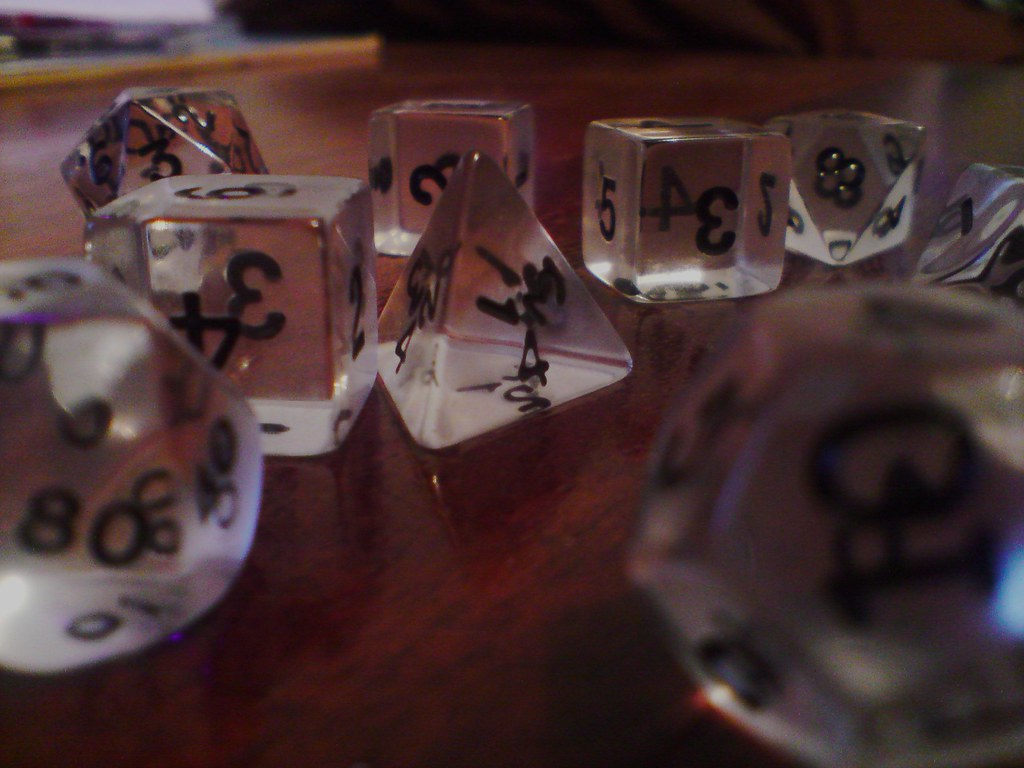
'Cat's eye' = glass, not gemstone. This one is unambiguous, and the makers themselves admit it. Those mesmerizing glowing-band 'cat's eye' dice are fiber-optic synthetic glass — thin glass fibers fused into a block. Norse Foundry sells them and titles the product, in plain text, 'Cats Eye — 7 Piece RPG Set Glass Dice,' stating outright that 'Cats Eye Stones are made of fiber optic synthetic glass.' GIA documents fiber-optic glass as the standard imitation of natural chatoyant ('cat's eye') gems, identifiable under magnification by a honeycomb structure on the side and parallel tubes on top. Buy them if you love the look — just know you're buying glass at a glass price, not chrysoberyl.
Reconstituted / 'pressed' stone. Some affordable 'turquoise,' 'malachite,' and 'amber' dice are real mineral ground to powder and bonded with resin. Tells: suspiciously uniform color and pattern (nature is messier), a seam or flow-line, and a lighter, warmer-to-the-touch feel than solid stone. Reputable sellers disclose this; sketchy ones don't.
The universal sanity checks: weight and temperature (real stone is heavier and stays cool longer than resin or light pressed blocks), price (a 'gemstone' 7-piece set for $12 is not solid natural stone), and seller transparency (a maker who names the stone's origin and Mohs hardness is telling you they have nothing to hide).
The maker tells you, if you read the title: Norse Foundry calls their cat's eye dice 'Glass Dice' and says so outright. Believe the label, not the romance of the name.
Will gemstone dice chip — and which stones actually survive play?
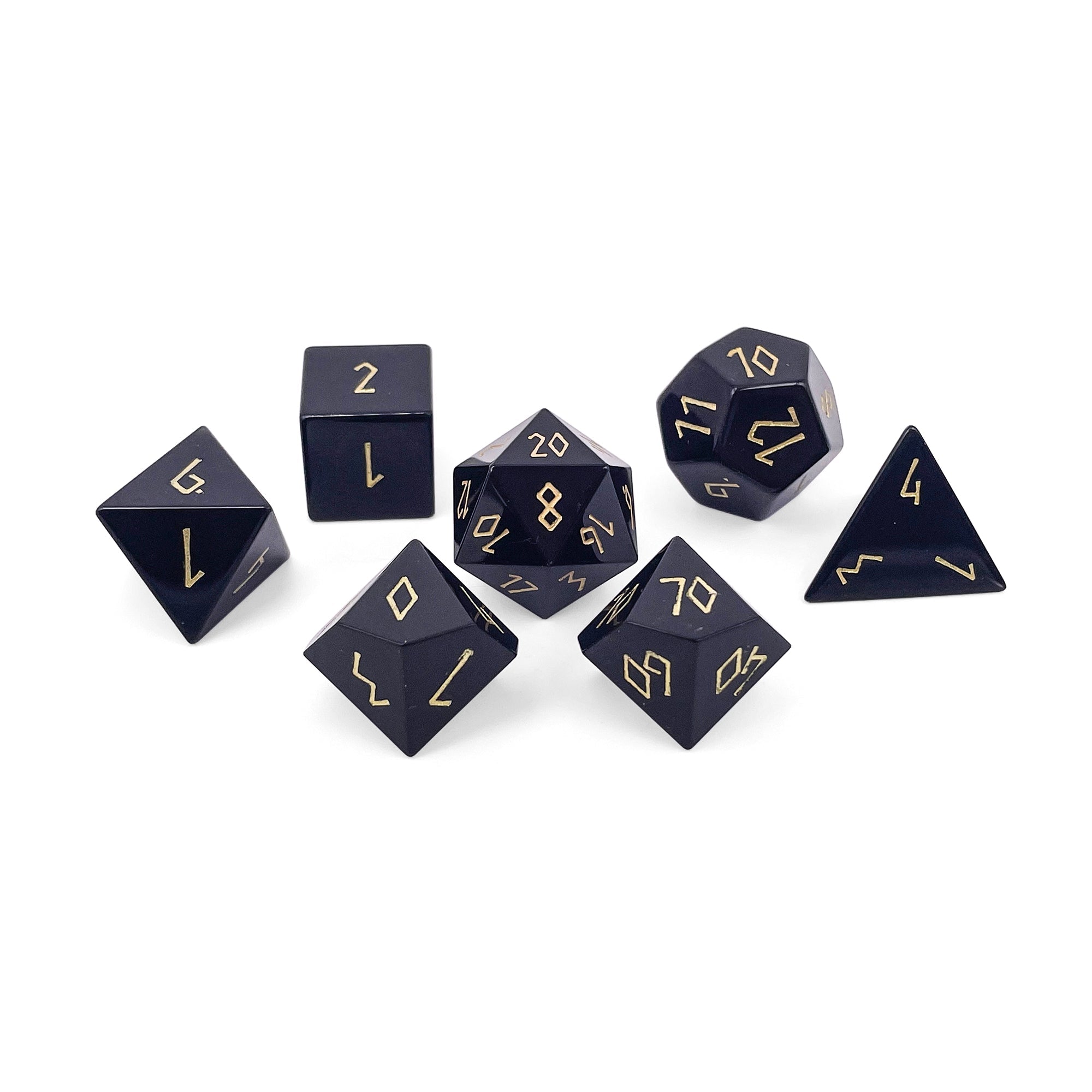

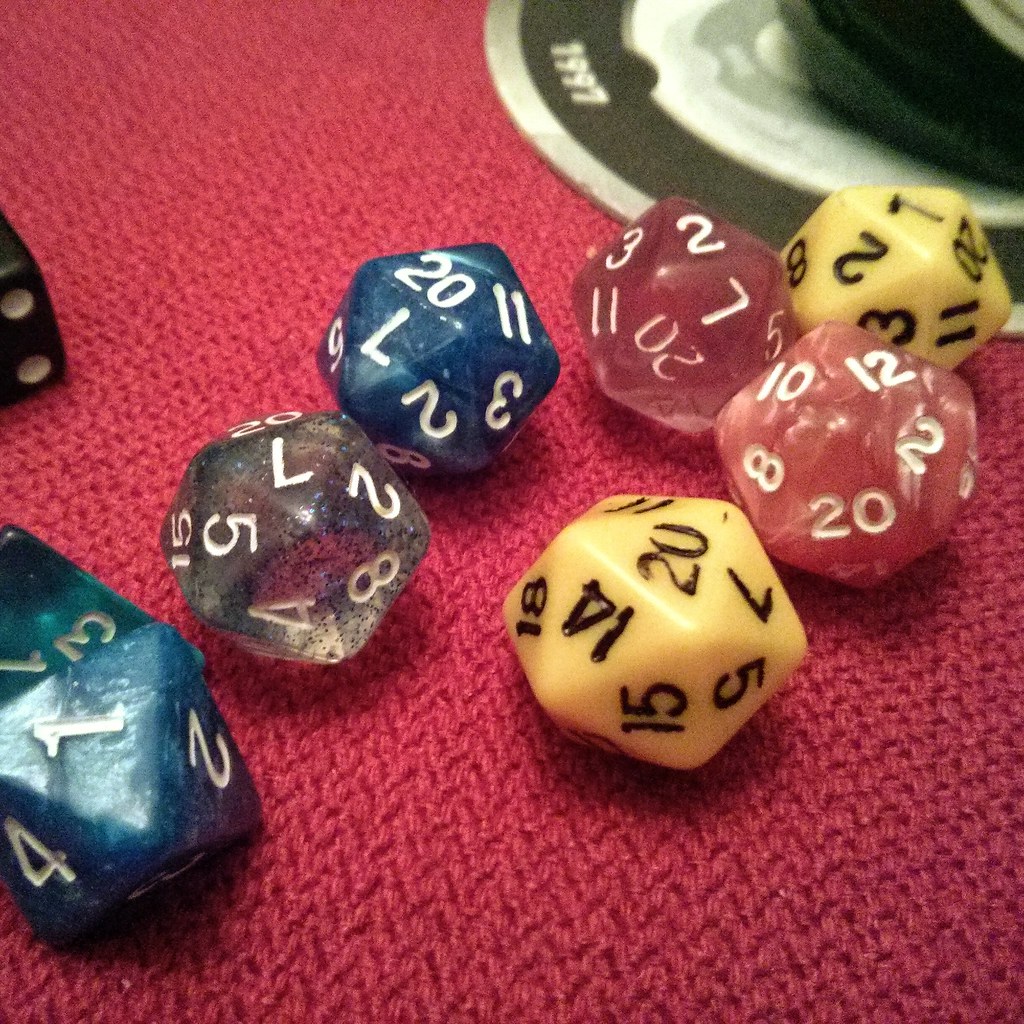
Yes, they chip. This is the single most important sentence in any honest gemstone-dice guide, and the makers themselves whisper it in their care notes. Awesome Dice says their stone dice are 'naturally softer than metal and more delicate than synthetic materials' and ask to be 'handled with respect.' Dice Craft Lab puts the trade-off bluntly: 'Drop a fluorite d20 on a hardwood floor and you'll likely lose a corner. Even harder stones like amethyst can chip on impact with tile, concrete, or other hard surfaces.'
The key concept — and the one most listings ignore — is that Mohs hardness measures scratch resistance, not toughness. Hardness tells you whether something can scratch the surface; toughness tells you whether it shatters or chips when it hits an edge. A die can be hard and still brittle. As Dice Craft Lab notes, 'Even quartz varieties (Mohs 7) will chip if they hit a hard edge at the wrong angle.' The cleanest example runs the other way: jade is softer on paper (Mohs ~6–7) but exceptionally tough, so it resists breaking better than its hardness suggests. Meanwhile obsidian is natural volcanic glass — Mohs ~5–5.5 — and fractures conchoidally into genuinely sharp edges, which is why a chipped obsidian die can actually cut.
So the practical ranking for people who want to roll their dice, not shelf them: quartz-family stones (amethyst, tiger's eye, rose quartz, agate, jasper — all near Mohs 7) and tough stones like jade are your best bets; obsidian is dramatic and popular but brittle at the edges; and the soft stones are display pieces, full stop. Fluorite (Mohs 4) chips from a short drop. Selenite (Mohs 2) scratches under a fingernail. Malachite (Mohs ~3.5–4) is gorgeous and soft. Buy those because they're beautiful, and roll them on felt, gently, if at all.
Hardness is scratch resistance; toughness is whether it shatters. A quartz-7 die can still lose a corner on tile — and soft, tough jade can outlast it. Read both, not just the Mohs number.
Are gemstone dice actually balanced and readable?
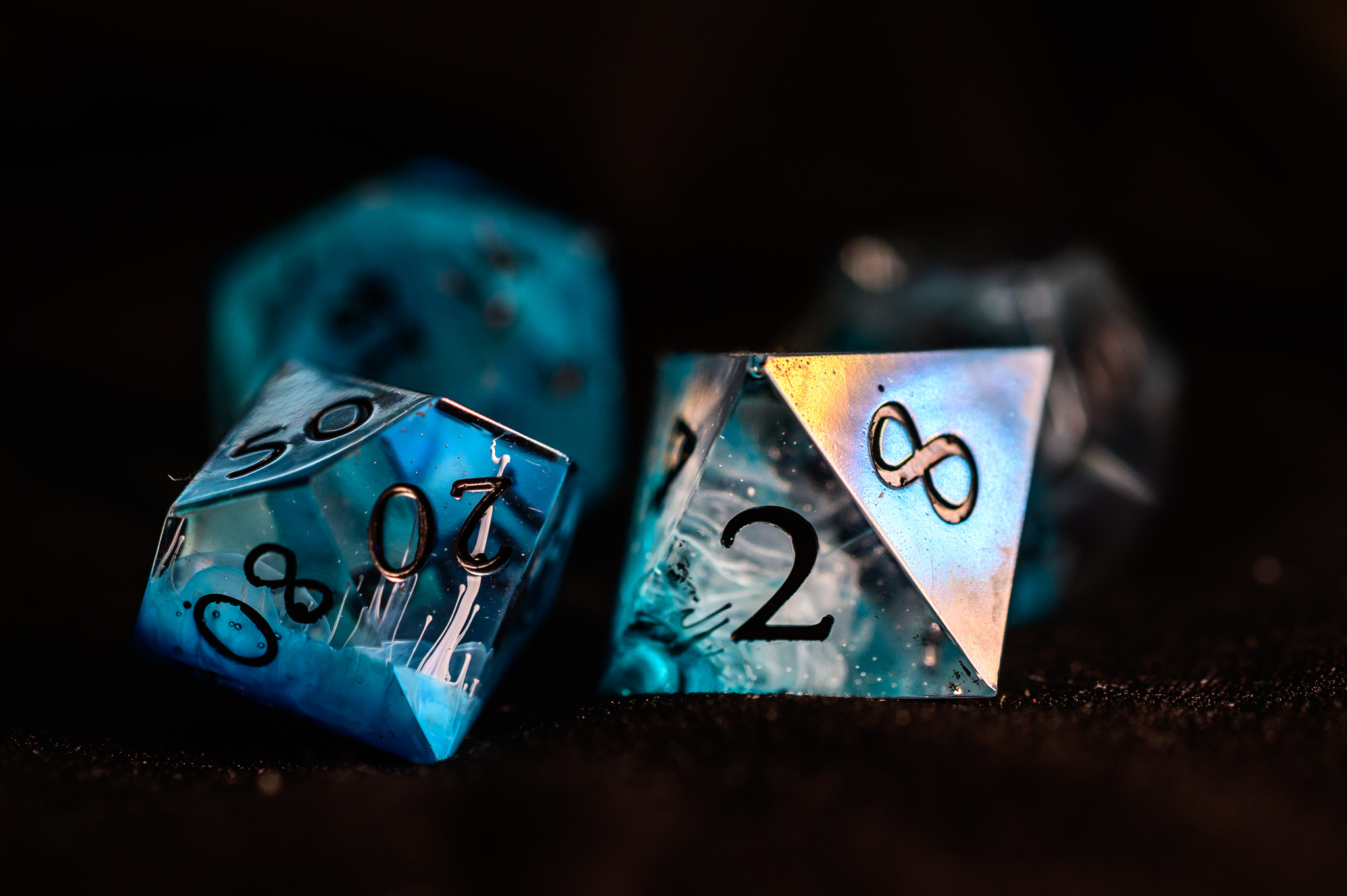
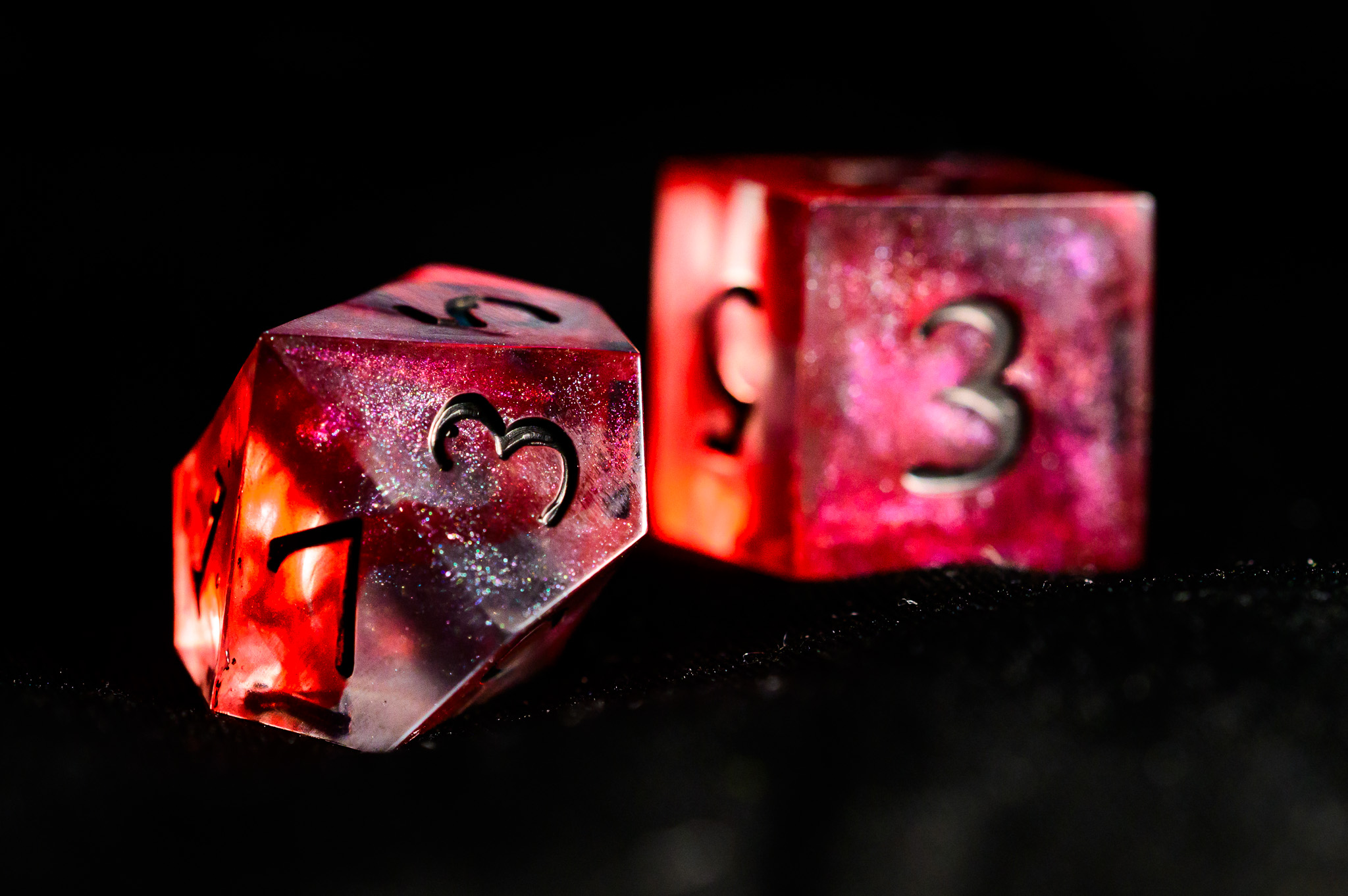
Two honest caveats here, and neither is a dealbreaker — but you should hear them before you spend.
Balance. Natural stone has internal density variations: a vein here, a slightly denser patch there. Mass-produced acrylic and especially precision-machined metal dice are far more uniform. So a gemstone die will, on average, show more bias in a float/salt-water balance test than a quality resin or metal die. Dice Craft Lab's verdict: 'Run a gemstone die through a dice balance test and you'll almost always find more bias than in a quality resin or metal die.' For home D&D and narrative play, this is almost always irrelevant — the bias is small and the dice roll fine. For anything where provable fairness matters, gemstone is the wrong tool, and that's a feature-of-the-material limit, not a maker defect.
Readability. Stone is rarely high-contrast, and translucent or pale stones are the worst offenders. A white or light-gold ink fill 'almost disappears' against translucent rose quartz or pale amethyst. This is why the better makers ink the engraving for visibility (Elderwood Academy explicitly inks their numerals) and why darker, opaque stones — obsidian, tiger's eye, hematite, sodalite, dark agate — read far more easily across a table than pale translucent ones. If you wear readers or game in dim light, weight your choice toward an opaque stone with a contrasting fill, and look for photos of the actual numerals, not just a glamour shot of the stone.
Net: gemstone dice are 'good enough' rollers for the vast majority of players and beautiful objects for all of them — but if perfect balance or instant legibility is non-negotiable, the material itself is fighting you, and no price tier fixes that.
For home D&D the balance bias is real and harmless. For provable fairness it's disqualifying. That's the material talking, not the maker — no price tier engineers it away.
What's the real price — and where should you actually buy?
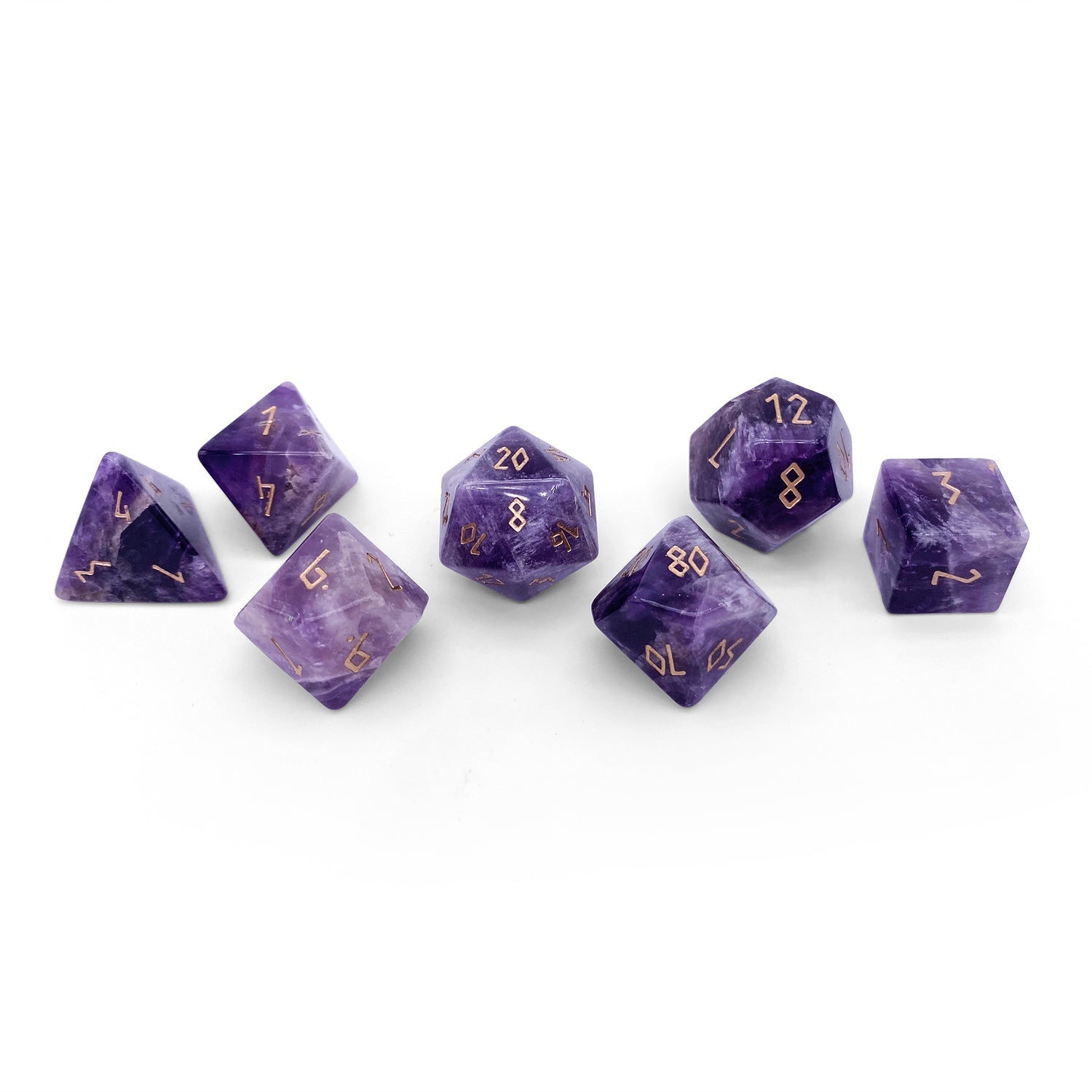

Let me give you verified numbers, not vibes. As of this writing, a genuine full polyhedral gemstone set from a reputable maker generally lands in the $75–$100 range, with single statement d20s and sale items dipping toward $35–$65, and premium or scarcer stones pushing past $100.
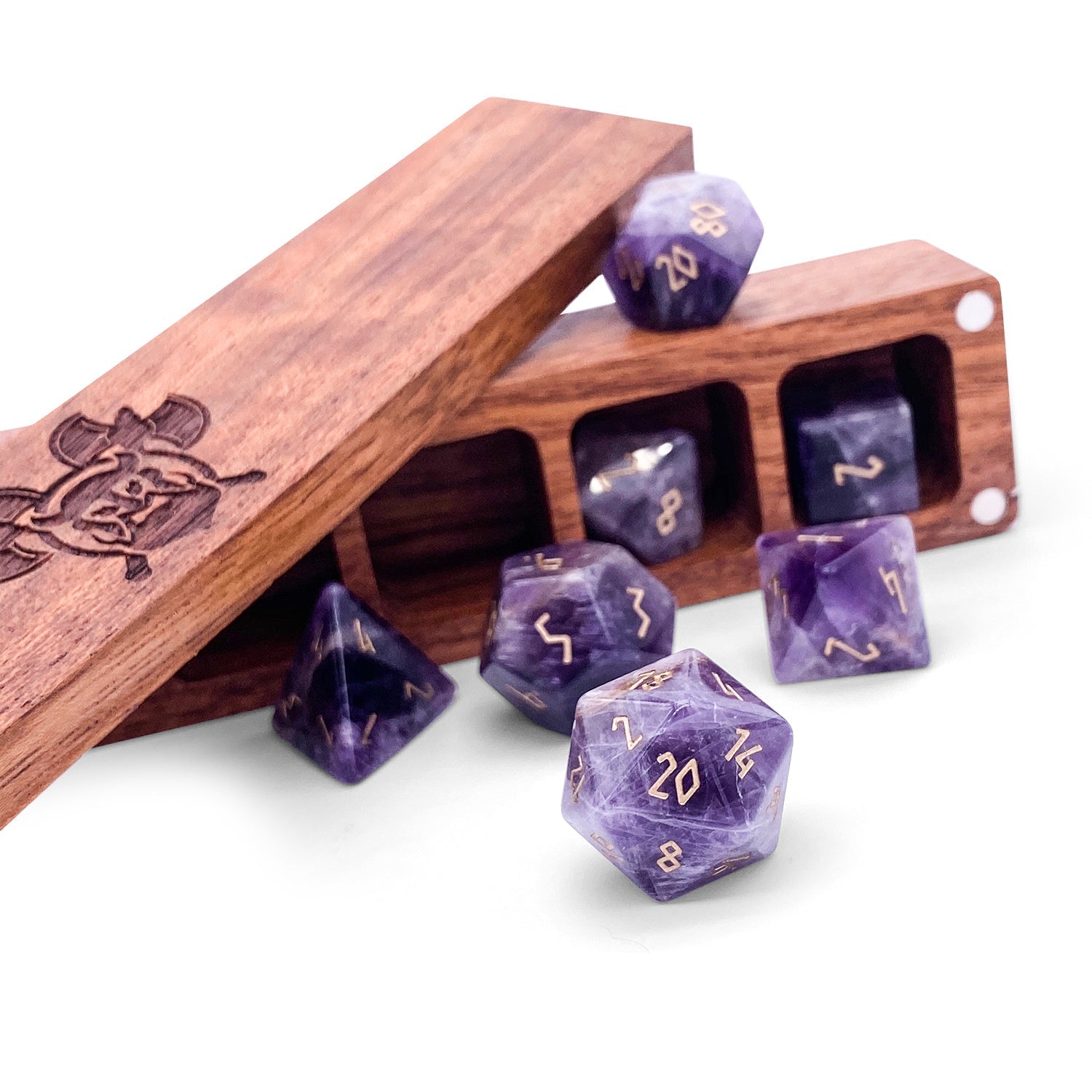
Verified examples I could confirm directly on maker pages: - Norse Foundry — Amethyst 7-piece $95 (genuine amethyst, Uruguay/Brazil, Mohs 7); Tiger's Eye 7-piece $85 (Mohs 6); Black Obsidian 7-piece $75 (natural volcanic glass, Argentina/Chile). Their 'Cats Eye' set is $85 and is explicitly titled 'Glass Dice' — useful as a price anchor for what glass costs. - Dark Elf Dice — agate sets $55–$65, hematite $60, green jadeite $70, labradorite $70, tiger's eye $55; note their 'Synthetic Black Obsidian' $44 and 'Dichroic Rainbow Glass' $100 are honestly labeled as not-natural. - Elderwood Academy (Phoenix line) — Amethyst, Lapis Lazuli, and Rose Quartz each $99; Obsidian variants $79–$89; numerals inked for legibility. - Dice Dungeons — Amethyst ~$83, Blue Sodalite ~$80, Matte Obsidian ~$110 (prices approximate; shown with cart-level rounding). - Awesome Dice — genuine amethyst set listed ~$64.93 (sold out at check), with a clear 'softer than metal, more delicate than synthetic' care note.
Where to buy: I'd steer you toward named makers with stated stone origins and care policies over anonymous marketplace listings. Norse Foundry, Dark Elf Dice, Elderwood Academy, Dice Dungeons, and Awesome Dice all name the stone, state hardness or sourcing, and publish return/damage policies (Norse Foundry's covers damaged-on-arrival with photo documentation). The Etsy-and-marketplace world has genuine artisans and the dyed-howlite/glass crowd in the same search — if you shop there, apply the 30-second fake test and demand the stone's real name and origin in writing before you pay.
A real full set is $75–$100 from a named maker who states the stone's origin and hardness. A 'gemstone' set for $12 is telling you something true about itself.
So who are gemstone dice genuinely FOR?
Here's my plain verdict, sorted by who you are.
Buy them if: you're a collector or a display-minded player; you love the heft, the cold, and the one-of-a-kind banding; you'll use a tray and store them in foam; and you treat them as treasured objects that happen to roll rather than tools that must roll perfectly. A real amethyst, tiger's eye, agate, jasper, or jade set, from a transparent maker, in the $75–$100 range, is a genuine and lasting pleasure — the kind of object that makes the whole table lean in. If you want exactly one set to be your beloved 'real' dice, this is a yes.
Skip them if: you need a provably fair roller; you game on hard surfaces and roll hard; you're rough on your gear or game with kids who are; or you simply want the best price-to-function ratio — in which case quality acrylic (a few dollars) or precision metal (~$35) beats stone on durability and balance every time. And skip the soft stones entirely as players' dice: fluorite, selenite, and malachite are shelf art.
And whatever you do, buy the stone you think you're buying. The single most common gemstone-dice regret isn't chipping or balance — it's discovering that the 'purple turquoise' was dyed howlite or the 'cat's eye' was glass. That regret is 100% preventable with the fake-spotting tools above. Know the stone, pay the stone's fair price, roll it on felt, and a gemstone set will reward you for years. That's the honest case — warts, glow, and all.
The most common gemstone-dice regret isn't a chip — it's learning the 'turquoise' was dyed howlite. That one's completely preventable. Know the stone before you pay for it.
What experienced tables keep reporting
Recurring owner patterns, synthesized in Puzzlewick's words. Follow each evidence trail to read the original discussion.
Drop a fluorite d20 on a hardwood floor and you'll likely lose a corner. Even harder stones like amethyst can chip on impact with tile, concrete, or other hard surfaces.
Read the evidence: Dice Craft Lab — Gemstone Dice buying guide (independent reviewer)
Run a gemstone die through a dice balance test and you'll almost always find more bias than in a quality resin or metal die.
Read the evidence: Dice Craft Lab — Gemstone Dice buying guide
The reviewer admits owning three gemstone sets but actively using only one: 'The other two live on a shelf. They're too pretty and too fragile to risk at a crowded table.'
Read the evidence: Dice Craft Lab — Gemstone Dice buying guide
Gemstone dice require a bit more care than their resin or metal cousins. They're naturally softer than metal and more delicate than synthetic materials, so they appreciate being stored safely and handled with respect.
Read the evidence: Awesome Dice — gemstone dice collection (retailer care note)
Cats Eye 'Stones' are made of fiber optic synthetic glass — and the product itself is titled 'Glass Dice,' not gemstone.
Read the evidence: Norse Foundry — Clear Cats Eye 7-Piece Glass Dice product page
Fiber-optic glass is the standard imitation of natural chatoyant ('cat's eye') gems; under magnification it shows a honeycomb structure from the side and parallel tubes from the top, distinguishing it from genuine chrysoberyl.
Read the evidence: GIA — Gems & Gemology, Glass Imitation of Cat's-Eye Chrysoberyl
The picks
Some links below are affiliate links — as an Amazon Associate, Puzzlewick earns from qualifying purchases, at no extra cost to you. It never changes a pick.
 3 photos
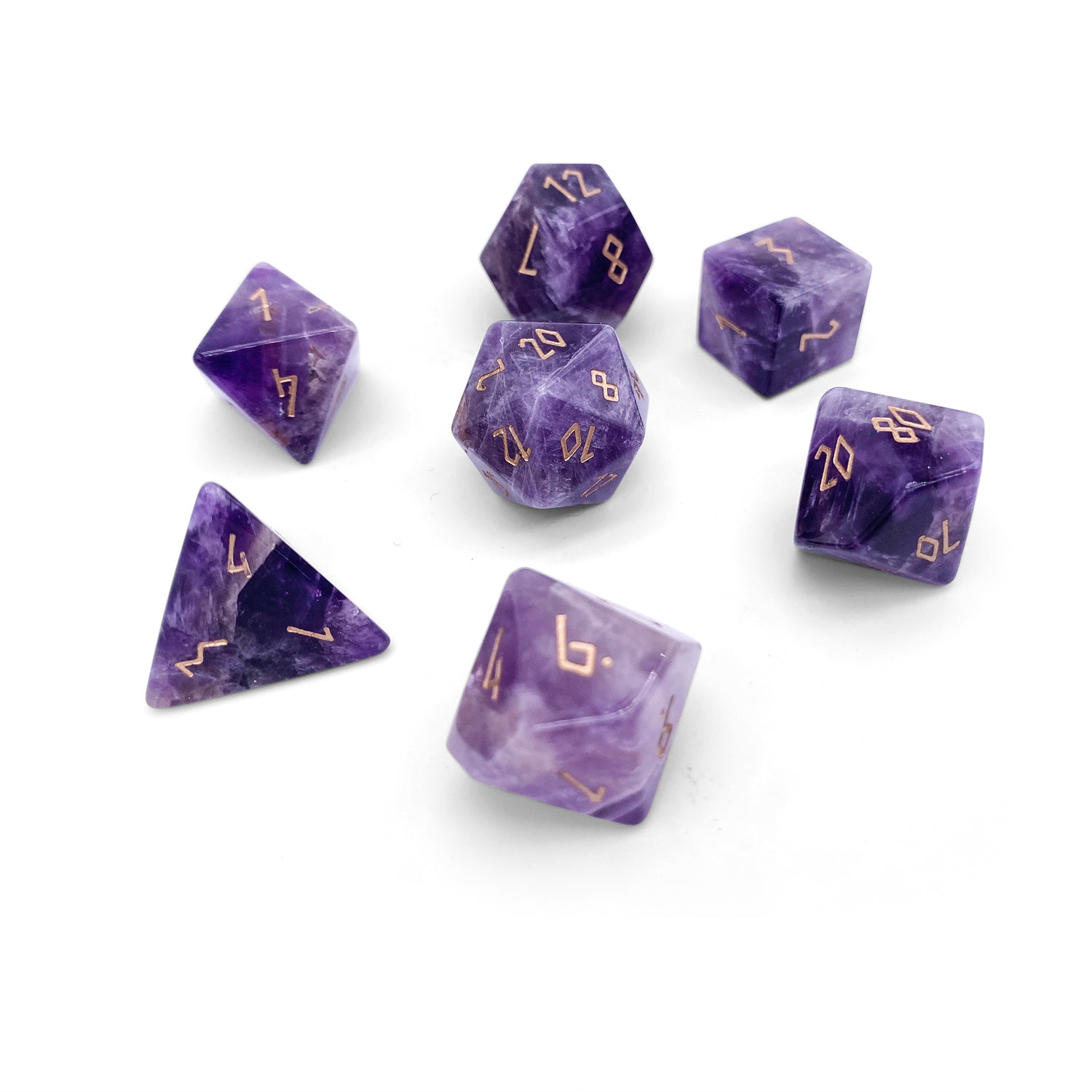
 Amethyst 7-Piece Set (genuine quartz, Mohs 7)
Genuine amethyst sourced from Uruguay and Brazil, Mohs 7, handpicked and sandblasted. Norse Foundry states upfront to expect slight natural variation in color, size, and number placement — exactly the honesty you want. At Mohs 7 it's among the more roll-friendly stones, though like any quartz it can still chip on a hard edge. A genuinely lovable flagship gemstone set.
- Verified genuine amethyst with stated origin (Uruguay/Brazil)
- Mohs 7 — durable end of the gemstone range
- Maker discloses natural variation and has a damage/return policy
- $95 is real money for dice that still need a tray
- Translucent purple can make light ink fills read soft in dim light
 3 photos
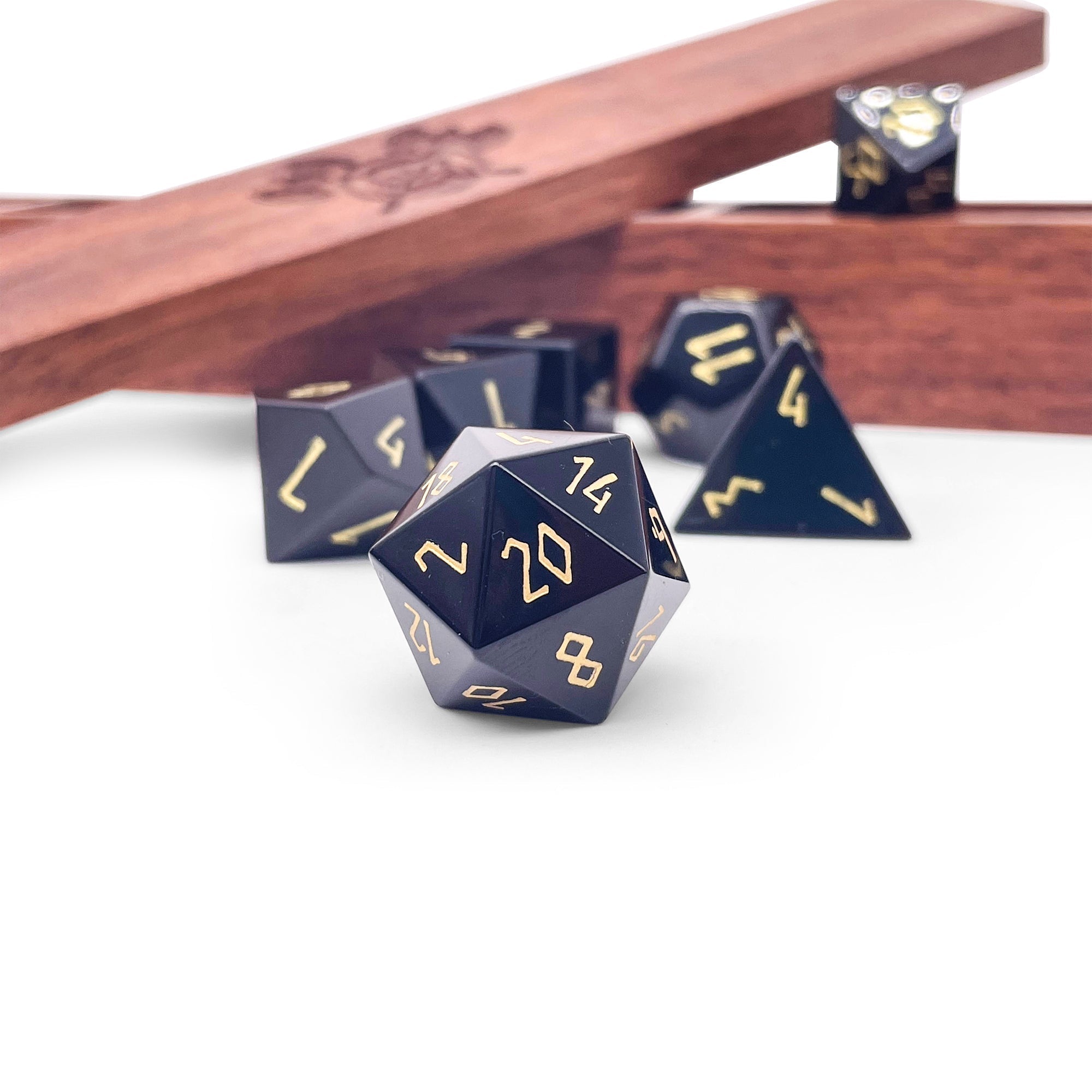
 Black Obsidian 7-Piece Set (natural volcanic glass)
Natural obsidian from volcanic sites in Argentina and Chile — deep, opaque black with gold engraving that reads beautifully across a table. The friendliest entry to the category: high contrast, striking, and well-priced. Caveat from the gemology, not the maker: obsidian is volcanic glass (~Mohs 5–5.5) that fractures conchoidally into sharp edges, so it's more brittle than the quartz family. Roll it on felt and it'll dazzle.
- Excellent readability — opaque black with gold numerals
- Genuine natural obsidian with stated volcanic origin
- Most approachable price among Norse Foundry's natural stones
- Brittle: volcanic glass chips into sharp edges on hard impacts
- Maker lists Mohs 6; general gemology puts obsidian nearer 5–5.5
 3 photos
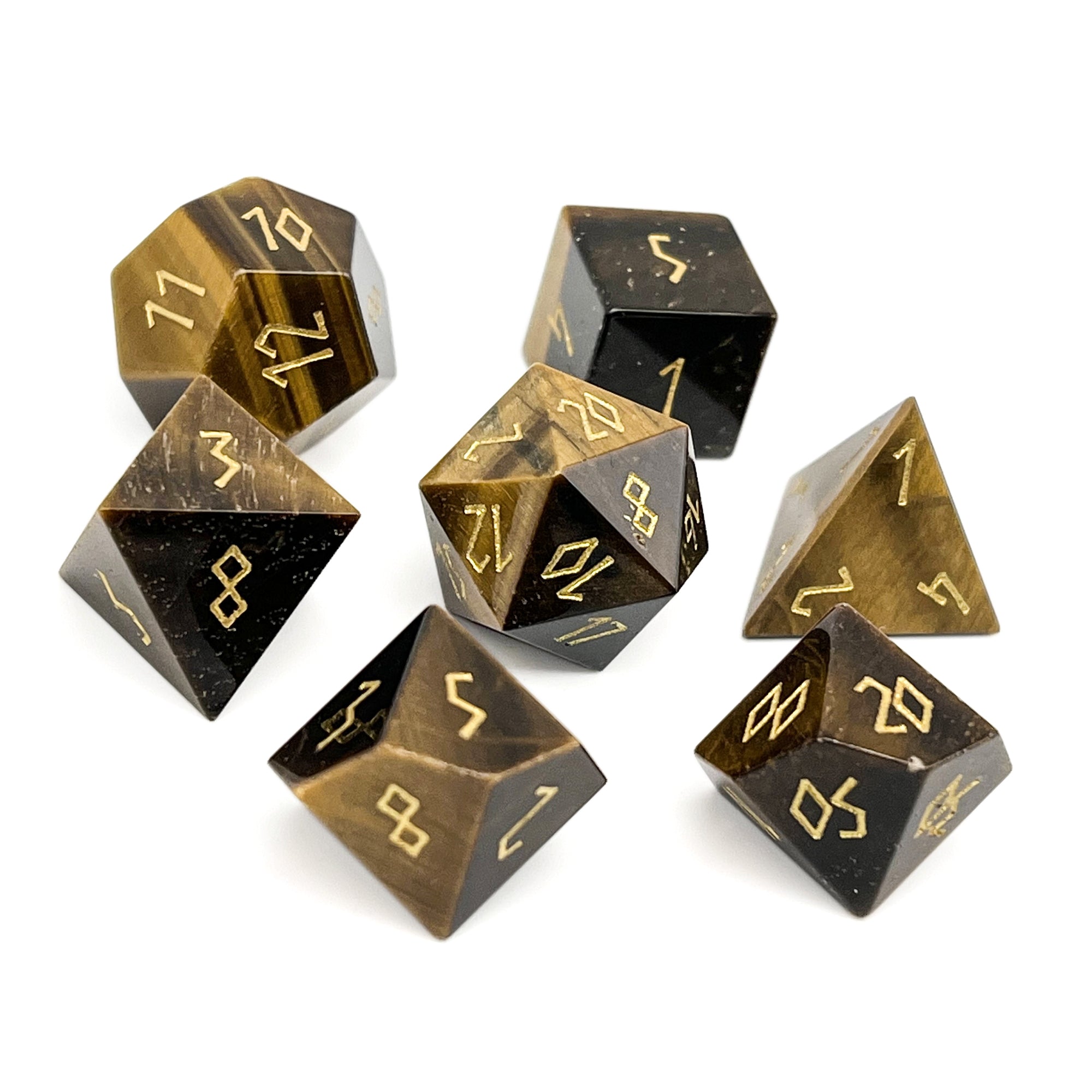
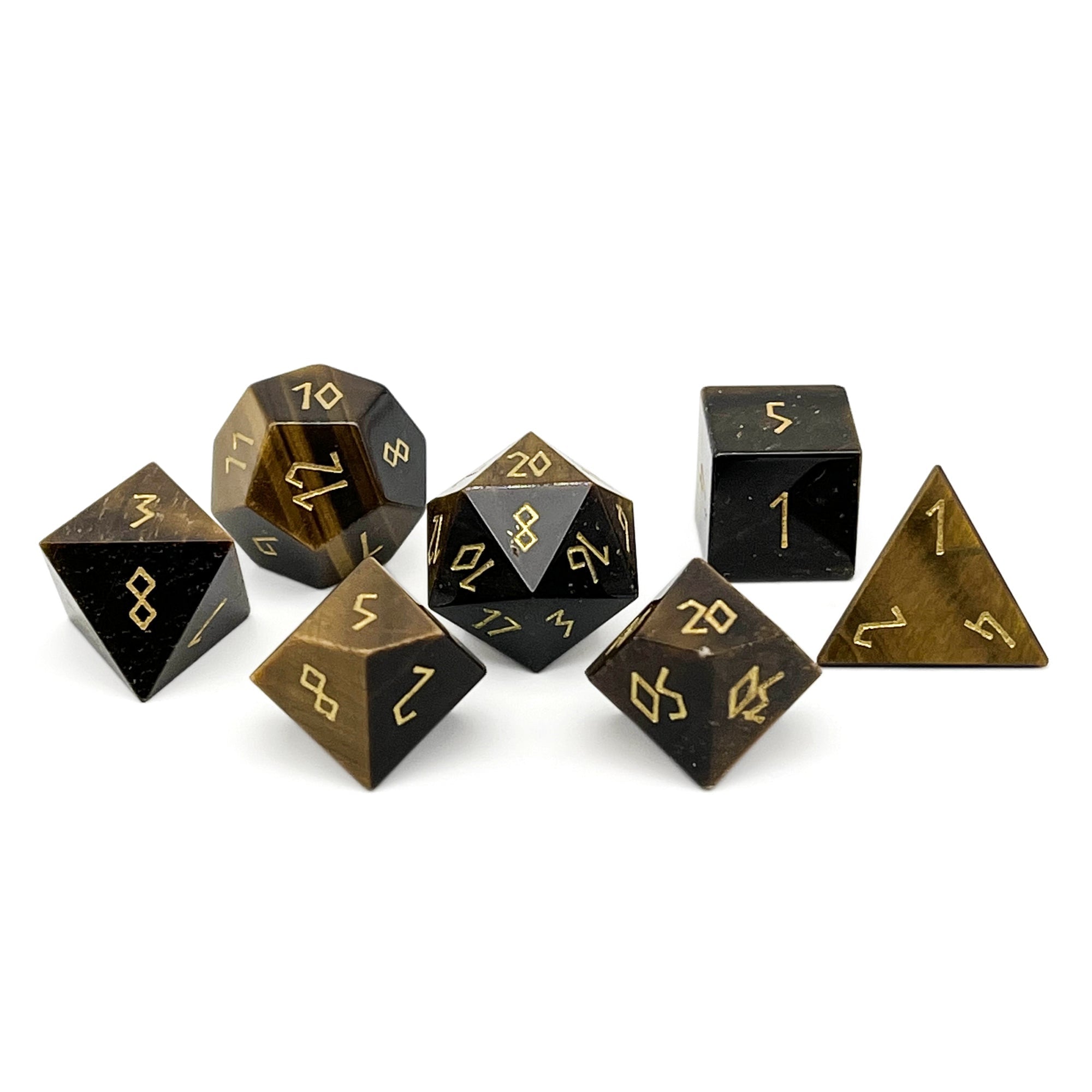
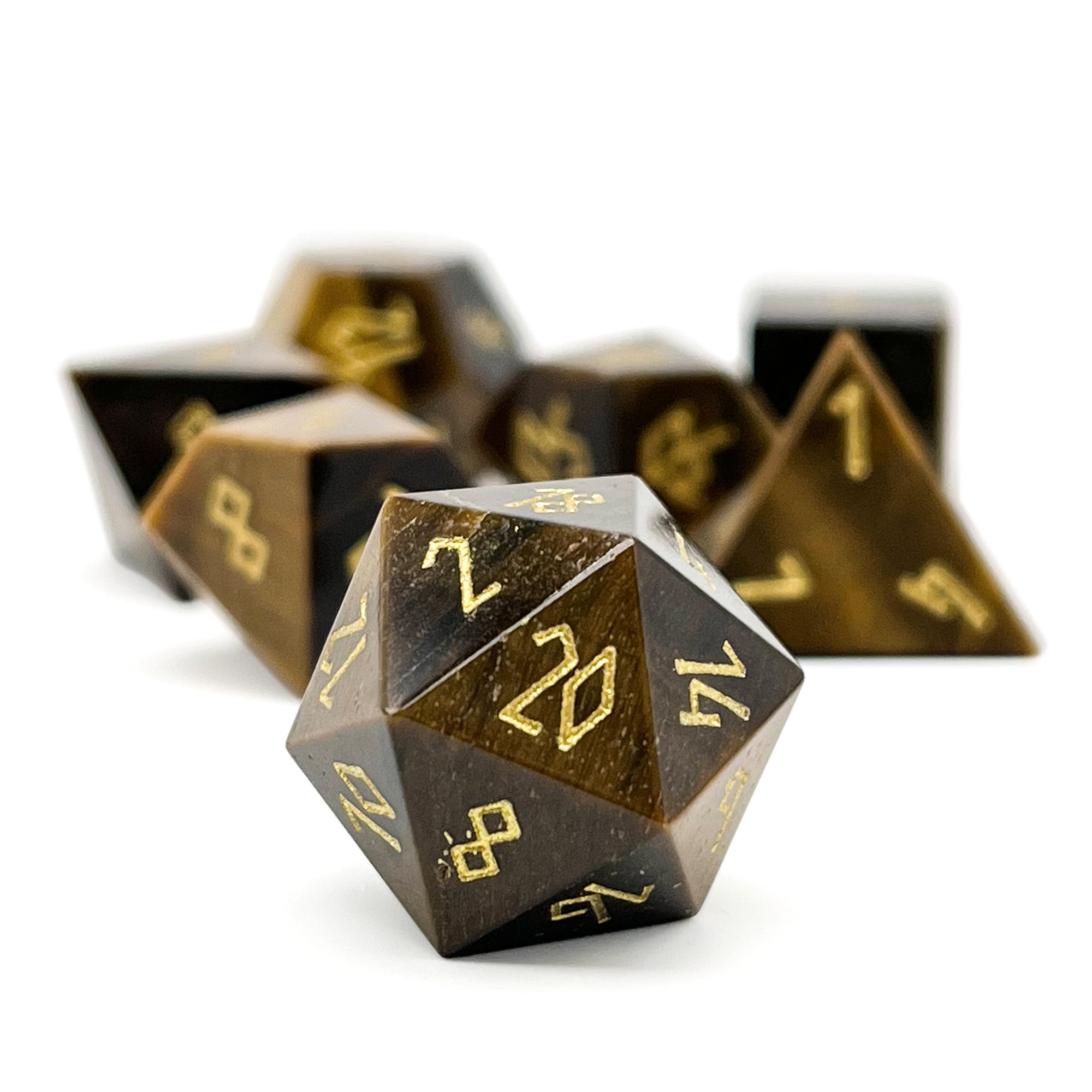
 Tiger's Eye 7-Piece Set (chatoyant quartz)
Genuine tiger's eye (India, South Africa, Sri Lanka), ~16–22mm, golden-brown with that signature shifting chatoyant band and gold number engraving. Mohs 6 — a touch softer than amethyst but still squarely a usable stone, and pleasantly opaque so the numerals read well. A distinctive, much-admired set that photographs as well as it plays.
- Real tiger's eye with stated origins
- Opaque warm stone — numerals read clearly
- That moving cat's-eye shimmer is genuinely captivating
- Mohs 6 — softer than the quartz-7 stones, so respect the tray
- Natural banding means no two dice match (a pro for some, con for the order-loving)
 3 photos
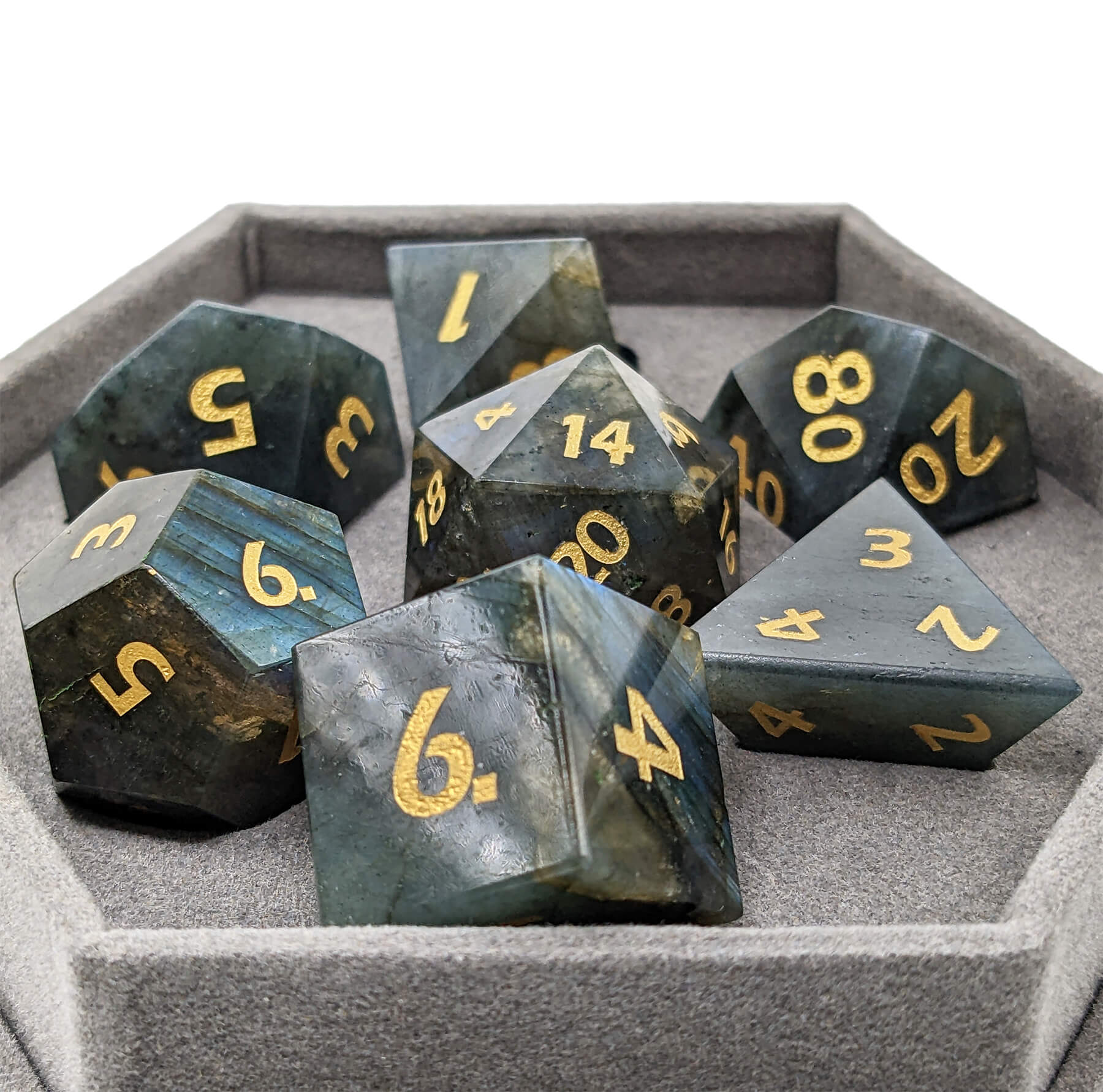
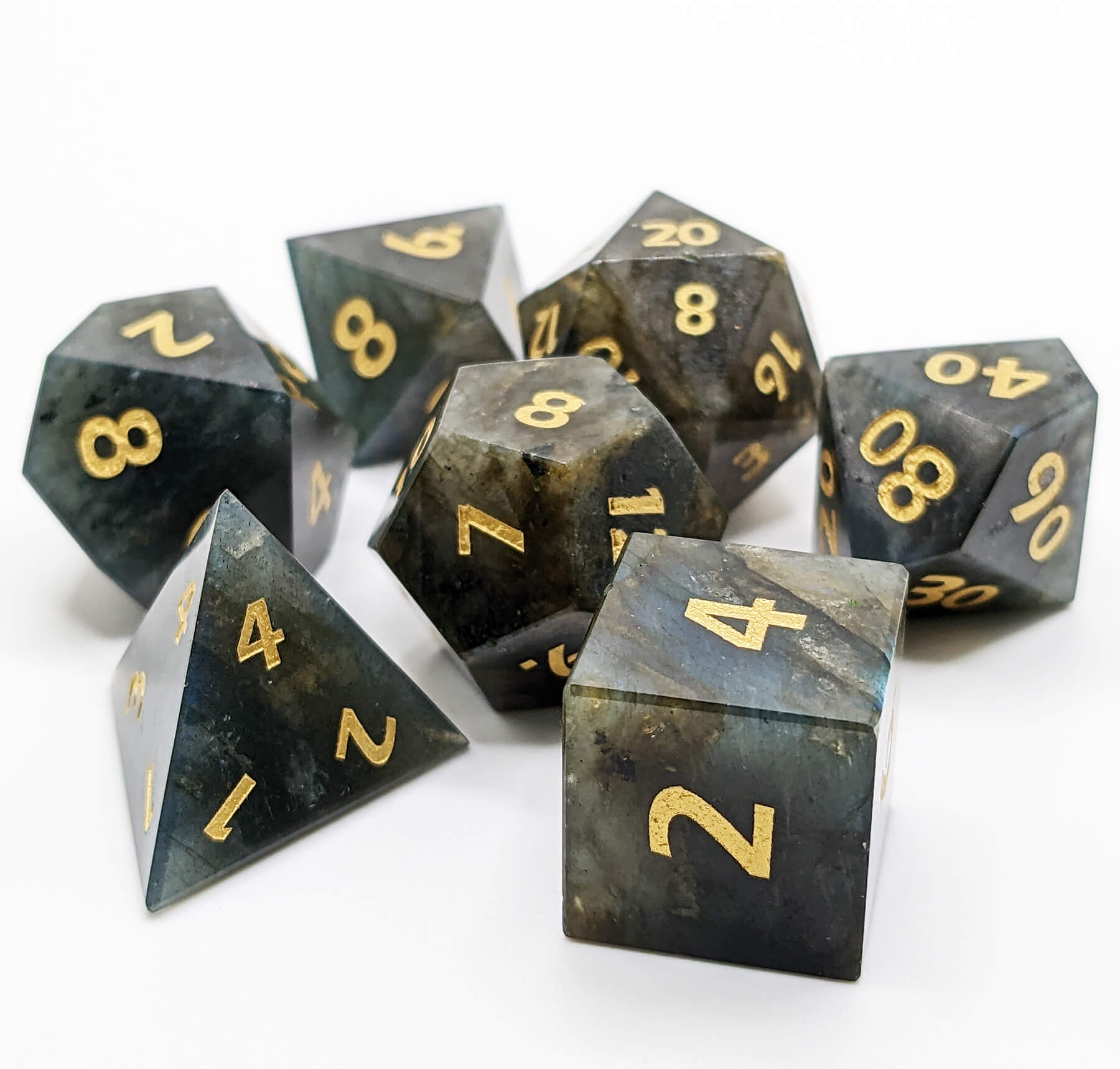
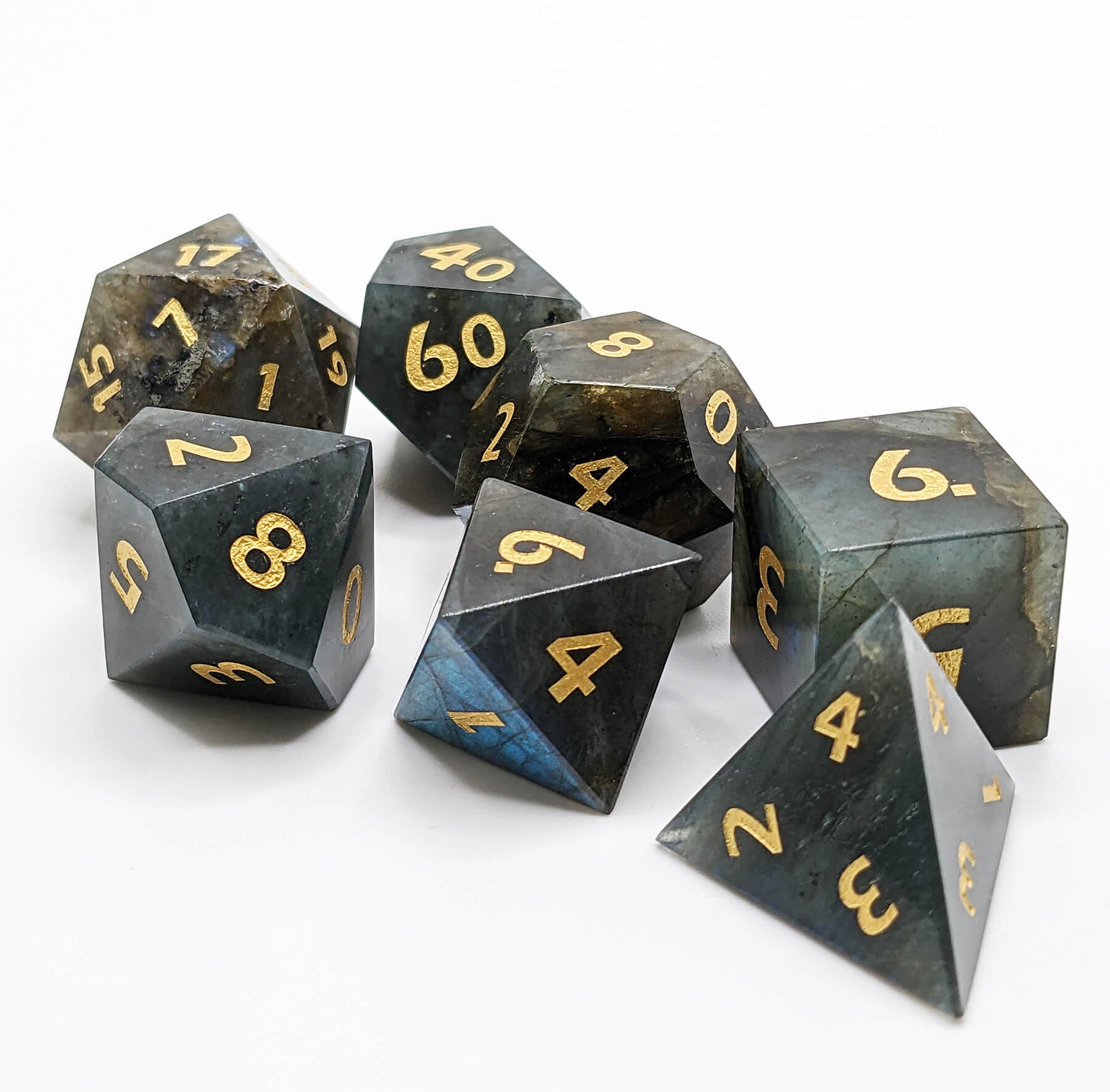
 Labradorite 7-Piece Set (the showstopper)
Labradorite's blue-green flash (labradorescence) is the stone people put down their drinks to look at — Dice Craft Lab literally uses it as the example of a set that stops conversation. Listed around $70 at Dark Elf Dice (on sale from $90). It's a feldspar (~Mohs 6–6.5), so treat it as a semi-display set: gorgeous in the hand, happiest rolled on felt.
- The flash is unmatched — a genuine showpiece
- Reasonable for such a striking stone, often on sale
- Each die's flash sits differently — true one-of-a-kind
- ~Mohs 6–6.5 and cleaves — more fragile than quartz
- The flash only shows at certain angles, so readability/glamour vary
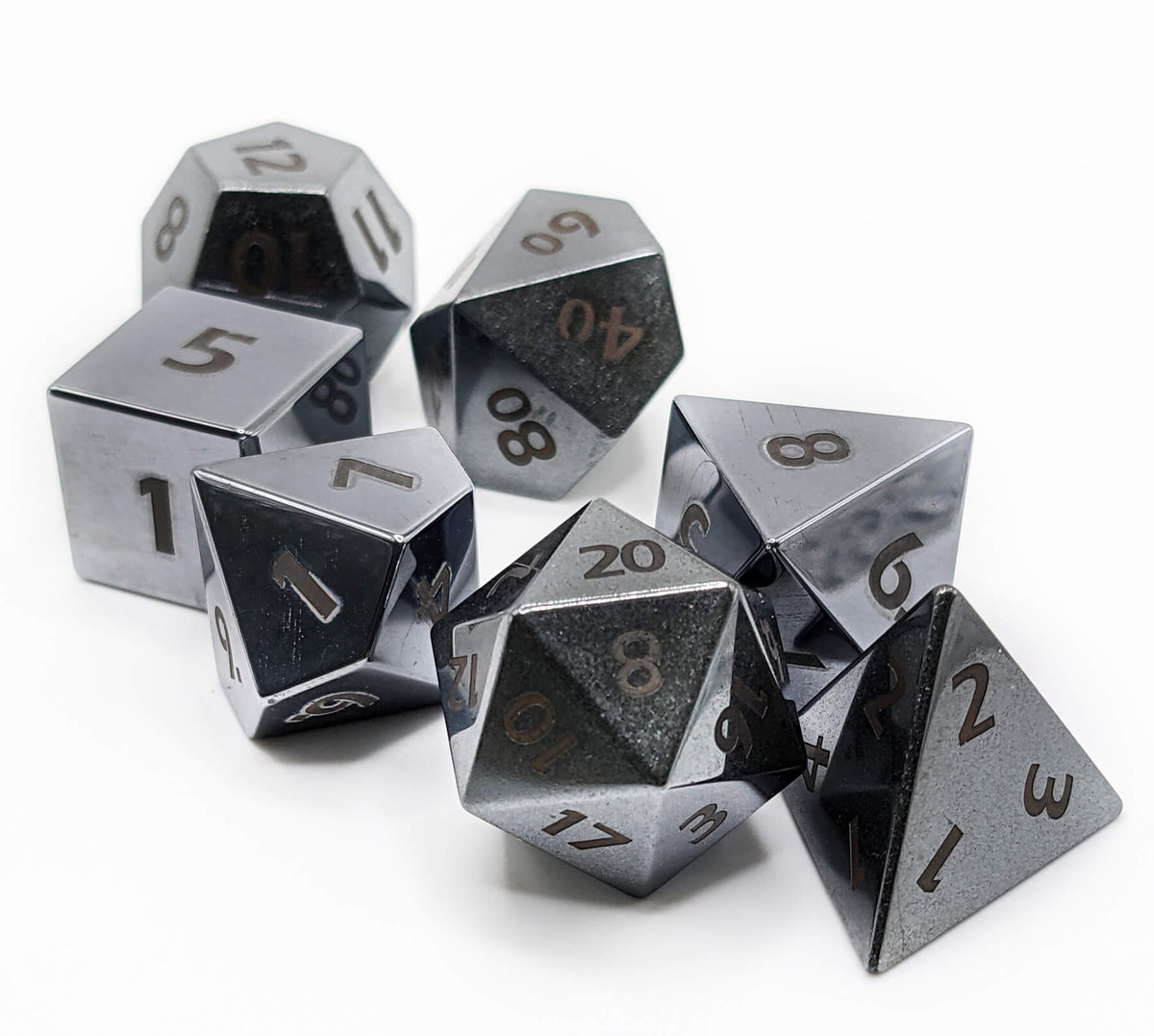
Hematite 7-Piece Set (heavy, metallic, opaque)
Hematite is iron-oxide-rich, unusually dense, and reads almost like polished gunmetal — a fun bridge between gemstone and metal aesthetics with serious hand-weight. Listed near $60 at Dark Elf Dice (on sale from $80). It's opaque, so numerals are legible; just note hematite is brittle and can chip/flake at edges, so the tray rule very much applies.
- Exceptional weight and a metallic sheen
- Opaque — easy to read
- Lower price than most full stone sets
- Brittle — chips and can flake at edges
- Very heavy dice can mar a hard table; use a tray both ways
 3 photos
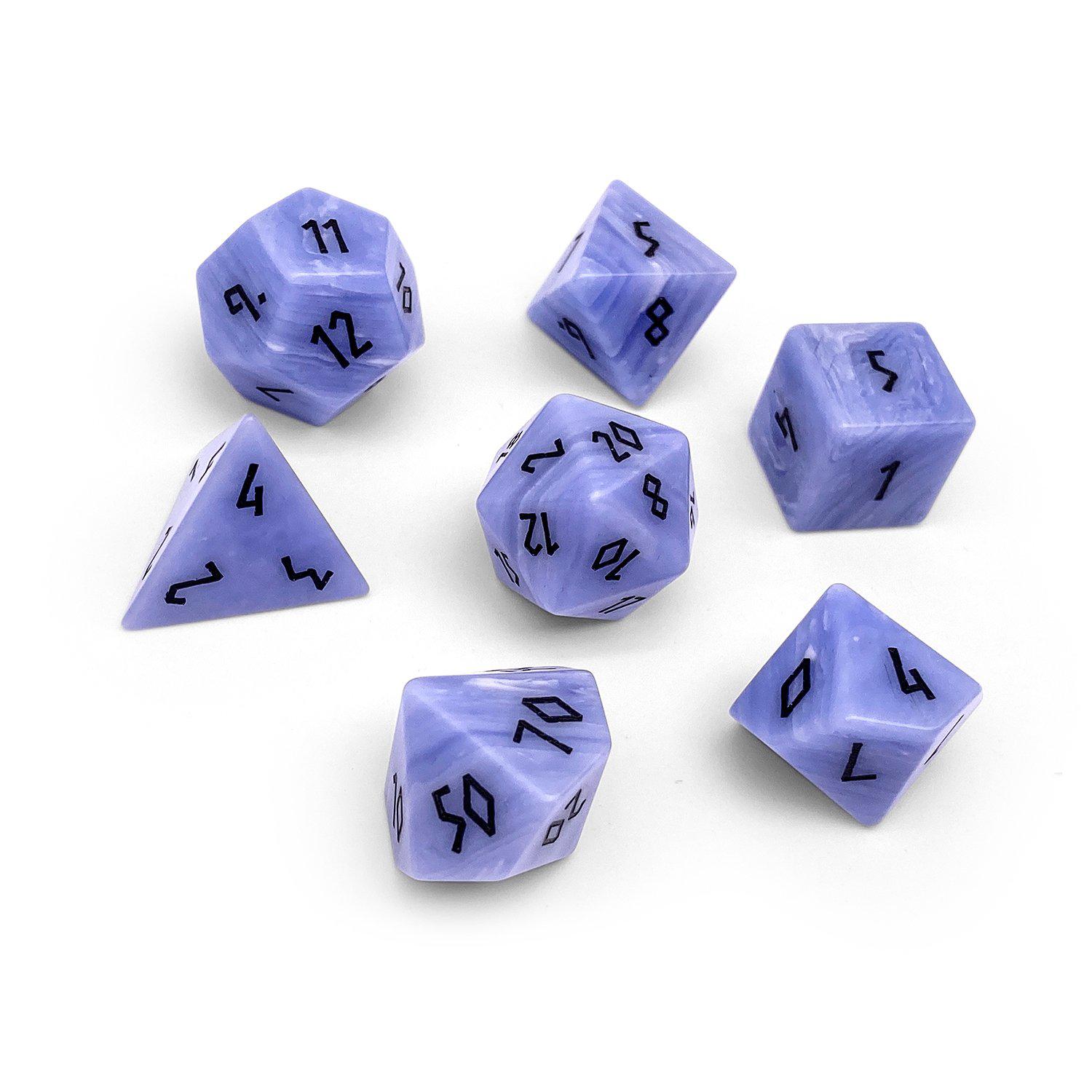
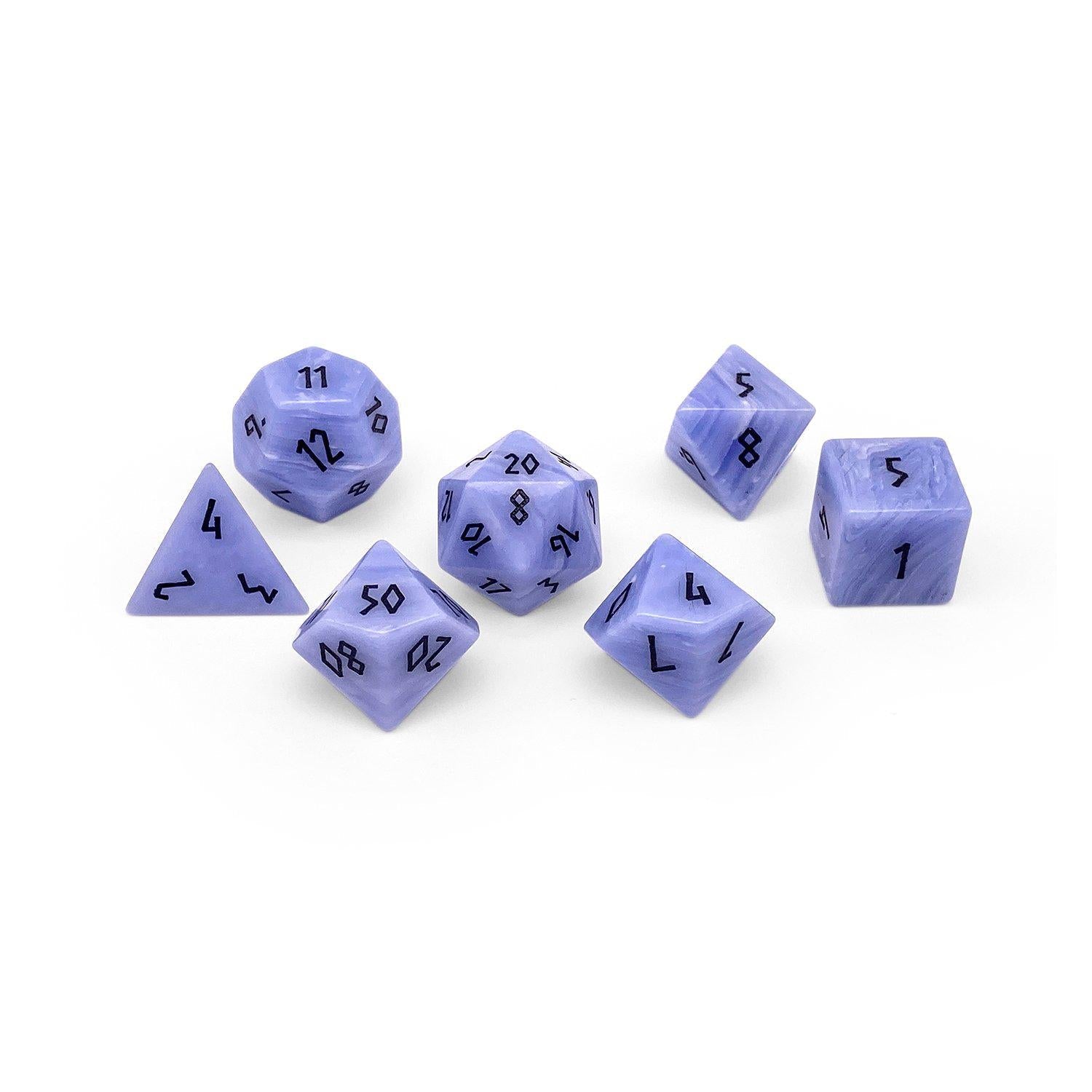
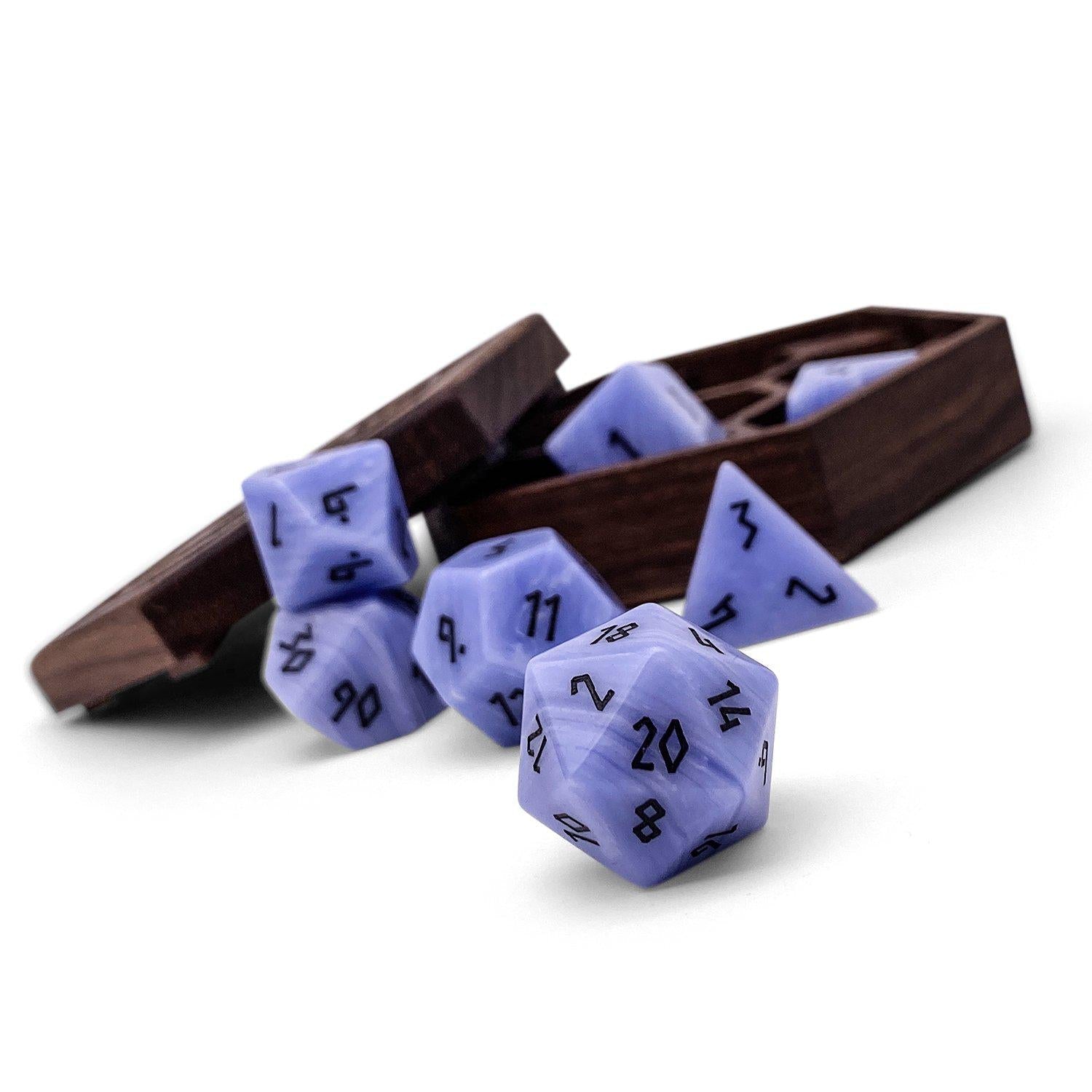
 Blue Lace Agate Set (banded chalcedony)
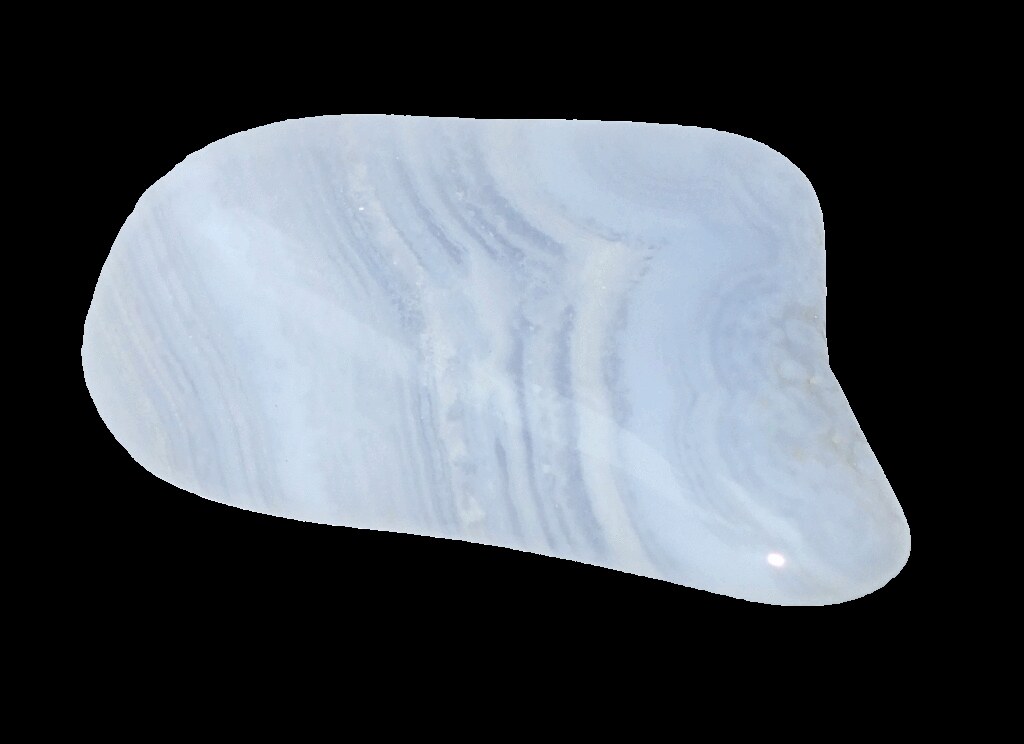
Agate is microcrystalline quartz (~Mohs 7), making it one of the more durable and affordable genuine-stone choices. Dark Elf Dice carries several agate colors from ~$55–$65 (often on sale from $75). Blue lace agate's pale banding is gentle and pretty; because it's light and somewhat translucent, prioritize a contrasting ink fill and check the numeral photos before you buy.
- Quartz-family durability near Mohs 7
- Among the most affordable genuine-stone sets
- Multiple natural colorways to choose from
- Pale/translucent banding can hurt readability
- Listed colors and prices shift with frequent sales
 3 photos
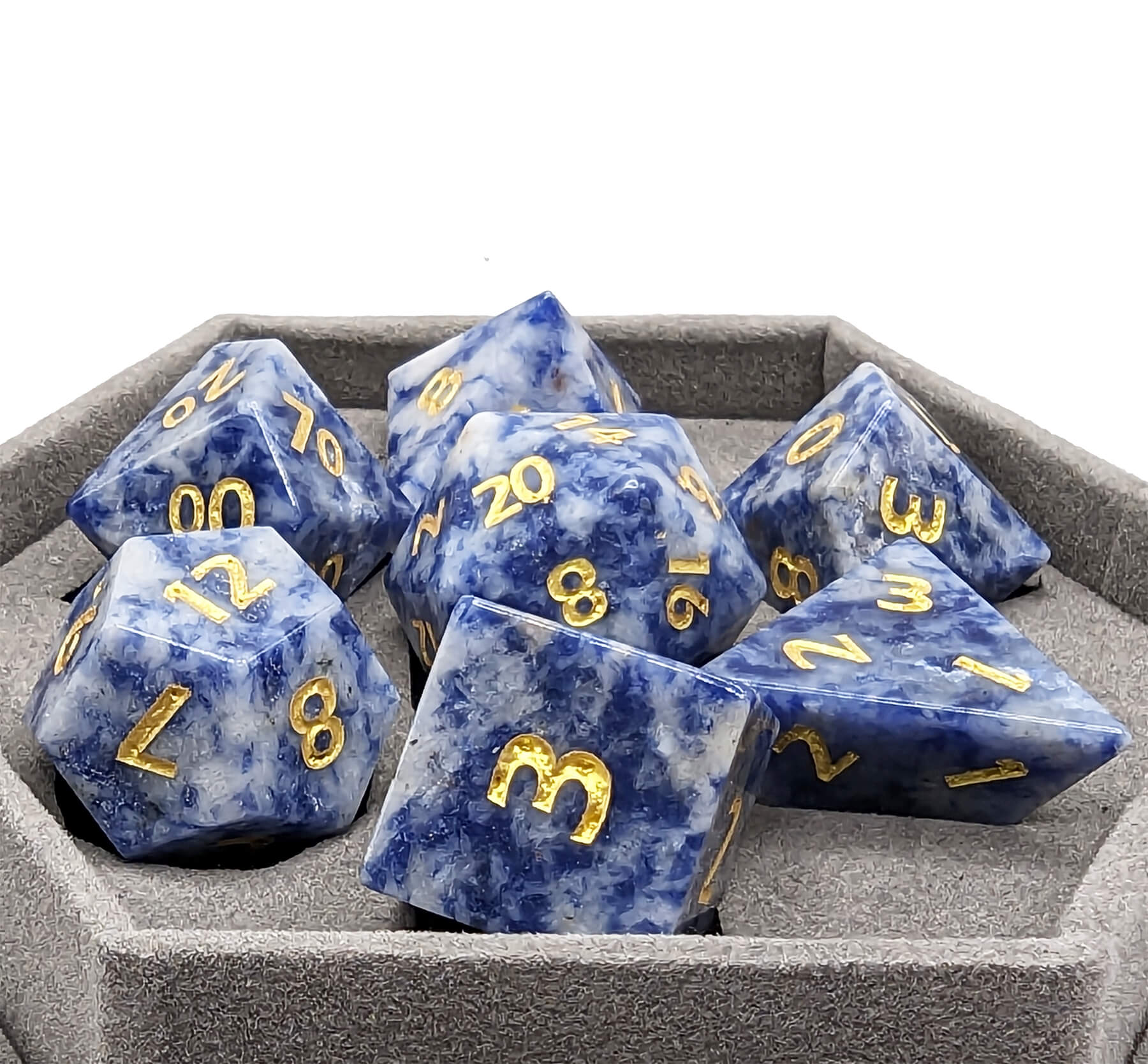
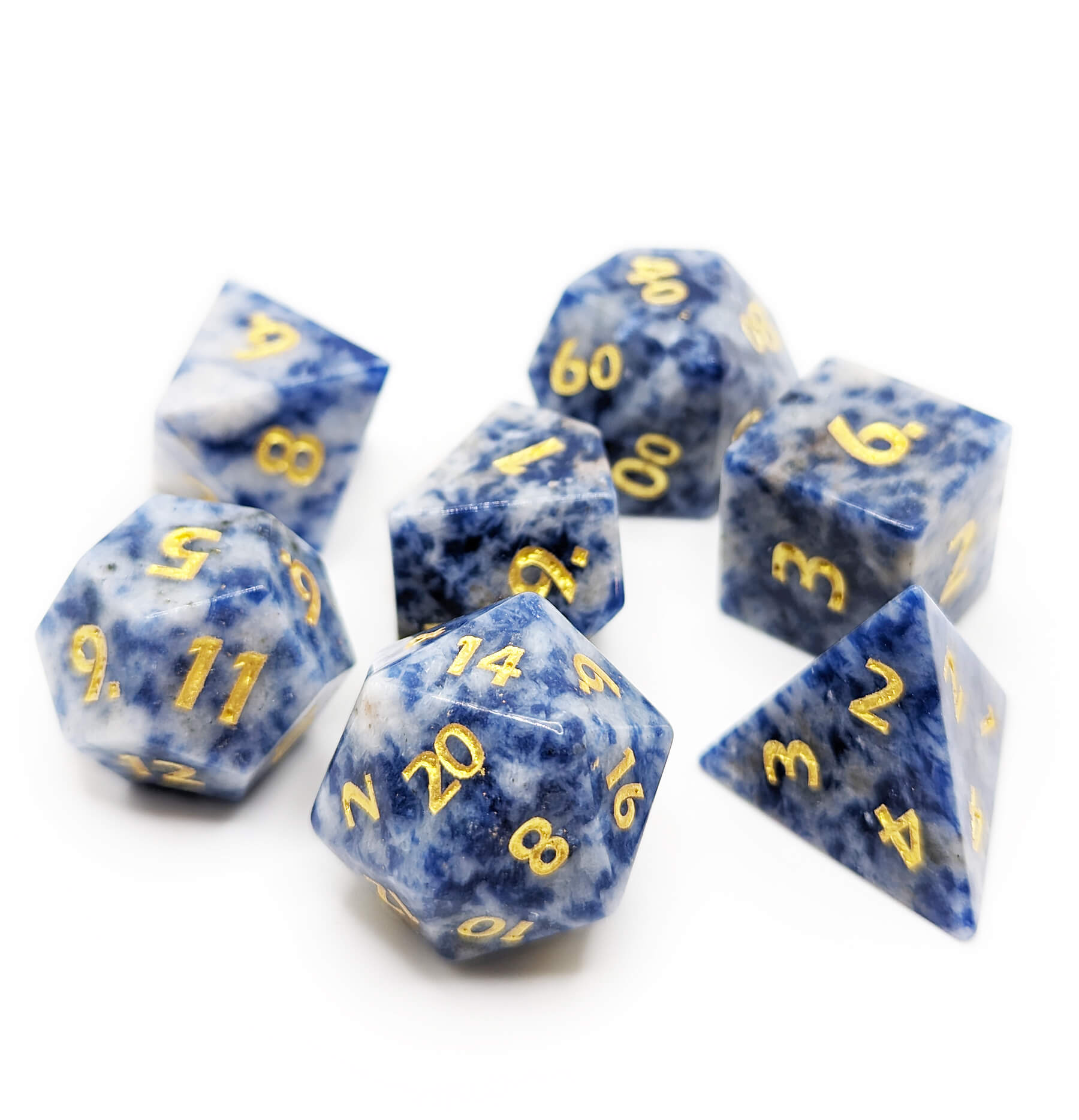
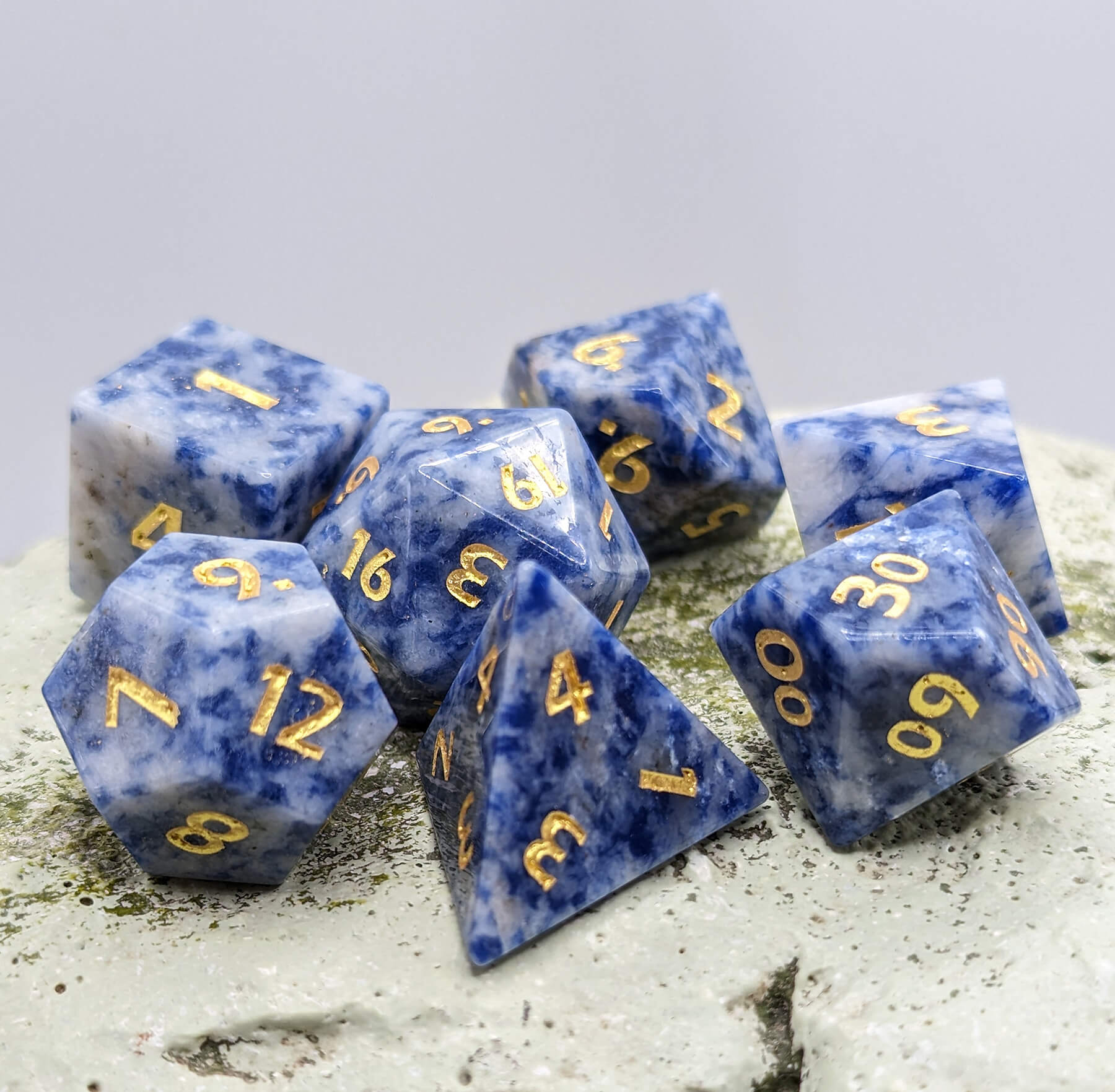
 Blue Sodalite Set (dark, opaque, readable)
Sodalite gives you that rich royal-blue-with-white-veining look, opaque enough to read well, at roughly $80 from Dice Dungeons (hand-cut stone). It's softer (~Mohs 5.5–6), so it's a respect-the-tray stone, but it's a handsome, legible choice and a sensible step down in price from $99 lapis. Confirm the exact price on the product page — cart rounding varies.
- Opaque royal blue with white veining — reads cleanly
- Less expensive than comparable lapis sets
- Hand-cut genuine stone
- ~Mohs 5.5–6 — moderately soft, handle with care
- Price shown with cart-level rounding (~$80); verify on page
At a glance
| stone | hardness | look | watch for |
|---|---|---|---|
| Amethyst (quartz) | 7 | Translucent purple, often zoned light-to-deep | Durable end of the range, but translucency can wash out light ink fills; still chips on hard edges |
| Tiger's Eye (quartz) | 6 | Opaque golden-brown with shifting chatoyant band | Opaque so it reads well; softer than amethyst — respect the tray |
| Agate / Jasper (chalcedony quartz) | ~7 | Banded or mottled, many natural colors | Affordable and durable; pale/translucent agates can be hard to read |
| Obsidian (volcanic glass) | ~5–5.5 | Deep opaque black, glassy; rainbow/sheen variants exist | Excellent readability but brittle — conchoidal fracture makes chipped edges genuinely sharp |
| Sodalite / Lapis Lazuli | ~5–6 | Deep royal blue; lapis adds gold pyrite flecks | Opaque and legible but moderately soft; verify lapis isn't dyed sodalite/howlite |
| Jade (jadeite/nephrite) | ~6–7 | Green (or lavender/white), waxy luster | Soft-ish but exceptionally TOUGH — best chip resistance despite the modest hardness number |
| Hematite | ~5.5–6.5 | Metallic gunmetal grey, very heavy | Dense and striking but brittle — chips and flakes at edges |
| Malachite | ~3.5–4 | Vivid banded/concentric green | Soft — display set only; handle raw stone dust with care; do not roll on hard surfaces |
| Fluorite | 4 | Glassy purple/green/rainbow zoning, often translucent | Beautiful but chips from a short drop and cleaves easily — display piece, not a roller |
| Selenite (gypsum) | 2 | Pearly white, satin/fibrous sheen | Scratches under a fingernail and dissolves in water — essentially unusable as functional dice |
| 'Cat's Eye' (FIBER-OPTIC GLASS — not stone) | ~5–6 (glass) | Glowing single band, candy colors | It's manufactured glass, not gemstone — makers themselves label it 'Glass Dice'; fine to own, just not stone |
| 'Purple/White Turquoise' (usually DYED HOWLITE/MAGNESITE) | ~3.5 (howlite) | Veined blue/purple mimicking turquoise | Dye pools in the cracks; soft and not actually turquoise — don't pay turquoise prices for it |
Questions, answered
Are gemstone dice worth the money?
For collectors and display-minded players, yes — a genuine $75–$100 set from a transparent maker is a lasting, one-of-a-kind pleasure. For players who need provable fairness or who roll hard on hard surfaces, no — acrylic or metal is more durable and better balanced for far less. Worth depends entirely on whether you value the object or the function.
Do gemstone dice chip easily?
More easily than resin or metal, yes. Even hard quartz-family stones (Mohs 7) can chip on impact with tile, concrete, or a hard edge, and soft stones like fluorite (Mohs 4) can lose a corner from a short drop. Always roll them on felt, neoprene, or in a lined tray, and store them in foam. A tray isn't optional with gemstone dice.
How can I tell if gemstone dice are real or fake?
Check four things: the name (a real mineral name like 'amethyst' beats a color-first name like 'purple turquoise'), the cracks (dye pooling in seams means dyed howlite/magnesite), the heft (real stone is heavier and stays cooler than resin or pressed composite), and the seller (a maker who states the stone's origin and Mohs hardness has nothing to hide). And remember: 'cat's eye' is glass by definition, not gemstone.
Is 'cat's eye' a real gemstone in dice?
No — in the dice world, 'cat's eye' means fiber-optic synthetic glass, not natural chrysoberyl. Makers state this themselves; Norse Foundry literally titles their cat's eye product 'Glass Dice' and notes the 'stones' are fiber-optic glass. They look fantastic and are fine to own — just buy them as glass at a glass price, not as a gemstone.
What does 'purple turquoise' or 'white turquoise' actually mean?
Usually dyed howlite or magnesite — soft white stones dyed to mimic turquoise. Turquoise doesn't naturally come in those candy colors, and the dye gives it away by pooling darker in the cracks and veins. It's sometimes relabeled 'turquenite.' Fine as an inexpensive stone; just don't pay genuine-turquoise prices for it.
Are gemstone dice balanced enough for serious play?
For home D&D and narrative games, yes — the bias from natural density variation is small and harmless. For anything requiring provable fairness, no: a balance test will almost always show more bias in stone than in a quality resin or precision metal die. That's a limit of natural material, not a maker defect, and no price tier removes it.
Which gemstone is best for dice you'll actually roll?
Quartz-family stones (amethyst, tiger's eye, agate, jasper — near Mohs 7) for everyday durability, or jade for its exceptional toughness (it resists shattering better than its hardness suggests). Obsidian reads beautifully and is popular but is brittle volcanic glass. Avoid soft stones — fluorite, selenite, malachite — as players' dice; they're display pieces.
Why is hardness not the same as durability for dice?
Mohs hardness measures scratch resistance; toughness measures resistance to chipping or shattering. A die can be hard and still brittle — even quartz at Mohs 7 chips if it hits a hard edge wrong. Conversely, jade is softer on the scale but very tough, so it survives impacts better. For dice, you want both a decent hardness AND good toughness, which is why jade and the quartz family are the safe bets.
How much do real gemstone dice cost?
A genuine full 7-piece set from a reputable maker generally runs $75–$100, with single statement d20s and sale items as low as $35–$65, and premium or scarce stones above $100 (e.g., Norse Foundry amethyst $95, tiger's eye $85, obsidian $75; Elderwood Academy stone sets $79–$99). Prices verified June 2026 and shift with frequent sales — confirm on the maker's page. A 'gemstone' set priced around $12 is not solid natural stone.
Margo's verdict
Genuine gemstone dice are worth it — for the right person. If you're a collector or a player who loves a heavy, cold, one-of-a-kind object and you'll roll on felt and store them in foam, a real $75–$100 set from a transparent maker (Norse Foundry, Dark Elf Dice, Elderwood Academy, Dice Dungeons, Awesome Dice) is a lasting joy. Lead with the quartz family (amethyst, tiger's eye, agate, jasper) or tough jade if you actually roll; lead with obsidian for drama and readability; relegate fluorite, selenite, and malachite to the shelf. If you need a provably fair, drop-proof roller, buy acrylic or metal instead — that's not a knock on gemstone dice, it's just the wrong tool for that job. Above all, buy the stone you think you're buying: 'cat's eye' is glass, 'purple turquoise' is usually dyed howlite, and the only common gemstone-dice regret that's 100% preventable is paying gemstone prices for neither. Know the stone, pay its fair price, roll it gently — and it'll reward you for years.
Research ledger 18 sources · reviewed 2026-08-10
Specifications, rules, current product information, community experience, and contrary evidence were checked against the sources below. Commercial links are kept separate from editorial evidence.
- norsefoundry.comnorsefoundry.com/products/amethyst-7-piece-rpg-dice-set-gemstone
- norsefoundry.comnorsefoundry.com/products/tigers-eye-7-piece-rpg-dice-set-gemstone
- norsefoundry.comnorsefoundry.com/products/black-obsidian-7-piece-rpg-dice-set-gemstone
- norsefoundry.comnorsefoundry.com/products/clear-cats-eye-7-piece-rpg-dice-set-gemstone
- norsefoundry.comnorsefoundry.com/collections/gemstone-dice
- darkelfdice.comdarkelfdice.com/collections/gemstone-dice
- elderwoodacademy.comelderwoodacademy.com/product-category/rpg-dnd-dice/gemstone-dice
- dicedungeons.comdicedungeons.com/collections/gemstone-dice
- awesomedice.comawesomedice.com/collections/gemstone-dice
- dicecraftlab.comdicecraftlab.com/buying-guides/gemstone-dice
- gia.edugia.edu/gems-gemology/summer-2023-lab-notes-glass-imitation-cats-eye-chrysoberyl
- rocktumbler.comrocktumbler.com/blog/dyed-howlite-the-turquoise-impostor
- gemsociety.orggemsociety.org/article/hardness-and-wearability
- gemsociety.orggemsociety.org/article/select-gems-ordered-mohs-hardness
- en.wikipedia.orgen.wikipedia.org/wiki/Tiger%27s_eye
- en.wikipedia.orgen.wikipedia.org/wiki/Obsidian
- en.wikipedia.orgen.wikipedia.org/wiki/Selenite_(gypsum)
- Community research index: r/DnD discussions about Are Gemstone Dice Worth It?reddit.com/r/DnD/search/?q=Are%20Gemstone%20Dice%20Worth%20It%3F&restrict_sr=1&sort=top
Let me check that before we say it.

Keep exploring
The next smart rabbit holes.
⬢ Topic PathTabletop Accessories: compare the whole shelfBuy the accessory that fixes a repeated annoyance first. Protection, setup speed, readable state, and comfortable handling beat...Buying GuidePremium Artisan Dice Sets: Japanese Craft, Resin & Gemstone CollectiblesThe finest gaming dice marry tradition, craft, and intention—where every roll carries the weight of careful hands and rare materials.Buying GuideBest Dice Trays & Rolling Trays, Ranked (2026)The ancestors chose silence over spectacle — four walls, soft floor, and the discipline of the contained roll. Here are ten, from eleven...