Best Metal Dice Sets for D&D (2026): Heft, Balance & Where to Buy
An archivist's verified ledger of metal dice worth owning—what the heft actually buys you, whether they roll fair, and which sets are craft versus costume jewelry for your table. With receipts.

AI-assisted curator persona · research and editorial responsibility: Robert Pruitt · how this guide was made
Last editorial refresh: 2026-06-13 Gold-standard QA: 2026-08-10 15 sources reviewed Affiliate links checked during gold-standard pass

The short answer
A good metal dice set is judged on three marks: heft (the authoritative weight of a die-cast zinc alloy or solid metal blank), balance (sharp, well-defined corners and a void-free casting, which is why metal generally rolls fairer than bubble-prone plastic), and finish (deeply engraved or enamel-filled numerals that won't rub away). The caveats are real and inseparable from the appeal — metal dice are loud, they can dent a bare hardwood table, and the d4 is a genuine caltrop, so a tray or mat is mandatory, not optional. For a first set, the steer is simple: Die Hard Dice's Mythica Dark Iron (~$50) gives you legitimate heft, readable raw-steel faces, and a foam case that won't punish you for a single hard roll.
Decision map
Choose in thirty seconds
The definitive first metal set
Best character / theme-forward zinc set
Best treasure-chest / gift aesthetic
Permit me, before we open the ledger, a confession: I love a heavy die. There is a particular gravity to a die-cast d20 settling into the felt—a thunk of consequence that no injection-moulded plastic has ever managed—and I will not pretend to be neutral about it. A metal die is an artifact with provenance, with weight in both the literal and the heraldic sense, and when it crits, the table feels it.
But reverence is not the same as gullibility, and this is where most metal-dice guides fail you. They will rhapsodize about 'premium feel' and then sell you a $90 vanity set carved from a stone that is, by the maker's own admission, not balanced. They will not tell you that the d4 will draw blood, that zinc enamel chips at the corners, or that 'antique' finishes are frequently pre-distressed precisely so you cannot tell when the plating has actually worn. I will tell you all of it, because a true collector buys with open eyes—and because I've checked the sources.
So: nine makers examined, eight sets I will actually vouch for, arranged from the $20 first-acquisition to the $95 reliquary-piece—and an honest accounting of which ones earn their weight and which are simply heavy. Roll them on a tray. Always a tray. Now, to the catalogue. Let me show you what the ledger actually says.
Start here, then go deeper
You are in the right cabinet.
 ⬡ Universe HubDungeons & Dragons: the whole buying pathDungeons & Dragons is the world's great storytelling engine — a few books, a fistful of dice, and a table of friends. This universe...⬢ Topic PathTabletop Accessories: compare the whole shelfBuy the accessory that fixes a repeated annoyance first. Protection, setup speed, readable state, and comfortable handling beat...
 ComparisonMetal vs Resin Dice: Which Should You Buy? (2026)Metal dealers call it 'fairer.' They're selling you heft and the sound of authority, not physics. Here's what actually changes—and what...
What actually makes a metal dice set 'good'?
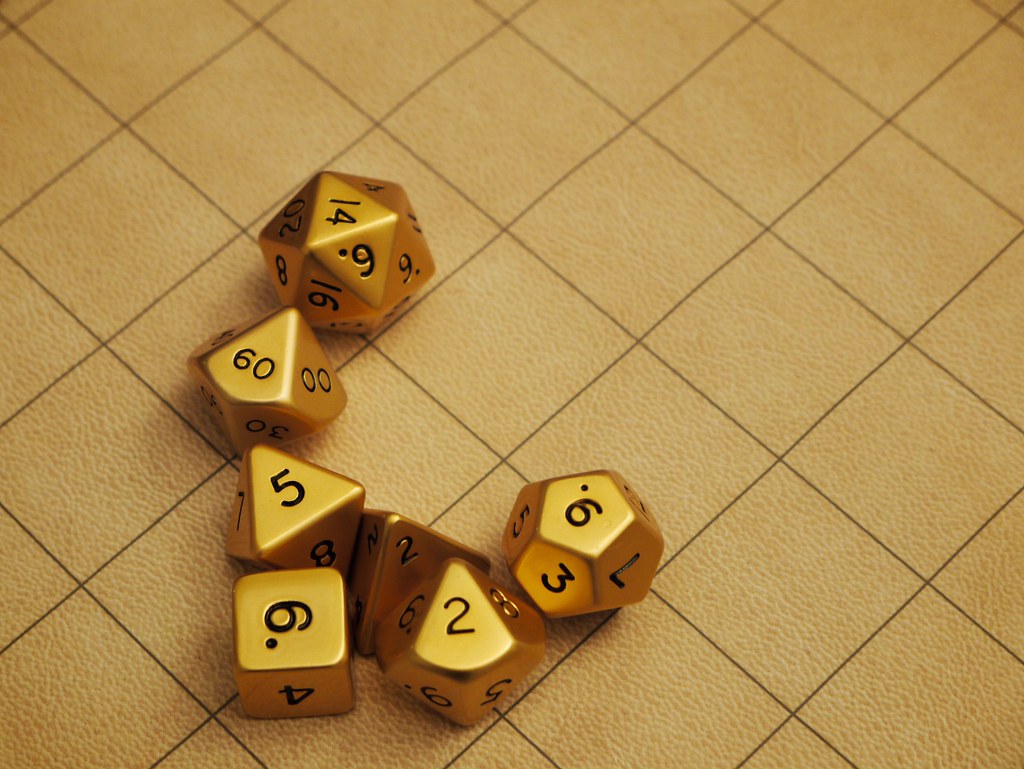
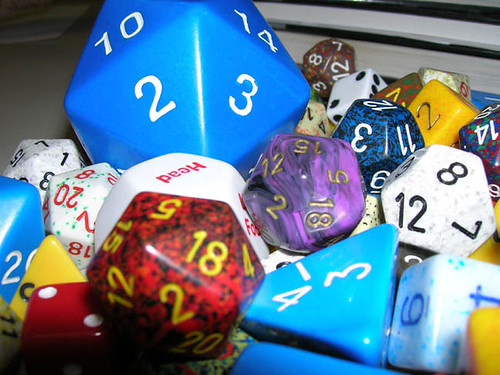
Strip away the marketing patina and a metal dice set is judged on three measurable marks.
Heft. This is the entire point and the one quality plastic cannot fake. A 7-piece metal set runs roughly 5 ounces versus a fraction of that in resin — enough that the dice 'roll extremely well' with 'less effort from your wrist,' as Forged Gaming's buying primer puts it. The weight does the tumbling for you. The trade is momentum: a heavy die rolled with a plastic-dice flick will travel, which is the first reason the tray is non-negotiable.
Balance. Here is the good news the skeptics overlook. Metal dice are cast or machined as solid pieces, so — unlike mass-market plastic — 'there is no chance of hidden voids' or air bubbles to weight one face. Sharp, well-defined corners also help a die stop honestly rather than rolling on like an egg. This is why a competently made metal set is, as a class, fairer than the bargain-bin plastic most players started with.
Finish. The difference between a set you'll hand down and one you'll replace in a year. Numerals that are engraved or cast into the face 'will never rub off'; surface paint and plated color, by contrast, fade and chip with heavy use. Enamel filling resists wear better than topical paint. Inspect the numeral, not the color, and you will rarely be disappointed.
Metal and glass dice are machined or cast as solid pieces, so there is no chance of hidden voids. The skeptic's fear is, ironically, plastic's problem — not metal's.
Do metal dice actually roll fair?
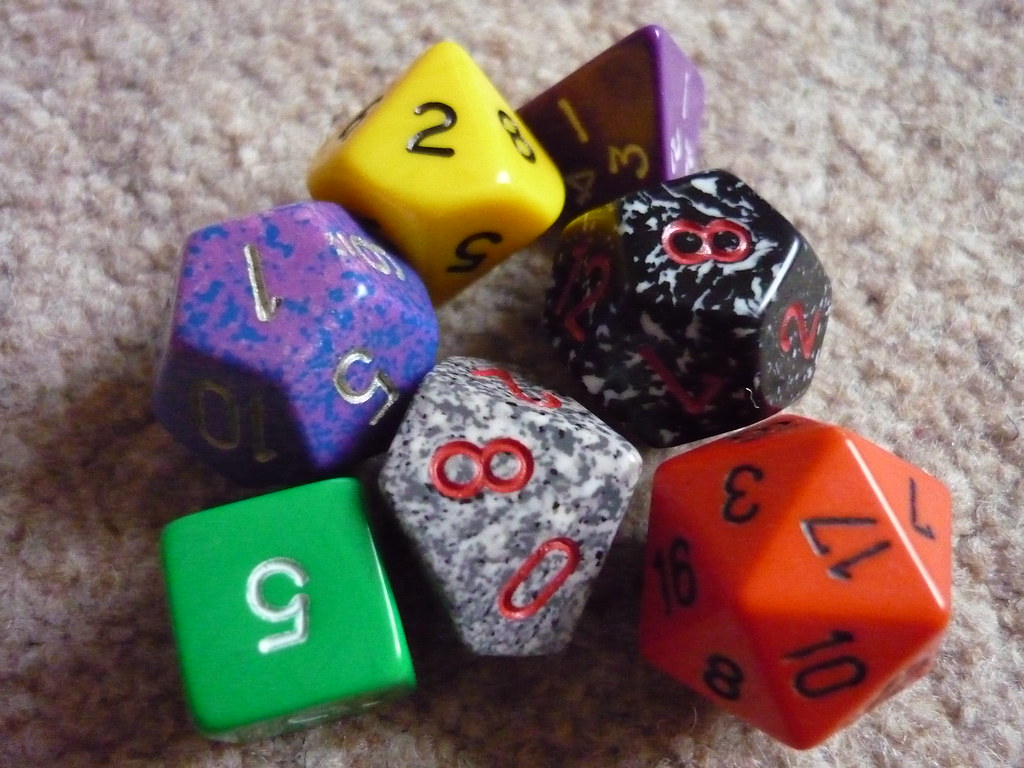

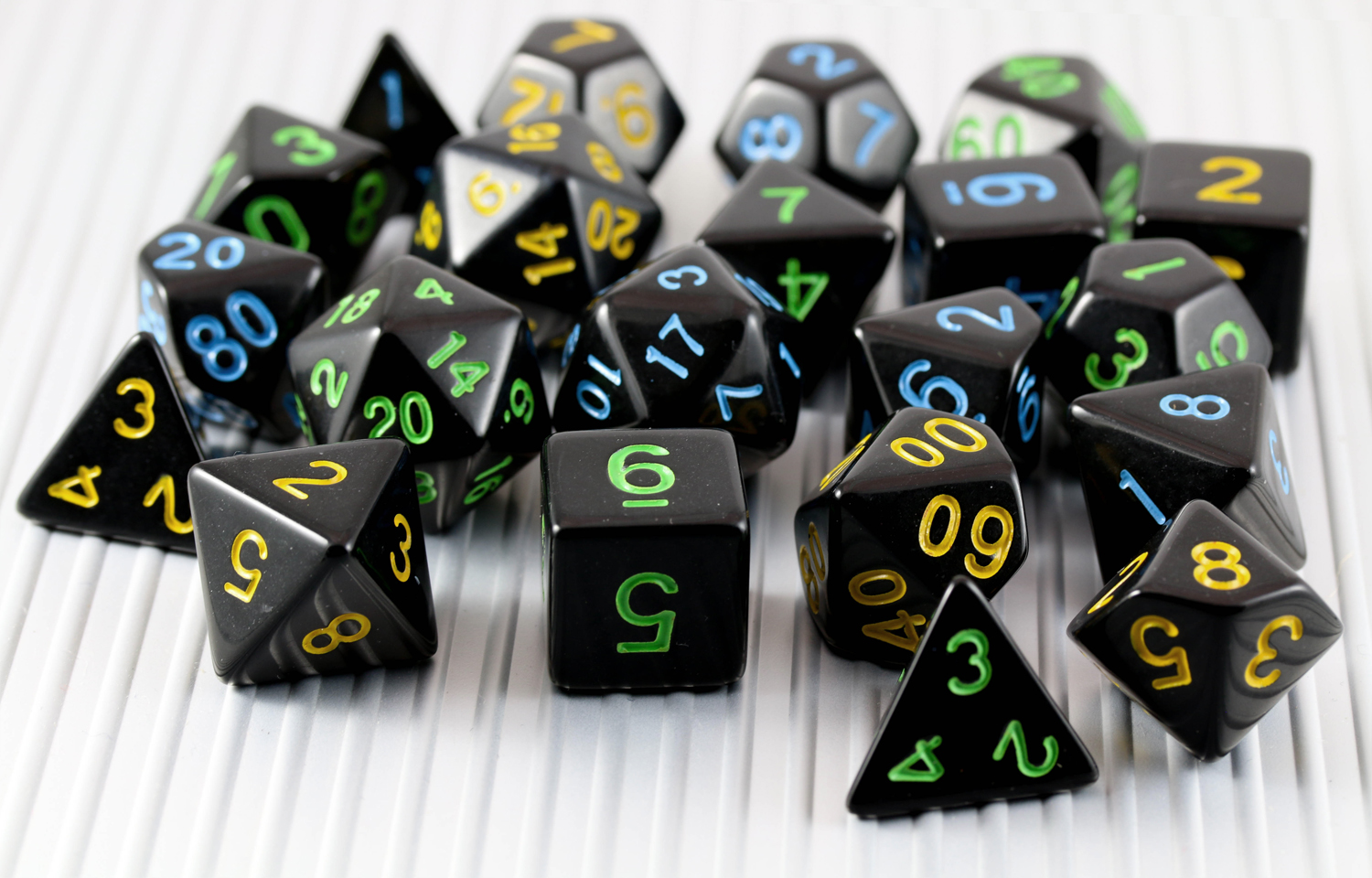
The short, archivable answer: yes — a well-made metal set is generally fairer than the cheap plastic most people start with, but no metal die is 'precision balanced' in the casino sense, and gemstone dice are openly not balanced at all.
The reasoning rewards a moment's attention. Fairness in a die comes down to whether every face has an equal chance of landing up, which is a question of (a) interior density and (b) exterior geometry. On density, metal wins by default: a die-cast or CNC-machined blank has no internal air pockets, whereas budget resin can hide bubbles or off-center inclusions that bias a face. On geometry, sharp, crisp corners stop a die quickly and randomize the tumble; rounded corners increase contact and, over years of wear, can drift a die toward an 'egg-shaped' bias. Mass-produced metal lands in a happy middle — 'relatively even distribution,' as the makers carefully phrase it, achieved through tighter manufacturing tolerances than cheap plastic allows.
What metal is not is laboratory-certified. The honest sellers say 'balanced enough for play,' never 'casino grade.' And the genuinely heavy caveat: natural gemstone dice are not balanced. Norse Foundry states it plainly on its Amethyst set — the stones are 'naturally occurring' with internal variation, so a stone d20 will favor faces. Buy gemstone for the beauty and the provenance; do not buy it expecting a fair fight.
Want to verify your own? Log 100–200 rolls of the d20 and watch for faces clustering well above the expected ~5%. The saltwater float test that works on plastic is unreliable on dense metal — ignore it here.
The honest sellers say 'balanced enough for play,' never 'casino grade.' Anyone promising you a perfectly fair metal d20 is selling you certainty that doesn't exist.
The noise and the table-denting problem (and how to solve it)
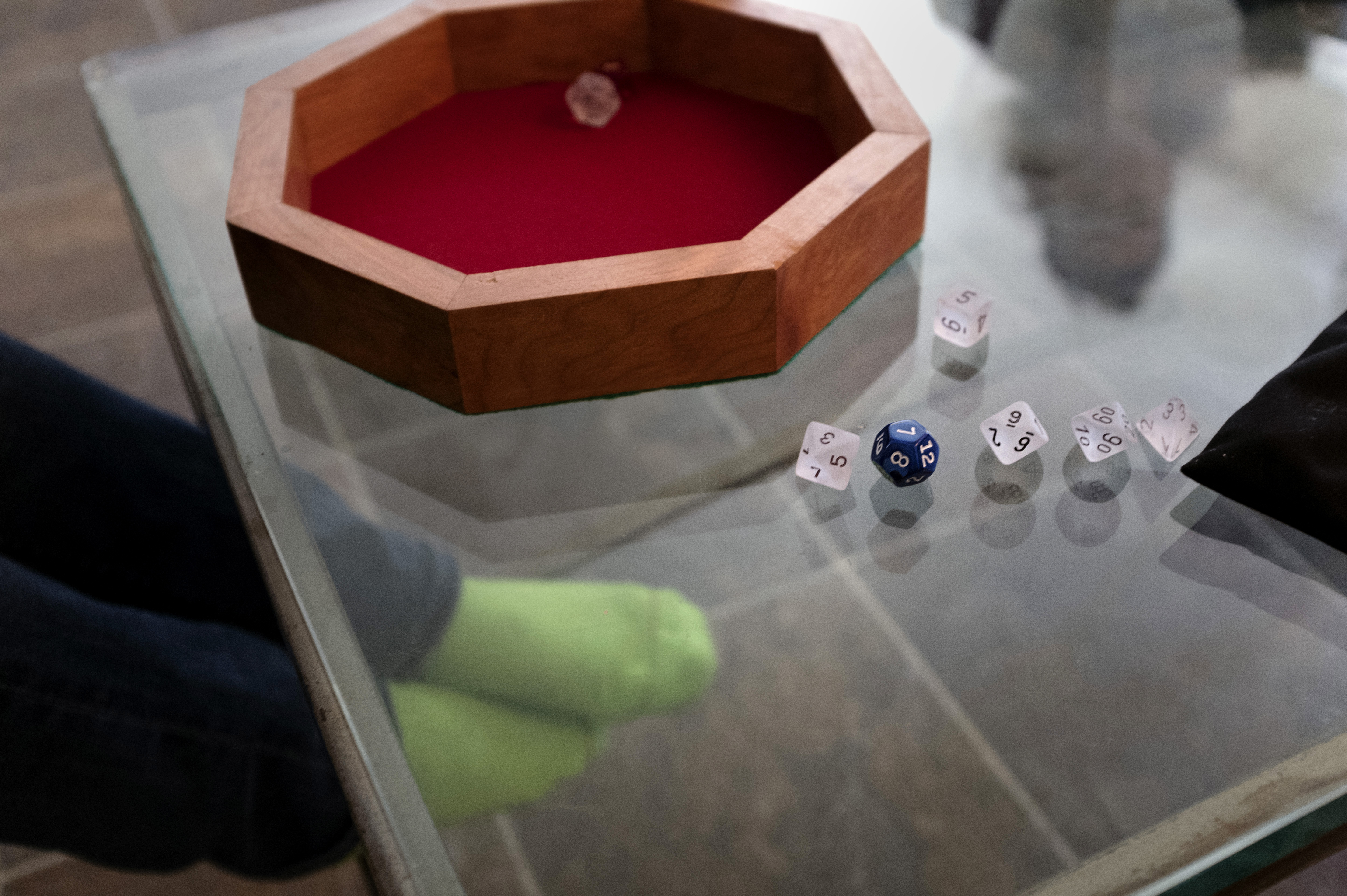

Let us not be coy: metal dice are loud, and they bite. The same heft that makes them feel like consequence also makes them a hazard to a bare walnut table and a trial to anyone sitting near you in a quiet room. The enthusiast framing calls it 'a critical roll accompanied by a thunk!' — and that thunk is, depending on your surface, either a delight or a small dent.
The solution is mercifully cheap and universal: roll on a dampening surface. Every reputable guide agrees, and the material hierarchy is well established. Neoprene is the most resilient — it both protects the surface and silences the roll. EVA foam trays similarly 'reduce the noise register' and cushion the landing. PU-leather trays are designed specifically so 'dice don't make a lot of noise.' Plain craft foam protects the table but dampens sound less. A felt-lined wooden tray or a velvet-paddled dice tower (the C4Labs style) is the luxe end of the spectrum.
A few archival notes from the field. The d4 is the real villain — three sharp metal points, upturned, on a hard surface; it is the die most likely to mark a table and the one that earns metal sets their 'caltrop' reputation. Hollow metal sets land noticeably softer and quieter than solid. And a good case matters as much as a tray for the dice themselves — Die Hard's Mythica sets ship in foam-slotted boxes that keep the corners from clacking together in your bag, which is also where finishes chip.
The d4 is the real villain — three sharp metal points, upturned, on a hard surface. Respect it the way you'd respect a dropped tack.
Materials and price tiers: zinc alloy vs solid metal vs stone
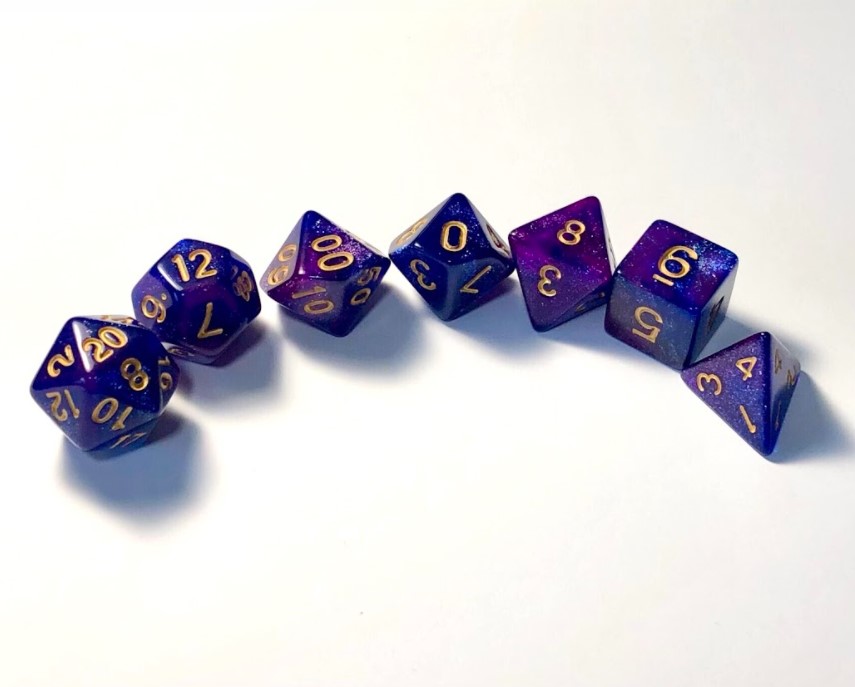
Understand the materials and the prices explain themselves. There are, in practice, three strata.
Zinc alloy (~$20–50) — the workhorse, and where ~90% of you should shop. Nearly every set named in this guide — Die Hard, Norse Foundry's metal line, Easy Roller, Misty Mountain, FanRoll, Dice Goblin — is die-cast zinc alloy, frequently electroplated or enamel-filled. It is affordable, takes detail and finish beautifully, holds genuine heft, and casts as a void-free (thus fair) solid. Its weaknesses are honest and known: zinc 'may chip if dropped frequently' and 'can easily scrape and scuff,' which is partly why so many designs arrive pre-'battle-worn' — the distressing hides wear before it happens. Roll on a tray and a zinc set lasts years.
Solid specialty metals & hollow constructions ($30–100+) — the connoisseur's middle. Aluminum (light, vivid anodized finishes), brass (warm, vintage), stainless steel (modern, corrosion-proof), and titanium (strongest, lightest-for-strength, dearest) occupy the upper tier; CNC-machined aluminum or titanium sets routinely run $100+. Hollow metal sets sit here too as the deliberate lighter/quieter option (~$30). This is where you pay for either exotic metal or precision machining rather than casting.
Gemstone & semi-precious (~$90+) — the reliquary shelf. Hand-carved natural stone (Norse Foundry's Amethyst, $95) is the most beautiful and the least fair, by the medium's nature. Buy it as an artifact, not an instrument.
The through-line: above roughly $50, you are paying for material rarity, machining, or hand-craft — not for better fairness. A $40 cast zinc d20 and a $100 machined aluminum d20 both roll honestly. The premium is provenance and pride of ownership, which — I will be the first to admit — are perfectly good reasons to spend.
Above roughly $50, you are paying for rarity, machining, or hand-craft — not for a fairer roll. The premium buys provenance, not probability.
Sharp-edge vs rounded, and the d4 question
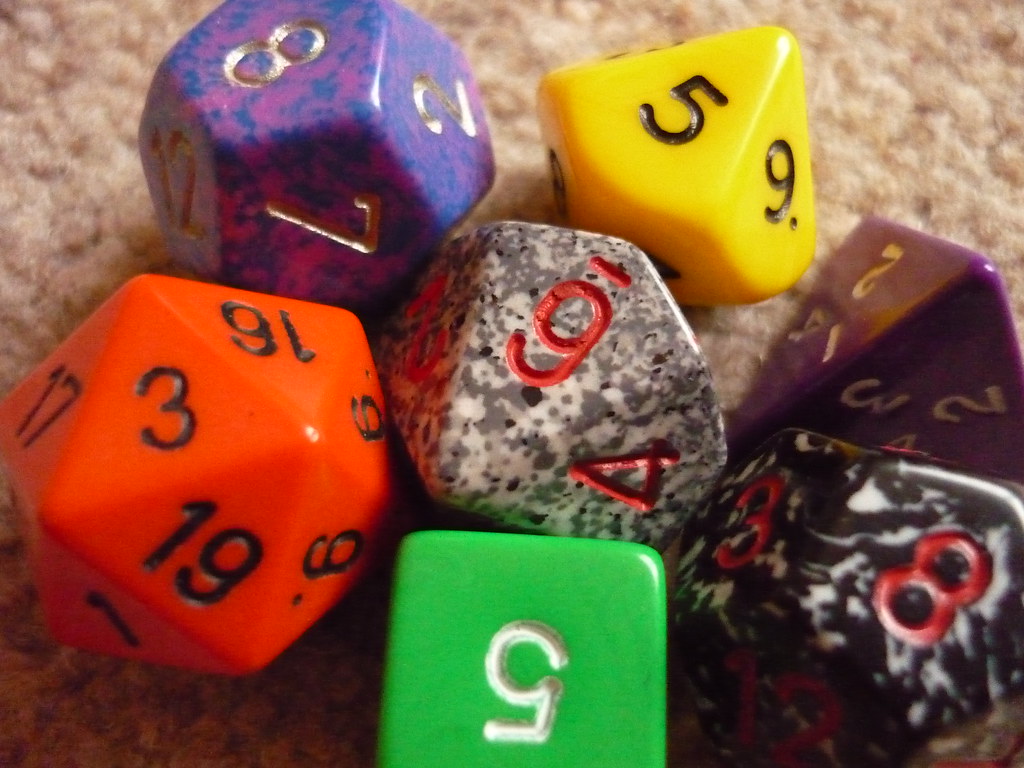
A finer point of geometry, for those who care to agonize — and you, dear reader, plainly do.
Sharp-edged metal dice roll fairer and stay fair longer. Crisp corners reduce contact area, create a more chaotic (thus more random) tumble, and 'help them stop quickly,' so a worn corner is less likely to skew the result. Rounded edges increase surface contact and, critically, wear toward bias: as corners round further with use, a die can drift slightly egg-shaped and start favoring faces. For a set you'll roll for years, sharp edges are the longevity play. Misty Mountain's Brushed Silver Sharp-Edged set ($44.99) is a clean example if this is your priority.
But — and metal makers know this — sharp corners are exactly what dent your table and threaten your fingertips. This is the eternal tension of the medium: the geometry that rolls fairest is the geometry that bites hardest. Many quality metal sets deliberately soften their corners (Die Hard's Mythica line advertises 'softened corners for improved aesthetics and table safety') as a considered compromise between fairness and not gouging your walnut.
Which brings us, inevitably, back to the d4. In metal, a sharp-cornered d4 is the single most table-hostile and finger-hostile object in the set — three upturned spikes with real mass behind them. If you buy sharp-edged metal, the d4 is the die that most demands a tray and a careful hand. Some players keep a plastic or rounded d4 alongside a sharp metal set purely to spare their table and their thumbs. There is no shame in it; there is only a tidier table.
The geometry that rolls fairest is the geometry that bites hardest. Every metal dice maker is quietly negotiating that exact treaty on your behalf.
How to choose your first metal set (a buyer's decision tree)
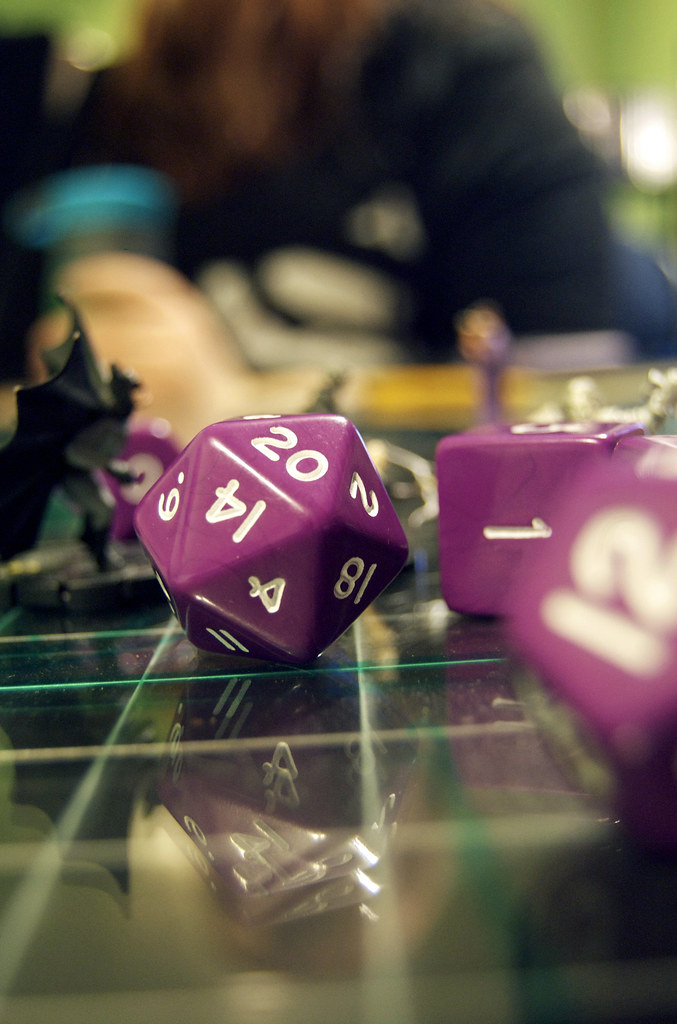
Enough connoisseurship; here is the practical ledger for the actual purchase.
If this is your first metal set ever: buy a single, mid-priced (~$35–50) cast-zinc 7-piece set with a foam case, in a finish you genuinely love, and a $20 neoprene tray to go with it. Die Hard's Mythica Dark Iron is my default recommendation — honest heft, readable raw-steel faces, softened corners, and a slotted case — but any of the sub-$50 zinc picks below will serve. Resist the urge to start at the $100 tier; learn what you like first.
If you're building a collection: now the specialty tiers earn their place. A gemstone reliquary-piece (Amethyst, $95) for the display shelf; a sharp-edged set for the players who care about fairness; a hollow set for quiet apartment nights; an antiqued brass or copper for the dwarven-treasure aesthetic. Buy for the role each set plays.
If it's a gift: budget-tier hollow or cast zinc, $20–35 (Dice Goblin, Easy Roller, FanRoll Antique), in a treasure-chest finish. High perceived value, low risk, and a case included so it presents well.
If you play in apartments or near sleeping housemates: hollow metal + neoprene mat, full stop. You keep the look and lose most of the war-drum.
Three rules that override all of the above: (1) always budget the tray, (2) buy on the numeral and the finish, not the color, and (3) never spend at the $100 tier expecting a fairer roll than $40 buys — spend there only because you want the object.
Learn what you like at $40 before you spend $100. The luxury tier rewards a collector who knows their taste, not a beginner guessing at it.
What experienced tables keep reporting
Recurring owner patterns, synthesized in Puzzlewick's words. Follow each evidence trail to read the original discussion.
I love the Dark Iron Dice I received! Not only is the set glorious, but on my first session with them, they rolled wonderfully.
Read the evidence: Customer review, Die Hard Dice — Mythica Dark Iron
I really like the number style and the simple, but well-made style.
Read the evidence: Customer review, Die Hard Dice — Mythica Dark Iron
These are naturally occurring stones and will not be balanced due to the natural makeup.
Read the evidence: Norse Foundry — Amethyst 7-Piece RPG Set (product page)
Metal dice feel heavy in the hand and are best rolled in a tray... most sets come up smaller than your average plastic or stone set.
Read the evidence: Hipsters & Dragons — The 33+ Coolest D&D Dice Sets
Metal and glass dice are machined or cast as solid pieces, so there is no chance of hidden voids.
Read the evidence: Awesome Dice — Sharp Edge Dice Explained (on metal fairness)
The picks
Some links below are affiliate links — as an Amazon Associate, Puzzlewick earns from qualifying purchases, at no extra cost to you. It never changes a pick.
 2 photos
 7pc RPG Set - Mythica Dark Iron
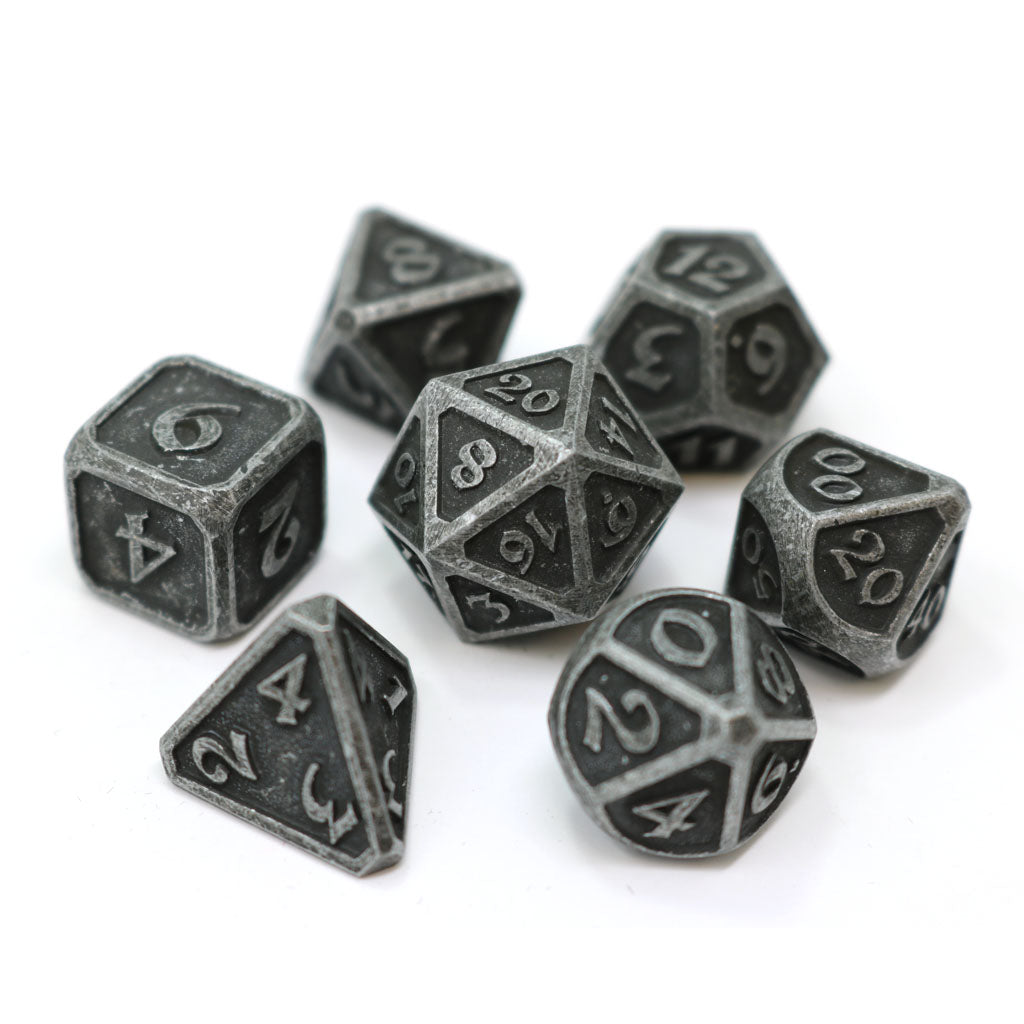
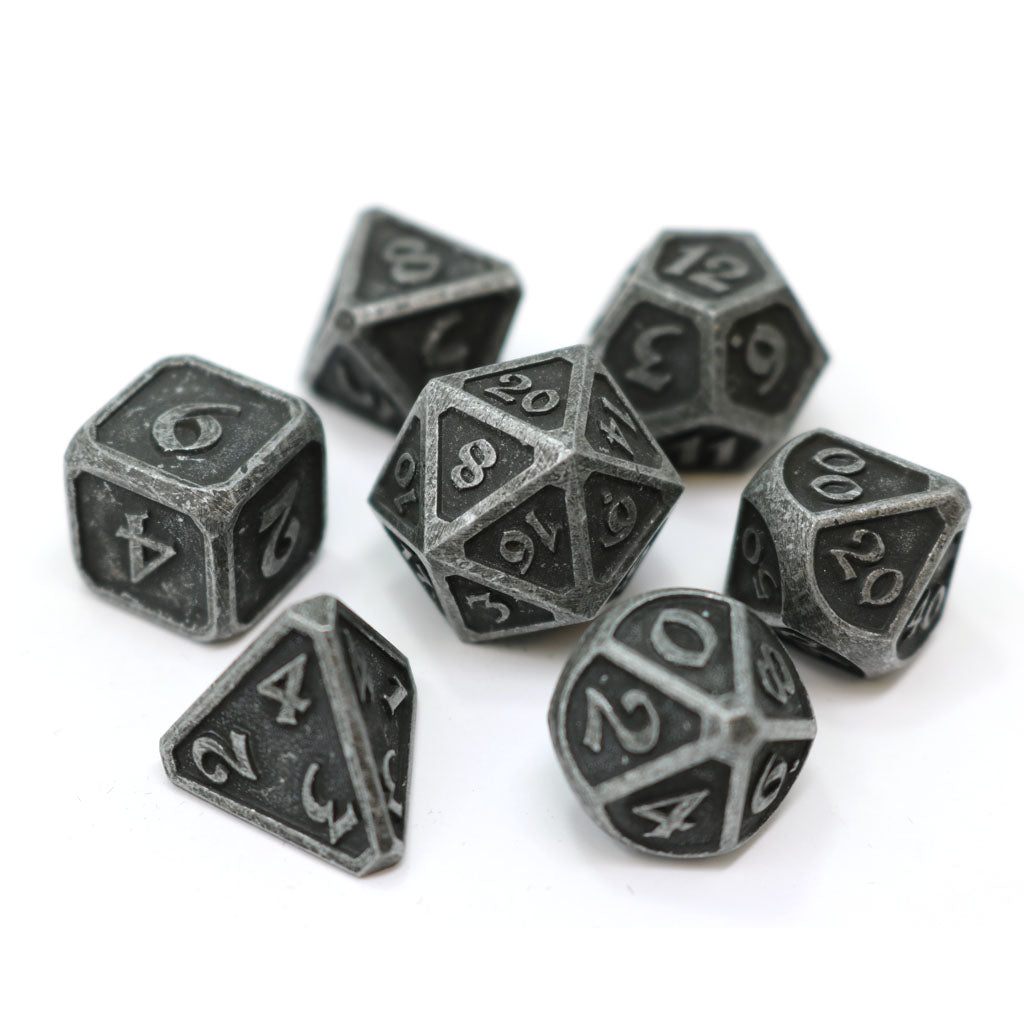
If I could press one set into a newcomer's hand, it would be this one. Die-cast zinc under an electroplated darkened wrought-iron finish — raw, unpainted, 'delightfully dark but readable,' with the kind of heft that makes a roll feel like a verdict. The corners are softened (a considered concession to your table), and it ships in a foam-slotted case with room to grow. 269 reviews, 99% positive, and a reviewer's line I keep returning to: 'on my first session with them, they rolled wonderfully.' Not the flashiest object in this ledger — the most correct one.
- Genuine die-cast heft with a darkened raw-steel finish that reads clearly at the table
- Softened corners are kinder to surfaces and fingers than sharp-edged metal
- Foam-slotted protective case included, with expansion slots
- Overwhelming review consensus (99% positive across 269 reviews)
- Like all solid metal, it's loud and demands a tray
- Raw/unpainted aesthetic won't suit players who want vivid color
- List price drifts toward the upper end of the zinc tier (watch for sales)
 4 photos
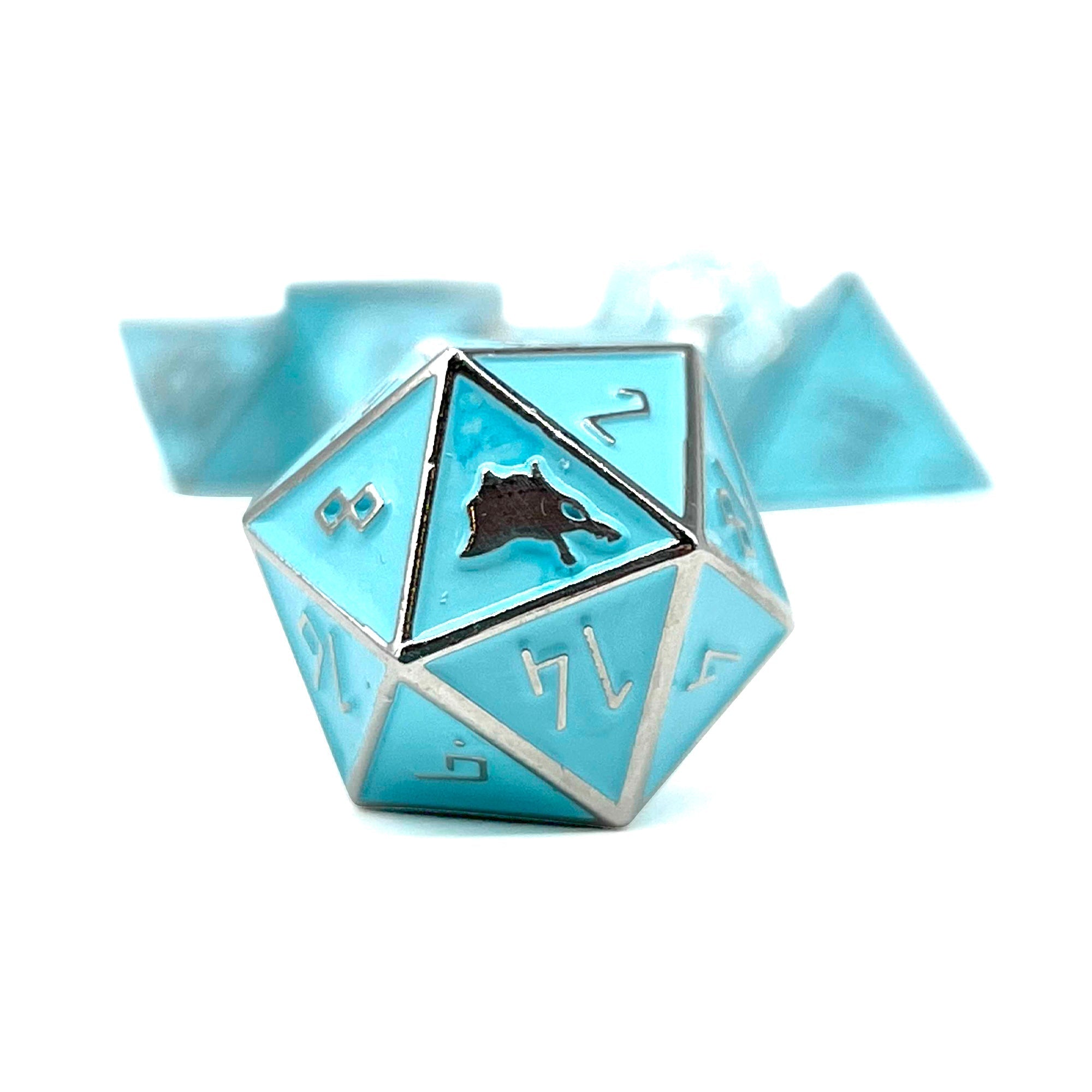
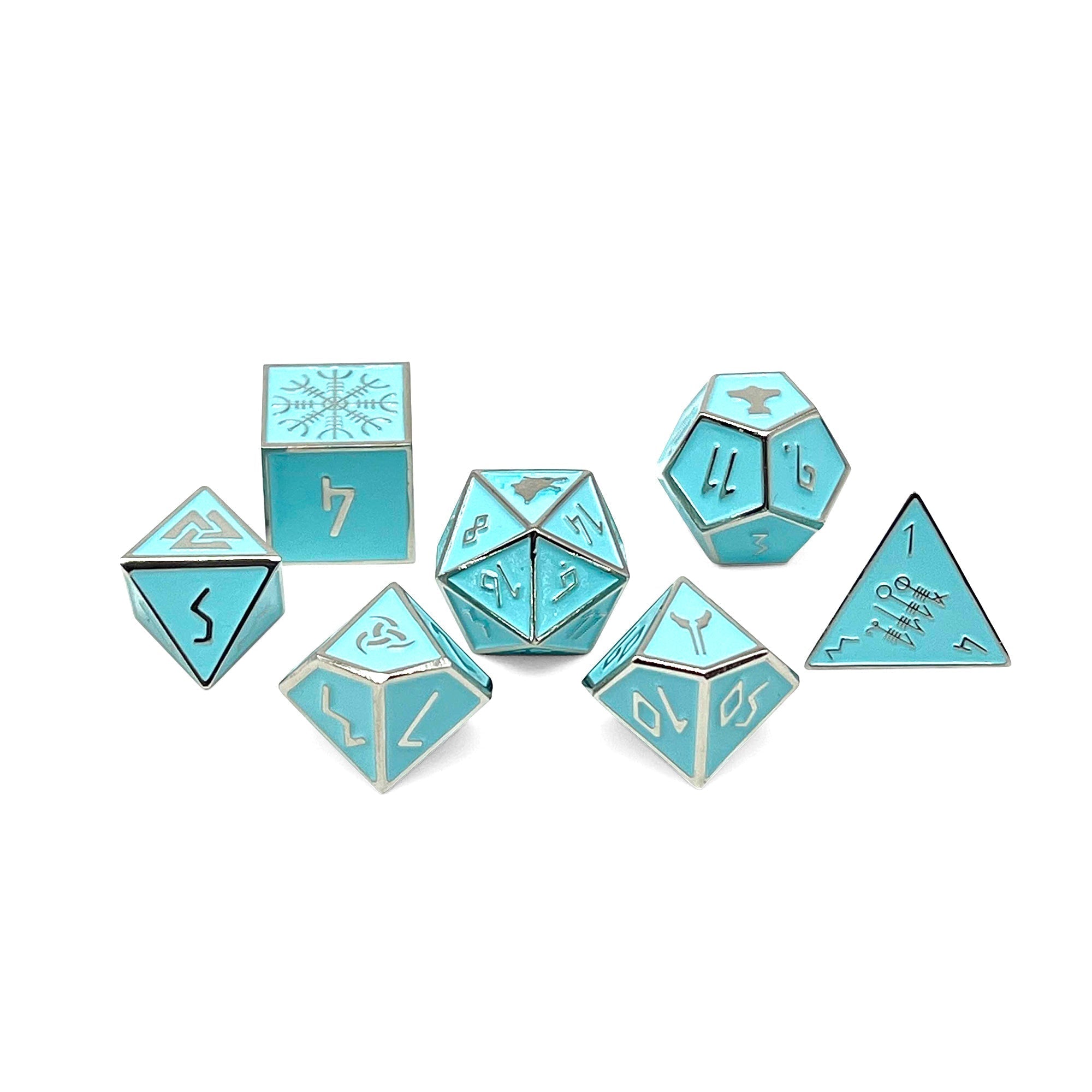
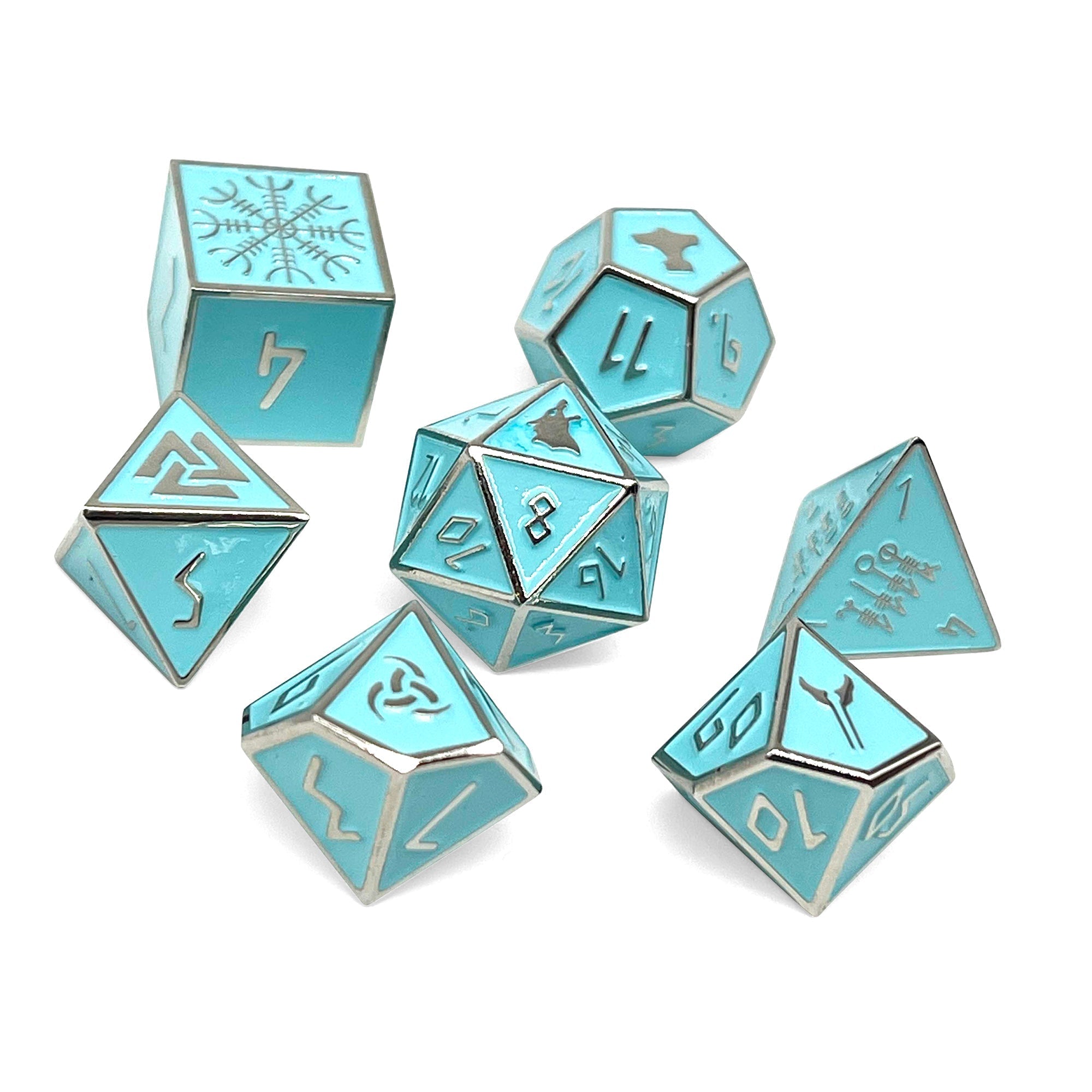
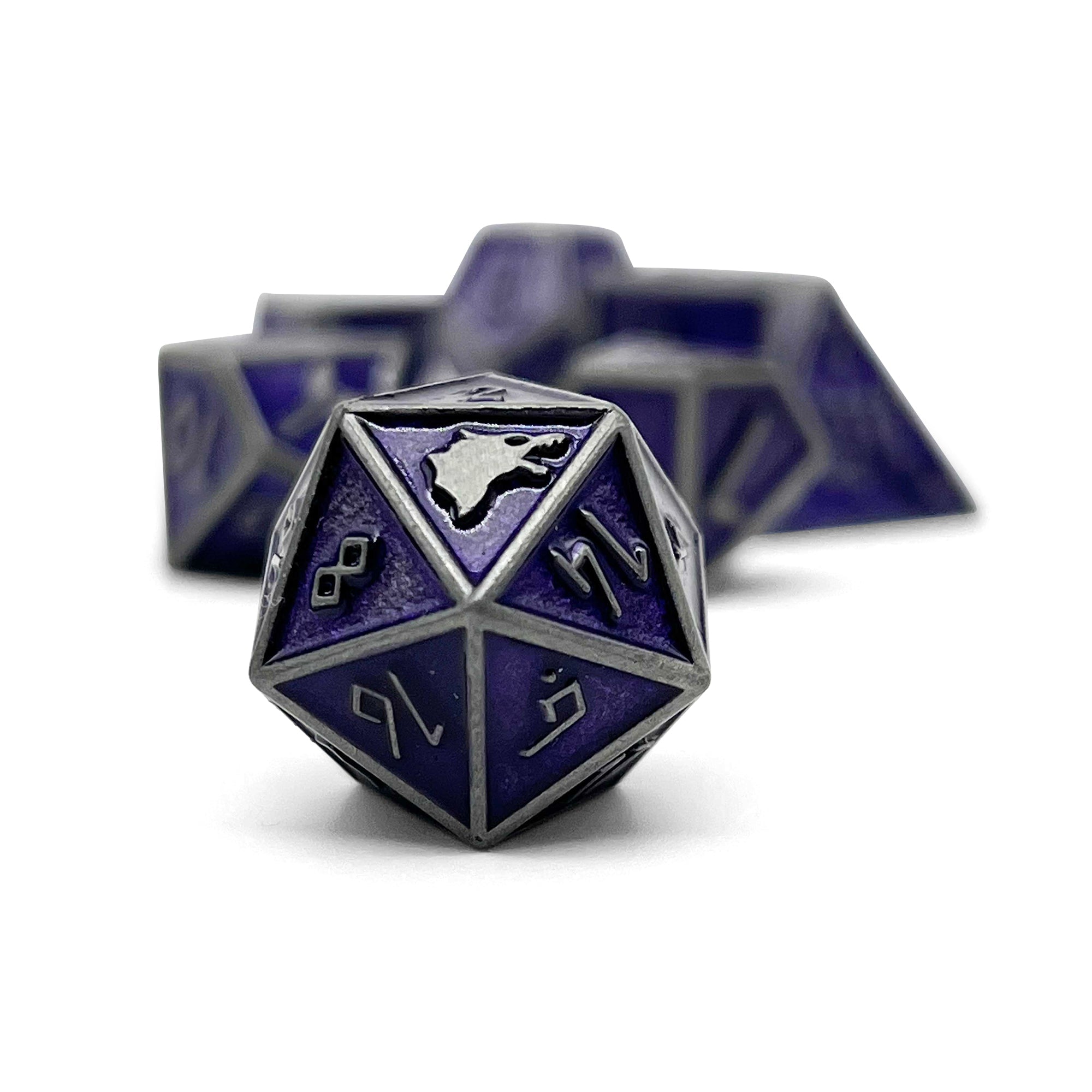
 Norse Themed Metal Dice Set
Norse Foundry is the house name in this trade, and this line shows why. Zinc alloy with colored enamel rising around each numeral, sharp defined corners for an honest tumble, and — the flourish I adore — a unique Norse rune in place of the top number on each die. The variants (Banshee Wail, Fenrir, Loki, Yggdrasil) let you match a set to a character's whole mythology. At $35 it's the sweet spot of brand pedigree, real finish, and theatrical detail. Stock comes and goes; pounce when your variant appears.
- Norse-rune top faces and enamel-filled numerals — genuine craft detail
- Sharp, defined corners aid balance
- Multiple mythic colorways to match a character
- Trusted flagship maker with broad retailer availability
- Popular variants frequently sell out
- Enamel/color fill on zinc can chip at corners with hard, tray-less rolling
- Runed top faces take a moment of acclimation for new players
 4 photos
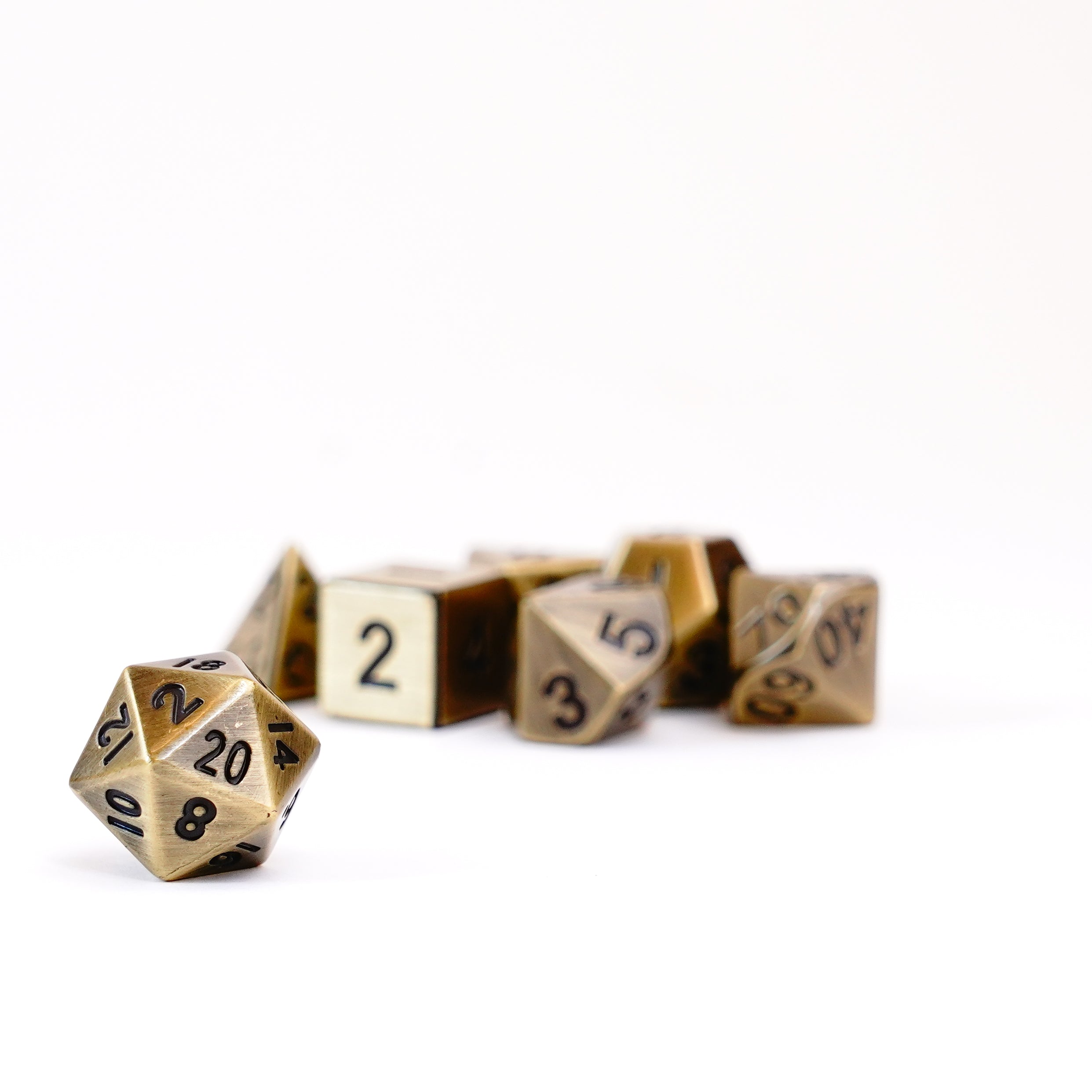
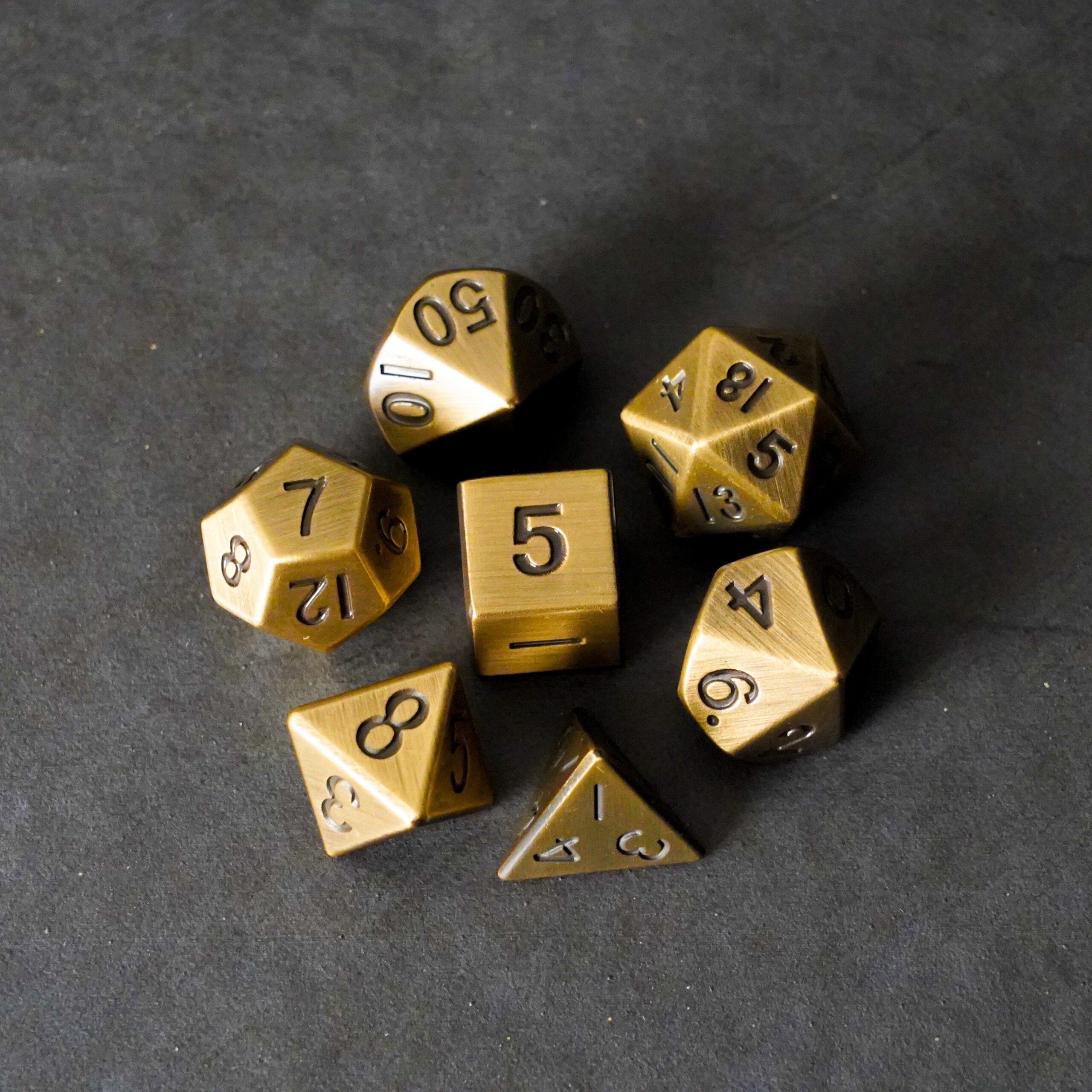
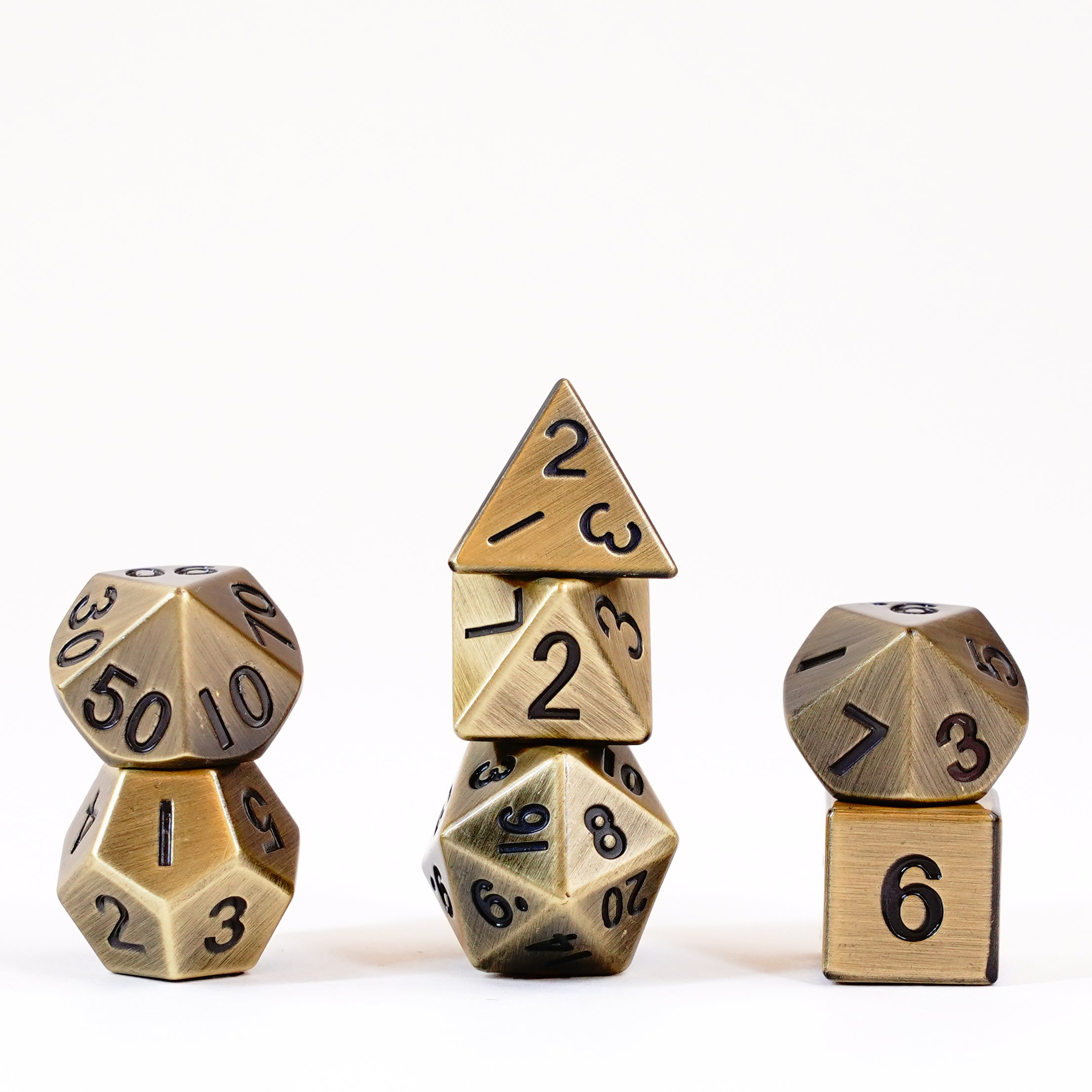
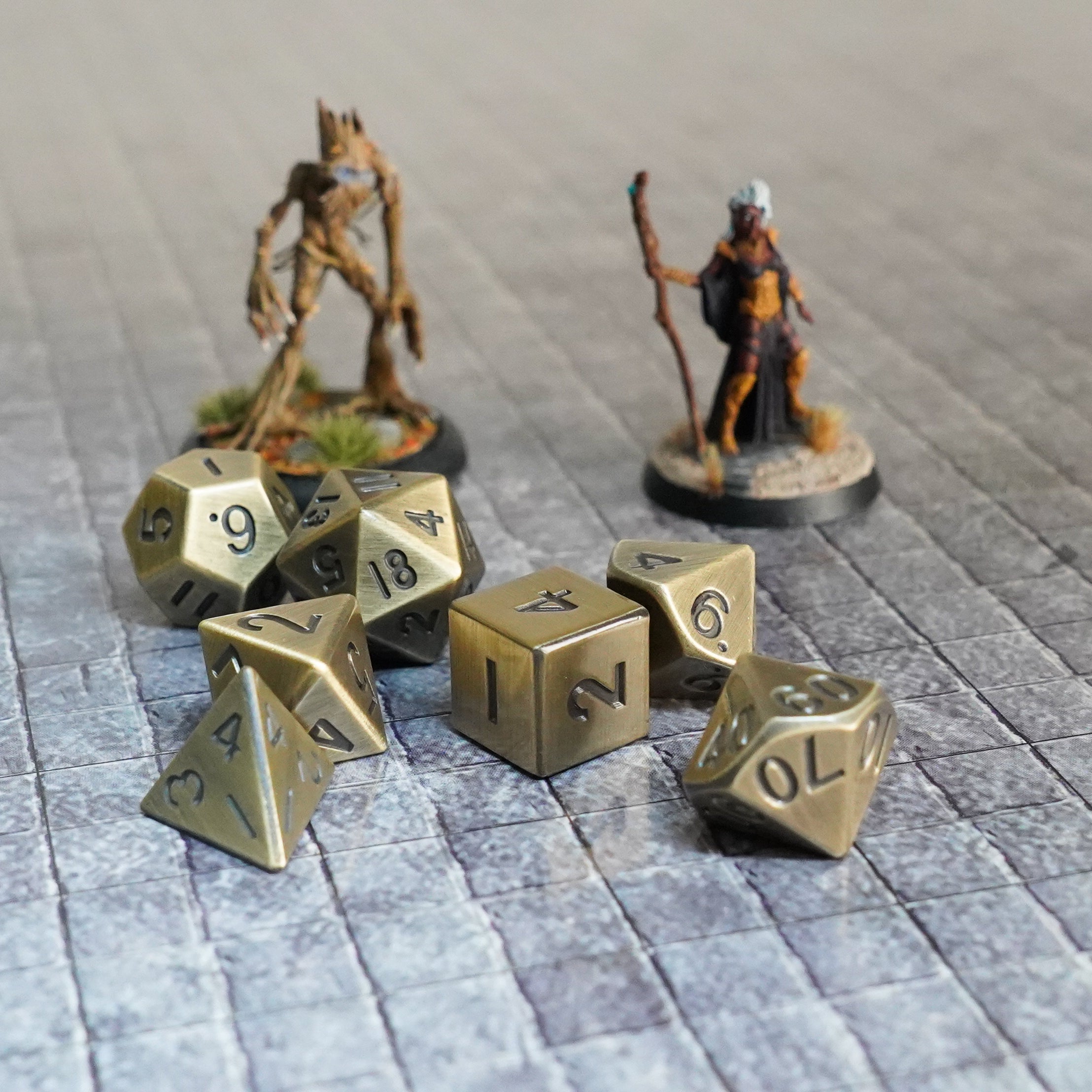
 Antique Gold 16mm Polyhedral Dice Set
The platonic 'dug from a dragon's hoard' set, and a perennial bestseller for good reason. Solid zinc plated in shiny-polished nickel with an antiqued gold tone that looks centuries old straight from the box — which, conveniently, means it never looks worn even when it is. FanRoll (the Metallic Dice Games house brand) is everywhere, so it's easy to find at $35–40 and even easier to gift. The antiquing is the whole pitch: high perceived value, low risk, and it photographs like loot.
- Outstanding treasure-hoard aesthetic at a sub-$40 price
- Solid zinc with nickel plating — real weight
- Antiqued finish disguises wear gracefully over time
- Very widely stocked (FanRoll/MDG carried by most retailers)
- Antique plating is topical color and can wear with heavy tray-less use
- 16mm is on the standard-to-small side, as most metal sets are
- Single classic look — less 'designed' than Norse Foundry or Die Hard lines
 4 photos
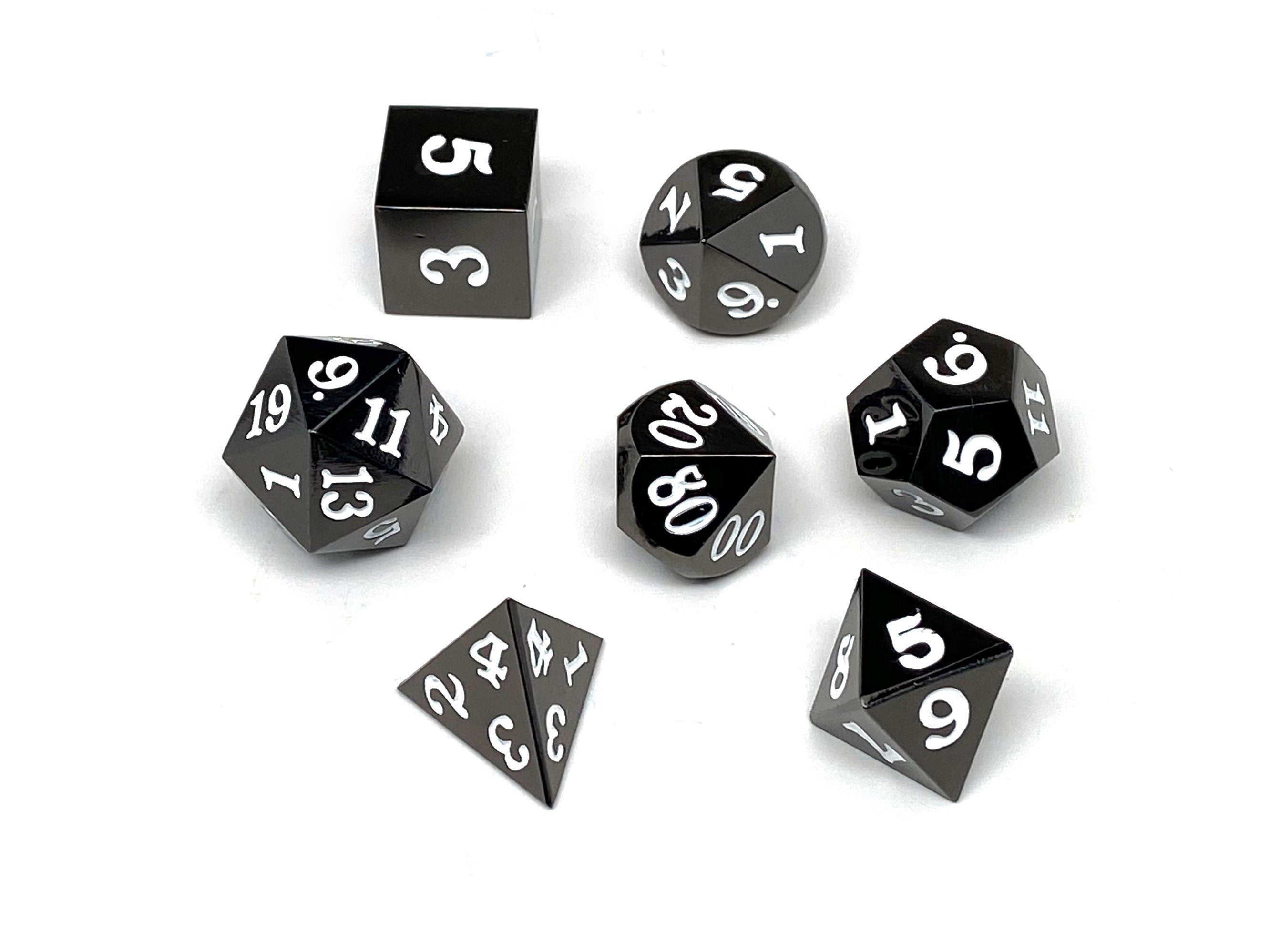
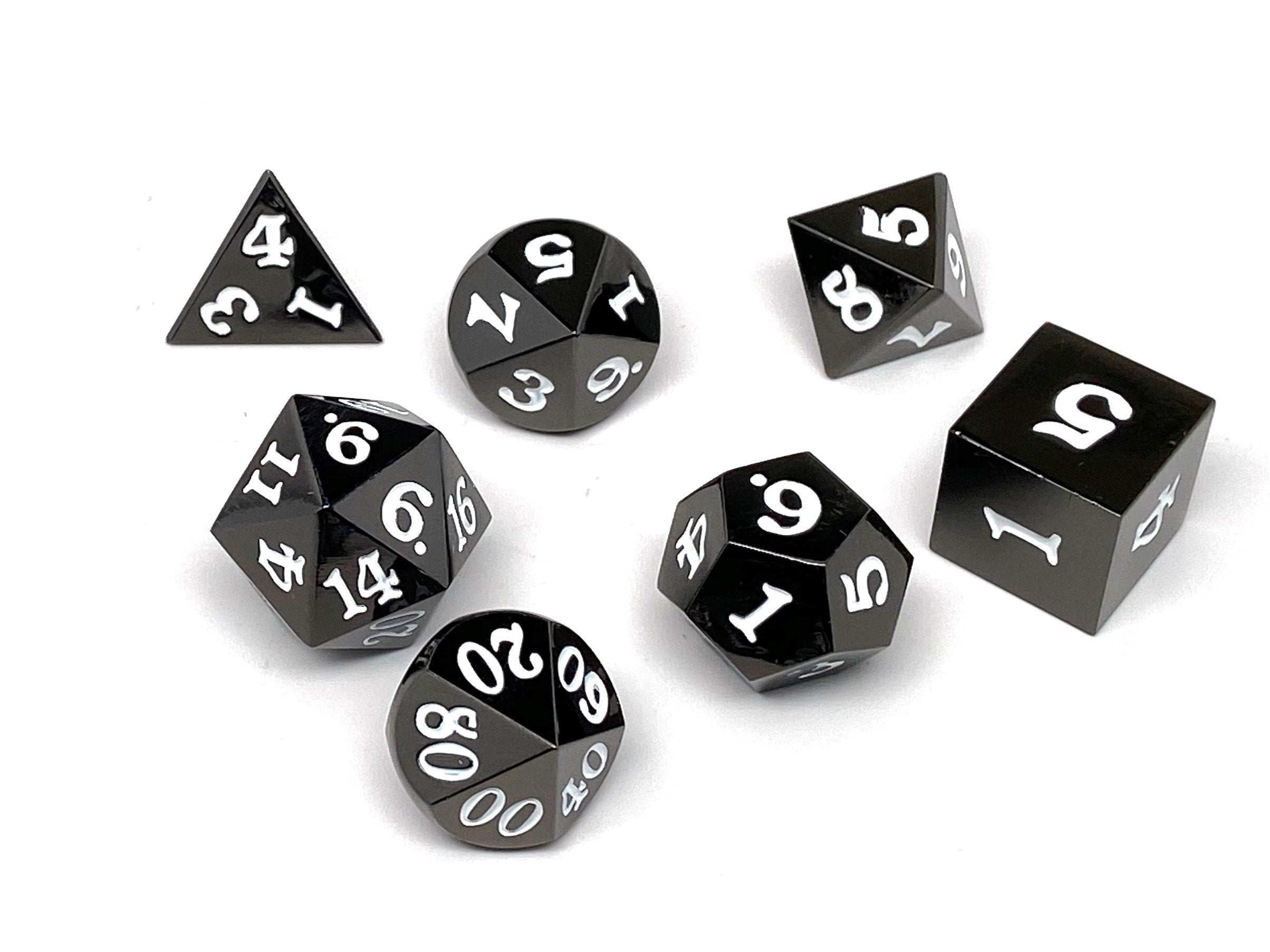
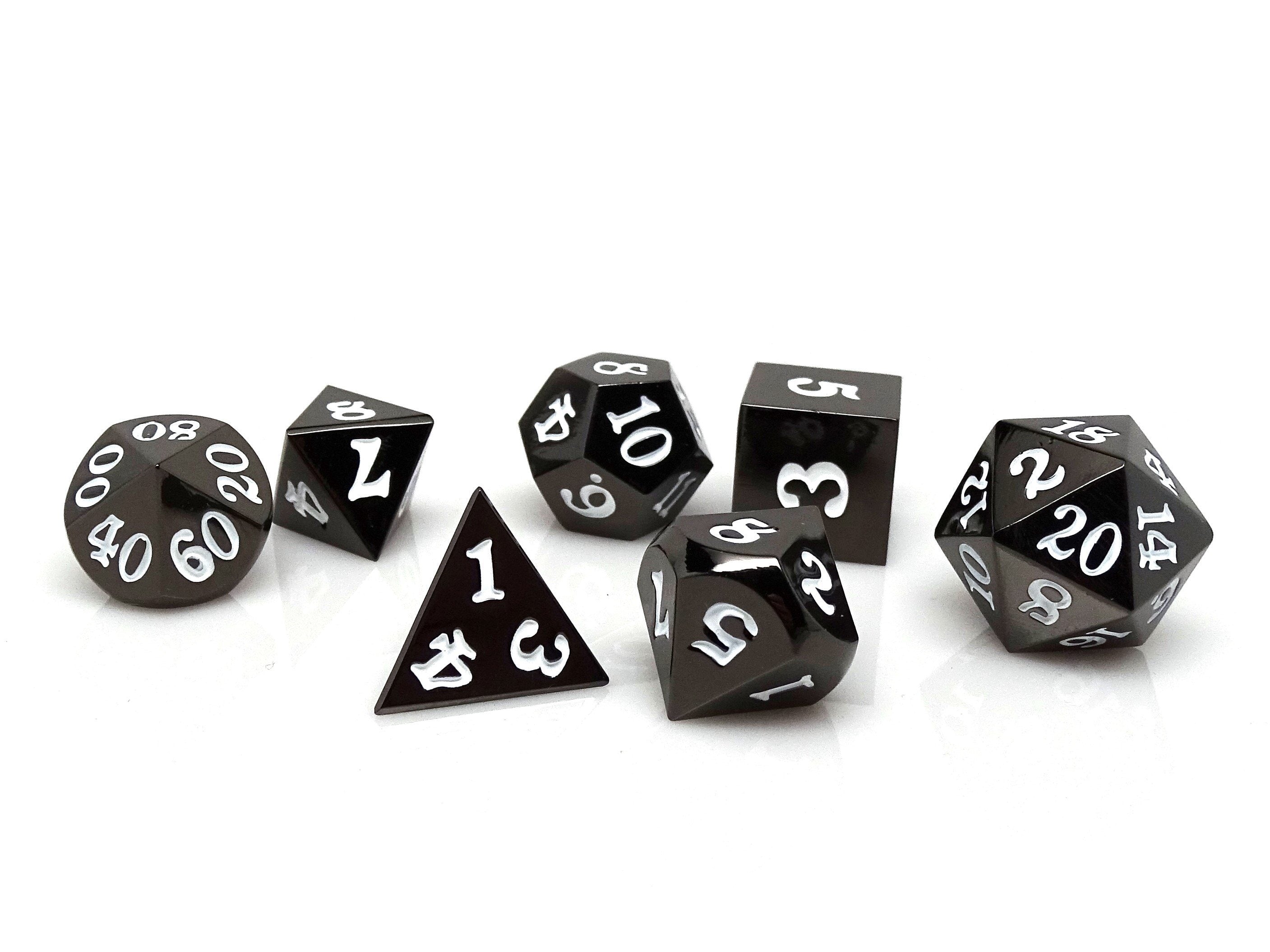
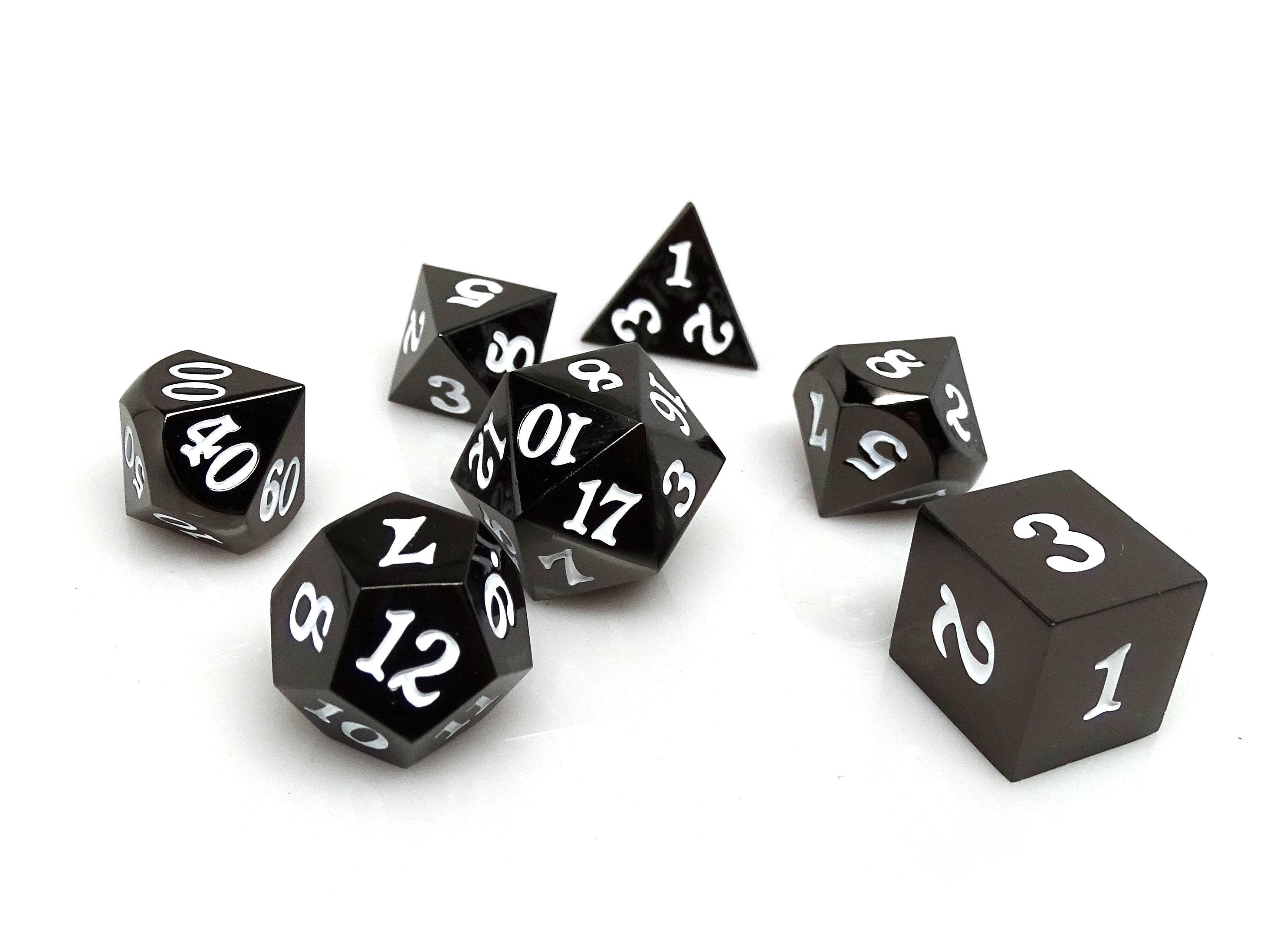
 Gun Metal 7 Piece Dice Set — Signature Font
Easy Roller's gun-metal line is the unpretentious value play: zinc alloy with a dark gun-metal body and 'vibrant colors that pop' in the signature-font numerals — White, Lime, Serpent Blood. At $34.95 with a 30-day money-back guarantee, it's a low-risk way into real metal heft with more chromatic personality than the antiqued and raw-steel sets. Easy Roller has been a reliable shop in this trade for years; this is their everyday metal, and it earns its keep.
- Dark gun-metal base makes the color-fill numerals genuinely pop
- Multiple vivid colorways at a friendly price
- 30-day money-back guarantee from an established retailer
- Real zinc heft for under $35
- Painted/filled color on zinc is the wear-prone layer over time
- Popular colorways (e.g. Serpent Blood) sell out
- Standard styling — value-tier, not a statement piece
 3 photos
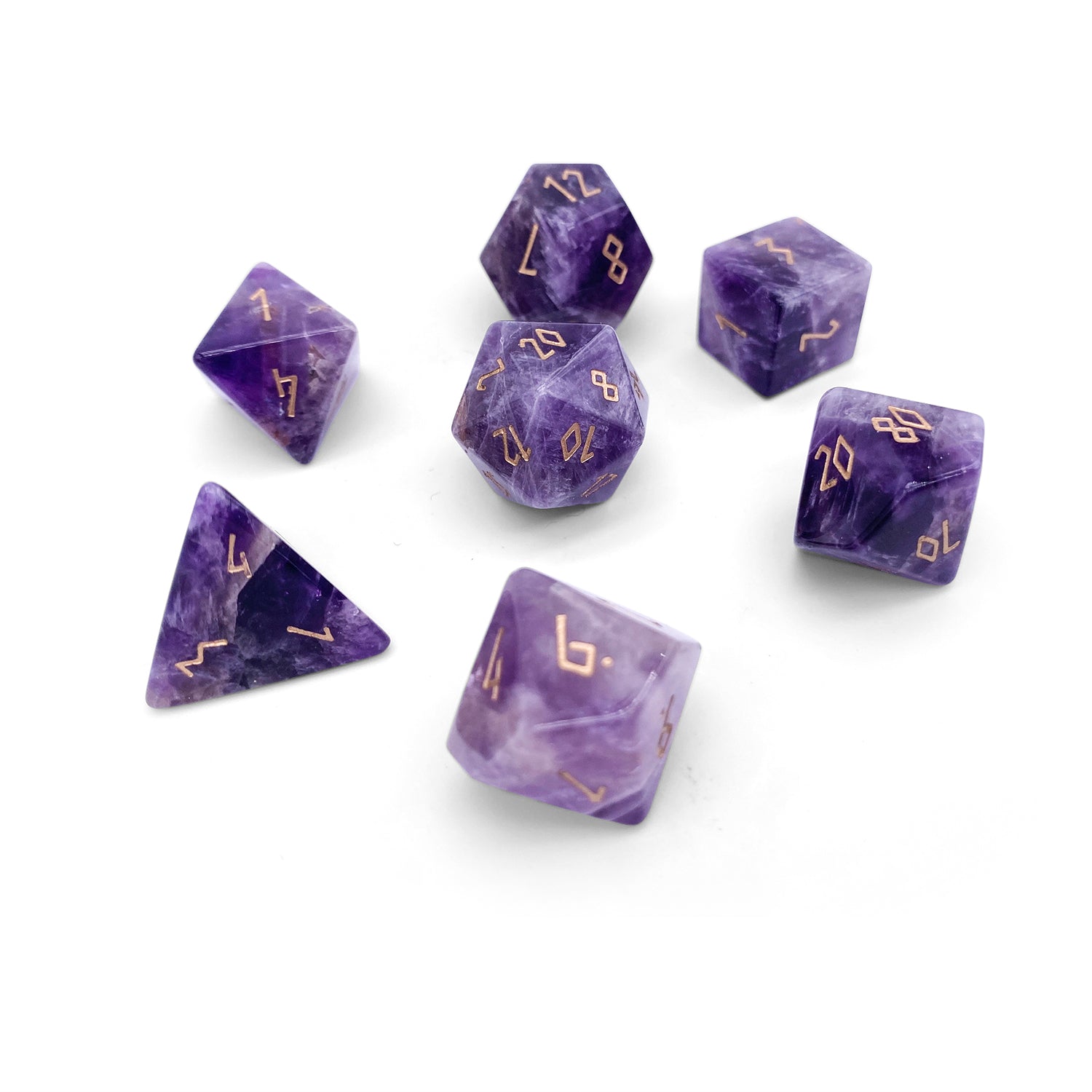
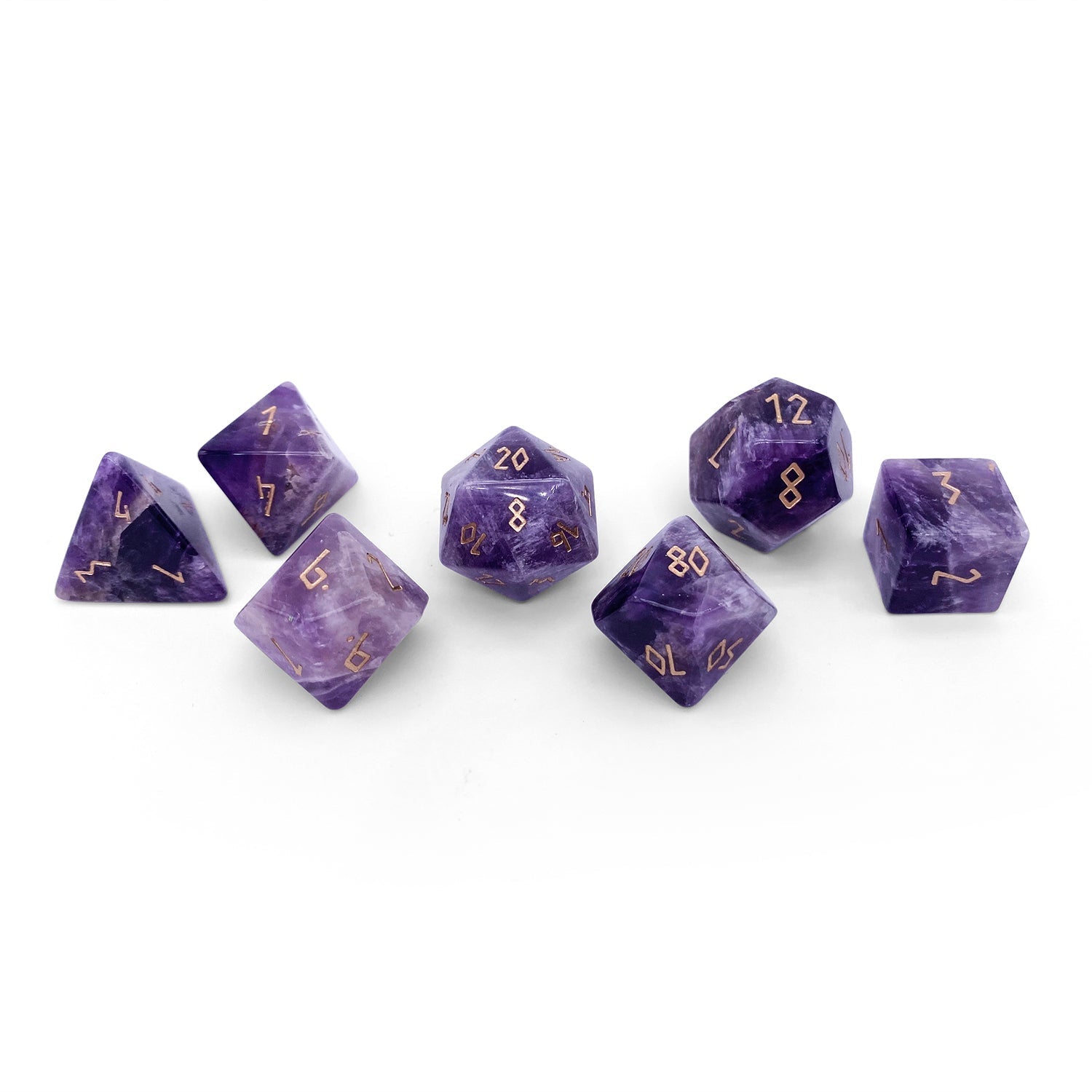
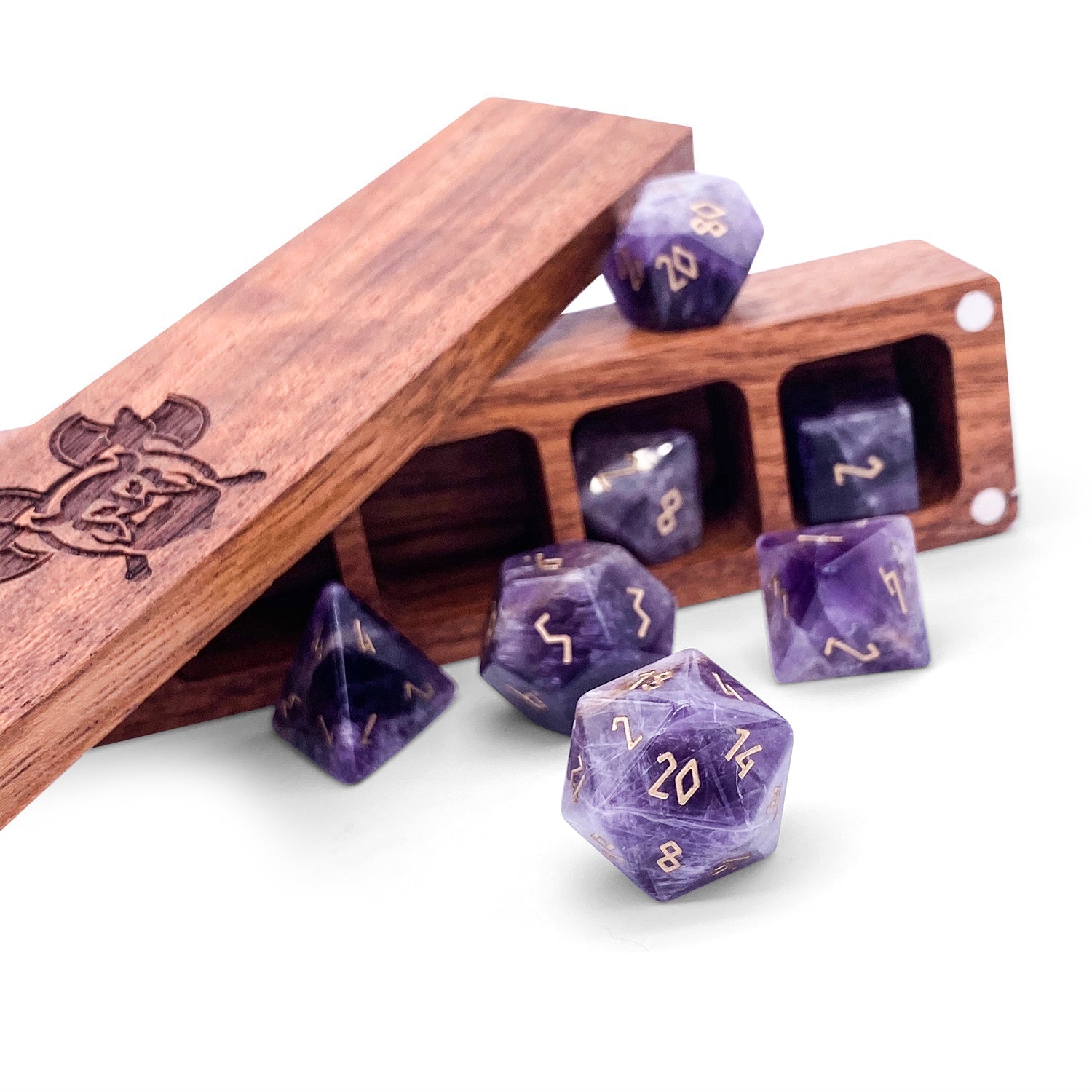
 Amethyst — 7 Piece RPG Set Gemstone Dice
Not metal, strictly — but no honest metal-dice ledger is complete without the artifact the metal crowd graduates toward, so I include it with full disclosure. Each die is hand-carved and sandblasted from genuine amethyst (Mohs 7), every face subtly unique, the whole set a small reliquary of natural stone. It is breathtaking. It is also, by Norse Foundry's own admission, not balanced — natural stone has internal variation no carver can correct. Buy it for the shelf, the photograph, the once-a-session ceremonial roll. Do not buy it to win a saving throw. At $95, and without an included box, it's a connoisseur's indulgence — and a glorious one.
- Genuinely stunning hand-carved natural amethyst — a true display artifact
- Each die unique; sandblasted finish with real provenance
- Norse Foundry's craft pedigree behind it
- The aspirational 'someday' piece for a serious collector
- Explicitly NOT balanced — natural stone favors faces (maker-stated)
- Premium price ($95) with no dice box included
- Stone is more fragile than metal — chips/cracks if dropped on hard floors
At a glance
| set | maker | material | price | best for |
|---|---|---|---|---|
| Mythica Dark Iron | Die Hard Dice | Die-cast zinc, raw-steel plating | $49.95 | Definitive first set |
| Norse Themed Metal Set | Norse Foundry | Zinc, enamel-filled, rune faces | $35.00 | Theme-forward character set |
| Antique Gold 16mm | FanRoll (MDG) | Solid zinc, nickel-plated | $39.99 | Treasure-hoard look / gifting |
| Brushed Silver Sharp-Edged | Misty Mountain | Zinc, sharp-edged brushed silver | $44.99 | Fairness-focused players |
| Gun Metal Signature Font | Easy Roller Dice | Zinc, gun-metal w/ color-fill | $34.95 | Color-pop value set |
| Dice Goblin Bones (Hollow) | Forged Gaming | Hollow zinc | $29.99 | Quieter, apartment-friendly |
| Dice Goblin Gears | Forged Gaming | Zinc, painted numerals | $19.99 | Cheapest real-metal entry |
| Amethyst 7-Piece | Norse Foundry | Hand-carved amethyst stone | $95.00 | Display reliquary (NOT balanced) |
Questions, answered
Do metal dice roll fairly, or are they biased?
Well-made metal dice generally roll fairer than the cheap plastic most players start with, because they're cast or machined as solid pieces with no internal air bubbles or hidden voids to weight a face, and their sharp corners help randomize the tumble. They are not casino-certified 'precision balanced,' though — reputable makers say 'balanced enough for play,' never perfect. The big exception is natural gemstone dice, which are openly not balanced due to internal stone variation.
Will metal dice damage or dent my table?
Yes — solid metal dice can dent bare hardwood and scratch finished surfaces, and the sharp metal d4 is the worst offender. The fix is universal and cheap: always roll on a dampening surface. Neoprene and EVA-foam dice trays both protect the table and quiet the roll; PU-leather and felt-lined trays work too. Budget a $15–30 tray into any metal-dice purchase.
Why are metal dice so loud, and how do I quiet them?
Their weight is the point and the problem — a heavy die hits hard and 'thunks.' Roll them on a sound-dampening tray or mat: neoprene is the most effective, EVA foam close behind, then PU leather, felt-lined wood, and (least effective for sound) plain craft foam. Hollow metal sets also land noticeably quieter than solid ones.
How much should I spend on a metal dice set?
Real metal starts around $20 (budget zinc like Dice Goblin), with the mainstream sweet spot at $35–50 for quality cast-zinc sets (Die Hard, Norse Foundry, FanRoll, Easy Roller, Misty Mountain). Specialty solid metals and hand-carved gemstone run $90–$100+. Crucially, above ~$50 you're paying for material rarity, machining, or hand-craft — not a fairer roll. A $40 set rolls as honestly as a $100 one.
What's the difference between zinc alloy and 'solid metal' dice?
Nearly all affordable metal dice ($20–50) are die-cast zinc alloy — durable, detailed, hefty, and void-free (thus fair), though zinc can chip or scuff if dropped on hard surfaces. 'Solid metal' usually refers to specialty metals like aluminum, brass, stainless steel, or titanium, often CNC-machined and priced $100+. Hollow metal sets are a separate, lighter, quieter, cheaper construction. For most players, cast zinc is the right material.
Do the numbers or paint wear off metal dice?
It depends on how the numerals are made. Engraved or cast-in numbers 'will never rub off'; enamel-filled numbers resist wear well. Topical paint and plated color (common on budget sets) can fade or chip in the number recesses with heavy use, especially when rolled on hard surfaces without a tray. It's cosmetic, not a fairness issue — but it's a real reason to favor engraved/enamel sets and use a mat.
Are sharp-edged or rounded-corner metal dice better?
Sharp-edged metal dice roll slightly fairer and stay fair longer — crisp corners stop the die quickly and resist the slow drift toward bias that rounded, worn dice can develop. The catch: sharp corners are exactly what dent tables and threaten fingertips, so many makers deliberately soften corners as a safety compromise. Choose sharp edges for fairness (and always use a tray); choose softened corners for shared, kid-friendly, or travel use.
What's the best metal dice set for a beginner or as a gift?
For a first set, a mid-priced (~$35–50) cast-zinc 7-piece set with a foam case — Die Hard's Mythica Dark Iron is the standout. For a gift, an antiqued treasure-chest set like FanRoll's Antique Gold ($39.99) or a budget Dice Goblin set ($20–30) presents beautifully at low risk. In all cases, pair it with a cheap dampening tray.
Are metal dice worth it compared to plastic?
If you love the tactile experience, yes — the heft is a genuine, unfakeable upgrade and the build is more durable and often fairer than budget plastic. But they're louder, harder on tables, pricier, and usually slightly smaller than plastic sets, and they require a tray to enjoy responsibly. For a player who wants ceremony and permanence in their dice, metal earns its weight; for someone who just wants cheap, quiet, colorful dice to throw anywhere, plastic still wins.
Margo's verdict
Metal dice are, to my archivist's eye, the most honest luxury in tabletop gaming: you pay for weight and you receive weight, with fairness thrown in for free by the simple physics of a solid, void-free casting. Buy one good cast-zinc set in the $35–50 band — Die Hard's Mythica Dark Iron remains my standing recommendation — roll it always on a neoprene or foam tray, and you will own dice that outlast the campaign and possibly the table. Climb to the specialty and gemstone tiers only when you're collecting for the love of the object, and climb with clear eyes: above $50 you are buying provenance and pride, not probability, and a hand-carved amethyst will betray you on a saving throw as readily as it will dazzle on a shelf. Respect the d4, mind the noise, inspect the numeral over the color — and let the good ones land with that thunk of consequence they were forged to make.
Research ledger 15 sources · reviewed 2026-08-10
Specifications, rules, current product information, community experience, and contrary evidence were checked against the sources below. Commercial links are kept separate from editorial evidence.
- dieharddice.comdieharddice.com/products/mythica-dark-iron
- norsefoundry.comnorsefoundry.com/products/norse-themed-metal-dice-set
- norsefoundry.comnorsefoundry.com/products/amethyst-7-piece-rpg-dice-set-gemstone
- fanrolldice.comfanrolldice.com/products/antique-gold-16mm-polyhedral-dice-set
- easyrollerdice.comeasyrollerdice.com/collections/7-piece-gun-metal-sets
- mistymountaingaming.commistymountaingaming.com/collections/metal-dice-sets
- forgedgaming.comforgedgaming.com/collections/dice-goblin-metal-rpg-dice-sets
- forgedgaming.comforgedgaming.com/blogs/news/10-things-to-consider-when-buying-metal-dice
- awesomedice.comawesomedice.com/pages/sharp-edge-resin-dice-explained-quality-fairness-what-to-expect
- hipstersanddragons.comhipstersanddragons.com/best-dnd-dice-sets
- dicedragons.co.ukdicedragons.co.uk/blogs/dice-advice/how-to-check-if-your-dice-are-balanced
- tangibleday.comtangibleday.com/best-dice-tray-material-to-dampen-dice-bounce-and-noise
- diceofdragons.comdiceofdragons.com/blogs/dice/sharp-edge-dice-vs-round-dice
- dicedungeons.comdicedungeons.com/blogs/inside/metal-resin-gemstone-dice-guide
- Community research index: r/DnD discussions about Best Metal Dice Sets for D&D: Heft, Balance & Where to Buyreddit.com/r/DnD/search/?q=Best%20Metal%20Dice%20Sets%20for%20D%26D%3A%20Heft%2C%20Balance%20%26%20Where%20to%20Buy&restrict_sr=1&sort=top

Let me check that before we say it.


Keep exploring
The next smart rabbit holes.
⬡ Universe HubDungeons & Dragons: the whole buying pathDungeons & Dragons is the world's great storytelling engine — a few books, a fistful of dice, and a table of friends. This universe...⬢ Topic PathTabletop Accessories: compare the whole shelfBuy the accessory that fixes a repeated annoyance first. Protection, setup speed, readable state, and comfortable handling beat...ComparisonMetal vs Resin Dice: Which Should You Buy? (2026)Metal dealers call it 'fairer.' They're selling you heft and the sound of authority, not physics. Here's what actually changes—and what...