Metal vs Resin Dice: Which Should You Buy? (2026)
Metal dealers call it 'fairer.' They're selling you heft and the sound of authority, not physics. Here's what actually changes—and what stays the same.

AI-assisted curator persona · research and editorial responsibility: Robert Pruitt · how this guide was made
Last editorial refresh: 2026-06-13 Gold-standard QA: 2026-07-17 21 sources reviewed Affiliate links checked during gold-standard pass

The short answer
Buy metal if you want a heavy, near-indestructible die that lands with a thunk, holds tighter manufacturing tolerances, and you're willing to roll it into a tray so it doesn't gouge the table or chip your other dice. Buy resin — especially sharp-edge resin — if you want the best readability, the widest range of art, a price that lets you own ten sets for the cost of one nice metal one, and a die you can roll bare on a wood table without flinching. Neither is meaningfully 'more fair' than the other at a real table; bias is dominated by die geometry and your throw, not the material. For most players who play every week, resin is the smarter buy; metal is a collector's and special-occasion piece.
Decision map
Choose in thirty seconds
The best-value entry into 'real' metal — heft and finish without the premium-line markup
The rational default — cheapest, lightest, most legible, perfectly fair
Budget metal from a well-stocked US retailer, blunt-tip option available
The fairness claim is the first lie I'm killing, because it's the one paying for half the metal sets in this hobby. 'Heavier means truer.' 'More uniform manufacturing.' Both technically true-ish, both completely irrelevant to what your die actually does at a table. A 130-gram zinc d20 and a 28-gram acrylic d20 are equally capable of being fair or garbage depending on geometry and throw, not weight. So if you're here thinking metal is justice in crystalline form, reset.
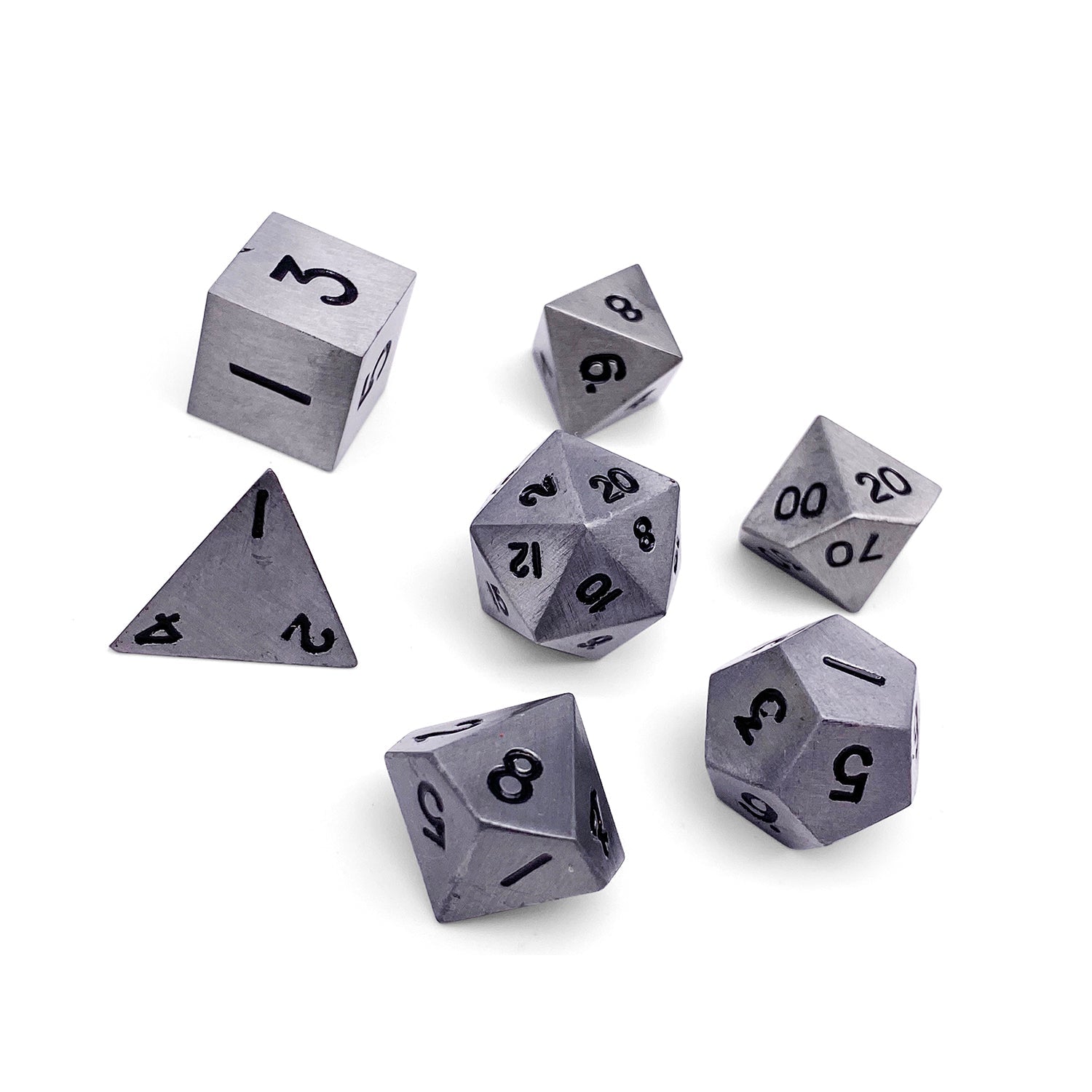
What you're actually buying with metal is real and I'll give it to you straight: feel. Die Hard Dice publishes the numbers because they know the numbers don't matter as a fairness pitch, only as a sensation pitch — Forge sets run about 4.6 oz (130g) and Mythica about 4.5 oz (126g), versus roughly 1 oz (28g) for polymer. That's four to five times the heft. Your brain registers it. The die stops faster. It sounds like money landed on the table. That's the whole product, and it's honest enough that I'll say it's worth wanting.
Resin's pitch is quieter and, for most people, actually smarter. It's lighter, it comes in art that metal physically cannot do (suspended inclusions, deep translucent color, layered glitter buried inside the die), and sharp-edge resin specifically gives you flat faces and readability that beats almost everything else in the hobby — for a third to a fifth of the metal price. You can roll it on your actual table without flinching.
I'm treating both as engineering objects, not feelings: weight, bias, what they do to your furniture and your other dice, how much noise they generate, whether you can read the numbers at arm's length, what they cost when you've bought three sets, how long they actually last. Then I'll tell you which one to buy based on who you are and how you play. Specs don't lie. Vibes do.
Start here, then go deeper
You are in the right cabinet.
 ⬢ Topic PathTabletop Accessories: compare the whole shelfBuy the accessory that fixes a repeated annoyance first. Protection, setup speed, readable state, and comfortable handling beat...
 Best OfBest Metal Dice Sets for D&D (2026): Heft, Balance & Where to BuyAn archivist's verified ledger of metal dice worth owning—what the heft actually buys you, whether they roll fair, and which sets are...
 Buying GuideAre Gemstone Dice Worth It? (2026)Genuine stone, dyed imposters, and glass under poetic names: the Archivist reads the label and the ledger both, then tells you exactly...
Does heavier (metal) actually mean a fairer roll?
No. This is the single most repeated myth in the hobby and it deserves to die.
A die is fair when every face has an equal chance of landing up. That depends on geometry — are the faces the same size, are the edges cut symmetrically, is the center of mass actually in the center — and on how it's thrown. Mass is almost irrelevant. AaronOfBarbaria put it cleanly on the D&D Beyond forums: 'air pockets in typical injection-molded dice are rarely large enough to have a significant effect,' and your 'rolling technique...has far more impact' than manufacturing imperfections. He's right.
Where metal has a small, real edge is consistency of manufacture. Die Hard Dice's own comparison page claims metal dice 'tend to have more uniform faces,' and that's plausible — cast-and-machined zinc holds tighter tolerances than a hand-poured resin blank that might trap a bubble or set unevenly. So at the extremes, a sloppy hand-poured resin die is more likely to be lopsided than a CNC-finished metal one. But 'more likely to be uniform' is not 'rolls a higher number for you.' Uniform means fair, not lucky. Anyone selling you metal as a luck upgrade is selling you a feeling.
The honest version: at a normal table, with a normal throw, metal and resin are both fair enough that you will never detect a difference across a campaign. Buy on feel, art, durability, and price — not on a fairness fantasy.
Uniform means fair, not lucky. Anyone selling you metal as a luck upgrade is selling you a feeling.
How do I actually test if my dice are biased?

Two methods. One is cheap and limited; one is tedious and definitive.
The salt-water float test (cheap, limited). Dissolve a heap of salt into warm water until a die floats — usually a couple tablespoons per cup, more for heavy resin, and metal often won't float at all, which is the test's first limitation. Float the die, flick it, and watch which face surfaces. If the same face keeps rolling to the top, the center of mass is offset toward the opposite face and the die is internally weighted. The RPG Museum and Hearns Hobbies both describe the same procedure; it's adapted from an old golf-ball balancing trick.
Here's the part the sellers skip: the float test catches mass-distribution bias only, and it's noisy. Critmaker and Haxtec both note that perfectly good dice can 'fail' the float test over trapped micro-bubbles or tiny density variation, and — critically — that real tabletop bias is more often caused by the die's shape (an oversized face, a rounded edge) than by its internal mass. A die can float perfectly and still roll unfair because one face is a hair larger than the others. So a float test that passes tells you less than you'd hope, and a float test that fails might be a false alarm.
The frequency test (tedious, definitive). Roll the die a few hundred times, tally each result, and look at the distribution. Every reputable source — including the float-test articles themselves — admits this is the only reliable method. It catches geometry bias and mass bias, because it measures the actual thing you care about: what the die does on a table. Nobody wants to roll a d20 300 times. Do it once for a set you're suspicious of and you'll never wonder again.
A die can float perfectly and still roll unfair because one face is a hair larger than the others.
Will metal dice wreck my table, my minis, and my other dice?
Yes, they can — and this is the tradeoff metal buyers most often underestimate. It's the first thing I bring up because it's the thing you can't undo.
The mechanism is simple: a 130g cast-zinc die with hard corners, thrown onto a wood or laminate surface, concentrates a lot of energy on a tiny contact point. Die Hard Dice tells you outright to 'carry metal dice in a separate dice case or bag so they don't scratch your polymer dice' — metal is harder than the acrylic and resin sitting next to it in your bag, so it sands them down over time. On the D&D Beyond forums, Barbarulo's one stated downside of metal was blunt: 'they can mark a nice table.' Tim, in the same thread, rolls his metal 'into a dice tray to avoid damaging my DM's table.' These aren't paranoid people; that's just what mass does.
The nuance: it's not guaranteed catastrophe. Several sources note that a typical roll on a forgiving surface, or rounded-corner ('blunt-tipped') metal, often does no visible harm — roll strength and surface hardness matter as much as the material. A gentle toss onto a felt mat is fine. A hard throw onto your grandmother's dining table is how you end up apologizing.
Resin sidesteps the whole problem. At ~28g with softer corners, it won't gouge a table or grind down your other dice. The damage risk runs the other way for resin: it's the one that chips if you drop it on a hard floor, especially at the corners. So the question isn't 'which is indestructible' — metal is — it's 'what do I want to protect.' Metal protects itself and endangers everything around it. Resin endangers itself and protects everything around it.
Metal protects itself and endangers everything around it. Resin endangers itself and protects everything around it.
Are metal dice too loud for real play?
Sometimes, yes — and whether that's a feature or a flaw depends entirely on where you play.
That 'solid thunk when they hit the table' (Tim's words on D&D Beyond) is the same physics as the table damage: a dense object dumping energy on impact. It sounds great. It commands the table on a clutch roll. It is also genuinely disruptive in a quiet library room, a thin-walled apartment at 11pm, or a café where you're trying not to be That Group. Bards & Cards sums the tension up well — metal dice 'make a wonderful sound and command attention' but are 'loud. Great for dramatic moments, potentially annoying in a quiet setting.'
Resin is the considerate choice acoustically. Lighter mass, softer impact, a duller and quieter landing. If you play in spaces where noise is a real constraint — shared housing, public venues, a sleeping kid down the hall — resin (or acrylic) removes the problem instead of managing it.
The good news for metal lovers: noise is the one metal drawback you can fully neutralize with gear. The same felt- or neoprene-lined tray that saves your table also muffles the clatter to a soft tap. Tangible Day's rundown of tray materials — leather, neoprene, EVA foam, velvet, felt — is essentially a list of ways to keep metal's sound without metal's collateral. So unlike the readability gap (which is intrinsic), the noise gap is a solved problem if you're willing to carry one accessory.
Noise is the one metal drawback you can fully neutralize with gear; readability is the one you can't.
Which is easier to read across the table — and why sharp-edge resin wins?
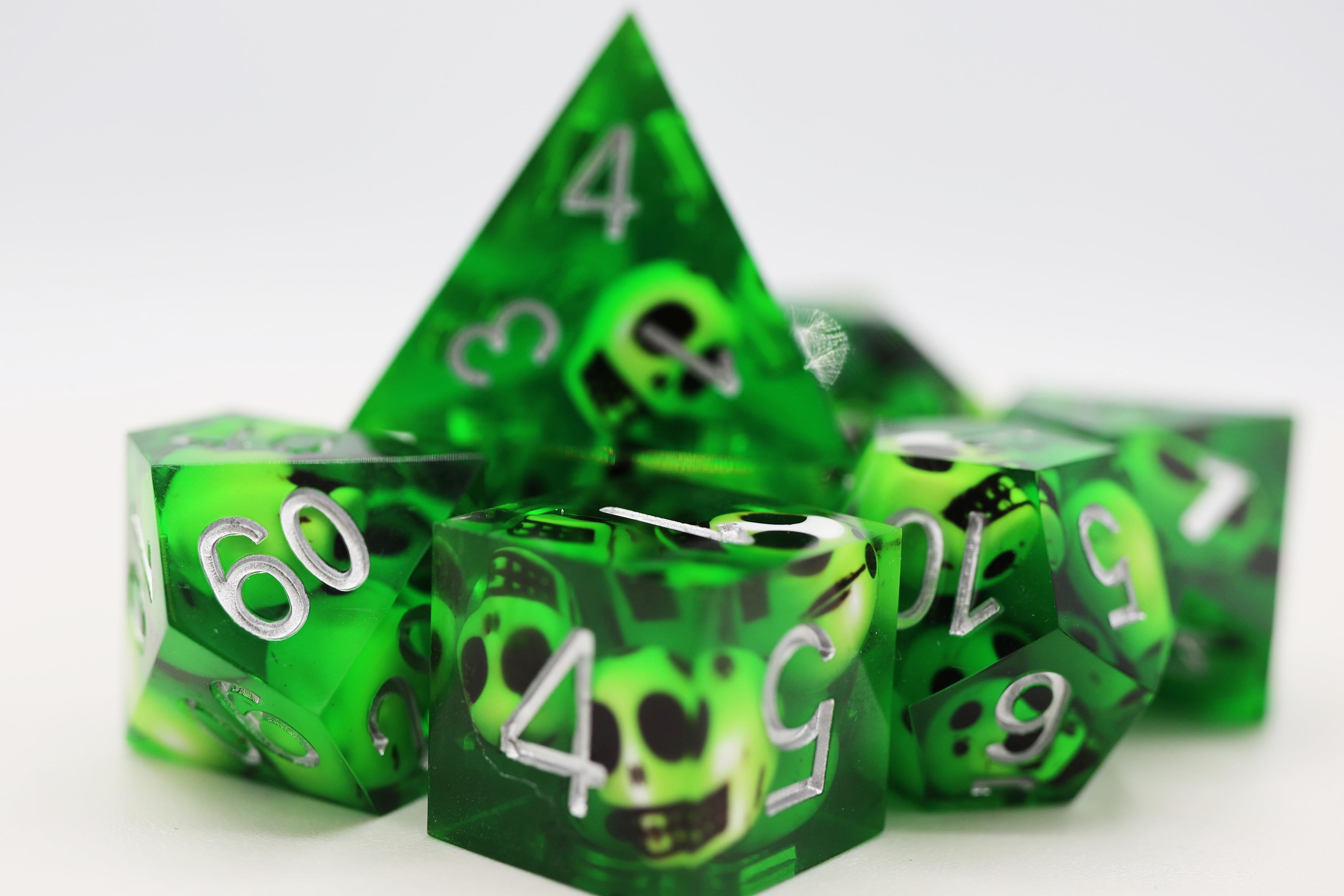
Readability is where I'll plant a flag, because it's where resin quietly beats metal and almost nobody mentions it in the metal-vs-resin fight.
Readability is contrast plus face geometry. You need the numerals to pop against the body, and you need the up-face to sit flat and visible. Sharp-edge resin is purpose-built for exactly this: as Misty Mountain and Dispel both describe their sets, the faces are 'mathematically flat sharp-edged' for 'cleaner rolls and easier reading,' with hand-painted numerals that sit crisply in deep, often translucent color. Flat faces + high-contrast paint = the number you can read at arm's length without leaning in. It's the best-reading tier in the hobby, period.
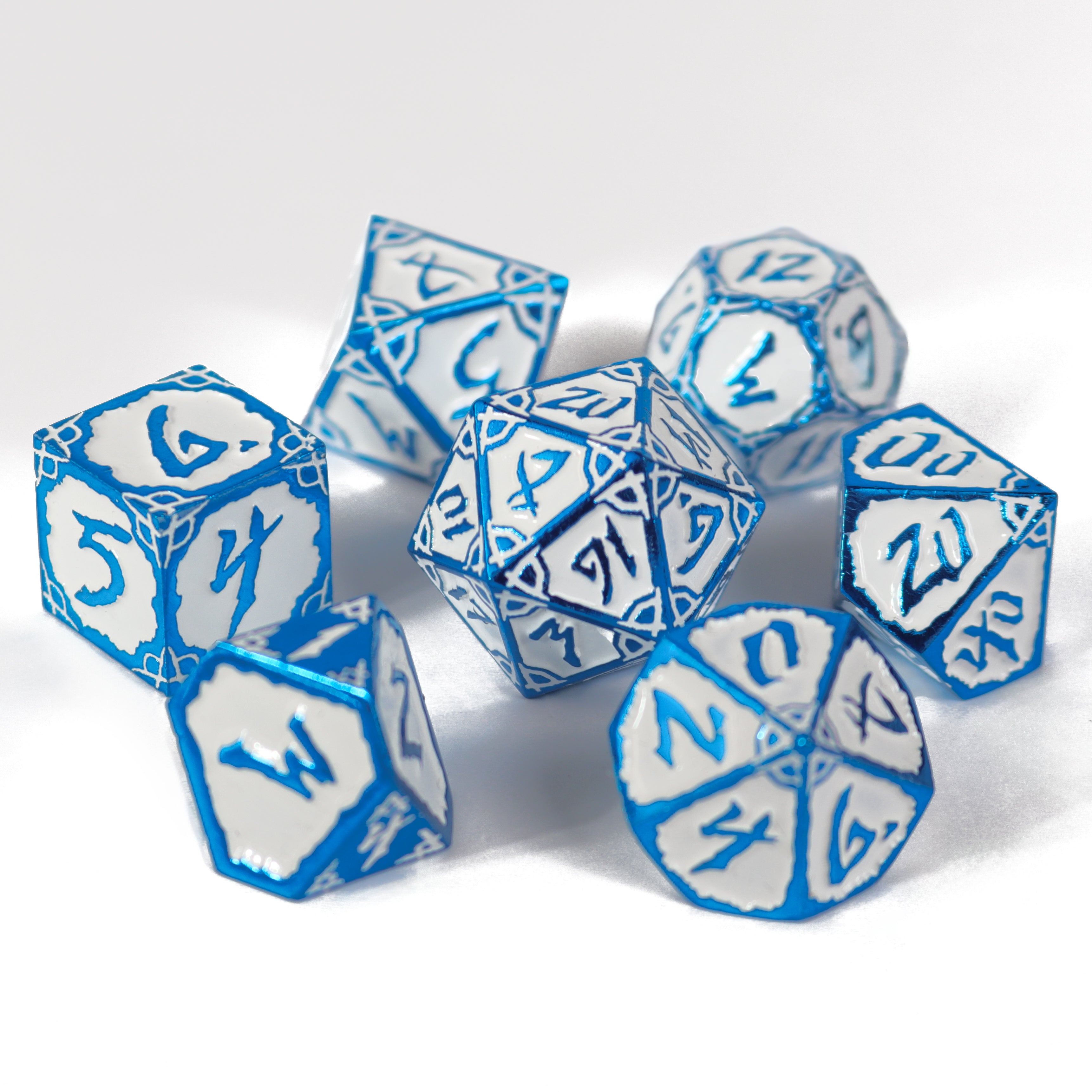
Metal is a mixed bag. A raw-steel or gunmetal die with a matching metallic ink fill can be a low-contrast nightmare under dim ambient lighting — silver numerals on a silver body, you're squinting. The good metal sets fix this with painted enamel fills (black, red, white) in the engraved numerals, and those read fine. But it's finish-dependent, and the all-one-tone electroplated sets that look gorgeous in product photos are often the hardest to read in play.
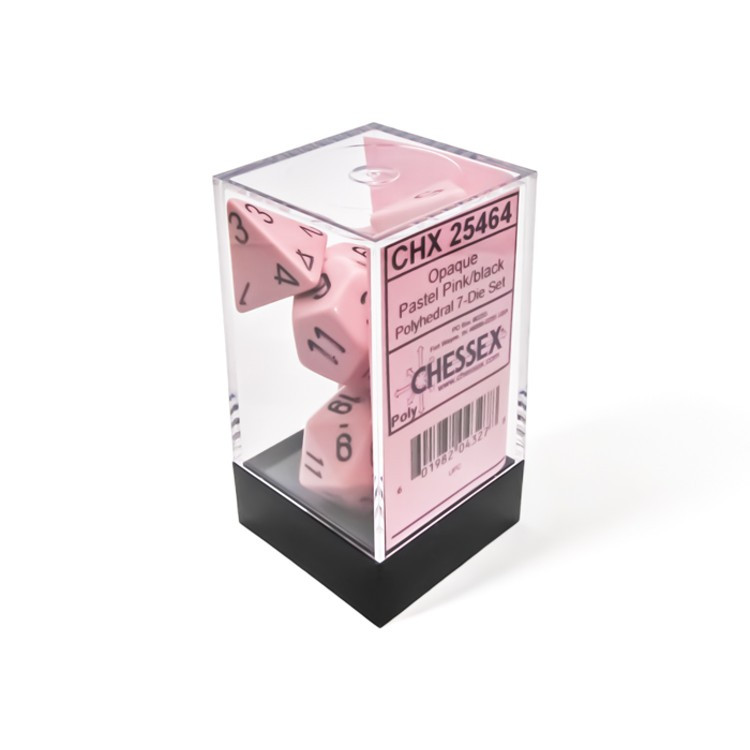
Resin's readability failure mode is self-inflicted and avoidable: Bards & Cards notes some artisan makers 'sometimes sacrifice legibility for aesthetics' — a smoky translucent body with same-color numerals, or busy inclusions crowding the digits. That's a per-set design choice you can see in the photo before you buy, not a material limit. Plain old acrylic (Chessex and friends) sidesteps all of it with bold engraved high-contrast ink fills — the most boringly legible dice made.
Net: for pure 'can I read it instantly,' sharp-edge resin and high-contrast acrylic lead, painted-fill metal is fine, and one-tone metallic or murky translucent dice are where you lose the number.
Silver numerals on a silver body under dim lighting is the prettiest unreadable die money can buy.
What's the real cost-per-set — and where do gemstone and acrylic fit?

Here's the number that should anchor your decision, because it's the one that compounds across a collection.
Using verified 2026 retail prices: a quality 7-piece metal set runs roughly $35–$45 (Norse Foundry Standard Alloy at $35; Easy Roller Legendary at $34.95; Die Hard Forge around $40), with premium and oversized metal climbing past $50–$125 (Norse Foundry's aluminum Wondrous set hits $125). Sharp-edge resin lands about $45–$50 for an artisan set (Dispel Magic at $44.99; Foam Brain sharp-edge at $50). Plain acrylic is the volume play at roughly $10–$13 a set (Chessex). Gemstone is the luxury tier at $60–$200+ depending on the stone.
So metal and sharp-edge resin actually sit close on price for a single set — within ten bucks. The cost story diverges when you think in collections. If you're a one-set-and-done player, buy whichever feels right; the price gap is a rounding error. If you're the type who wants a different set per character, acrylic lets you own four sets for the price of one metal or sharp-edge set, and that math is brutal in resin/acrylic's favor.
Where the other materials slot in:
- Acrylic — the rational default. Cheapest, lightest, most legible, perfectly fair, endlessly varied, takes a bare-table roll without complaint. Unsexy and correct. This is what most people should roll most nights.
- Sharp-edge resin — the readability-and-art sweet spot. Flat crisp faces, deep color, suspended inclusions metal can't do, lifetime warranties common (Dispel, Misty Mountain). Pricier than acrylic, lighter and safer than metal.
- Gemstone — beautiful, fragile, and the least balanced of the bunch. Hand-carved stone has internal density variation (veins, voids, crystal structure) that no machining removes; Runic Dice and Dice Craft Lab both warn it 'almost always' tests more biased than quality resin or metal, and it chips. Buy it as an art object, not a daily driver.
- Metal — the heft-and-permanence pick. Near-indestructible, tightest tolerances, the most dramatic feel and sound, the highest care burden (tray + separate storage). A statement set, not a stable of ten.
Metal and sharp-edge resin are within ten bucks for one set; the gap explodes only when you start collecting — and there acrylic eats everyone's lunch.
What experienced tables keep reporting
Recurring owner patterns, synthesized in Puzzlewick's words. Follow each evidence trail to read the original discussion.
I have a set of metal dice and they are heavy. They have a solid thunk when they hit the table. I roll them into a dice tray to avoid damaging my DM's table.
Read the evidence: Tim — D&D Beyond Forums, 'Dice material benefits and disadvantages?'
Only disadvantage of metal dice I've heard is they can mark a nice table.
Read the evidence: Barbarulo — D&D Beyond Forums, 'Dice material benefits and disadvantages?'
Air pockets in typical injection-molded dice are rarely large enough to have a significant effect; your rolling technique has far more impact than manufacturing imperfections.
Read the evidence: AaronOfBarbaria — D&D Beyond Forums (paraphrased from thread)
Metal dice are typically 4 to 5 times heavier than plastic dice. They feel substantial and rolling them from your hand is very satisfying. Carry metal dice in a separate dice case or bag so they don't scratch your polymer dice.
Perfectly functional dice can 'fail' the float test because of tiny air bubbles or slight density variation; in practice tabletop bias is more often caused by the die's shape than its internal mass. Rolling a die many times and counting results is the most reliable check.
Read the evidence: Critmaker / Haxtec dice-balance guides (consensus)
Because gemstone dice are hand-carved, they're not always perfectly balanced — natural stone has density variations, and a gemstone die will almost always test with more bias than a quality resin or metal die.
Read the evidence: Runic Dice / Dice Craft Lab gemstone guides
The picks
Some links below are affiliate links — as an Amazon Associate, Puzzlewick earns from qualifying purchases, at no extra cost to you. It never changes a pick.
Norse Foundry Doppleganger Full Metal Polyhedral Dice Set
If you want metal and you want it to make sense on price, this is the on-ramp: a solid cast 7-piece set at $35 in dozens of finishes (Aged Mithral, Bronze Dragon Scale, Gunmetal). Pick a variant with contrasting enamel in the numerals so you can actually read it. Buy a felt tray in the same order — non-negotiable with any metal.
- Lowest sensible entry price for quality metal ($35)
- Huge finish range, including high-contrast painted fills
- Near-indestructible, tight cast tolerances
- Demands a tray + separate storage to protect table and other dice
- Some all-one-tone finishes read poorly in dim light
- Free shipping only kicks in at $50, nudging an add-on
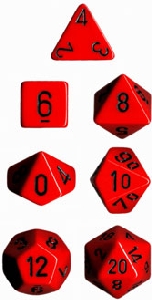
Polyhedral 7-Die Set (acrylic, Opaque/Translucent/Speckled lines)
The dice nobody brags about and everybody should own. Bold engraved high-contrast ink fills make these the most boringly legible dice made; they're fair, light, silent enough, and roll bare on any table. Street price typically lands around $10–$13. Buy two sets and you've spent less than one metal set.
- Cheapest quality option (~$10–$13 street)
- Excellent high-contrast readability
- Light, quiet, table-safe, endlessly varied
- No heft or 'thunk' — feels cheap to mass-lovers
- Standard look; no inclusions or deep artistry
- Can chip on a hard-floor drop like any plastic
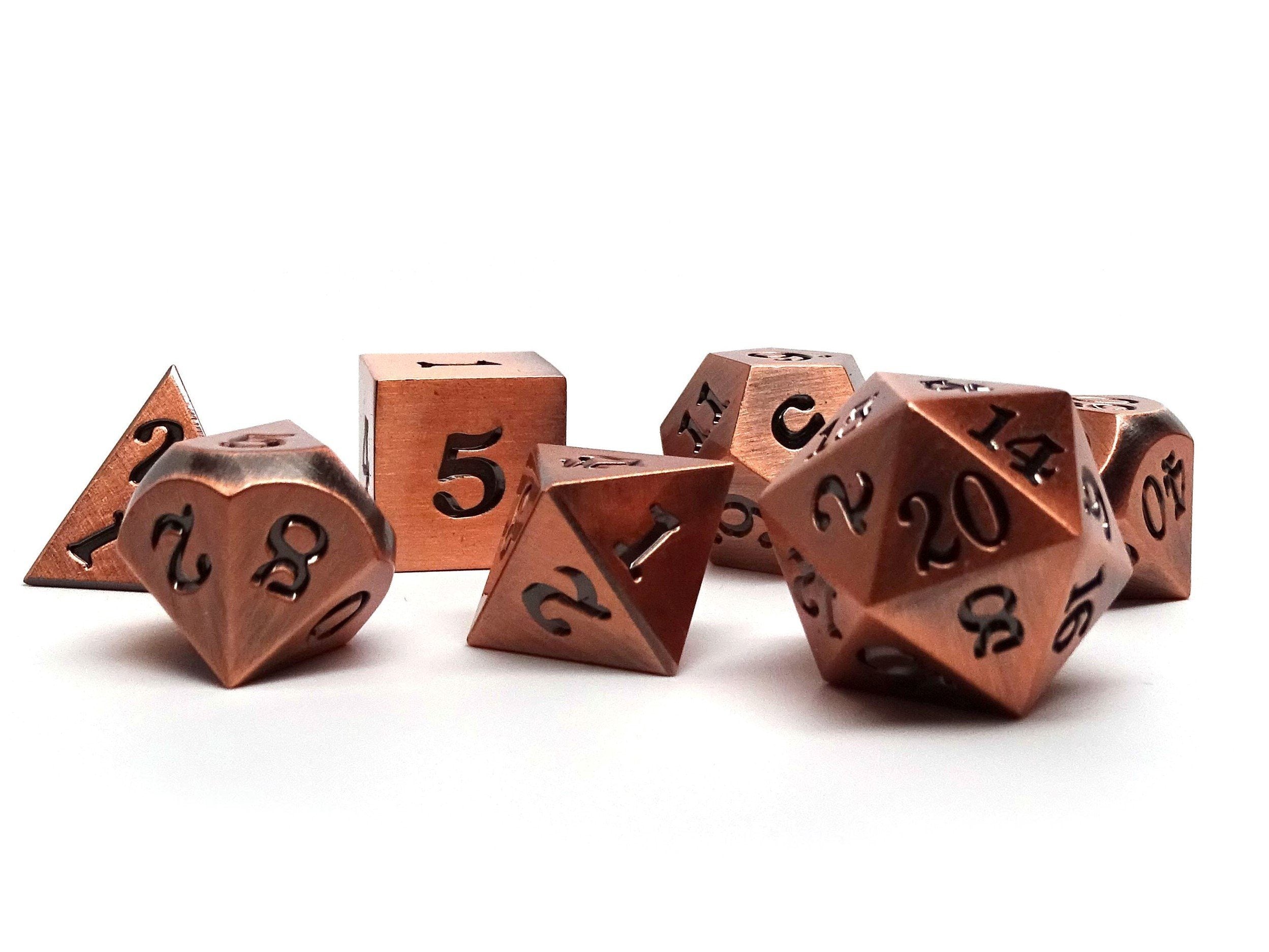
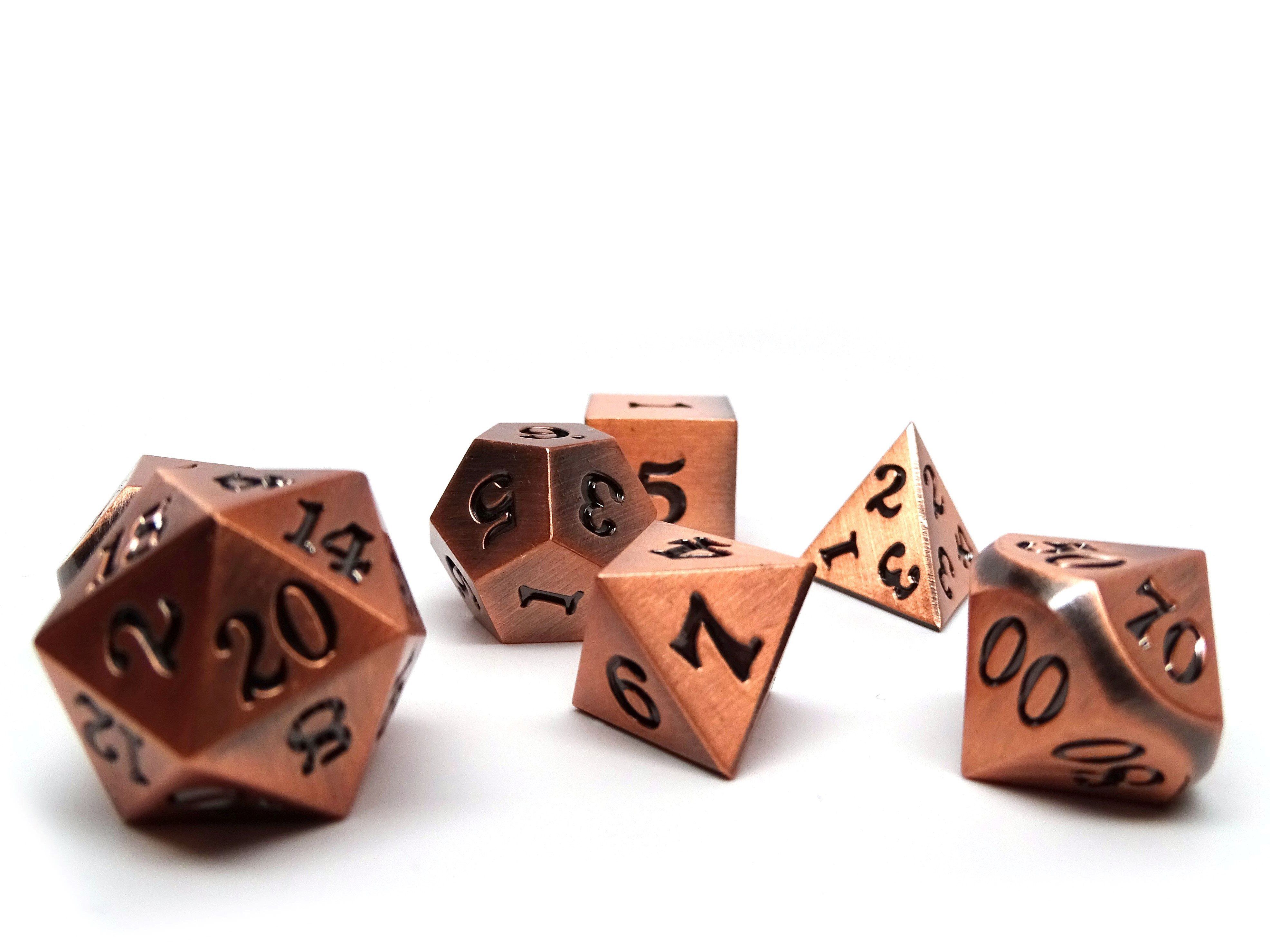 2 photos
 Legendary Silver / Copper 7-Piece Metal Dice Set
Another sub-$35 metal on-ramp with a deep catalog. Notably, Easy Roller sells 'blunt-tipped' variants with rounded corners — a genuinely smart pick if you're worried about table damage, since rounded metal corners concentrate less energy on impact. Pair the blunt-tip line with a mat and you've meaningfully reduced metal's biggest downside.
- $34.95 entry; frequent sales
- Blunt-tip (rounded-corner) options reduce table-gouge risk
- Large in-stock US catalog of finishes
- Still heavy enough to need a tray and separate storage
- Some metallic-on-metallic finishes read poorly
- Mini sets (~$19.95) trade away the heft you came for
 2 photos
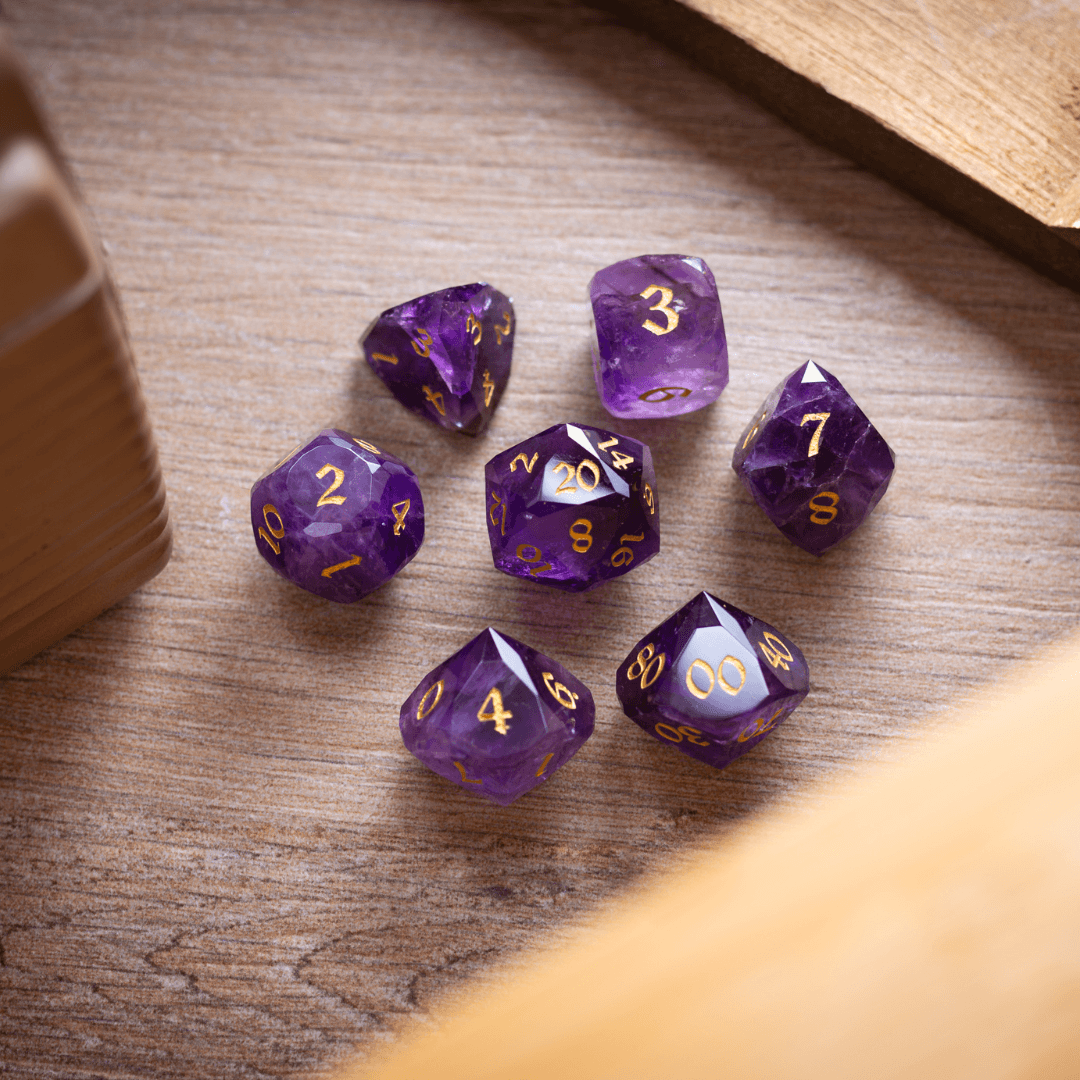
 Gemstone Polyhedral Dice Set (category pick)
Listed as a category, not an endorsement. Real stone is stunning and unique per set, but hand-carving plus natural density variation makes it the least balanced and most fragile material in this guide; sources warn it 'almost always' tests more biased than quality resin or metal. Prices run $60–$200+. Buy for the shelf and the photo, never expecting it to out-roll a $13 acrylic. Price left null — it varies wildly by stone.
- Genuinely unique, beautiful natural material
- Heft and cool-to-the-touch feel of real stone
- Conversation-piece prestige
- Least balanced tier — density veins and voids
- Chips and cracks; needs careful handling
- Most expensive ($60–$200+) for the least fairness
At a glance
| factor | metal | resin |
|---|---|---|
| Heft / feel | Heavy and authoritative — ~126–130g per 7-set (Die Hard Forge 130g, Mythica 126g), 4–5× a polymer set. Lands with a 'thunk,' stops fast. | Light, comfortable middle ground — ~28g per set, heavier than acrylic, far lighter than metal. Tumbles and skitters more freely. |
| Balance / bias | Tight cast/machined tolerances; 'more uniform faces' per makers. Fair — but NOT luckier. Hard to float-test (it sinks). | Fair at any real table; cheap hand-poured blanks risk a bubble or uneven set. Sharp-edge resin's flat faces are excellent. Easy to float-test. |
| Table / dice safety | Can mark tables and abrade softer dice — store separately, roll in a tray. Hard corners concentrate impact; blunt-tip variants help. | Bare-table safe; won't gouge furniture or grind other dice. Risk runs the other way — IT chips if dropped on a hard floor. |
| Noise | Loud clatter — dramatic, but disruptive in quiet/shared spaces. Fully muffled by a felt/neoprene tray. | Quieter, duller impact. The considerate choice for apartments, public venues, late nights. |
| Readability | Finish-dependent. Painted enamel fills read well; one-tone metallic-on-metallic can vanish in dim light. | Sharp-edge resin is best-in-class (flat faces + crisp paint). Murky translucent + same-color numerals is the avoidable failure mode. |
| Price per 7-set (USD) | ~$35–$45 quality (Norse Foundry $35, Easy Roller $34.95, Die Hard Forge ~$40); premium/aluminum $50–$125. | Sharp-edge ~$45–$50 (Dispel $44.99, Foam Brain $50). Plain acrylic ~$10–$13. Best $/set for collecting. |
| Durability / chipping | Essentially indestructible under normal use; outlasts everything. The trade is it endangers what it touches. | Durable in the bag but chips/cracks on hard-floor drops, especially at sharp corners. Lifetime warranties common (Dispel, MMG). |
Questions, answered
Are metal dice fairer than resin dice?
No. Fairness comes from a die's geometry and your throw, not its weight. Metal holds slightly tighter manufacturing tolerances, so it's a bit more likely to be uniform than a cheap hand-poured resin blank — but 'uniform' means fair, not lucky. At any real table you won't detect a difference.
Will metal dice scratch or damage my table?
They can. A ~130g cast-zinc die with hard corners thrown onto wood or laminate can leave marks; makers like Die Hard Dice say so directly. Roll metal into a felt- or neoprene-lined tray, or use rounded 'blunt-tip' metal, and the risk drops sharply. On a forgiving surface with a gentle toss, damage is unlikely — but a tray is the safe default.
Do metal dice damage my other dice?
Yes, over time, if stored together. Metal is harder than acrylic and resin, so loose in a shared bag the corners abrade softer dice. The fix is free: keep metal sets in their own pouch or tin, separate from your plastic and resin collection.
Which dice are easiest to read across the table?
Sharp-edge resin and high-contrast acrylic. Sharp-edge resin has mathematically flat faces with crisp hand-painted numerals; acrylic uses bold engraved ink fills. Painted-fill metal reads fine too — but avoid one-tone metallic-on-metallic finishes, which can be nearly unreadable in dim light.
How do I test if my dice are balanced?
Two ways. The salt-water float test (float a die in heavily salted warm water, flick it, see if one face keeps surfacing) is a quick screen for mass bias but is noisy and misses shape bias — and metal usually sinks. The definitive method is rolling the die a few hundred times and tallying results; that's the only test that catches both geometry and mass bias.
Are metal dice too loud for D&D night?
In quiet or shared spaces, yes — they clatter. That's great for dramatic rolls at your own table but disruptive in apartments, cafés, or late at night. Unlike readability, noise is fully fixable: a felt- or neoprene-lined dice tray muffles metal to a soft tap while still protecting your table.
What does a good 7-piece set actually cost?
Quality metal runs about $35–$45 (Norse Foundry $35, Easy Roller $34.95, Die Hard Forge ~$40), with premium/aluminum reaching $50–$125. Sharp-edge resin is about $45–$50 (Dispel $44.99, Foam Brain $50). Plain acrylic is roughly $10–$13. For one set, metal and sharp-edge resin are within ten dollars; for a collection, acrylic's price wins decisively.
Where do gemstone dice fit in?
They're the luxury tier ($60–$200+) and, honestly, the least balanced and most fragile. Hand-carving plus natural density variation (veins, voids, crystal structure) means gemstone almost always tests more biased than quality resin or metal, and stone chips. Buy gemstone as an art object for display, not as a fair daily roller.
Is sharp-edge resin worth it over regular resin or acrylic?
If you value readability and looks, yes. Sharp-edge resin's flat faces give the cleanest number readability in the hobby and showcase deep color and inclusions, often with lifetime warranties. The tradeoffs: it costs more than plain acrylic for the same fairness, and the sharp corners chip more easily on a hard-floor drop.
Dax's verdict
Buy resin for life, buy metal for love. For the player who rolls every week — especially in an apartment, a public venue, or on a table you'd rather not gouge — sharp-edge resin or plain acrylic is the smarter purchase: better readability, bare-table safe, quiet, fair, and (in acrylic's case) a quarter the price, so you can own a set per character. Buy METAL if you specifically want the heft and the thunk and the near-indestructible permanence, accept that it comes with a mandatory felt tray and separate storage, and treat it as a statement set rather than a stable of ten — choose a painted-fill finish so you can read it, or a blunt-tip variant to spare your table. Buy GEMSTONE only as an art object; it's the priciest and least balanced tier, full stop. Segmented: COLLECTOR / special-occasion roller → one nice metal set ($35–$45, Norse Foundry or Die Hard Forge) plus a tray. EVERY-NIGHT player → sharp-edge resin for the showpiece (Dispel $44.99) backed by a $13 acrylic workhorse. GIFT → sharp-edge resin in the recipient's color or theme; it's the 'wow' material that's also genuinely practical, warranty-backed, and won't make them buy a tray to use it. The cost-smart loadout for almost anyone is one hero set plus a cheap acrylic bench — under $55 gets you the drama and the daily driver both.
Research ledger 21 sources · reviewed 2026-07-17
Specifications, rules, current product information, community experience, and contrary evidence were checked against the sources below. Commercial links are kept separate from editorial evidence.
- bardsandcards.combardsandcards.com/blogs/news/metal-vs-resin-vs-gemstone-dice-complete-guide
- dicedungeons.comdicedungeons.com/blogs/inside/dice-weight-explored
- dicedungeons.comdicedungeons.com/blogs/inside/using-metal-dice
- dieharddice.comdieharddice.com/pages/metal-vs-plastic
- norsefoundry.comnorsefoundry.com/collections/7-piece-metal-dice-set
- norsefoundry.comnorsefoundry.com/collections/dice-sets
- mistymountaingaming.commistymountaingaming.com/products/dispel-magic-sharp-edged-resin-dice-set
- mistymountaingaming.commistymountaingaming.com/products/disenchanted-resin-dice-set
- foambrain.comfoambrain.com/products/sharp-edge-resin-rpg-dice-set-green-skulls
- easyrollerdice.comeasyrollerdice.com/collections/metal-dice-sets
- dieharddice.comdieharddice.com/collections/metal-dnd-dice
- chessex.comchessex.com/polyhedral-dice-set
- rpgmuseum.fandom.comrpgmuseum.fandom.com/wiki/Salt_water_test
- boingboing.netboingboing.net/2016/09/06/check-the-balance-of-your-gami.html
- hearnshobbies.comhearnshobbies.com/blogs/tabletop-gaming/testing-gaming-dice-balance-float-tests-and-fair-play
- critmaker.comcritmaker.com/blogs/articles/are-your-dice-balanced-and-does-it-even-matter
- haxtec.comhaxtec.com/blogs/product-guides/biased-dice-test-guide
- dndbeyond.comdndbeyond.com/forums/d-d-beyond-general/general-discussion/14258-dice-material-benefits-and-disadvantages
- runicdice.comrunicdice.com/blogs/news/mistakes-to-avoid-when-buying-your-gemstone-dice-set
- dicecraftlab.comdicecraftlab.com/buying-guides/gemstone-dice
- tangibleday.comtangibleday.com/best-dice-tray-material-to-dampen-dice-bounce-and-noise

I'll be honest with you — flattery is boring.

Keep exploring
The next smart rabbit holes.
⬢ Topic PathTabletop Accessories: compare the whole shelfBuy the accessory that fixes a repeated annoyance first. Protection, setup speed, readable state, and comfortable handling beat...Best OfBest Metal Dice Sets for D&D (2026): Heft, Balance & Where to BuyAn archivist's verified ledger of metal dice worth owning—what the heft actually buys you, whether they roll fair, and which sets are...Buying GuideAre Gemstone Dice Worth It? (2026)Genuine stone, dyed imposters, and glass under poetic names: the Archivist reads the label and the ledger both, then tells you exactly...