Spiel des Jahres 2026: Every Nominee, the Awards Explained, and Who Wins
The 2026 Spiel des Jahres nominees explained: all nine games across three awards, how the categories differ, who the favorites are, and who I think wins July 12.


AI-assisted research and drafting in Margo’s voice · reviewed by Robert Pruitt · how this guide was made
Last editorial refresh: 2026-07-03 Gold-standard QA: 2026-08-10 16 sources reviewed Affiliate links checked during gold-standard pass

The short answer
The Spiel des Jahres 2026 winners are announced in Berlin on Sunday, July 12, 2026 — and this is the most wide-open main race in years. Three awards are decided that night. Spiel des Jahres (family/gateway) nominees are Cozy Stickerville, Dito! (released elsewhere as JinxO), and Morty Sorty Magic Shop. Kennerspiel des Jahres (connoisseur) nominees are Boss Fighters QR, Moon Colony Bloodbath, and Rebirth by Reiner Knizia — Rebirth is the clear favorite. Kinderspiel des Jahres (children's) nominees are Boo Party, Mookie Island, and Verflixt Verzaubert. My read: Morty Sorty Magic Shop edges the main award, Rebirth takes the Kennerspiel, and either result could put a designer one win away from a historic career trio. Winner names go live July 12; I will update this the moment the envelopes open. With receipts, always.
Decision map
Choose in thirty seconds
The best overall game on the slate, and the Kennerspiel favorite
My pick to win Spiel des Jahres 2026 and a tidy family puzzle
A committed 2–4 group that wants a shared story across many nights
THE VERDICT: After chasing every official source and a stack of reviews, my prediction is Morty Sorty Magic Shop for Spiel des Jahres and Rebirth for Kennerspiel des Jahres — but I want it on the record that the main-award jury vote is genuinely close this year, and I would not stake the reference desk's reputation on a single name.
THE FLAW: The internet is already treating two of these games as interchangeable — Dito! and JinxO are the same game under two titles, which trips up half the coverage — and the algorithm-driven prediction sites and the human jury disagree hard on the main award. If you read only headlines, you will come away thinking a game the jury did not even nominate is the favorite....so let me check that.
I pulled the official nominee list from spiel-des-jahres.de, cross-checked it against ICv2 and BoardGameWire's launch-day reporting, and confirmed the ceremony details. Everything below is sourced. Where I am guessing — and a winner prediction is always a guess — I say so plainly and tell you what would change my mind.
This guide does four jobs, in order: it explains what the three awards actually are (most English-language readers conflate them); it walks every one of the nine nominees with real gameplay detail; it answers the specific questions people are searching this week — what is Cozy Stickerville, why does Dito! have two names, which nominee should I buy for family game night; and it gives you my prediction with the reasoning exposed so you can disagree with the evidence in front of you. The winners drop July 12. This is field intelligence dated the week before — accurate as of research, and updated the instant it isn't.
Start here, then go deeper
You are in the right cabinet.
 ✦ Topic PathBoard Game Buying Guides: compare the whole shelfStart with the decision, not the shelf. These guides compare the games, editions, expansions, player counts, and costs people...
 Beginner's GuideBest Gateway Board Games (2026): Picked by Who You're ConvertingTen welcoming games organized by the person at your table, with teach time, interaction and failure modes made explicit.
 ComparisonThe Best Family Board Games of 2026, Ranked (Kids + Adults Together)One table, three generations, zero meltdowns — the games that make a 7-year-old and a tired grown-up scheme against each other and both...
What is the Spiel des Jahres, and why does the whole hobby stop for it?
The Spiel des Jahres — literally "Game of the Year" — is a German award founded in 1978 by a jury of German-speaking board game critics from Germany, Austria, and Switzerland. It is, without much argument, the most commercially important board game award on earth. People call it the board gaming Oscars, and for once the comparison is not marketing hyperbole: a nomination can lift a game's sales from a few thousand copies into the tens of thousands, and a winner routinely sells 500,000 copies or more. That red meeple logo on a box is a license to print money in the German mass market, which is why publishers plan release calendars around eligibility windows.
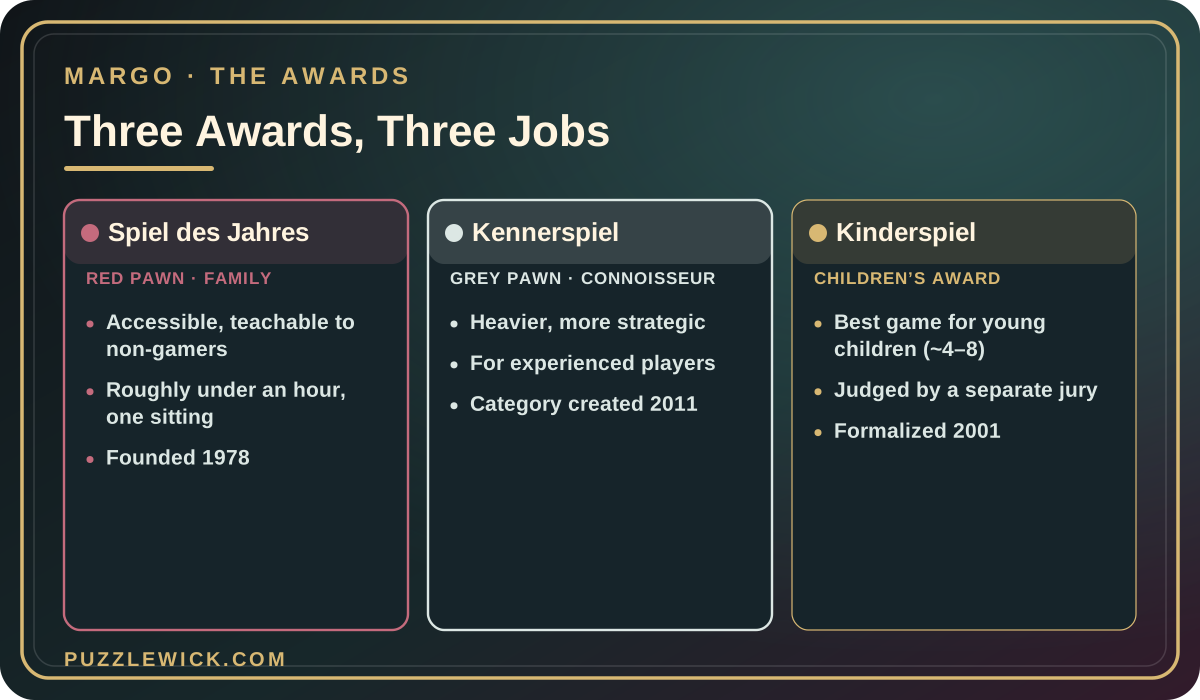
Here is the part the headlines skip. There are three separate awards decided the same night, and they are not tiers of prestige — they are different jobs.
Spiel des Jahres (the red pawn) is the headline award, and it honors the family and gateway game: something a group of adults and reasonably patient children can learn in one sitting and finish in under an hour. Accessibility is not a weakness here; it is the entire brief. The jury is choosing the game most likely to convert a non-gamer.
Kennerspiel des Jahres (the anthracite-grey pawn, added in 2011) honors the connoisseur game — heavier, more strategic, aimed at people who already own a shelf of games and want more decisions per turn. It exists precisely because titles like this were being overlooked when forced to compete with pure gateway fare.
Kinderspiel des Jahres (the children's award, formalized in 2001) honors the best game for young children, typically ages four to eight. It is judged by a separate specialist jury.
So when someone asks "who won the Spiel des Jahres," the precise answer is: which one? Three trophies, three different definitions of "good," one ceremony. Getting that distinction right is the whole foundation of understanding the 2026 race — and it is the single most common mistake in the English coverage.
Three trophies, three different definitions of "good," one ceremony. Getting that distinction right is the whole foundation.
Who are the 2026 Spiel des Jahres nominees, in full?



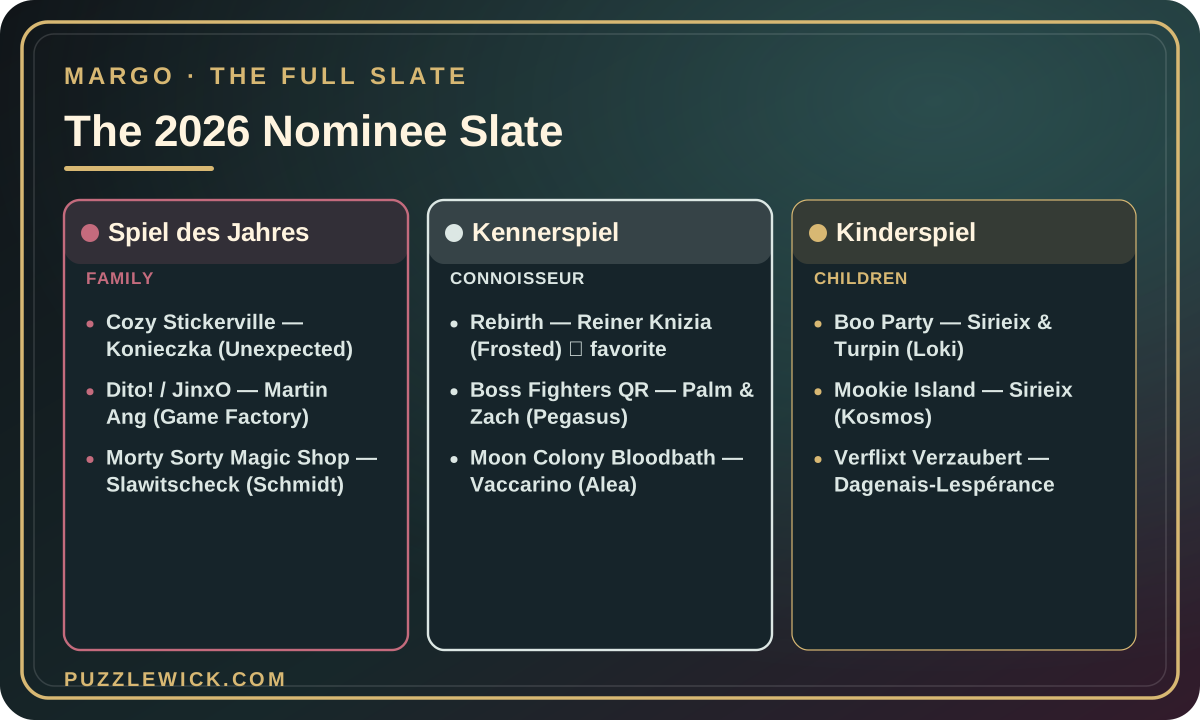
The jury announced the nominees on May 19, 2026, after reviewing a record 571 eligible games. Here is the complete, official slate across all three awards — titles verified against spiel-des-jahres.de and ICv2's launch-day report.
Spiel des Jahres (main / family award):
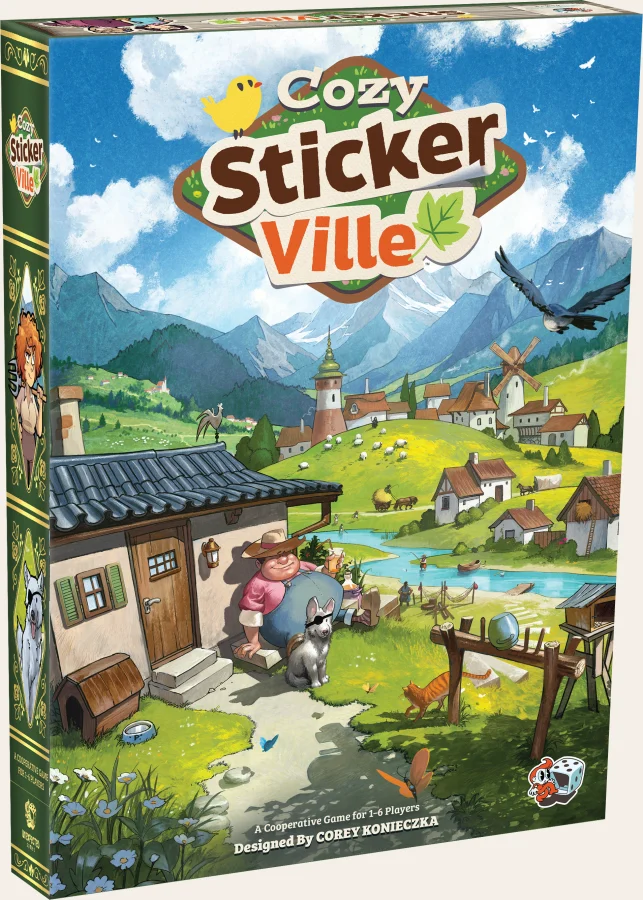
- Cozy Stickerville — Corey Konieczka (Unexpected Games)
- Dito! — Martin Ang (Game Factory in German-speaking territories; released elsewhere as JinxO by Tabletoys)
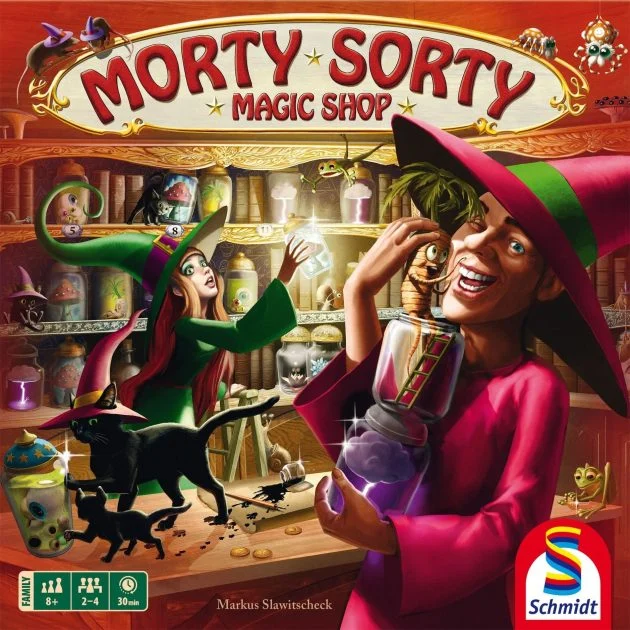
- Morty Sorty Magic Shop — Markus Slawitscheck (Schmidt Spiele)
Kennerspiel des Jahres (connoisseur award):
- Boss Fighters QR — Michael Palm and Lukas Zach (Pegasus Spiele)
- Moon Colony Bloodbath — Donald X. Vaccarino (Alea / Rio Grande Games)
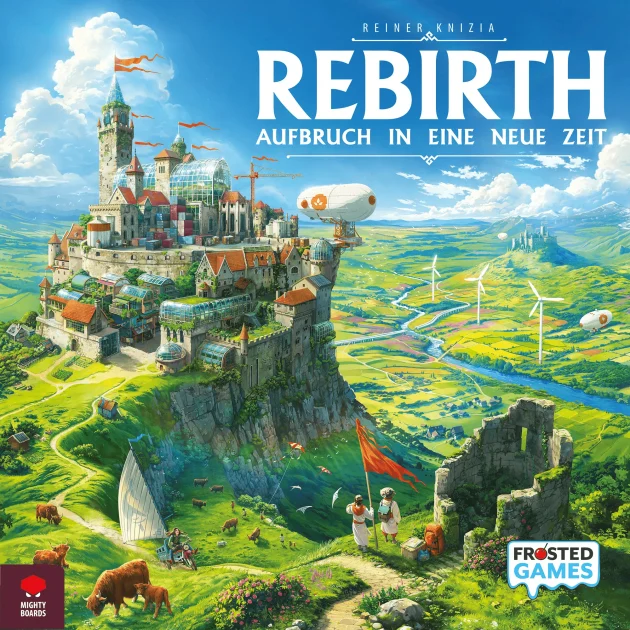
- Rebirth — Reiner Knizia (Frosted Games in German; Mighty Boards in English)
Kinderspiel des Jahres (children's award):
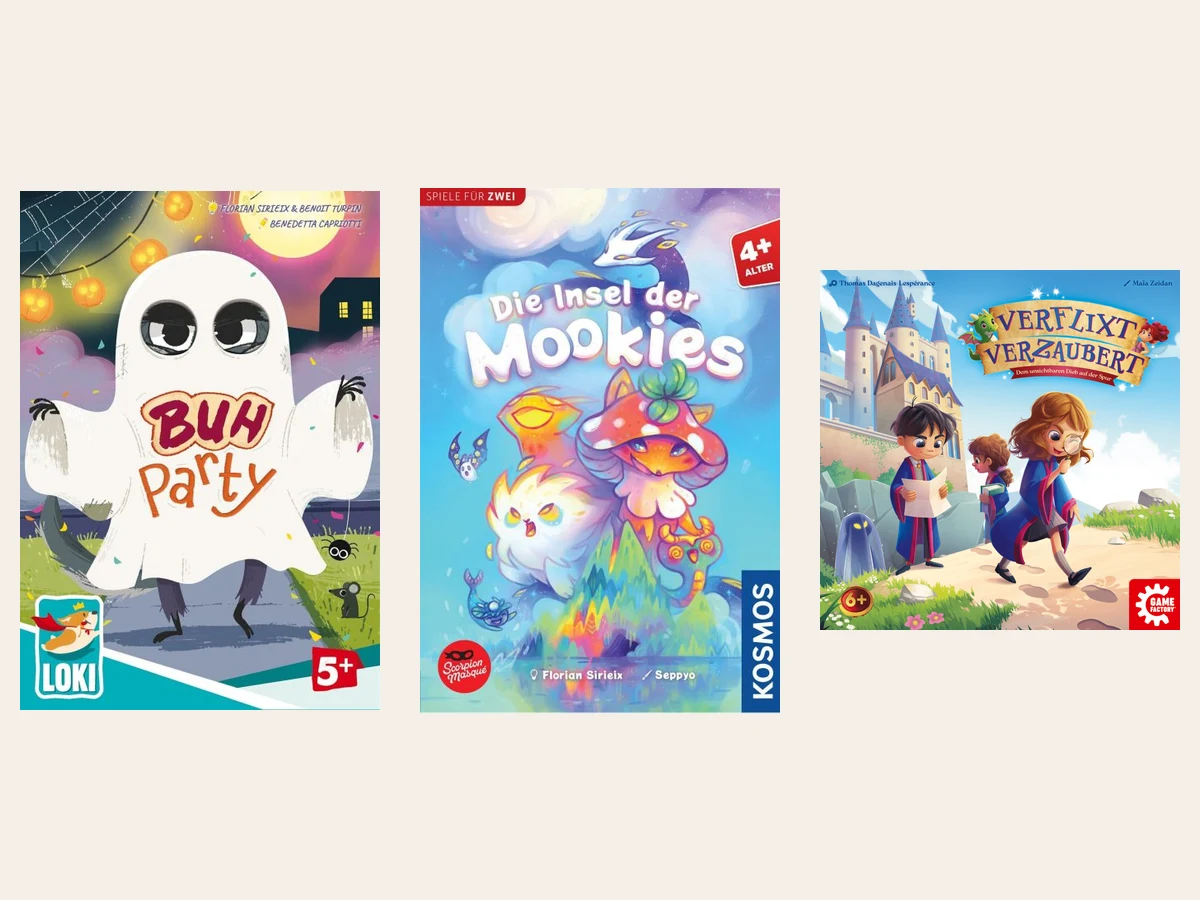
- Boo Party (German: Buh Party) — Florian Sirieix and Benoit Turpin (Loki)
- Mookie Island (German: Die Insel der Mookies) — Florian Sirieix (Kosmos / Scorpion Masqué)
- Verflixt Verzaubert — Thomas Dagenais-Lespérance (Game Factory / Locomuse)
Beyond the nominees, the jury also publishes recommendation lists, which function as a shortlist of "also excellent" titles. For the main award the 2026 recommendations include Hot Streak, Meister Makatsu, Take Time, Toriki, Toy Battle, and Wilmot's Warehouse; for the Kennerspiel, Artengarten, Frosted Blooms, Grundstein von Metropolis, and Tag Team. That Meister Makatsu name matters — hold onto it, because it is the reason algorithm-based prediction sites and the jury are pointing in different directions this year.
A note on titles you will see mangled elsewhere: "Cozy Sticker Ville" (three words) and "Cozy Stickerville" (one) refer to the same game — the publisher styles it Stickerville. And Dito!/JinxO is a single game with a naming split I will untangle in its own section, because it is the number-one point of confusion in the current coverage.
What is Cozy Stickerville, and how does the sticker mechanic actually work?
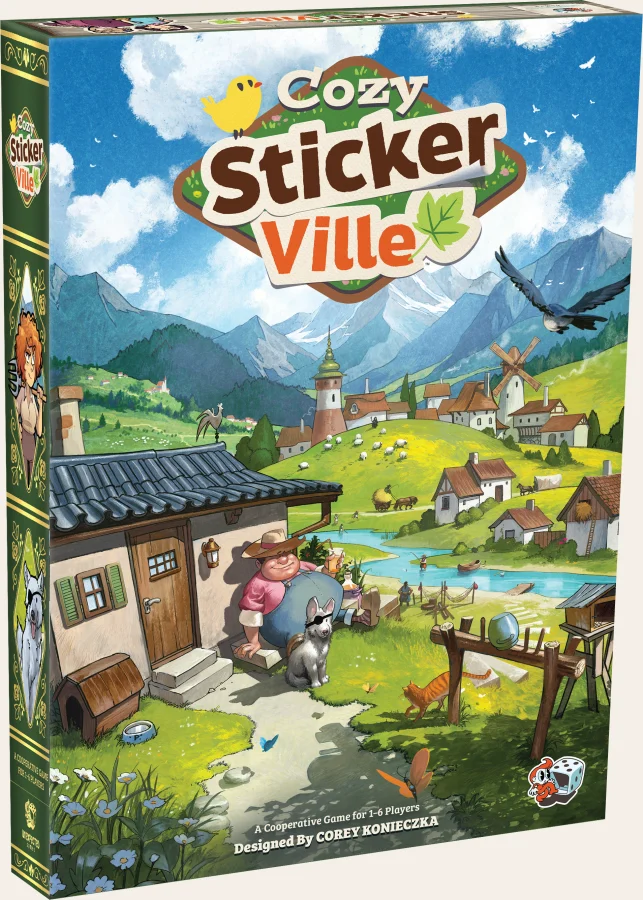
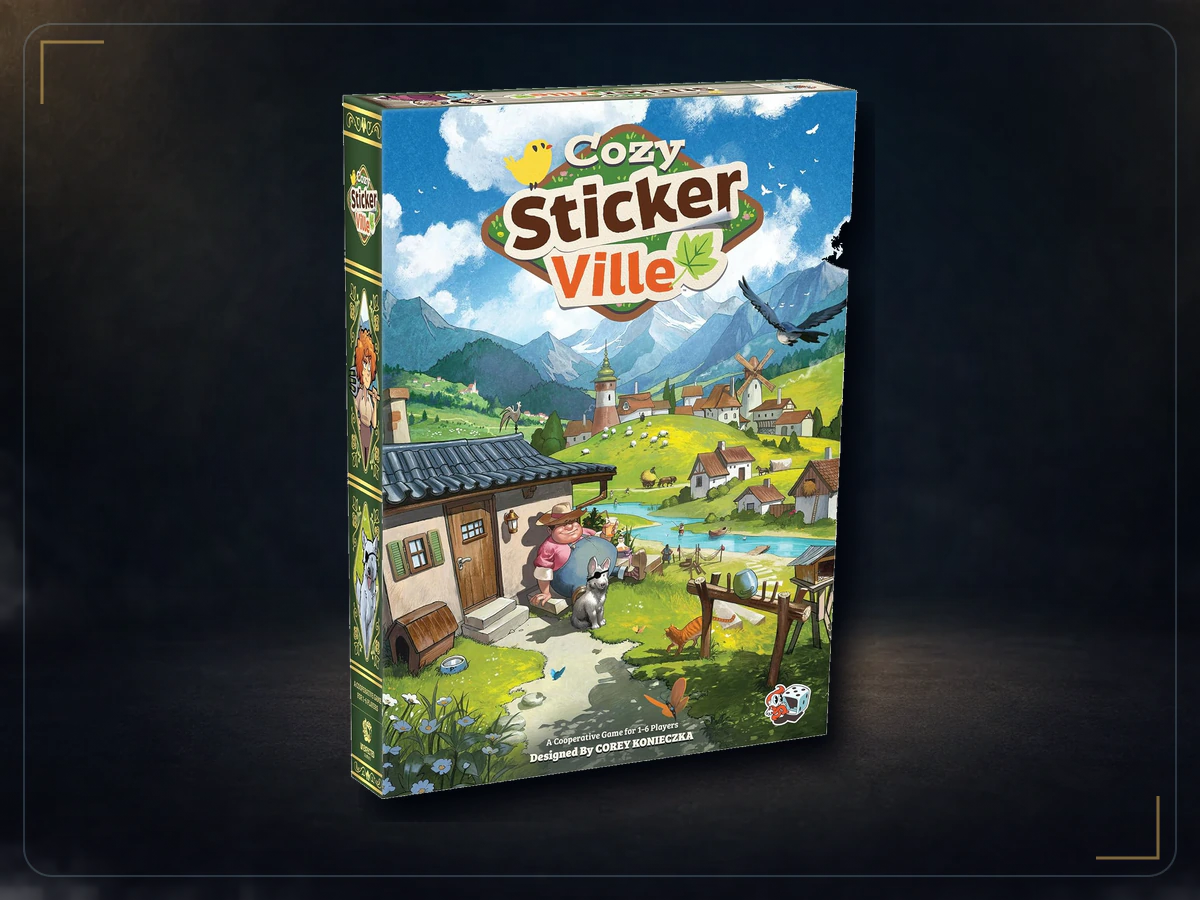
Cozy Stickerville is the most-searched of the three main nominees, and for a delightful reason: it is a board game you permanently deface, on purpose, and that is the whole point. Corey Konieczka — a designer better known for heavier fare — built a legacy-adjacent "cozy" game around a pad of more than 800 stickers.
Here is how it works. You start with a blank game board, a storybook, and that glorious sticker pad. Over a campaign of roughly ten linked sessions, you build up a village in the countryside across a decade of in-fiction time. On your turns you make choices and allocate resources to actions; when you hit milestones, you earn the right to place stickers onto your map. Those stickers are not just decoration — placing them unlocks further actions, opens new events, and advances the storybook. A second sticker type, little heart "Happiness" stickers, feeds directly into the narrative. Crucially, you place stickers where you want them; that freedom is a real part of the charm, even though the underlying gameplay is mostly the familiar "pick an action, spend a resource" loop.
The result is a visual diary. By the end of ten games your board is a one-of-a-kind record of the decisions your group made — a town that exists nowhere else. That is a genuinely novel emotional hook, and it is why the game gets talked about beyond the hobby core.
So why is it a longshot for the win? Two reasons, and I will be honest about both. First, it is a campaign game measured against opponents that deliver a complete experience in half an hour — that is an awkward fit for an award built around the one-hour family session. Second, it is not cheap or reprint-friendly at scale, and stickers are consumable: once used, a copy cannot be reset. The jury has occasionally rewarded ambition of exactly this kind, so I would not call it dead. But if I am setting odds, Cozy Stickerville is the heart pick, not the head pick.
A board game you permanently deface, on purpose — and by the end, a town that exists nowhere else.
Why does Dito! have two names — is it the same game as JinxO?
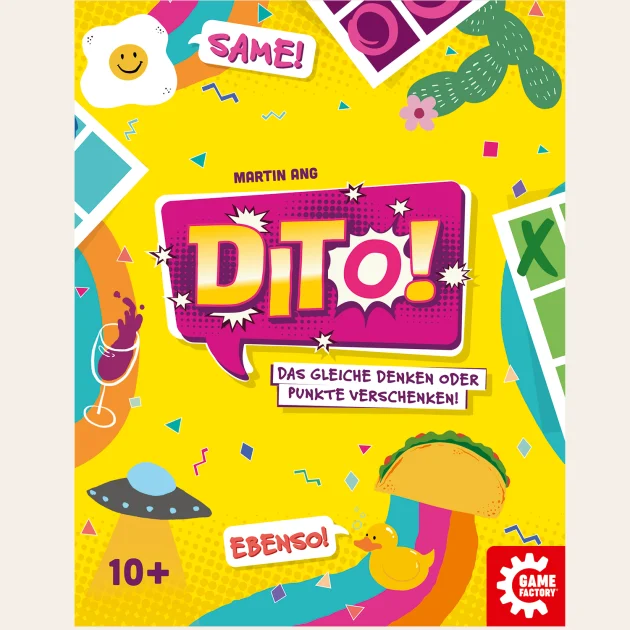
Yes. Dito! and JinxO are the same game. This is the single most confusing thing about the 2026 slate, so let me lay it out cleanly.
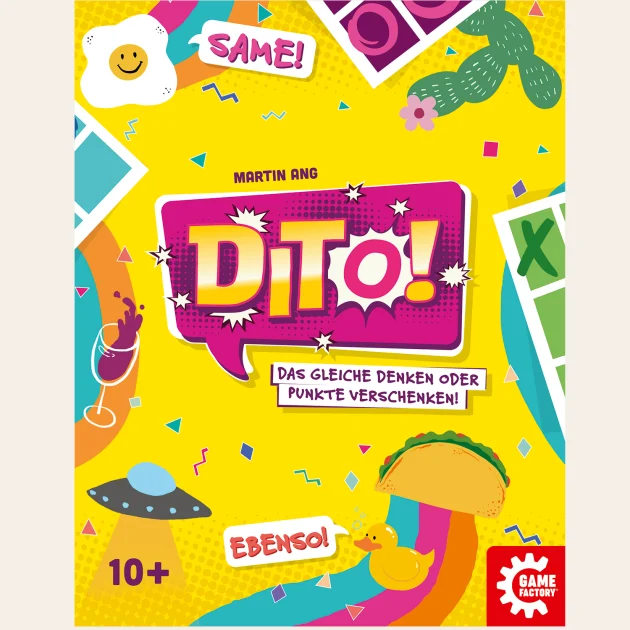
Martin Ang designed a party game that first reached English-speaking players as JinxO, published by Tabletoys. In German-speaking territories — the only market that matters for Spiel des Jahres eligibility — it is published by Game Factory under the title Dito!. The jury nominates the version released in Germany, so the official nominee is Dito!, and every list keyed to the ceremony uses that name. English coverage, working from the version its readers already knew, keeps calling it JinxO. Same game, same designer, different box in a different language. There is no "which one should I buy" dilemma beyond picking the edition in your language.
Now the actual game, because it is genuinely good. Dito!/JinxO is a written party game for 3–7 players, about 30 minutes. Each round has three topics drawn from a deck of roughly 400. For each topic, every player secretly writes three short answers (one or two words) onto a personal nine-square dry-wipe board — you choose which square each answer goes in, and that placement is where the tactics live. Then players take turns reading answers aloud. If anyone else wrote the same thing, both matching answers get circled and score. Match nobody: zero points. But here is the twist that names the game — if exactly one other person matches you, that is a JINX, and you both score more. So you are not trying to be obvious (everyone gets that) or obscure (nobody gets that); you are hunting for the answer that exactly one specific kind of person at the table will also think of.
Reviewers have pegged it as a smart competitive answer to the cooperative party smash Just One — "a well-designed, familiar party game" that delivers high-fives and friendly arguments rather than reinventing the genre. That is precisely the profile the main award loves: teachable in a minute, plays with grandparents and teenagers, always ends with people talking. It is the safest "buy this for family game night" pick of the three main nominees, and it is a legitimate dark-horse for the win.
What is Morty Sorty Magic Shop, and why do I think it wins?
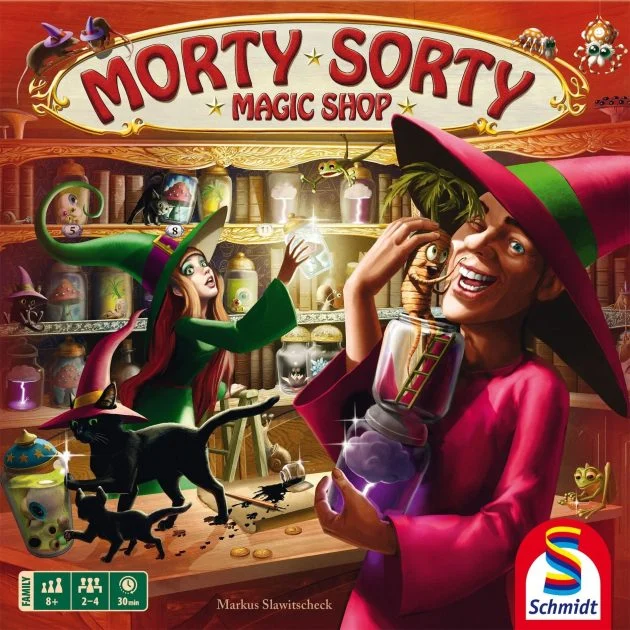
Morty Sorty Magic Shop is, to my eye, the most Spiel-des-Jahres-shaped game in the main category — and that shape is not an accident. Markus Slawitscheck designs family games with a jeweler's precision, and this one is a tight tile-placement puzzle dressed as a wizard's stockroom.
Two to four players are apprentice sorting-masters stocking a magic shop's shelves to win the owner's favor. On your turn you choose a tile — an ingredient jar — and place it on your personal shelf board. The rules are strict but genuinely simple: the color of the jar's lid dictates which shelf it may go on, and within each row the numbers must run in ascending order. That's the core, and it is the kind of clean constraint that produces a satisfying "where does this go" decision every single turn. Layered on top are magical kittens and special jars, earned through play, that grant small but meaningful advantages when you stock. Games run about 30 minutes.
That is the whole recipe the award rewards: half an hour, pleasant theme, real-but-gentle mental challenge, plays with the family. Reviewers describe it as feeling like an ideal candidate almost by design — approachable, quick, quietly clever. It is the head pick where Dito! is the safe pick and Cozy Stickerville is the heart pick.
And then there is the storyline the jury loves and I cannot ignore. Slawitscheck has already won two of the three award categories in recent years. A Spiel des Jahres win for Morty Sorty would make him — per BoardGameWire's launch-day framing — a candidate to become the first designer to complete the full trio, and to do it across just a handful of years. Awards juries are human; a well-made game and a history-making narrative is a hard combination to vote against. That is why my head lands here. I hold it loosely: the main-award vote is close, Meister Makatsu (a recommendation, not a nominee) is the algorithm's darling, and the jury has surprised everyone before. But if you make me pick one name for the red pawn, it is Morty Sorty Magic Shop.
The head pick where Dito! is the safe pick and Cozy Stickerville is the heart pick.
Rebirth by Knizia leads the Kennerspiel — but can it complete a historic trio?
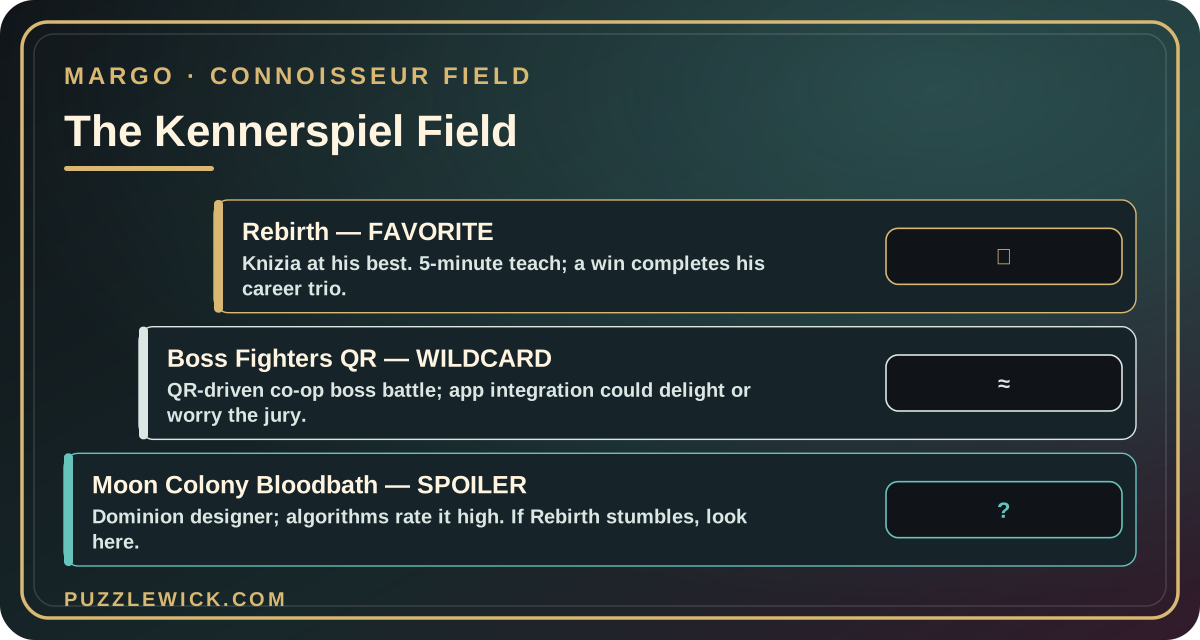
If the main award is a coin-flip, the Kennerspiel is the closest thing to a safe bet on the board, and its name is Rebirth. This is the one nomination where the human juries, the prediction algorithms, and — I will admit it — my own gut all landed in the same place.
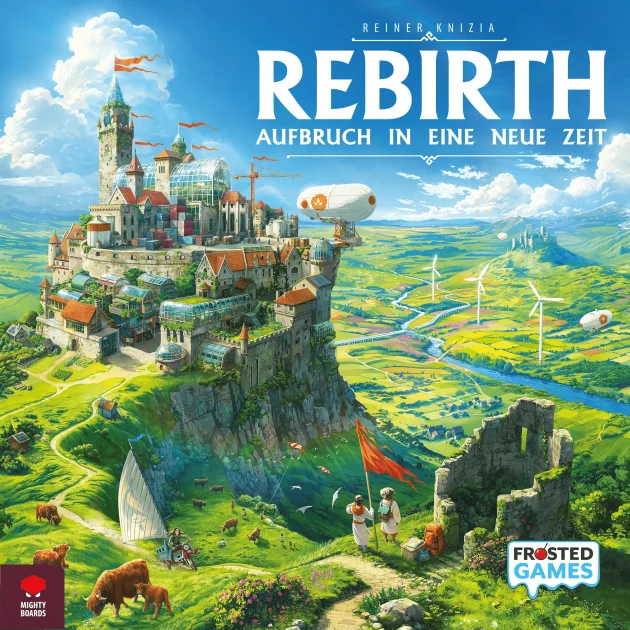
Rebirth is a Reiner Knizia tile-laying game in which players are Scottish (or, on the flip side of the double-sided board, Irish) clans rebuilding their lands after catastrophe. The teach is famously fast — about five minutes on the Scotland map. Each turn you place a tile from your supply, immediately score it, and draw a replacement. Place next to a castle or cathedral space and you may set one of your gorgeous castle or cathedral pieces onto the board; cathedrals can be influenced exactly once per player per game, and doing so draws you a scoring objective. That is essentially the whole rulebook, and out of it Knizia extracts the thing he does better than almost anyone: a stream of small, sharp, meaningful placement decisions, wrapped in genuinely beautiful production. Reviewers have called it "playful elegance" and Knizia "at his best." It runs 2–4 players, age 10 and up, and is the rare heavier game a family can actually absorb — which is exactly the accessible-but-deep sweet spot the Kennerspiel exists to reward.
Now the history, because it is remarkable and it is real. Reiner Knizia won the Spiel des Jahres for Keltis in 2008, and the Kinderspiel des Jahres the same year for Wer war's?. He has never won the Kennerspiel — which is unsurprising, since that category was only created in 2011. A Rebirth win on July 12 would give Knizia all three trophies, a career trio no designer has ever completed. For a man once likened to Susan Lucci for his long drought of Spiel des Jahres near-misses before 2008, that would be a full-circle capstone. Do the jury factor narrative into a Kennerspiel vote? They shouldn't, officially. But when the game is also the best in its category, the story is a free bonus rather than a thumb on the scale. My call: Rebirth wins the Kennerspiel des Jahres 2026. I hold this one tighter than my main-award pick.
A Rebirth win would give Knizia all three trophies — a career trio no designer has ever completed.
What about Boss Fighters QR, Moon Colony Bloodbath, and the rest of the Kennerspiel field?
Rebirth is the favorite, but a favorite is not a certainty, and the other two Kennerspiel nominees are interesting precisely because they are so different from it — and from each other.
Boss Fighters QR (Michael Palm and Lukas Zach, Pegasus Spiele) is the technological curiosity of the slate. The "QR" is not decoration: the game leans on QR-code scanning to drive a co-operative boss-battle experience, the kind of app-and-cardboard hybrid the jury has historically approached with caution. When it works, that integration is genuinely novel; when a jury worries about long-term app support or component reliability, novelty can cut against you. It is the nominee most likely to divide the room.
Moon Colony Bloodbath (Donald X. Vaccarino, Alea / Rio Grande Games) has the most arresting name on the entire slate — a title that, as one outlet drily noted, single-handedly demonstrates the breadth of design the awards now honor. Vaccarino is the mind behind Dominion, the game that arguably invented modern deck-building, so any design of his carries weight. The prediction algorithms actually ranked it and Boss Fighters QR higher than Rebirth on raw metrics, which tells you these are not filler nominees — they are strong games that happen to be standing next to a Knizia at the top of his form.
And this is the honest limit of my desk research: I have far more verified detail on Rebirth's mechanics than on the moment-to-moment play of these two, because the English-language review coverage is thinner and I would rather flag a gap than paper over it. What I can tell you with confidence is the shape of the race: Rebirth is the frontrunner on quality and narrative; Boss Fighters QR is the wildcard whose tech could delight or worry the jury; Moon Colony Bloodbath is the pedigreed spoiler. If Rebirth stumbles — and juries do occasionally reward the bolder swing over the polished favorite — Moon Colony Bloodbath is where I would look next.
Which nominee should I buy for family game night?
This is the question I get most, and the answer depends less on which game wins the trophy than on who is sitting at your table. Let me be a reference desk about it and route you by situation rather than by hype.
For a mixed-age group that wants to laugh together tonight: Dito! (JinxO). It is a 3–7 player party game, teaches in a minute, and works whether your table is board-gamers or complete novices. It is the closest thing on this slate to a universal crowd-pleaser, and the competitive JINX scoring keeps adults engaged where a pure kids' game wouldn't. If you want one game that never sits on the shelf, this is it.
For a family of 2–4 that likes a tidy little puzzle: Morty Sorty Magic Shop. Thirty minutes, a genuinely charming theme, and a place-the-tile decision every turn that rewards paying attention without ever feeling like homework. It is my pick for the win and an easy recommendation regardless of the result.
For a couple or small group that wants a bit more meat: Rebirth. Yes, it is the Kennerspiel nominee, but its five-minute teach makes it far more family-accessible than most "connoisseur" games. If your household has graduated past pure gateway fare and wants beautiful, decision-rich tile placement, this is the standout — and probably the best game, full stop, on the entire slate.
For a committed group that wants a shared story over many nights: Cozy Stickerville. Only if everyone will show up for the ten-game arc, and only if you are at peace with a game you cannot reset. When those conditions are met, nothing else here delivers the same personal-diary payoff.
For younger children specifically, skip straight to the Kinderspiel section below — those three games are built for ages four to eight and will land far better with little ones than any of the main nominees.
The answer depends less on which game wins the trophy than on who is sitting at your table.
Who wins the Kinderspiel des Jahres 2026, and does it matter?
It matters enormously — just to a different audience. The Kinderspiel des Jahres is judged by its own specialist jury and often outsells the grown-up awards in the children's category, because a red-pawn logo on a kids' game is a powerful signal to parents and grandparents choosing a gift. The 2026 nominees are all strong, and one designer name jumps out immediately.
Boo Party (German: Buh Party), by Florian Sirieix and Benoit Turpin (Loki), is a lively, interactive children's game with the kind of physical, everyone-involved energy that tends to win this category. Turpin (of Welcome To fame) and Sirieix are a serious design pairing for a kids' title.
Mookie Island (German: Die Insel der Mookies), also by Florian Sirieix (Kosmos / Scorpion Masqué) — yes, Sirieix has two nominees in the same category this year, which is a genuinely unusual feat and a testament to a designer having a very good year in children's games.
Verflixt Verzaubert by Thomas Dagenais-Lespérance (Game Factory / Locomuse) rounds out the trio.
I am going to do the responsible thing and not hand you a confident Kinderspiel prediction, because this category turns on qualities — tactility, how a five-year-old actually reacts, replay appeal for tiny attention spans — that I cannot assess from reviews written by adults, and the specialist jury weighs them differently from the main jury. If forced, the Sirieix double-nomination makes him the story to watch, and Boo Party has the profile this award has historically favored. But that is a lean, not a call. What I will say without hesitation: any of the three is a safe, jury-vetted gift for a young child, and that vetting is exactly what the Kinderspiel exists to provide.
So who actually wins on July 12, 2026?

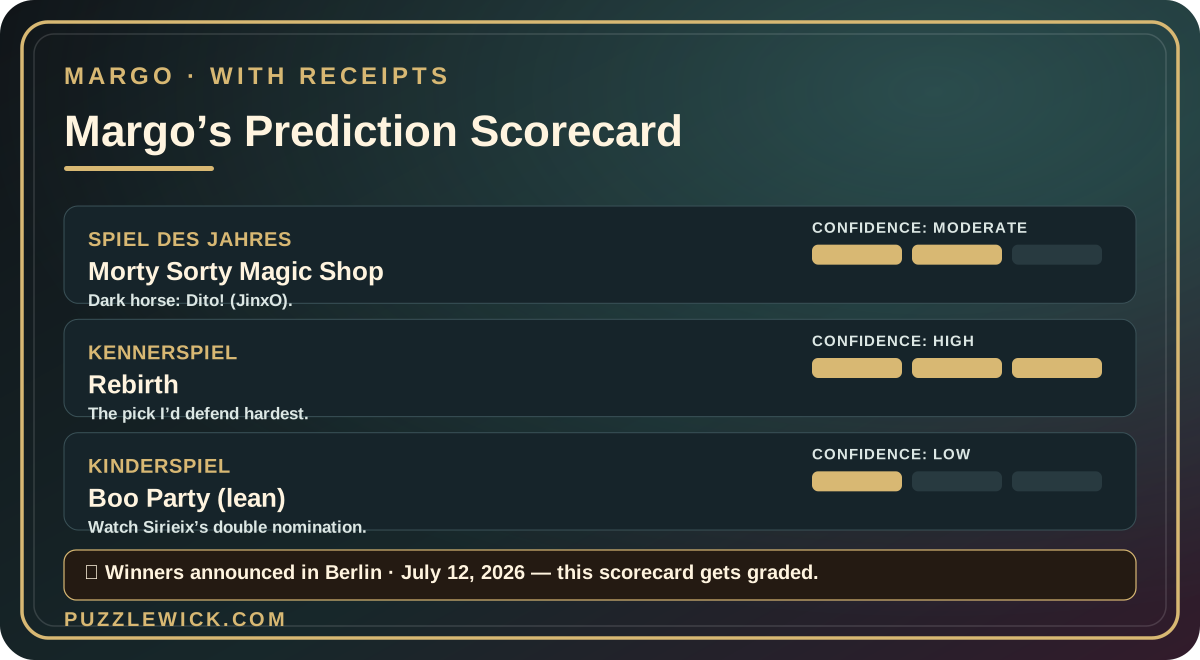
Time to commit, with all my cards face-up. The ceremony is Sunday, July 12, 2026, in Berlin. Here is my full prediction ballot and exactly how confident I am on each line.
Spiel des Jahres — my pick: Morty Sorty Magic Shop. Confidence: moderate. It is the most precisely award-shaped game in the field, and Slawitscheck's shot at a historic designer trio is the kind of narrative juries quietly love. But this is the closest main race in years; Dito! could take it on sheer universal appeal, and the algorithm's love for the non-nominee Meister Makatsu is a reminder that models and juries see differently. If I am wrong, Dito! is where I lose.
Kennerspiel des Jahres — my pick: Rebirth. Confidence: high. Best game in its category by consensus, with a Knizia career-trio storyline as a bonus. Boss Fighters QR's tech and Moon Colony Bloodbath's pedigree are real, but Rebirth is the one everyone — algorithm, humans, and me — agrees on. This is the pick I would defend hardest.
Kinderspiel des Jahres — no confident pick, leaning Boo Party. Confidence: low, and honestly stated. This category rewards things I cannot measure from an armchair. Watch the Sirieix double-nomination.
Notice the pattern: I am most confident where the evidence converges (Rebirth) and least confident where it is soft or subjective (Kinderspiel). That is not fence-sitting — it is calibrating my certainty to the strength of my sources, which is the only honest way to make predictions in public.
And here is the standing promise. The winners are announced July 12. The moment the envelopes open in Berlin, I will update this guide with the actual results, mark which of my calls survived contact with reality, and — win or lose — show my work on why. A prediction you cannot check later is just noise. This one, you can check. Come back after the ceremony and hold me to it.
A prediction you cannot check later is just noise. This one, you can check.
What experienced tables keep reporting
Recurring owner patterns, synthesized in Puzzlewick's words. Follow each evidence trail to read the original discussion.
Reiner Knizia and Markus Slawitscheck could both seal a historic trio of wins in this year's Spiel des Jahres.
Rebirth was the one and only nomination both the algorithm and my guts got dead on right.
JinxO isn't recreating the party game genre; it's 'just' a well-designed, familiar party game — friendly time spent with others, with high-fives and gentle disagreements.
There were various games where there were quite serious flaws, including incomplete rules and defective components.
Read the evidence: Harald Schrapers, SdJ jury chairman, via BoardGameWire
The picks
Some links below are affiliate links — as an Amazon Associate, Puzzlewick earns from qualifying purchases, at no extra cost to you. It never changes a pick.
2 photos Rebirth
Reiner Knizia's tile-laying clan-rebuilding game teaches in five minutes and rewards you for hours. Place a tile, score it, draw another; castles and cathedrals unlock gorgeous bonus pieces and objective cards. It is the rare 'connoisseur' game a whole family can actually play, and reviewers keep calling it Knizia at his best. If you buy one game from this list, buy this.
- Five-minute teach, real strategic depth
- Double-sided Scotland/Ireland board adds variety
- Beautiful production; 2–4 players, age 10+
- The clear Kennerspiel des Jahres favorite
- Lighter than some hardcore Euro fans want
- Scoring can feel understated on a first play
2 photos Morty Sorty Magic Shop
A precise little tile-placement game dressed as a wizard's stockroom. Sort ingredient jars so the lid color matches the shelf and every row runs in ascending order; magical kittens and special jars grant small edges. Thirty minutes, genuinely charming, a satisfying decision every turn. It is the most award-shaped game in the main category, which is exactly why I think it wins.
- Clean, teachable constraints; ~30 minutes
- Charming theme that lands with families
- A real decision every single turn
- My pick for the red pawn
- US pricing and wide availability still settling
- Less universally instant than a party game
Cozy Stickerville
Corey Konieczka's cozy legacy-adjacent game hands you a blank board, a storybook, and 800-plus stickers, then lets you build a village across a decade over roughly ten linked sessions. Milestones earn stickers; stickers unlock actions and events; the board becomes a permanent diary of your group's choices. A novel emotional hook, if an awkward fit for the one-hour family award.
- Genuinely unique personal-diary payoff
- Beautiful, evocative campaign arc
- Stickers make every group's board one-of-a-kind
- Consumable — a copy cannot be reset
- Campaign length is a poor fit for the award's brief
- Requires the whole group to commit to ~10 games
At a glance
| Award | Nominee | Designer | Publisher | Players / Time | Margo's read |
|---|---|---|---|---|---|
| Spiel des Jahres | Cozy Stickerville | Corey Konieczka | Unexpected Games | 2–4 / campaign (~10 games) | Heart pick; awkward award fit |
| Spiel des Jahres | Dito! (JinxO) | Martin Ang | Game Factory / Tabletoys | 3–7 / ~30 min | Safe crowd-pleaser; dark horse |
| Spiel des Jahres | Morty Sorty Magic Shop | Markus Slawitscheck | Schmidt Spiele | 2–4 / ~30 min | My pick to win |
| Kennerspiel des Jahres | Rebirth | Reiner Knizia | Frosted Games / Mighty Boards | 2–4 / ~45 min | Clear favorite; best game overall |
| Kennerspiel des Jahres | Boss Fighters QR | Michael Palm & Lukas Zach | Pegasus Spiele | Co-op / app-driven | Tech wildcard; could divide the jury |
| Kennerspiel des Jahres | Moon Colony Bloodbath | Donald X. Vaccarino | Alea / Rio Grande | Strategy | Pedigreed spoiler |
| Kinderspiel des Jahres | Boo Party | Sirieix & Turpin | Loki | Kids 4+ | Lean pick; classic profile |
| Kinderspiel des Jahres | Mookie Island | Florian Sirieix | Kosmos / Scorpion Masqué | Kids 4+ | Sirieix's second nomination |
| Kinderspiel des Jahres | Verflixt Verzaubert | Thomas Dagenais-Lespérance | Game Factory / Locomuse | Kids 4+ | Solid, jury-vetted |
Questions, answered
When is the Spiel des Jahres 2026 winner announced?
The 2026 winners for all three awards are announced at a ceremony in Berlin on Sunday, July 12, 2026. Nominees were revealed on May 19, 2026. This guide will be updated with the actual winners the moment they are announced.
Who is predicted to win Spiel des Jahres 2026?
My prediction for the main Spiel des Jahres award is Morty Sorty Magic Shop, at moderate confidence — it is the most award-shaped game in the field and its designer is chasing a historic trio. Dito! (JinxO) is the strongest dark horse. This is the closest main race in several years, so treat any prediction, including mine, as a calibrated guess, not a result.
What are the 2026 Spiel des Jahres nominees?
The three main Spiel des Jahres nominees are Cozy Stickerville (Corey Konieczka, Unexpected Games), Dito! / JinxO (Martin Ang, Game Factory / Tabletoys), and Morty Sorty Magic Shop (Markus Slawitscheck, Schmidt Spiele).
What are the Kennerspiel des Jahres 2026 nominees?
The three Kennerspiel (connoisseur) nominees are Boss Fighters QR (Michael Palm and Lukas Zach, Pegasus Spiele), Moon Colony Bloodbath (Donald X. Vaccarino, Alea / Rio Grande Games), and Rebirth (Reiner Knizia, Frosted Games / Mighty Boards). Rebirth is the favorite.
What are the Kinderspiel des Jahres 2026 nominees?
The three children's-game nominees are Boo Party (Buh Party) by Florian Sirieix and Benoit Turpin, Mookie Island (Die Insel der Mookies) by Florian Sirieix, and Verflixt Verzaubert by Thomas Dagenais-Lespérance. Sirieix has two of the three nominations.
Are Dito! and JinxO the same game?
Yes. They are the identical Martin Ang party game. It is published as Dito! by Game Factory in German-speaking territories (the version the jury nominated) and as JinxO by Tabletoys in English. Same rules, same designer, different language edition — there is no gameplay difference to choose between.
What is Cozy Stickerville and how does the sticker mechanic work?
Cozy Stickerville is a cozy, legacy-adjacent campaign game by Corey Konieczka. You start with a blank board, a storybook, and a pad of 800-plus stickers, then build a village across about ten linked games. Reaching milestones earns you stickers to place on your map, which unlock new actions and events; heart 'Happiness' stickers feed the storyline. The stickers permanently mark your board into a personal diary — a copy cannot be reset once used.
What is the difference between Spiel des Jahres and Kennerspiel des Jahres?
Spiel des Jahres (red pawn) rewards the best family and gateway game — accessible, quick, teachable to non-gamers. Kennerspiel des Jahres (grey pawn, created in 2011) rewards the best connoisseur game — heavier and more strategic, for experienced players. Kinderspiel des Jahres rewards the best children's game. They are three different awards, not a ranking of prestige.
Why is Rebirth the Kennerspiel favorite?
Rebirth is Reiner Knizia at the top of his form — a five-minute-teach tile-laying game with deep, satisfying placement decisions and beautiful production. It is the one nomination where prediction algorithms, human predictors, and reviewers all agree it is the class of its category, and a win would complete a historic career award trio for Knizia.
Could Reiner Knizia complete a historic Spiel des Jahres trio in 2026?
Yes. Knizia won Spiel des Jahres in 2008 (Keltis) and Kinderspiel des Jahres the same year (Wer war's?), but has never won the Kennerspiel — which only existed from 2011. A Rebirth win on July 12 would give him all three trophies, a feat no designer has completed.
Could Markus Slawitscheck also complete a trio?
Per BoardGameWire's launch-day reporting, Slawitscheck has already won two of the three award categories in recent years. A Spiel des Jahres win for Morty Sorty Magic Shop would put him in position to become the first designer to complete the full trio, and in a remarkably short span. That narrative is part of why he is a strong contender.
Which 2026 nominee should I buy for family game night?
For a mixed-age group that wants to laugh together tonight, buy Dito! (JinxO). For a tidy 30-minute puzzle, buy Morty Sorty Magic Shop. For a couple or small group wanting a bit more depth, buy Rebirth (its five-minute teach makes it very approachable). For a group committed to a long shared story, buy Cozy Stickerville. For young children, choose from the Kinderspiel nominees.
What is Morty Sorty Magic Shop about?
It is a family tile-placement game for 2–4 players by Markus Slawitscheck. You stock a magic shop's shelves by placing ingredient-jar tiles: the lid color determines which shelf a jar can go on, and numbers within each row must run in ascending order. Magical kittens and special jars grant small advantages. Games run about 30 minutes.
How does Dito! / JinxO play?
For 3–7 players. Each round has three topics; every player secretly writes three short answers (one or two words) onto a personal nine-square board. Players read answers aloud and score by matching others — but matching exactly one other player triggers a bonus 'JINX' worth more points. It is a competitive, roughly 30-minute party game often compared to a competitive Just One.
What is Rebirth about?
Rebirth is a Reiner Knizia tile-laying game for 2–4 players (age 10+) where you play Scottish or Irish clans rebuilding after catastrophe on a double-sided board. Each turn you place a tile and immediately score it; placing near castles and cathedrals lets you add bonus pieces and, for cathedrals, draw objective cards. It teaches in about five minutes.
How many games did the jury review for 2026?
Jury chairman Harald Schrapers said the jury reviewed a record 571 eligible games for 2026. He also publicly flagged concern about several games with serious flaws — incomplete rules and defective components — a notable note given a nomination or win drives large production runs.
How big is a Spiel des Jahres win for sales?
Enormous. A nomination alone can lift a game from a few thousand copies to around 10,000, and a winner can sell up to 500,000 copies. That is why publishers treat the award as the most commercially important honor in the hobby and why it is called the board gaming Oscars.
Where is the 2026 ceremony held?
In Berlin, on Sunday, July 12, 2026. The Spiel des Jahres awards are decided by German-speaking critics and hold major mainstream cultural prominence in Germany, Austria, and Switzerland.
Is this guide's winner already confirmed?
No. As of writing, the winners are not yet announced — July 12, 2026 is the ceremony. Every 'winner' statement in this guide is a clearly labeled prediction. Any site claiming a confirmed 2026 winner before July 12 is publishing a prediction, not a result. I will update this guide with the actual winners the moment they are announced.
What were the 2026 recommendation-list games?
Beyond the nominees, the jury's main-award recommendations included Hot Streak, Meister Makatsu, Take Time, Toriki, Toy Battle, and Wilmot's Warehouse; Kennerspiel recommendations included Artengarten, Frosted Blooms, Grundstein von Metropolis, and Tag Team. Notably, prediction algorithms rated Meister Makatsu highly even though it was recommended rather than nominated.
Margo's verdict
Here is my ballot, with receipts and with my confidence stated honestly.
For the main Spiel des Jahres, I pick Morty Sorty Magic Shop — moderate confidence. It is the most precisely award-shaped game on the slate, and its designer is one win from a historic trio, which juries quietly reward. But the main race is a genuine coin-flip this year; Dito! (JinxO) could take it on universal appeal, and I'd flip to it on credible evidence that it's landing better in German family-game clubs.
For the Kennerspiel des Jahres, I pick Rebirth — high confidence, and the one call I'd defend hardest. It is the best game in its category by consensus, and a win completes Reiner Knizia's own career trio. For the Kinderspiel, I lean Boo Party but will not pretend to certainty on a category judged on qualities I cannot measure from a review.
My confidence tracks the evidence: highest where algorithm, humans, and reviewers converge, lowest where the sources are soft. That is the only honest way to predict in public.
And the standing promise: the winners are announced in Berlin on July 12, 2026. The moment the envelopes open, I update this guide with the real results, mark which calls survived, and show my work either way. Come hold me to it.
While you wait, two places to go next. If a nominee here converts your table, our best gateway board games guide is the natural next shelf. And if the cozy corner of the hobby is what drew you to Stickerville, dig into our best cozy board games of 2026. — Margo, with receipts, always.
Research ledger 16 sources · reviewed 2026-08-10
Specifications, rules, current product information, community experience, and contrary evidence were checked against the sources below. Commercial links are kept separate from editorial evidence.
- spiel-des-jahres.despiel-des-jahres.de/en/bestof2026
- icv2.comicv2.com/articles/news/view/62427/spiel-des-jahres-nominees-2026-announced
- boardgamewire.comboardgamewire.com/index.php/2026/05/19/reiner-knizia-markus-slawitscheck-could-both-seal-historic-trio-of-wins-in-this-years-spiel-des-jahres
- tabletopsentinel.comtabletopsentinel.com/news/hobby/the-board-gaming-oscars-2026-spiel-des-jahres-nominations-revealed
- blog.recommend.gamesblog.recommend.games/posts/spiel-des-jahres-2026-nominations
- wericmartin.comwericmartin.com/2026-spiel-des-jahres-nominees-cozy-stickerville-jinxo-and-morty-sorty-magic-shop
- wericmartin.comwericmartin.com/a-first-look-at-morty-sorty-magic-shop
- ourboardgamelife.comourboardgamelife.com/2026/02/02/cozy-stickerville-review
- unexpectedgames.comunexpectedgames.com/news/announcing-cozy-stickerville
- spiel-des-jahres.despiel-des-jahres.de/en/games/dito-jinxo
- spiel-des-jahres.despiel-des-jahres.de/en/games/morty-sorty-magic-shop
- boardgamereview.co.ukboardgamereview.co.uk/game-reviews/rebirth-board-game-review
- opinionatedgamers.comopinionatedgamers.com/2025/02/21/dale-yu-review-of-rebirth
- boardgameoracle.comboardgameoracle.com/boardgame/price/ZyiH5bw6oJ/rebirth
- en.wikipedia.orgen.wikipedia.org/wiki/Spiel_des_Jahres
- en.wikipedia.orgen.wikipedia.org/wiki/Reiner_Knizia
Let me check that before we say it.

Keep exploring
The next smart rabbit holes.
✦ Topic PathBoard Game Buying Guides: compare the whole shelfStart with the decision, not the shelf. These guides compare the games, editions, expansions, player counts, and costs people...Beginner's GuideBest Gateway Board Games (2026): Picked by Who You're ConvertingTen welcoming games organized by the person at your table, with teach time, interaction and failure modes made explicit.ComparisonThe Best Family Board Games of 2026, Ranked (Kids + Adults Together)One table, three generations, zero meltdowns — the games that make a 7-year-old and a tired grown-up scheme against each other and both...