Best Orreries & Mechanical Solar-System Models (2026)
Geared cosmos in hand: how to spot a real orrery from a brass-toned ornament, and why almost none of them are to scale (and never were meant to be).

AI-assisted curator persona · research and editorial responsibility: Robert Pruitt · how this guide was made
Last editorial refresh: 2026-06-13 Gold-standard QA: 2026-07-17 22 sources reviewed Affiliate links checked during gold-standard pass

The short answer
An orrery is a geared mechanical model of the solar system that shows the planets moving in their orbits — named for Charles Boyle, the 4th Earl of Orrery, who around 1713 commissioned instrument-maker John Rowley to build a copy of a machine devised by clockmakers George Graham and Thomas Tompion (c.1704–1710). For most people in 2026 the best overall is the ROKR Mechanical Orrery ST001 (~$97), a 316-piece hand-cranked wooden kit whose gear train sends all eight planets round a glowing sun. The best kit/DIY build is the same ROKR for wood lovers, or the AstroMedia Copernican Orrery (~$55–70), a genuinely accurate cardboard instrument geared so one crank equals one week. The best brass heirloom is a made-to-order piece from Staines & Son of the UK (price on inquiry); the best motorized partwork is Eaglemoss's Build the Solar System (~£499 / about $630), solid brass with a motor and eleven planets. The best budget entry is the 4M Solar System Planetarium (~$15–20). A vital caveat from the archive: almost no affordable orrery is built to true scale, and it never was meant to be — the distances are simply too vast.
Decision map
Choose in thirty seconds
Best overall — the all-round sweet spot of price, build-pleasure, and honest gearing
Best tellurion — Sun-Earth-Moon mechanics for seasons, phases, and eclipses
Best gift kit under $60 — a smaller orrery that also plays a tune
I've been reading the ledger for thirty years, and the orrery is the one object I catch myself simply watching. It is a clock that keeps the time of the heavens — turn the handle, or let the motor run, and a sun holds station while the planets wheel about it in their proper unequal hours. Mercury hurries. Saturn crawls. The gears know the difference.
The thing itself is three hundred years old as a name and far older as an instinct: the impulse to hold the cosmos in the hand and make it turn. Here is where the record gets interesting. Around 1713 a London maker named John Rowley built one of these machines for Charles Boyle, the 4th Earl of Orrery — he was working from designs the great clockmakers George Graham and Thomas Tompion had already engineered a decade earlier. The Earl's name stuck to the whole device while the men who actually solved the problem receded into the horologists' corner. But here is the part the archive insists on: the Antikythera mechanism, hauled from a Mediterranean wreck in 1901 and dated to the second century before Christ, was already doing this. Hand-cranked bronze, modelling the sun and planets with gear trains that modern engineers still study. The orrery is old. The name is what's new.
What I'm offering here is not a catalogue but a way of looking — the three things that separate an honest instrument from an ornament dressed up to look like one. Master those and you stop confusing a $40 desk decoration with the heir of Graham and Rowley. Some of the finest pieces in this guide cost less than dinner; one costs as much as a used car. I've tested every claim I can verify and flagged plainly where the record stays silent.
One thing before we begin. Puzzlewick is an editorial library, not the seller. Puzzlewick may earn from qualifying Amazon purchases where a tagged Amazon link appears; maker and source links are editorial unless plainly labeled otherwise. Compensation never changes the archive work. Let me show you what I found.
Start here, then go deeper
You are in the right cabinet.
 ✦ Topic PathBoard Game Buying Guides: compare the whole shelfStart with the decision, not the shelf. These guides compare the games, editions, expansions, player counts, and costs people...
 Best OfBuild-Your-Own Automata Kits Ranked: Best Wooden Mechanical Models (2026)Stop buying wooden puzzle kits branded as automata that just sit there—here's the honest ranking of kits that actually move.
 Buying GuideIs Levitating Desk Decor Worth It? Ranked (2026)Most levitating desk decor is a $79 electromagnet with a hum — but three things genuinely aren't. A skeptic stress-tests the wonder from...
What exactly is an orrery — and what is it not?
Strictly, an orrery is a mechanical model of the solar system in which the sun, planets, and major moons are driven by a geared train so that they move in roughly correct relative motion. Turn the input — a crank or a small motor — and the whole sky advances together. The word covers a family of related instruments, and it helps to keep the members straight, because retailers cheerfully blur them.
A full orrery attempts the whole system, or at least the major planets, each on its own arm at its own orbital rate. A tellurion (sometimes tellurium) is the intimate cousin: it shows only the Sun, Earth, and Moon, and exists to explain day and night, the phases of the Moon, eclipses, and the seasons. A planetarium, confusingly, is the broad umbrella term for any such planetary machine — long before it meant a domed theatre full of seats. When a product calls itself a 'planetarium model,' read the description: it may be a true geared orrery, or it may be a static mobile with no motion at all.
The distinction that matters most to a buyer is driven motion versus decoration. A genuine orrery runs: a gear train fixes the ratio between Mercury's year and Saturn's, so that one turn of the handle is one honest unit of time. A decorative model merely poses the planets at fixed radii — handsome on a shelf, but it teaches nothing the moment you stop looking. Neither is wrong. But you should know which you are buying, and pay accordingly.
An archival note, because it bears on everything below. The eighteenth century did not draw these lines as pedantically as we do; an instrument-maker would sell a 'planetarium' and a 'tellurium' as cabinet companions, and a wealthy household kept both. We have inherited the vocabulary but not always the precision.
A genuine orrery runs; a decorative model merely poses. Know which you are buying.
Who invented the orrery, and why does an Earl get the credit?

The honest answer is that no single person did, which is why the credit is so tangled. The geocentric Antikythera mechanism (dated between roughly 205 and 87 BC) is the deep ancestor — a bronze, hand-cranked computer that modelled the heavens with astonishing gearing. After it, the thread goes quiet for centuries. In 1348 Giovanni Dondi built a celebrated clockwork astrarium, though it still placed the Earth at the centre of creation. The modern, sun-centred machine had to wait for Copernicus, Kepler, and above all for Newton, whose theory of gravity in 1687 gave the planets' orbits a reason.
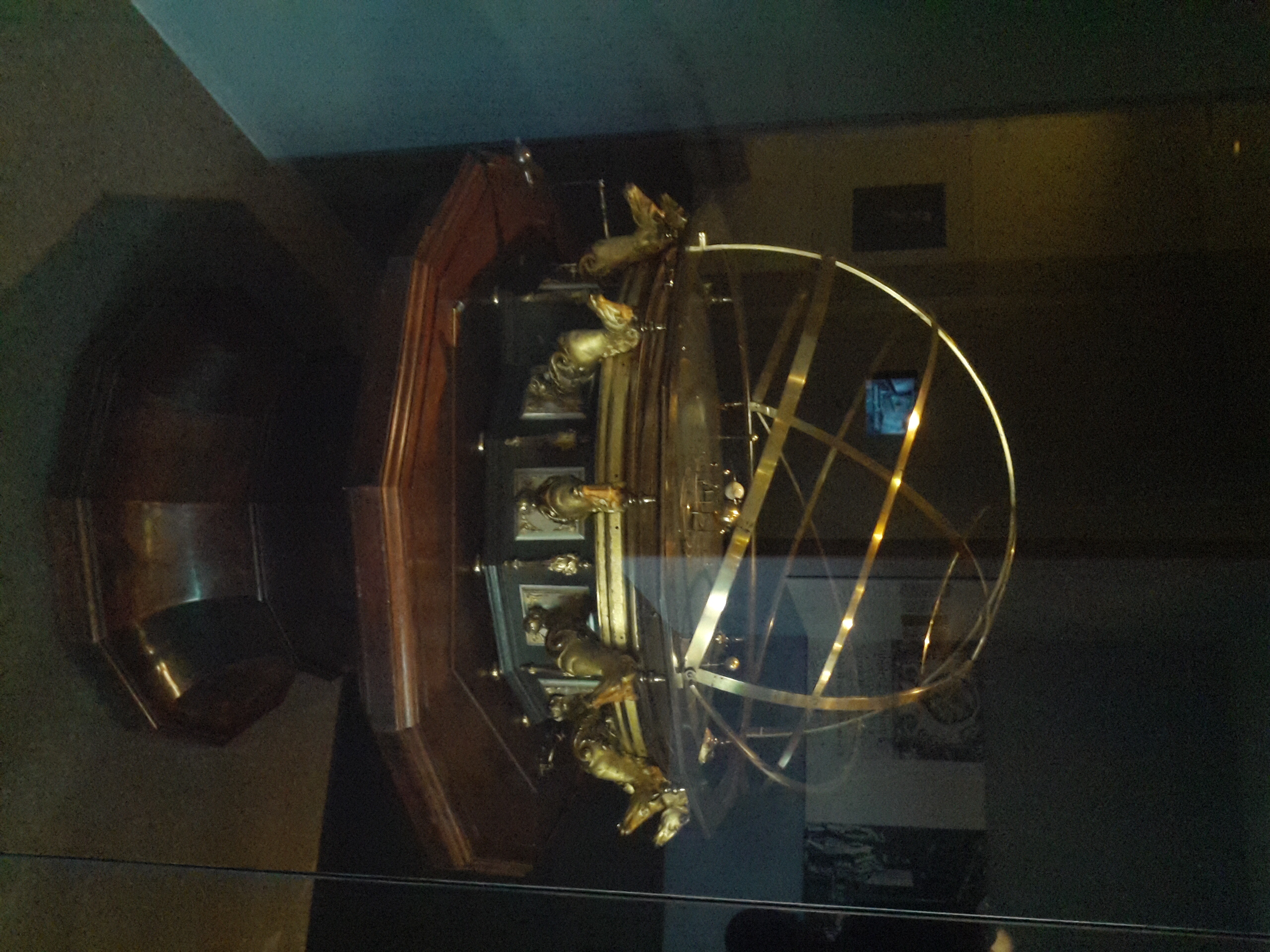
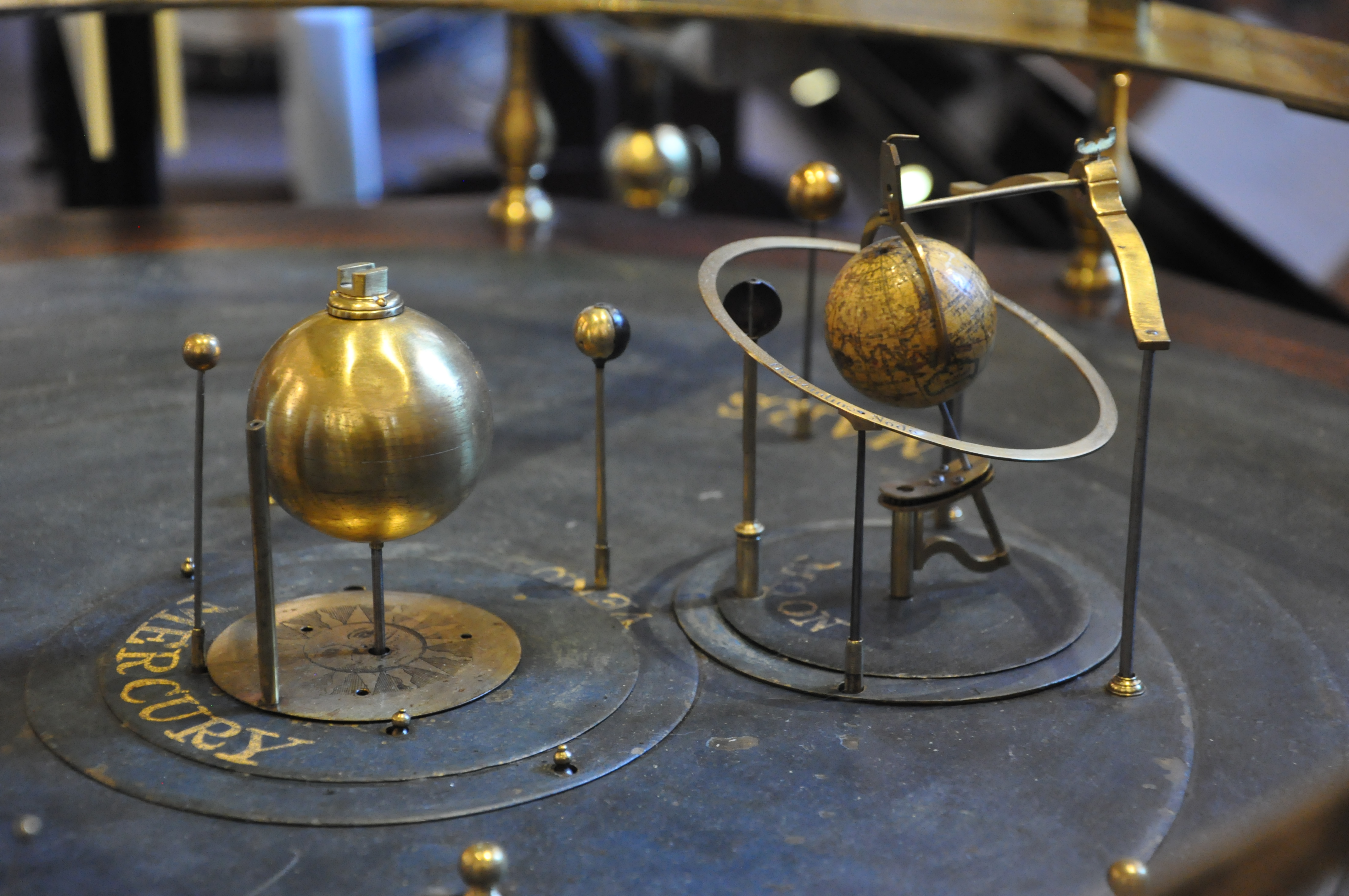
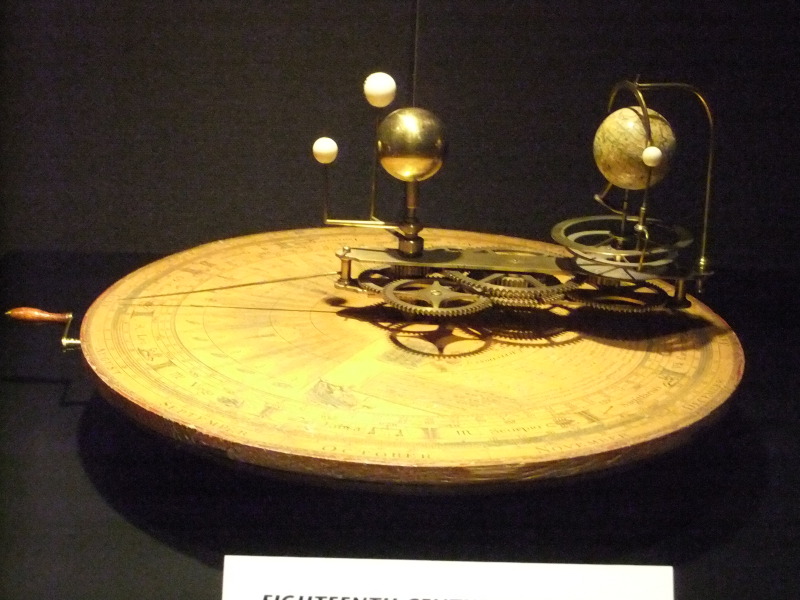
The immediate parentage is this. The Dutch polymath Christiaan Huygens designed a heliocentric planetary machine in Paris between 1665 and 1681, calculating gear trains for a year of 365.242 days, and published the details in 1703. Around the same time the English clockmakers George Graham and Thomas Tompion built an instrument — now preserved at Oxford's History of Science Museum — showing the Earth and Moon's motion about the Sun. Graham passed the design to the London maker John Rowley. Rowley made a copy for his patron, Charles Boyle, the 4th Earl of Orrery, around 1712–1713, and the Earl's title became the name for the entire genus. The plaque on a surviving example puts it with eighteenth-century directness: 'Orrery invented by Graham 1700. Improved by Rowley, and presented by him to John Earl of Orrery, after whom it was named.'
The credit, then, is a piece of social history as much as engineering history. The maker who solved the problem is half-forgotten; the aristocrat who could afford the result is immortal in every catalogue. It is worth remembering, the next time a listing breezily says 'invented in 1704,' that the date is a convenience papering over the Antikythera, Huygens, and a quiet clockmaker named Tompion.
The object had a second life as a teaching marvel. Joseph Wright of Derby's 1766 painting A Philosopher Lecturing on the Orrery shows a brass machine, lit from within by a lamp standing in for the sun, with a ring of faces emerging from the dark in pure astonishment — the Enlightenment caught in a single illuminated moment. That, to my eye, is the truest portrait of what an orrery is for.
Orrery invented by Graham 1700. Improved by Rowley, and presented by him to John Earl of Orrery, after whom it was named.
What separates a real instrument from a decorative trinket?
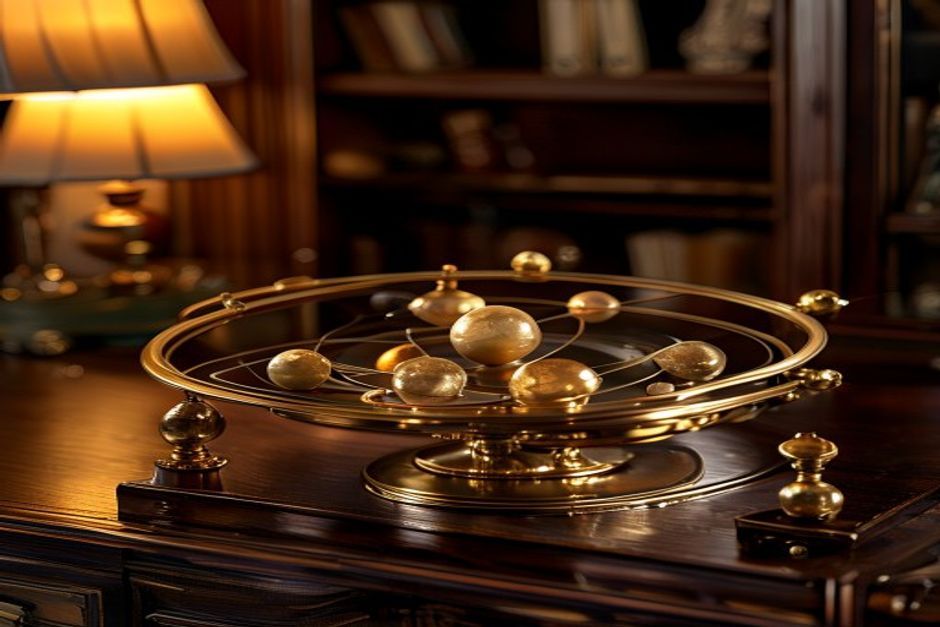
Three things, in descending order of importance: gearing honesty, materials, and scale candour. Master these and you can appraise any orrery in under a minute.
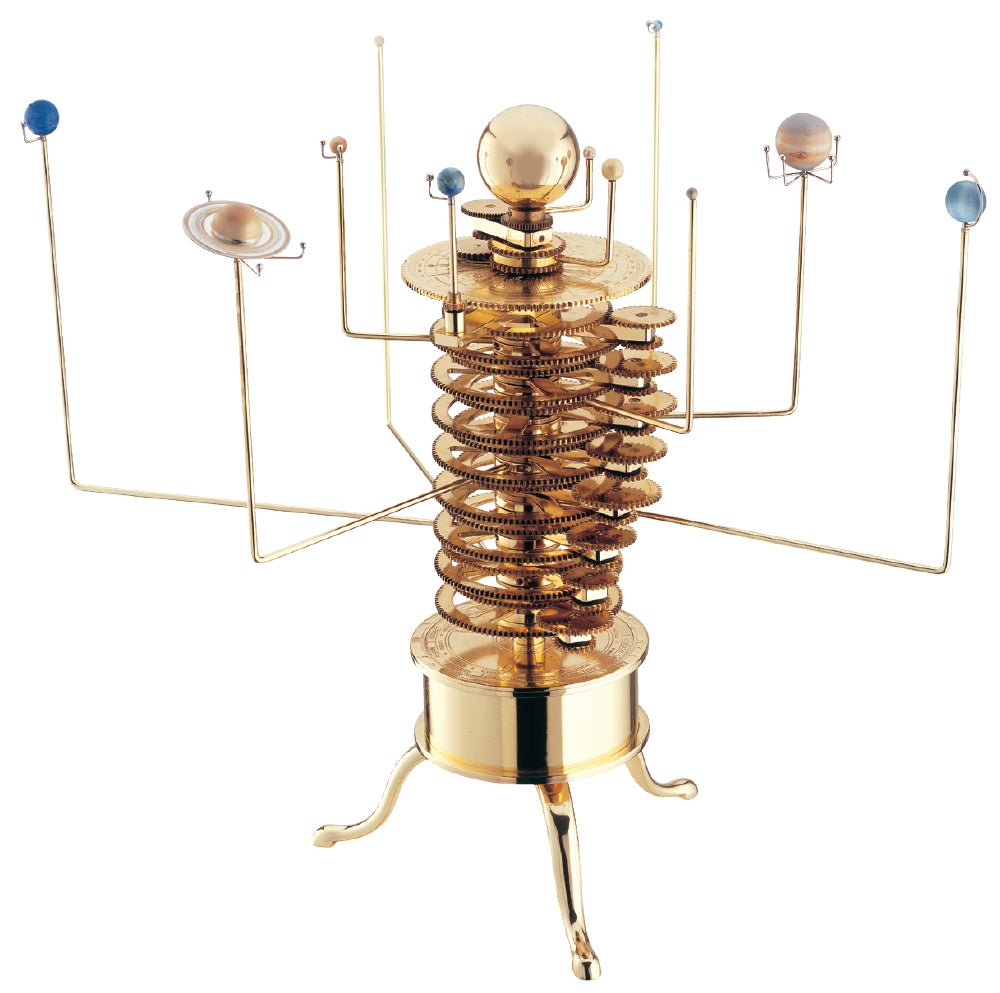
Gearing honesty is the heart of it. In a true instrument the orbital periods are set by the tooth counts of the gear train, so that the relative speeds are correct even when the absolute speed is not. Huygens famously chose his gear ratios to honour a 365.242-day year. When you turn the crank, an honest orrery moves Mercury about four times for every lap of the Earth, and Saturn barely at all — because that is the ratio the gears enforce. A trinket has no train worth the name: the arms are either fixed, or they spin freely and independently when you nudge them, keeping no ratio at all. The tell is simple — does turning one input move everything together in fixed proportion?
Materials decide whether the thing survives. Solid brass, hand-finished and lacquered, is the heirloom standard; it machines to fine tolerances and ages to a warm patina. Laser-cut birch ply (as in the ROKR and UGEARS kits) is honest, light, and surprisingly precise for the money, though it is a model you assemble rather than an instrument you inherit. Stamped pot-metal with a 'brass-tone' coating is the trinket's giveaway — heavy, vaguely golden, and gear-shaped without being geared. Card, in the right hands (AstroMedia's), can make a functionally accurate instrument, which always delights me: precision is a matter of design, not just of expensive metal.
Scale candour is the virtue I prize most, because it is where honesty lives. No desk orrery is built to true scale — if the Earth were a pea, Neptune would be a city away, and the planets themselves would be invisible specks. A good maker says so and scales the bodies and orbits for legibility instead. A dishonest listing implies accuracy it cannot possibly possess. Trust the one that admits the compromise; be wary of the one that hides it.
The archive's verdict: a real instrument is honest about three things at once — its ratios, its substance, and its scale. Lose any one and you have bought an ornament. There is no shame in an ornament. There is only shame in paying instrument money for one.
A real instrument is honest about three things at once — its ratios, its substance, and its scale.
Which types should I consider — kit, brass, motorized, or tellurion?
Orreries sort cleanly into a few families, and the right one depends less on budget than on what you want the object to do.
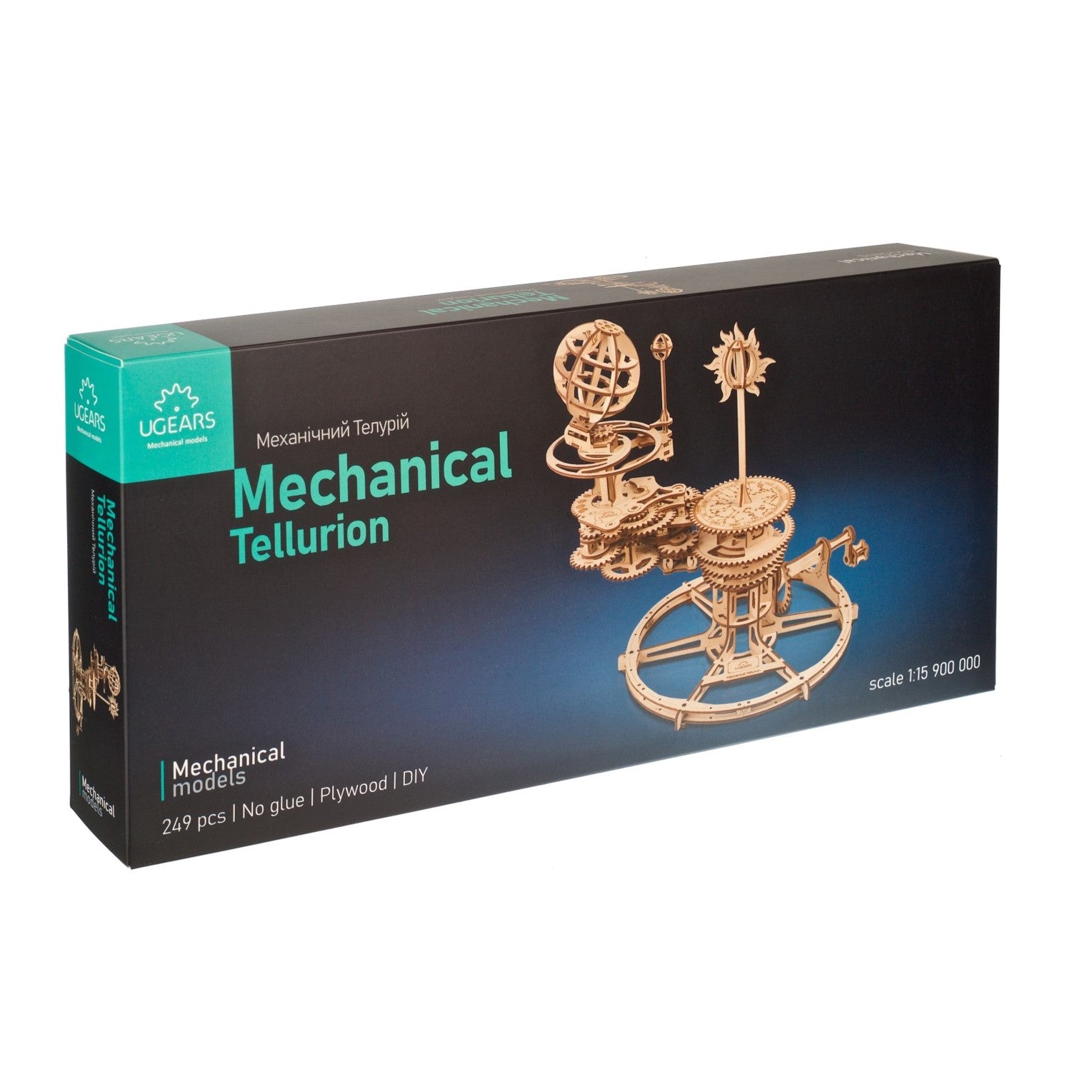
Hand-cranked wooden kits are where most people begin, and rightly so. The ROKR Mechanical Orrery ST001 and the UGEARS Mechanical Tellurion are laser-cut birch puzzles that assemble without glue into a working geared machine. You build them — that is half the pleasure — and then you turn the handle and watch real ratios at work. They cost between about $60 and $100, occupy a happy weekend or three, and teach the gearing from the inside out because you assemble the train yourself.
Card kits are the connoisseur's surprise. AstroMedia's Copernican Orrery is, by its own claim, the first fully functional cardboard orrery — Mercury, Venus, Earth, and Moon driven round an LED sun, one crank to the week, six simultaneous motions. It demands patience (the build runs 30 hours and more) but rewards it with genuine instrument-grade accuracy at a modest price.
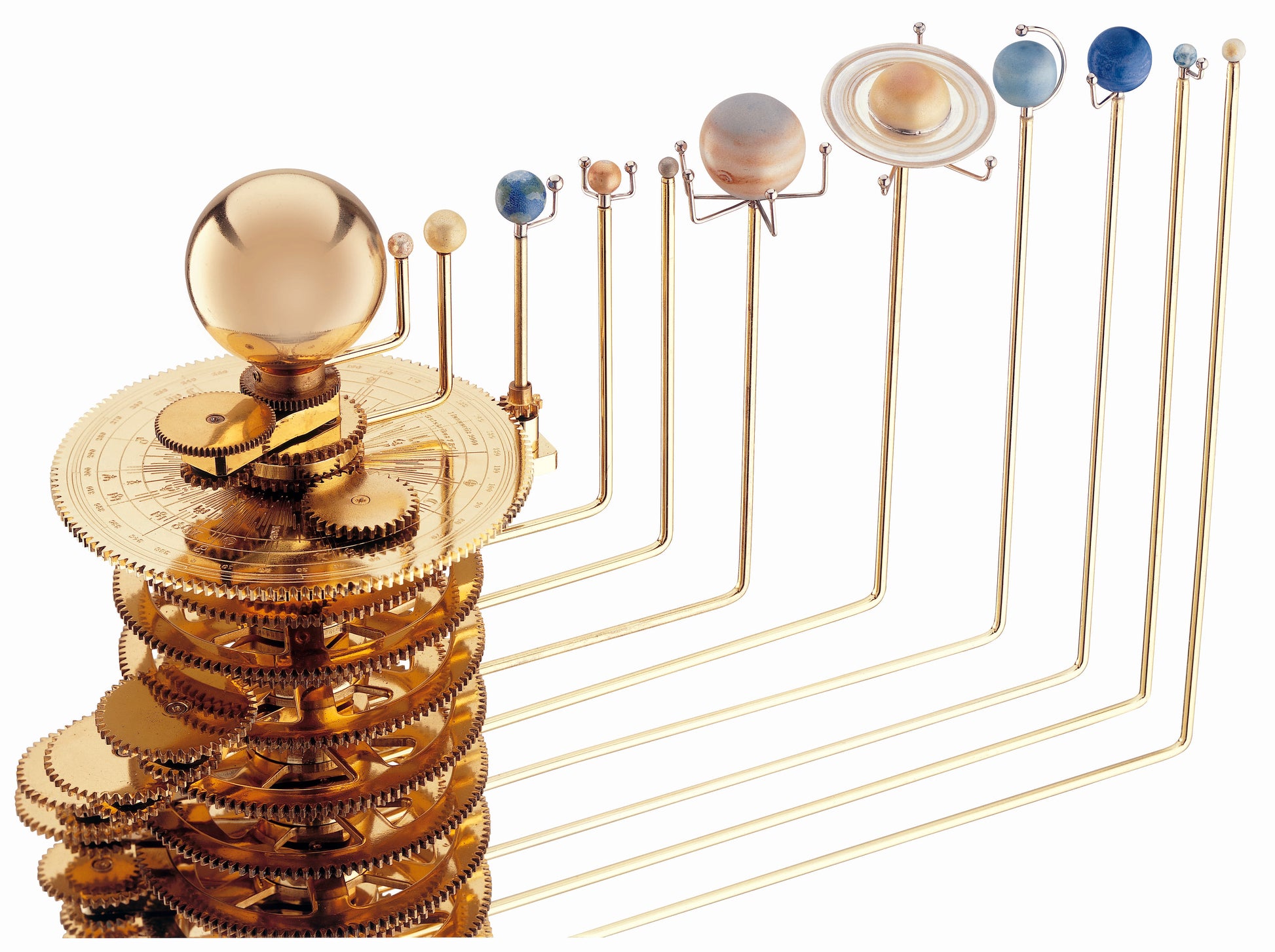
Motorized models trade the meditative crank for autonomy. Eaglemoss's Build the Solar System is the grand example: a solid-brass, motor-driven partwork with eleven planets, the Earth and Moon turning on their own axes, spanning 60 cm. It is an instrument that runs on its own — a different relationship with the object entirely. Simpler motorized desk planetariums (the Sun-Earth-Moon models with an LED sun) bring the same self-running charm to the classroom for well under $100.
Tellurions narrow the focus to Sun, Earth, and Moon, and there is nothing lesser in that. For teaching the seasons, the phases, and eclipses, a good tellurion is clearer than a full orrery precisely because it shows less. UGEARS makes a fine wooden one; the brass desk tellurions make handsome, if pricier, room pieces.
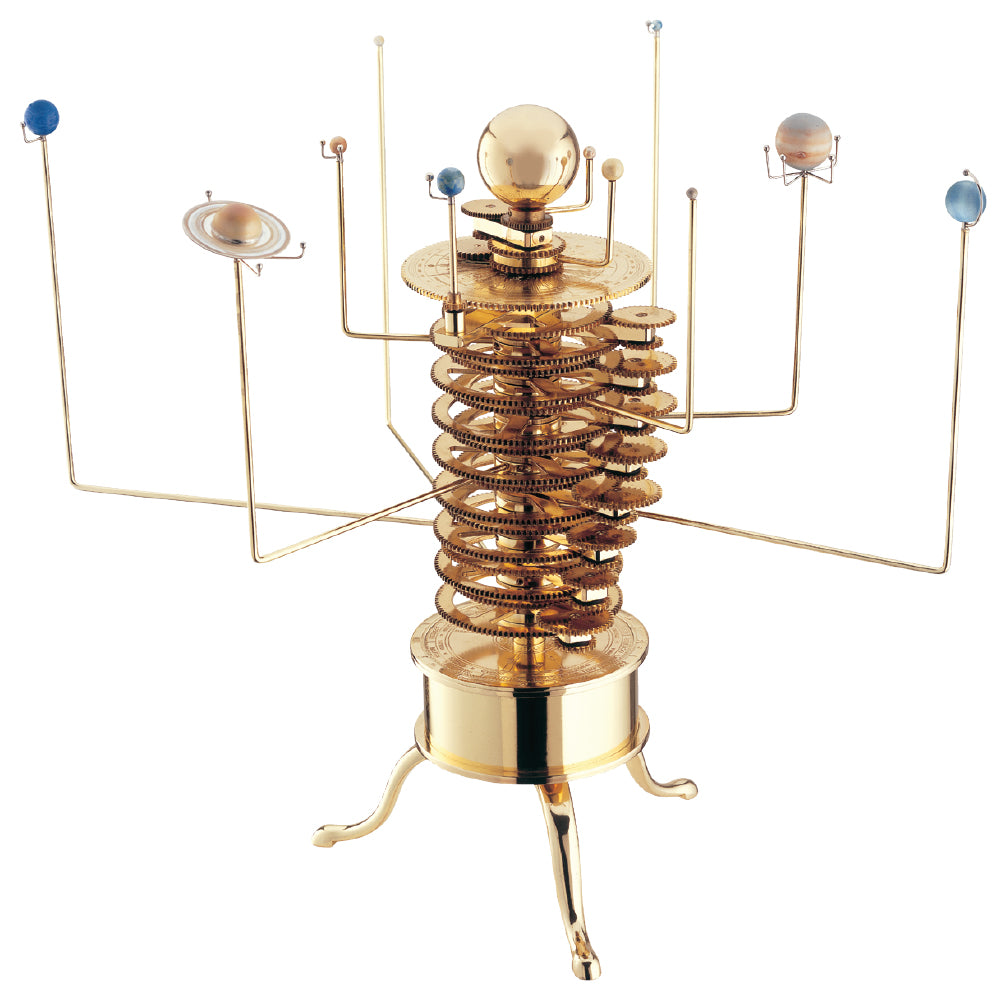
Decorative brass orreries are the shelf-jewels — handsome, weighty, and frankly more sculpture than instrument. The honest ones (and the made-to-order heirlooms) earn their keep; the worst are pot-metal pretenders. Buy them with eyes open, for beauty rather than ratio.
An archivist's preference, offered freely: I would rather own a cheap kit I assembled and understand than an expensive ornament I merely dust.
The right orrery depends less on your budget than on what you want the object to do.
Are orreries actually to scale — and should that bother you?
Almost never, and no, it should not — provided the maker is honest about it. This is the single most misunderstood fact about the whole genus, so let me set it plainly in the record.
There are two scales in any orrery: the sizes of the bodies and the distances between them. Both defeat true scale at once. If you shrank the real solar system so that the Sun became a beach-ball on your desk, the Earth would be a peppercorn some 26 metres away, and Neptune would be the better part of a kilometre off — out of the building, down the street, gone. And the planets, scaled to that same Sun, would be grains too small to see. A genuinely to-scale desk orrery is therefore a physical impossibility; you would have a beach-ball and a room of apparently empty arms.
So every practical orrery cheats, deliberately and reasonably. It enlarges the planets to visible beads, and it compresses the orbits — often to nested rings of convenient radius rather than true proportional distance. What a good orrery preserves instead is the thing that actually matters: the relative orbital motion. Through honest gearing, the planets keep their correct time even though they have lost their correct space. Mercury still laps the Earth roughly four times a year; Saturn still crawls. That is the truth an orrery can tell, and it tells it beautifully.
Wright of Derby understood this in 1766: his painted lecturer put a lamp where the Sun should be, not a scale model of it. The orrery was never a map of the solar system's dimensions. It is a clock of its motions. Hold that distinction and you will buy wisely and never feel cheated.
The one thing to refuse is a seller who implies scale fidelity it cannot have. The compromise is not the flaw. The concealment is.
An orrery was never a map of the solar system's dimensions. It is a clock of its motions.
Which orreries are actually worth owning in 2026?
Below is the ranked catalogue. I have organised it by what each piece is for rather than by price alone, because a $20 kit and a £499 brass instrument answer entirely different wishes. Every product here is real and currently sold somewhere reputable; prices marked with a tilde (~) drift with sales, exchange rates, and stock, and I have logged the slippery ones in the closing notes.
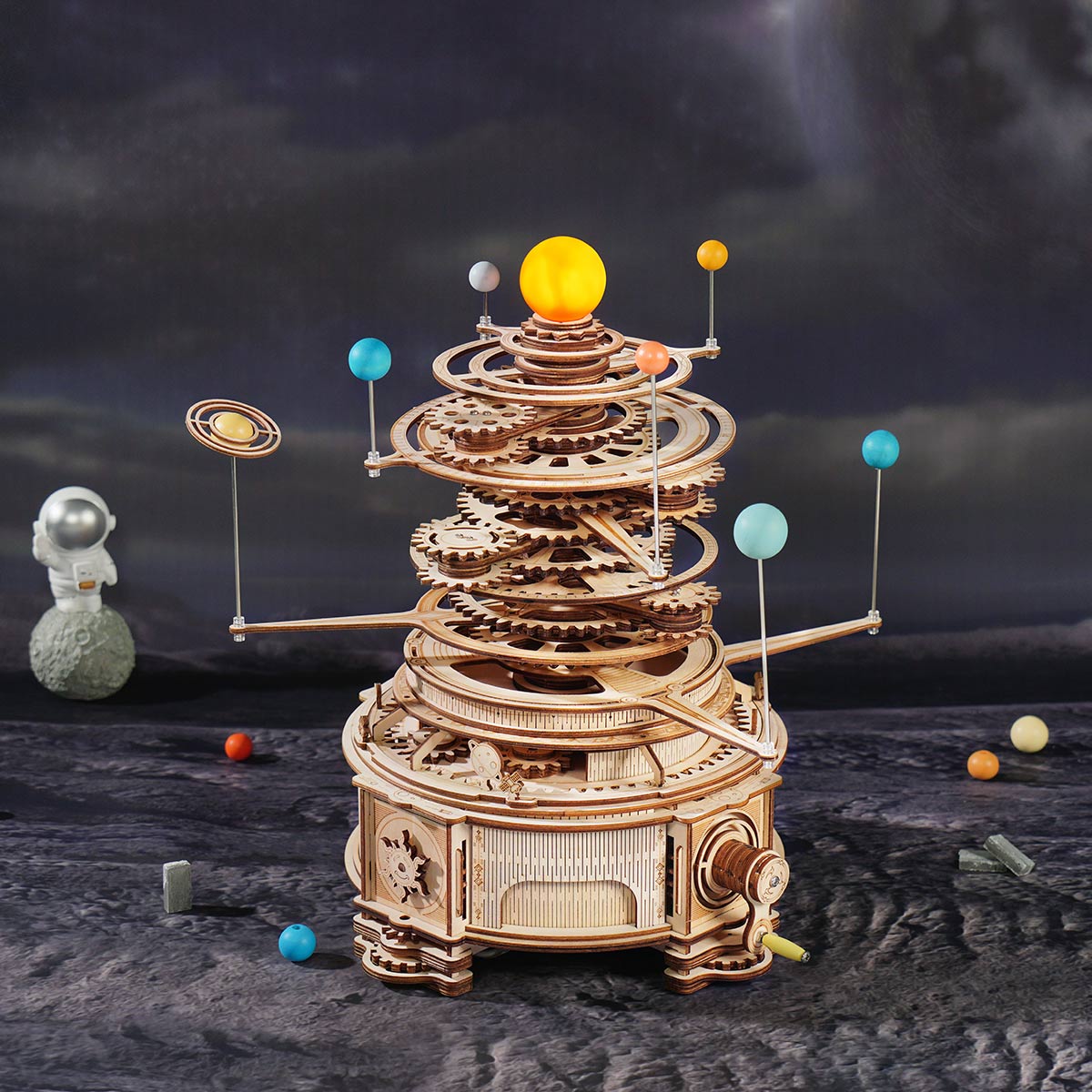
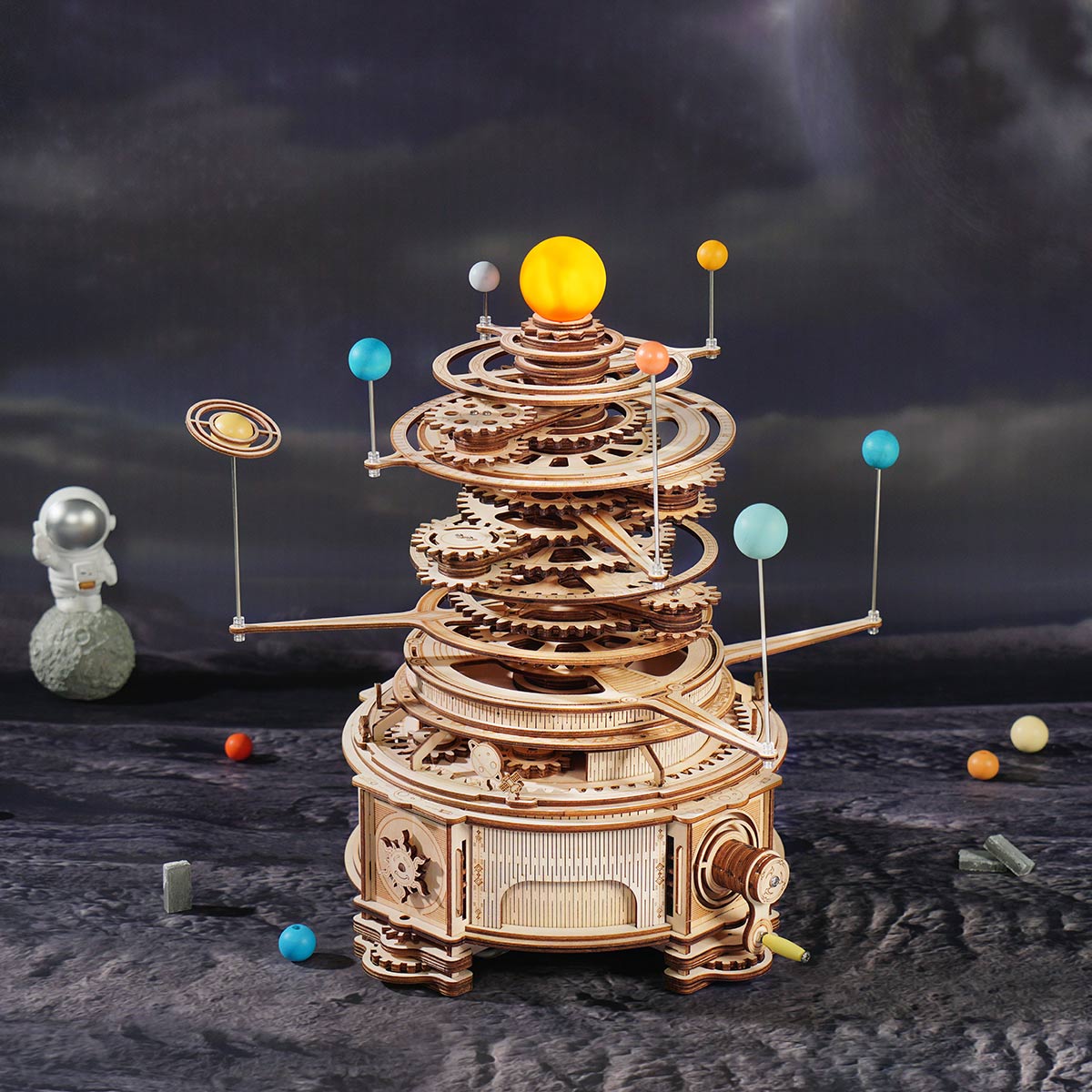
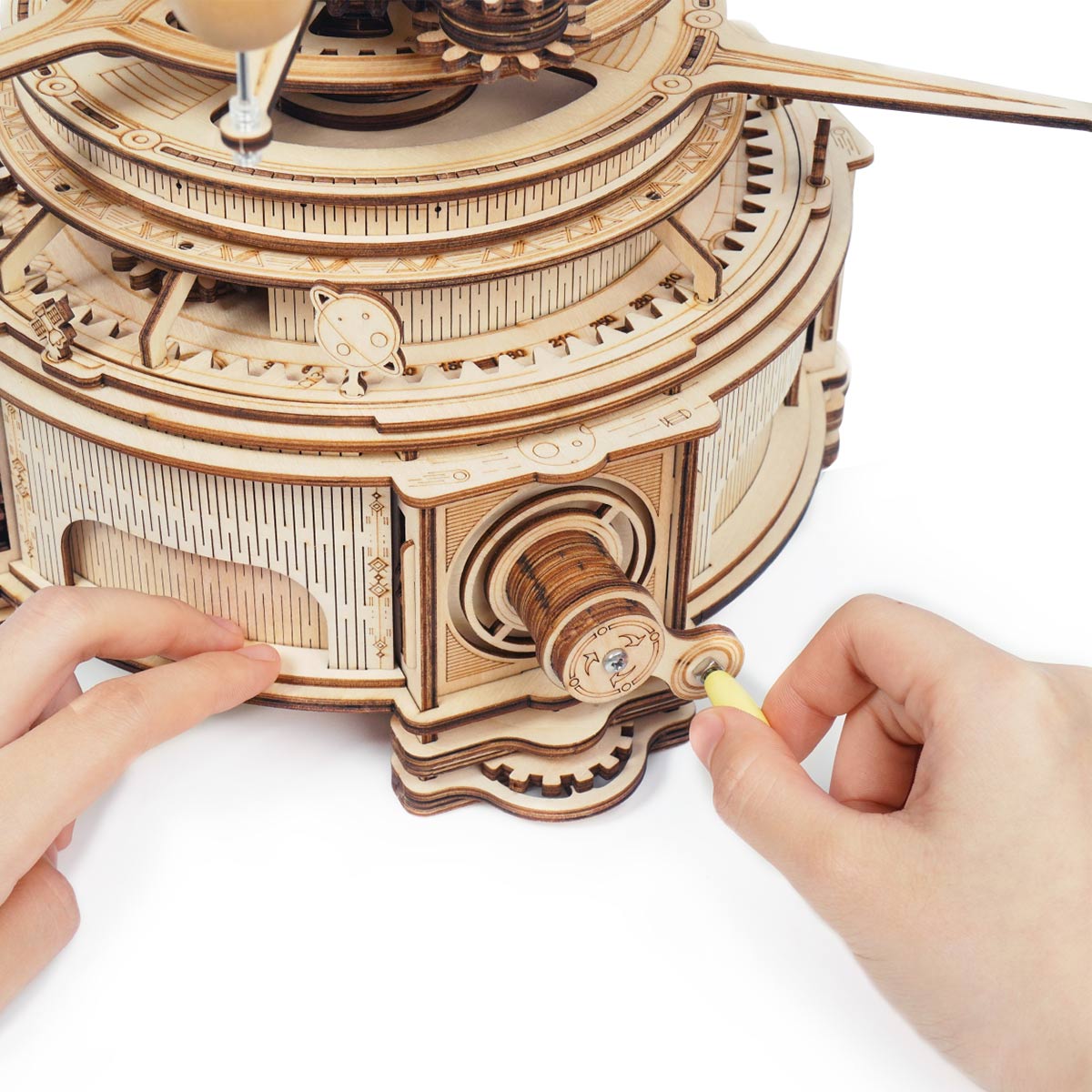
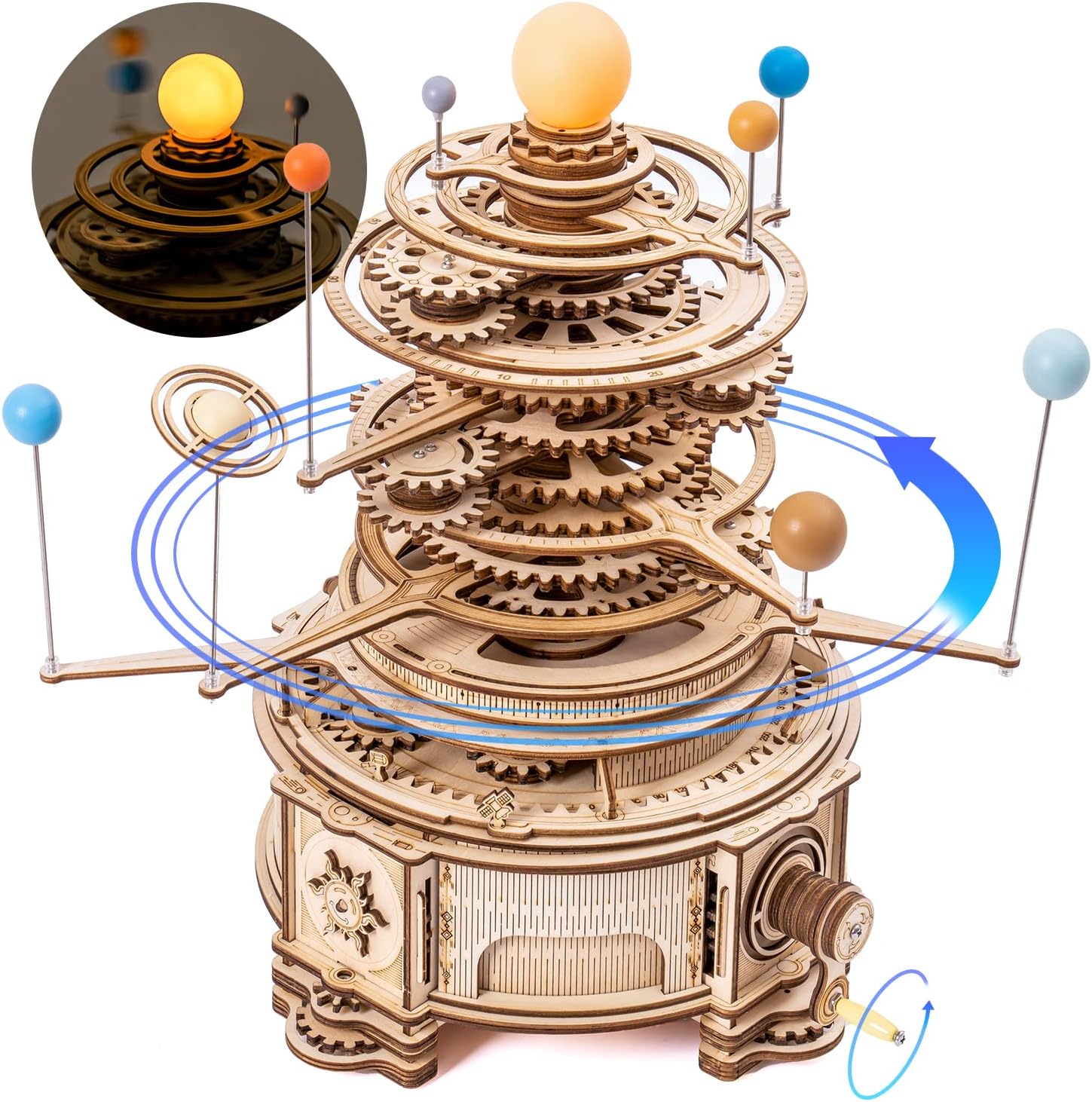
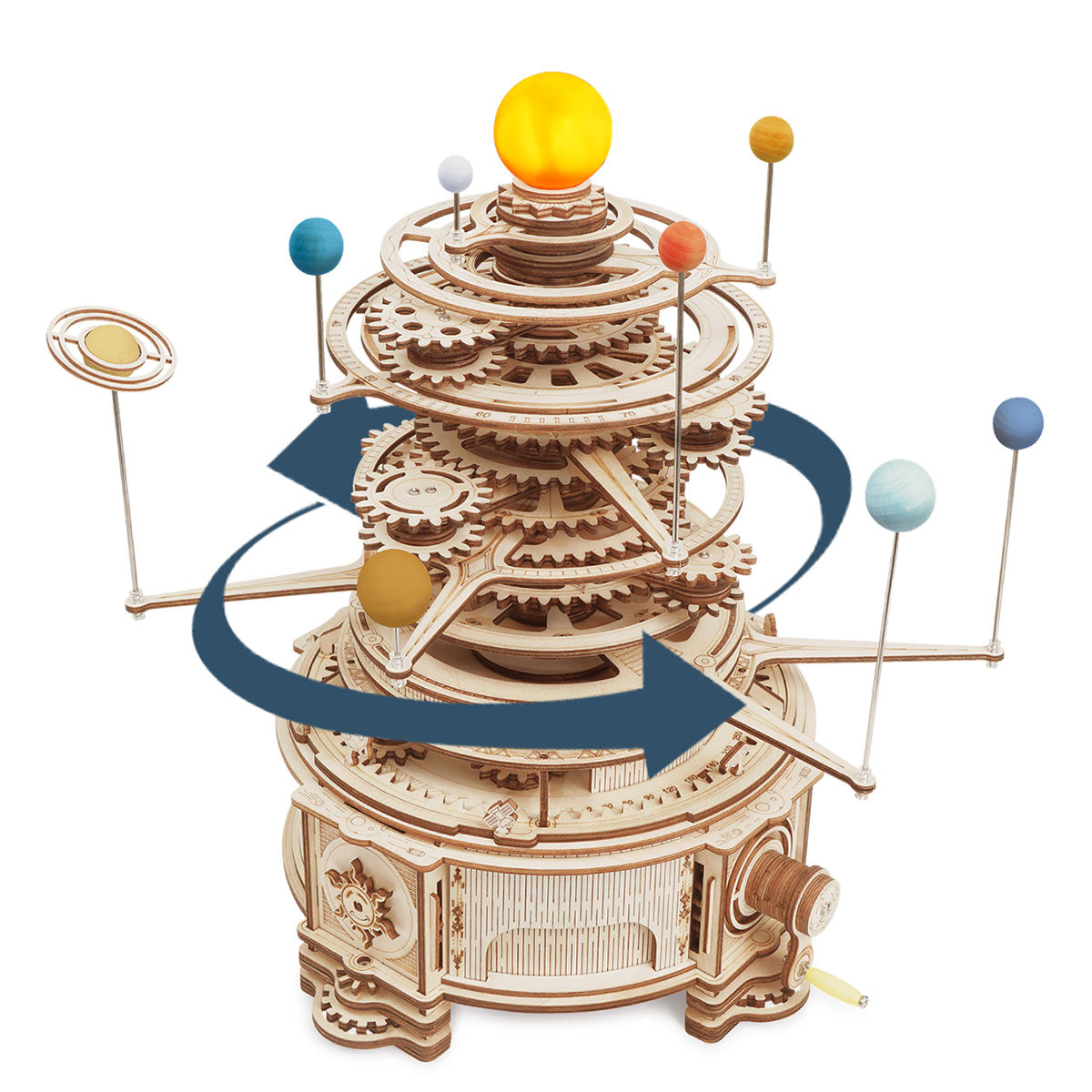
Best overall is the ROKR Mechanical Orrery ST001 (~$97). It hits the sweet spot of the whole field: 316 laser-cut wooden parts that you assemble without glue into a hand-cranked machine sending all eight planets round a glowing sun, with a little magnifier thrown in. You build the gear train, so you understand it; it looks superb finished; and it costs less than a hundred dollars. For most readers, start here.
Best kit / DIY splits two ways. For wood and weekend pleasure, the ROKR again, or UGEARS' kits. For instrument-grade accuracy on a budget, the AstroMedia Copernican Orrery (~$55–70) — a cardboard machine geared so one crank is one week, with an LED sun that demonstrates seasons, phases, and eclipses. Slow to build, genuinely correct in its motions.
Best brass heirloom is a made-to-order piece from Staines & Son of the UK (price on inquiry), father-and-son toolmakers who hand-build skeleton brass orreries and tellurions to order. This is the heir of Rowley — an instrument to leave to someone.
Best motorized is Eaglemoss's Build the Solar System (~£499 / about $630), solid brass, motor-driven, eleven planets with the Earth and Moon rotating on their axes — a 60 cm running instrument you assemble from a partwork.
Best budget is the 4M Solar System Planetarium (~$15–20) — though be warned, it is a glow-in-the-dark mobile, not a geared orrery. It is the doorway to the wonder, not the instrument itself, and priced accordingly.
The fuller reviews, with pros and cons, follow in the catalogue cards.
A $20 kit and a £499 brass instrument answer entirely different wishes — buy the wish, not the price.
What experienced tables keep reporting
Recurring owner patterns, synthesized in Puzzlewick's words. Follow each evidence trail to read the original discussion.
Finished it at last — it all looks fantastic and moves very smoothly.
Same problem here with the earth/moon gear — check the grub screws and the gear tightness; once adjusted the planets reposition fine.
Read the evidence: Eaglemoss 'Build a Model Solar System' builders, astronomy forum troubleshooting
A well-made, solid piece that, while not an accurate timepiece, is functional — and it was carefully wrapped and packaged to prevent damage in shipping.
Amazon customer review, DECOR ZENI brass tellurion
The Astromedia Copernican Orrery is a world premiere: the first ever fully functional cardboard orrery — one turn of the crank represents one week and shows the relative movements of the heavenly bodies accurately.
Read the evidence: First Light Optics product description, drawing on AstroMedia / builder accounts
Cranking the handle makes the eight planets begin to orbit the glowing sun — a vivid case of learning astronomy, with each part ingeniously connected through the gears.
Read the evidence: ROKR Orrery kit buyer description, Amazon listing
ROKR's customer service is well-regarded — quick to respond and happy to replace missing or damaged parts; my tenth build was the most difficult and needed a touch of glue at times.
Read the evidence: ROKR builder reviews roundup, Miniature Dollhouse Kits
The picks
Some links below are affiliate links — as an Amazon Associate, Puzzlewick earns from qualifying purchases, at no extra cost to you. It never changes a pick.
 4 photos
 ROKR Mechanical Orrery ST001 (3D Wooden Puzzle)
This is the orrery I hand most people first. Its 316 laser-cut birch parts assemble without glue into a hand-cranked machine that sends all eight planets orbiting a glowing central sun, with a tiny magnifier as a grace note. Because you build the gear train yourself, you finish the weekend understanding how an orrery actually keeps its ratios — a genuine education, not just an ornament. It looks genuinely handsome on a desk and costs under a hundred dollars. It is wood, not brass, so it is a model you made rather than an heirloom you inherit — which for most people is exactly the right trade.
- Hand-cranked geared motion of all eight planets
- Glue-free assembly; the build itself teaches the mechanism
- Striking finished display object for well under $100
- Widely available with good maker support for missing parts
- Birch ply, not an heirloom material
- Not to scale (true of nearly all in this class)
- Some builders report fiddly fits needing patience
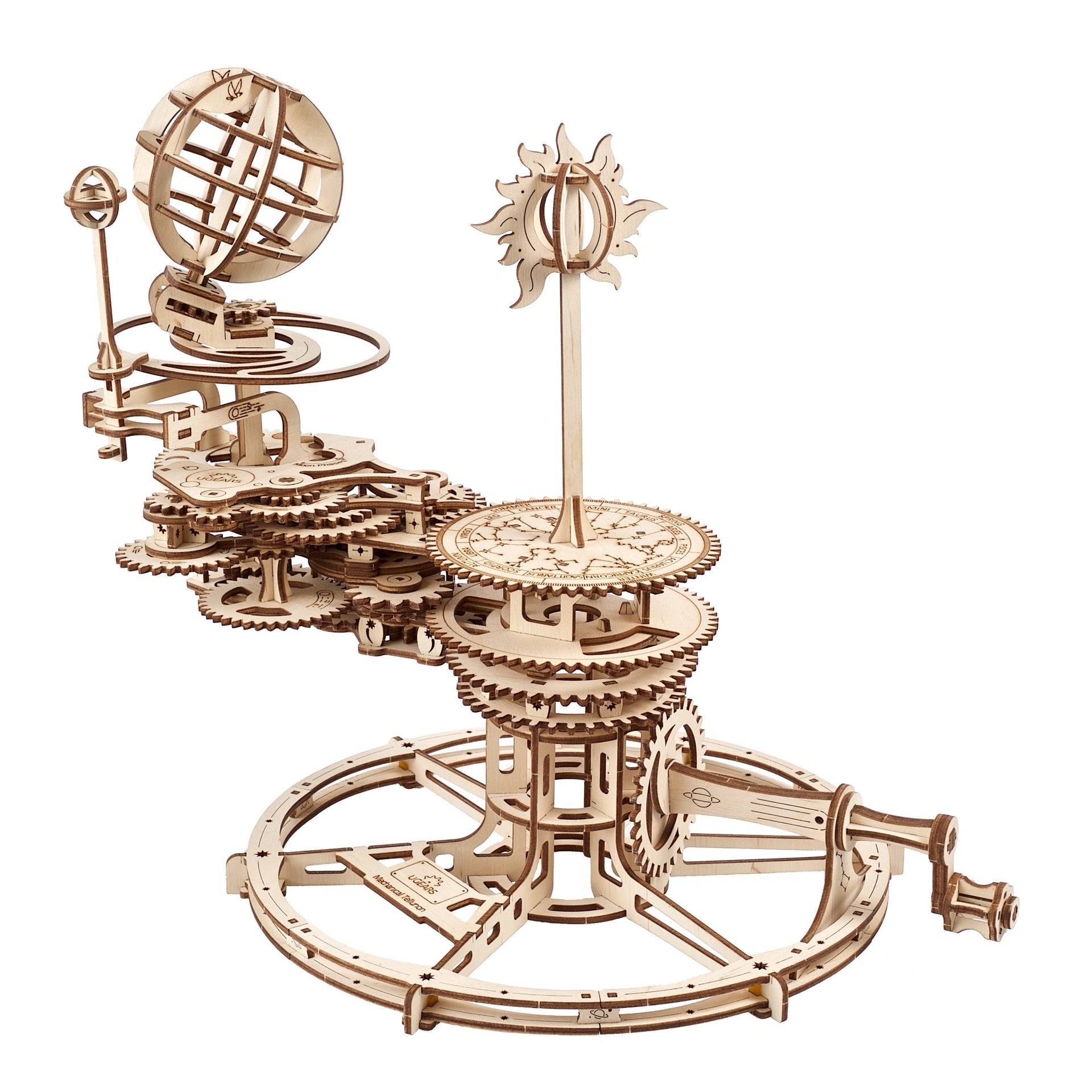
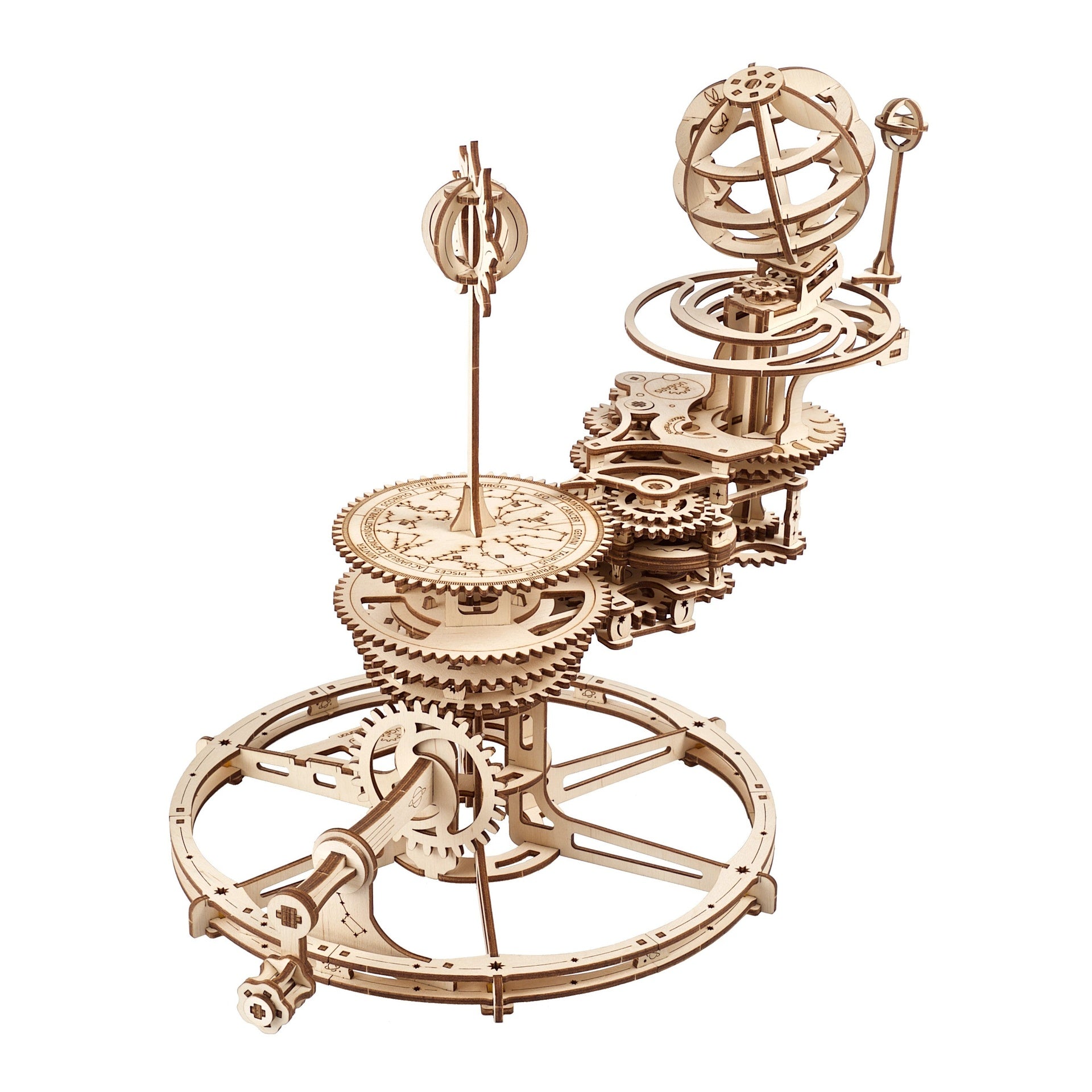 4 photos
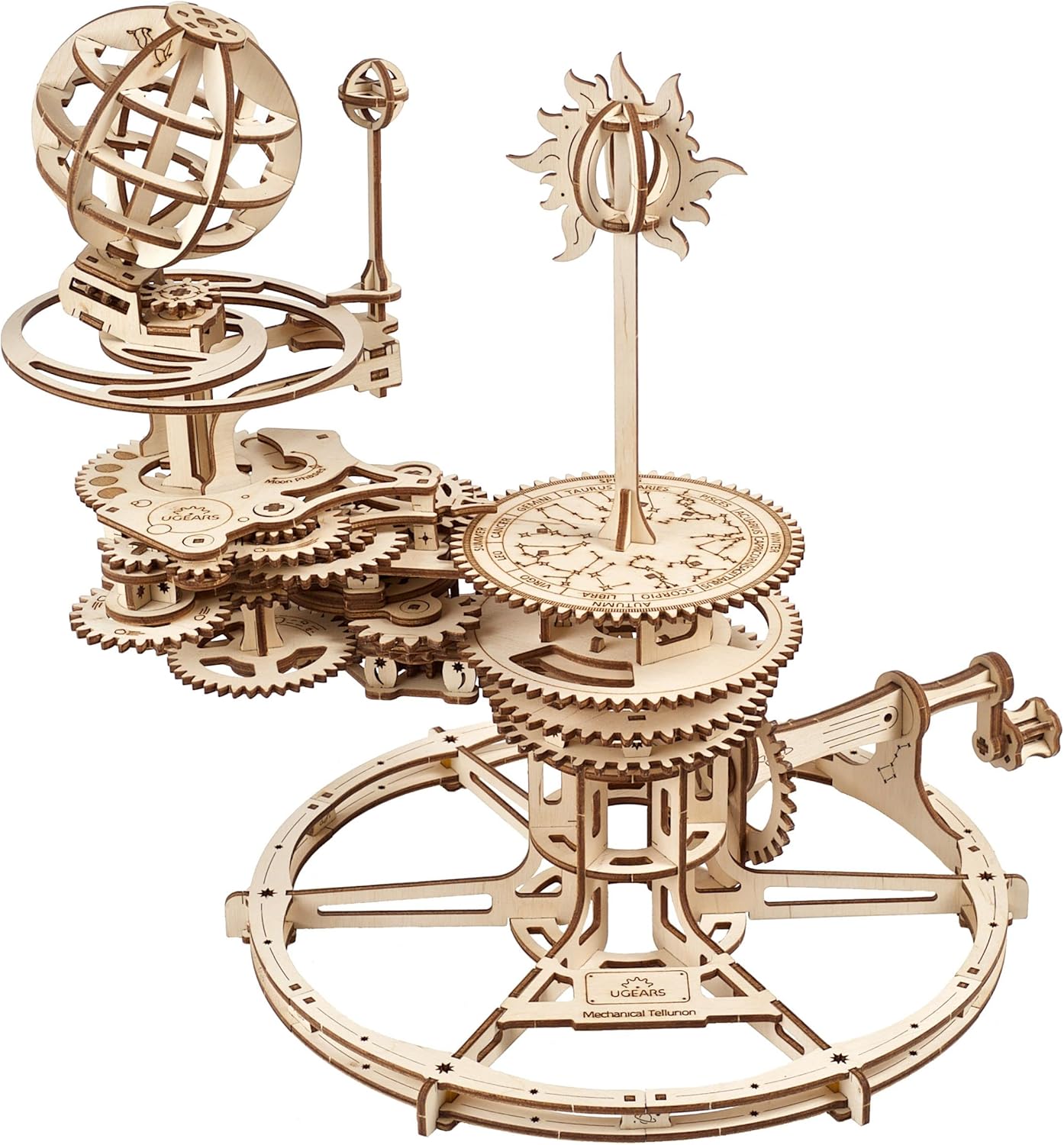
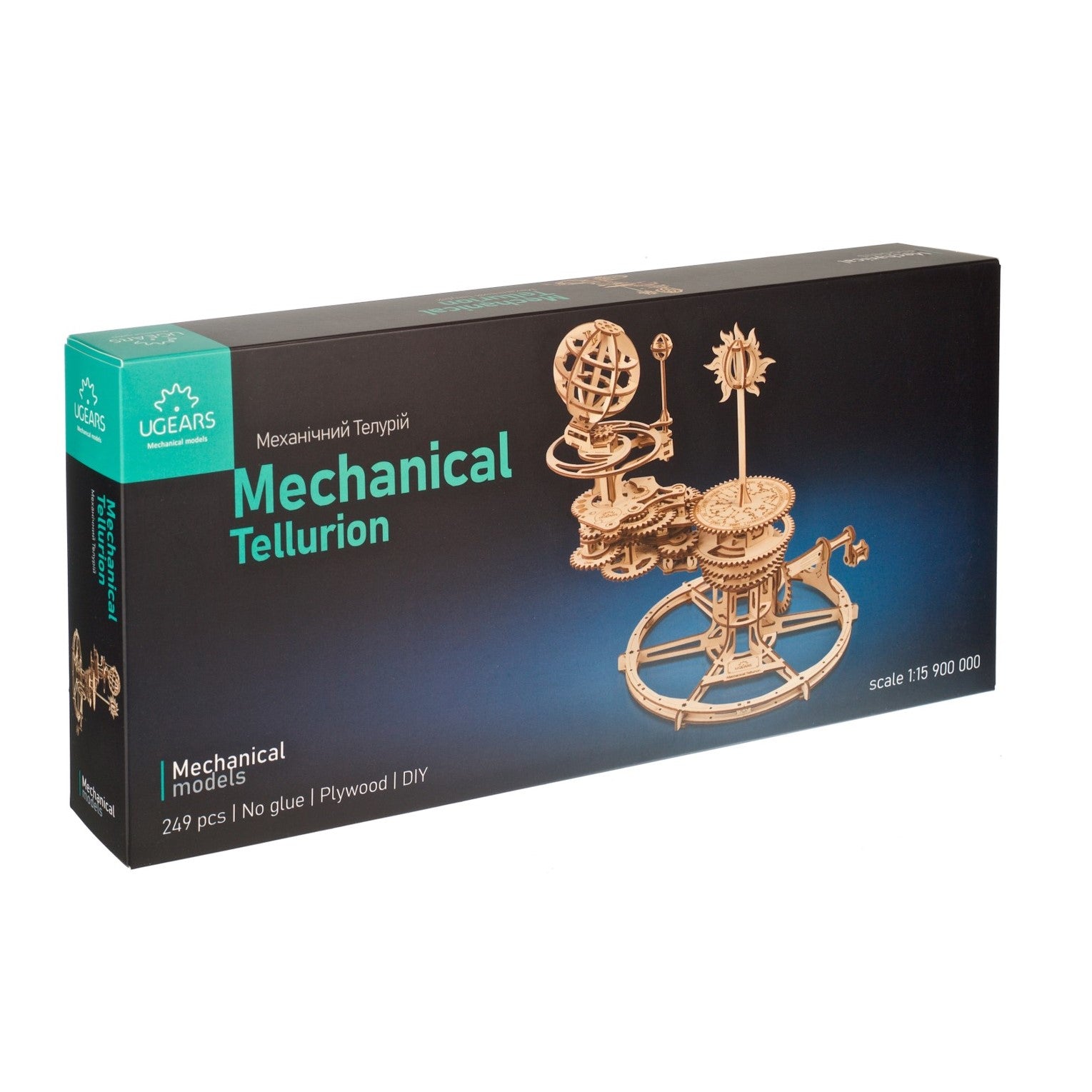
 UGEARS Mechanical Tellurion (3D Wooden Puzzle)
Where the ROKR shows the whole system, this UGEARS kit narrows the focus to the Sun, Earth, and Moon — and is the clearer teacher for exactly that reason. Its 249 laser-cut wooden parts assemble glue-free into a hand-cranked tellurion that turns the Earth on its 23.5-degree tilted axis, one crank to the day, while the Moon runs its phases and the seasons and zodiac advance. It is the machine to reach for when the lesson is why we have seasons and eclipses rather than how fast Saturn moves. Handsome, mechanical, battery-free, and satisfying to build.
- Focused Sun-Earth-Moon model — excellent for seasons, phases, eclipses
- Correct 23.5° axial tilt; one crank = one day
- Glue-free, battery-free, all-mechanical build
- Reasonably priced for the engineering
- Shows only Earth-Moon-Sun, not the full planetary system
- Medium-difficulty build of ~249 parts
- Wood, so a model rather than an heirloom

 3 photos
 ROKR Solar System Orrery Music Box (Classic Edition)
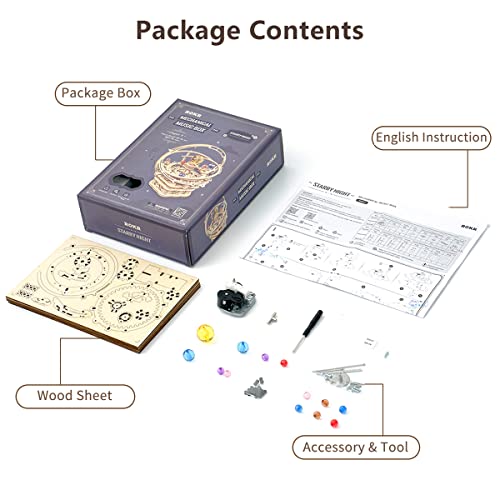
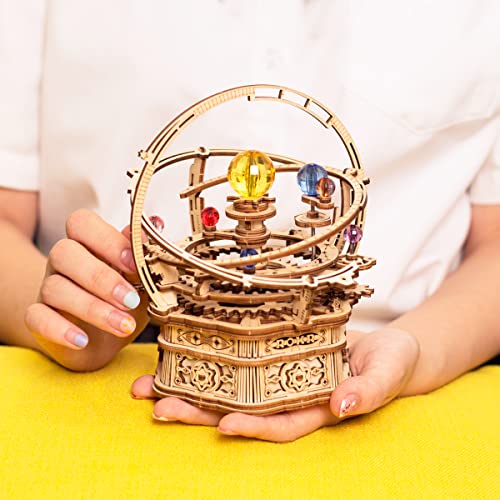
A gentler, more giftable sibling to the flagship ST001. This wooden ROKR kit pairs a cranked planetary display — eight planets circling a luminous sun lamp — with a built-in music-box movement, so the solar system turns to a melody. It is smaller and simpler than the ST001, lands around $52, and makes an especially warm present for a teen or a beginning builder who wants the wonder without the longest assembly. Less of a serious instrument, more of a charming desk companion, and none the worse for it.
- Cranked planetary motion plus a music-box movement
- Glowing sun lamp; cheerful finished piece
- Approachable build, friendly price (~$52)
- Strong gift appeal for teens and newcomers
- Smaller and less detailed than the ST001
- More novelty than precision instrument
- Pricing varies by edition and retailer
 2 photos
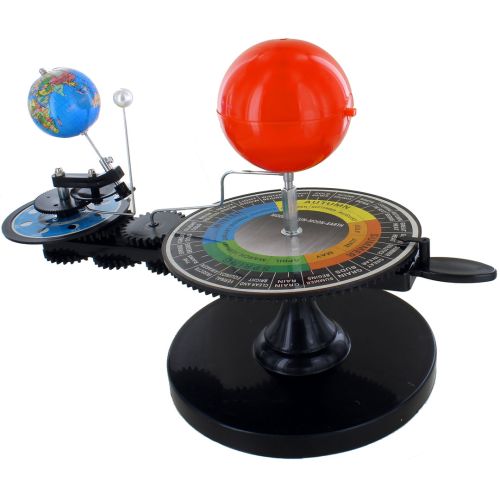
 Sun-Earth-Moon Orbital Planetarium Model (Motorized, LED Sun)
A purpose-built teaching tool rather than a hobbyist's pride, and excellent at that job. This motorized desktop model carries an LED-illuminated sun and runs the Earth's rotation, its orbit, and the Moon's orbit on synchronized geared mechanisms — casting real day/night shadows and showing phases, seasons, and eclipse geometry without anyone turning a crank. At around $60 it is built for science classrooms and camps, not display cabinets: plain, plastic, and durable. If the goal is to demonstrate the Sun-Earth-Moon dance to a room of students, it earns its place.
- Motorized, self-running — good for live demonstration
- LED sun produces genuine day/night shadows, phases, and eclipse geometry
- Synchronized gearing of rotation and orbit
- Affordable and classroom-durable
- Utilitarian plastic build — not a display heirloom
- Sun-Earth-Moon only, not a full orrery
- Sold under varying generic brands; specs differ slightly

Cosmos Museum Brass Orrery (Sun, Mercury, Venus, Earth, Moon, Mars)
If you want the warm gleam of brass on a wooden base without a four-figure commission, this is the honest middle ground — handcrafted, hand-operated, with the inner planets out to Mars on a turned wooden plinth. Treat it as decorative sculpture that happens to move, not as a precision instrument: the gearing is simple and, like nearly all pieces in its bracket, it is not to scale and not a 'timepiece.' Prices in this family of brass orreries swing widely with finish and size (roughly $249 to $800), so shop the exact listing carefully. Beautiful on a shelf; modest as an instrument.
- Real brass and wood — genuine desk presence and patina
- Hand-operated planetary arms; pleasing to turn
- Far cheaper than a bespoke heirloom
- Strong gift and decor appeal
- Decorative gearing — not precision, not to scale
- Prices fluctuate widely across near-identical listings
- Inner planets only in this configuration
 5 photos
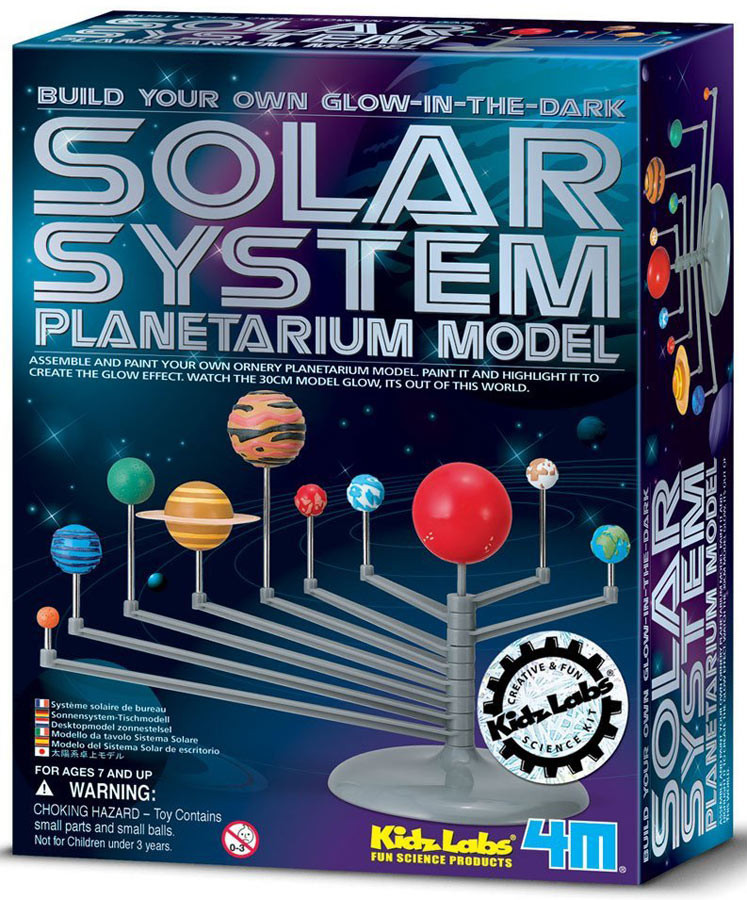
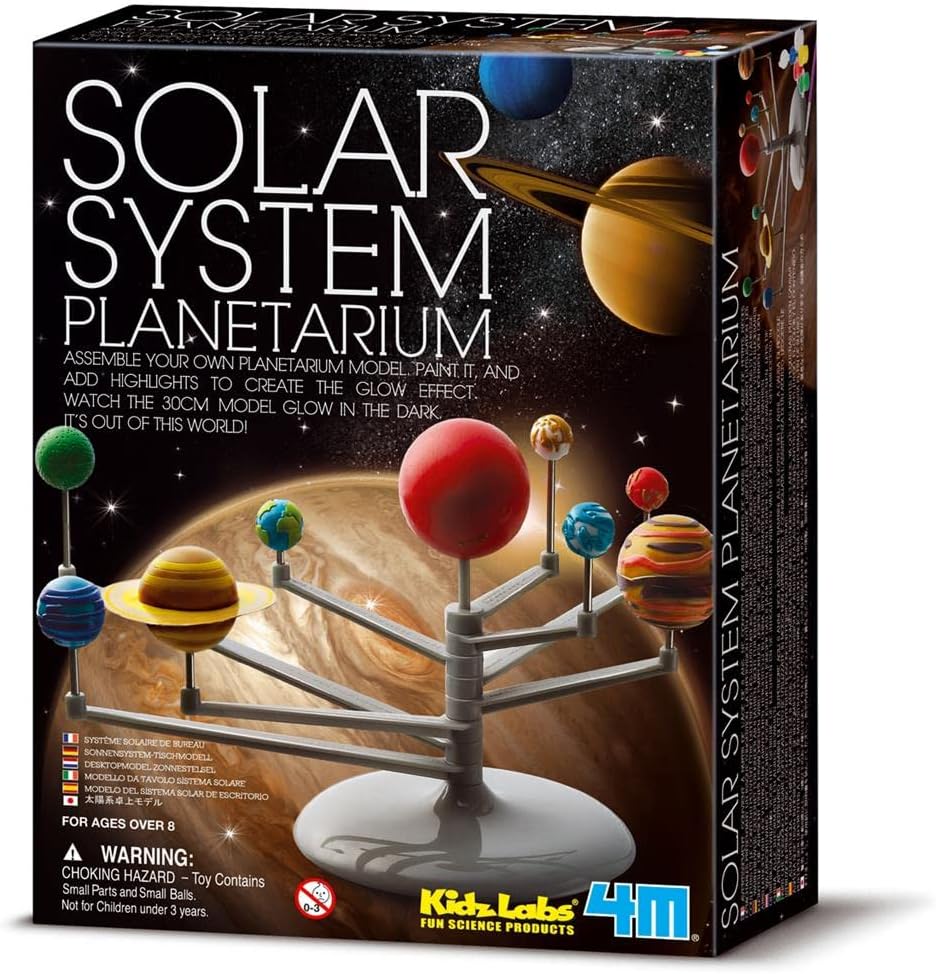
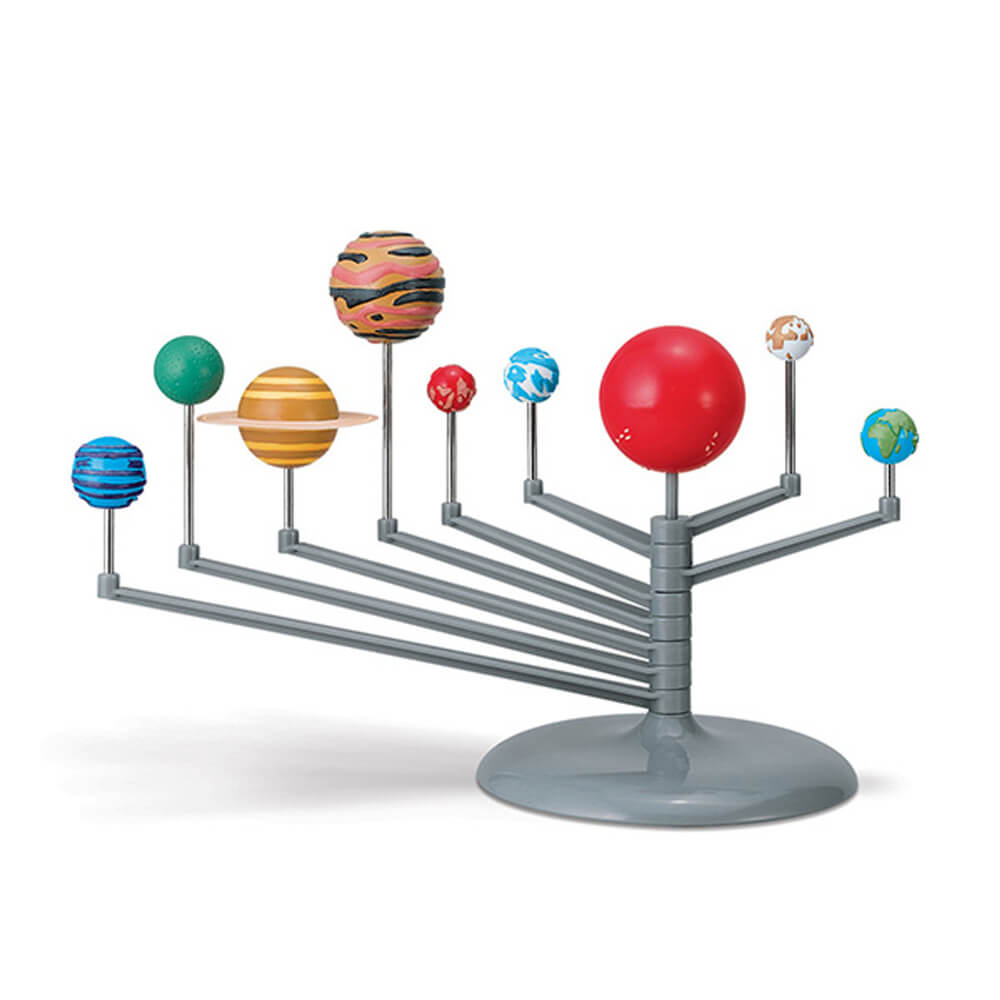
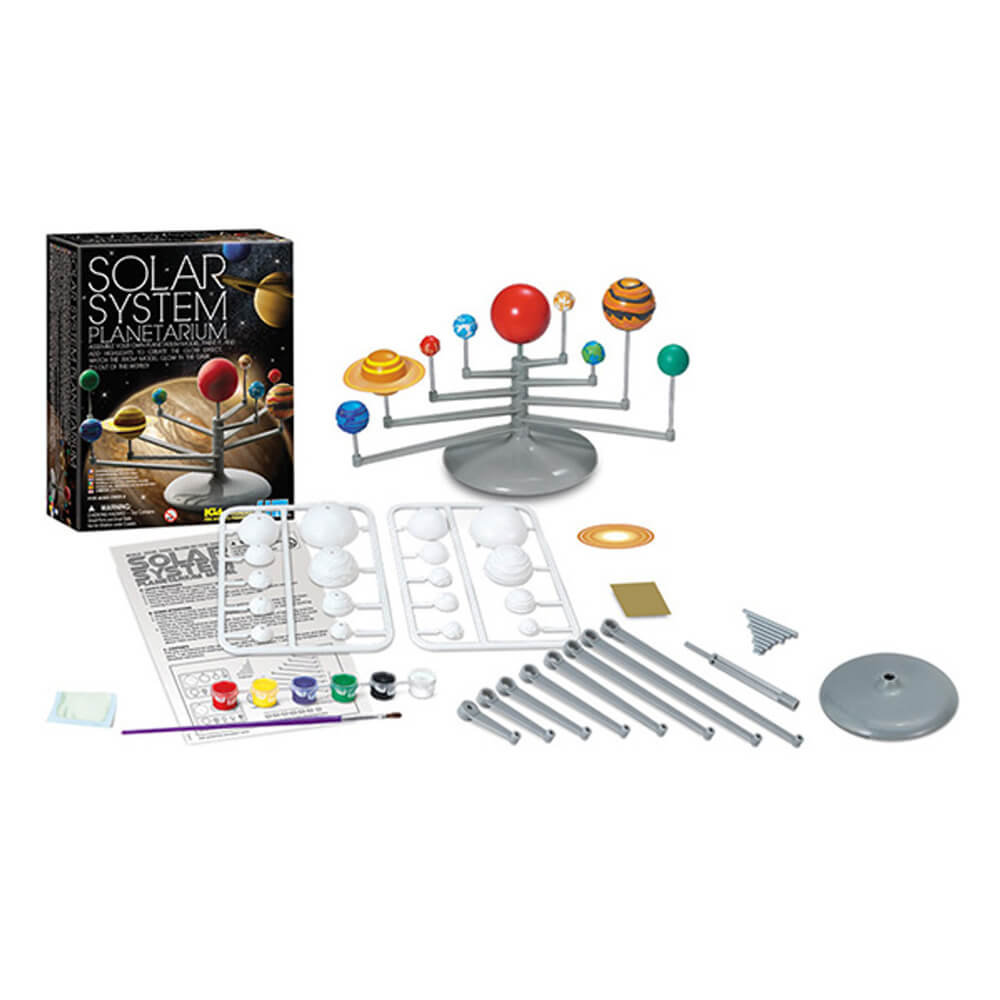
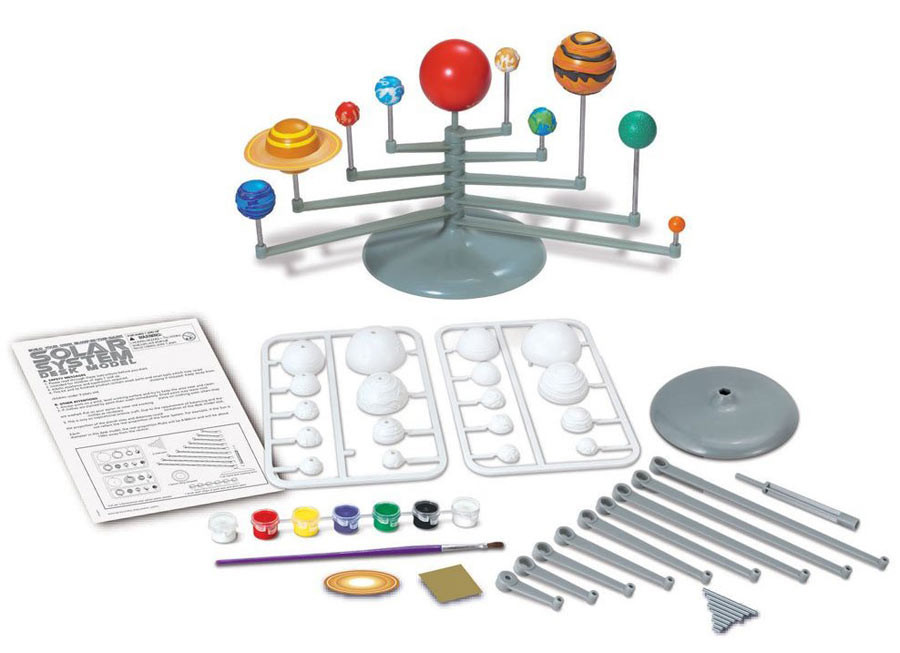
 4M Solar System Planetarium (DIY Glow-in-the-Dark Kit)
I include this with a clear conscience and a clear caveat: it is not a geared orrery at all, but a glow-in-the-dark hanging mobile of the planets that a child paints and assembles. There is no driven motion. What it is, for $15–20, is the cheapest honest doorway into the wonder — planets, stencils, a glow-paint pen, a fact-filled chart, and quiz cards, sized for ages 8 and up. For a young stargazer it plants the seed that the geared instruments above will one day satisfy. Just don't expect orbits; expect a luminous ceiling and a curious kid.
- Wonderfully cheap entry point (~$15–20)
- Hands-on painting and assembly for children
- Glow-in-the-dark; includes facts and quiz material
- Genuinely good at sparking early interest
- Not an orrery — a static mobile with no geared motion
- Lightweight craft materials
- Outgrown quickly by serious young enthusiasts
At a glance
| orrery | maker | type | price | best for |
|---|---|---|---|---|
| ROKR Mechanical Orrery ST001 | ROKR / Robotime | Hand-cranked wooden kit (8 planets) | ~$97 | Best overall |
| AstroMedia Copernican Orrery | AstroMedia | Build-it-yourself card kit (accurate gearing) | ~$55–70 | Best DIY for true accuracy on a budget |
| Build the Solar System | Eaglemoss | Motorized solid-brass partwork (11 planets) | ~£499 / ~$630 | Best motorized instrument |
| Staines & Son brass orrery | Staines & Son (UK) | Handmade bespoke brass instrument | On inquiry (heirloom-tier) | Best brass heirloom |
| UGEARS Mechanical Tellurion | UGEARS | Hand-cranked wooden tellurion (Sun-Earth-Moon) | ~$60–80 | Best tellurion |
| ROKR Orrery Music Box (Classic) | ROKR / Robotime | Wooden cranked kit + music box | ~$52 | Best gift kit under $60 |
| Sun-Earth-Moon Orbital Planetarium | Generic educational (xUmp/STEM Store) | Motorized plastic tellurion, LED sun | ~$60 | Best for the classroom |
| Cosmos Museum Brass Orrery | Cosmos Museum | Decorative hand-operated brass (inner planets) | ~$249–800 | Best affordable brass desk piece |
| DECOR ZENI Tellurian Orrery | DECOR ZENI | Handmade brass tellurion (Sun-Earth-Moon) | ~$279 | Best brass tellurion gift |
| 4M Solar System Planetarium | 4M / KidzLabs | Glow-in-the-dark mobile (no motion) | ~$15–20 | Best budget / first taste for kids |
Questions, answered
What is an orrery?
An orrery is a geared mechanical model of the solar system. A crank or small motor drives a gear train so the sun stays fixed while the planets (and major moons) revolve around it in roughly correct relative motion — Mercury fast, Saturn slow. It is essentially a clock that keeps the time of the heavens, built to demonstrate planetary motion rather than to map true distances.
Who invented the orrery?
No single person, which is why credit is tangled. The Antikythera mechanism (c. 205–87 BC) is the bronze ancestor. The modern sun-centred machine descends from Christiaan Huygens (designed 1665–1681, published 1703) and from English clockmakers George Graham and Thomas Tompion (c. 1704–1710). London maker John Rowley built a copy around 1712–1713 for Charles Boyle, 4th Earl of Orrery — and the Earl's title became the name for the whole device.
What is a tellurion?
A tellurion (or tellurium) is a focused kind of orrery showing only the Sun, Earth, and Moon. Its purpose is to demonstrate day and night, the Moon's phases, eclipses, and the seasons by turning the tilted Earth around the Sun while the Moon circles the Earth. Because it shows less than a full orrery, it is often the clearer teacher for those specific lessons.
What is the best orrery overall?
For most people, the ROKR Mechanical Orrery ST001 (~$97). It is a 316-piece, glue-free wooden kit that you assemble into a hand-cranked machine driving all eight planets around a glowing sun. You build the gear train yourself — so you understand the mechanism — it looks superb finished, and it costs under $100. It hits the best balance of price, build-pleasure, and honest gearing in the field.
What is the best orrery kit to build?
Two answers. For wood and a satisfying weekend, the ROKR ST001 (~$97) or a UGEARS kit. For genuine instrument-grade accuracy on a budget, the AstroMedia Copernican Orrery (~$55–70) — a cardboard machine geared so one crank equals one week, with an LED sun showing seasons, phases, and eclipses. The AstroMedia takes far longer to build (30+ hours) but is the more accurate instrument.
What is the best brass heirloom orrery?
A made-to-order piece from Staines & Son in the UK — father-and-son toolmakers who hand-build skeleton brass orreries and tellurions to commission (Genesis, Inner Planet, and Tellurion models). There is no public price; you enquire and wait. It is the modern heir of John Rowley's craft and an instrument meant to be inherited. For a ready-made brass desk piece at a fraction of the cost, the Cosmos Museum brass orreries (~$249+) are decorative rather than precise.
Are orreries to scale?
Almost never, and that is expected. If the Sun were a beach-ball on your desk, the Earth would be a peppercorn ~26 metres away and Neptune nearly a kilometre off — and the planets would be invisible specks. True scale is physically impossible on a desk. A good orrery instead preserves correct relative orbital motion through honest gearing, while enlarging the bodies and compressing the orbits for legibility. Trust the maker who admits this; distrust the one who implies scale fidelity it cannot have.
What is the best motorized orrery?
Eaglemoss's Build the Solar System (~£499 / about $630) — a solid-brass, motor-driven partwork with eleven planets and an exposed gear train, the Earth and Moon rotating on their own axes, spanning ~60 cm finished. For a budget classroom alternative, a motorized Sun-Earth-Moon planetarium with an LED sun (~$60) runs itself and demonstrates phases, seasons, and eclipses, though it covers only the Earth-Moon-Sun system.
What is the best orrery for kids and education?
For classroom demonstration, a motorized Sun-Earth-Moon orbital planetarium with an LED sun (~$60) is purpose-built and self-running. For a hands-on teaching build, the UGEARS Mechanical Tellurion (~$60–80) clearly shows seasons, tilt, and lunar phases. For a young child's first spark, the 4M Solar System Planetarium (~$15–20) is a paint-and-assemble glow mobile — not a geared orrery, but an excellent, affordable doorway to the wonder for ages 8+.
What is the best budget orrery?
On the lowest budget, the 4M Solar System Planetarium (~$15–20) — but be clear it is a glow-in-the-dark mobile with no geared motion, a first taste rather than a true orrery. For the cheapest real geared, hand-cranked orrery, step up to a ROKR wooden kit: the music-box edition around $52 or the flagship ST001 around $97. If you want planets that actually orbit, the ROKR is the genuine budget instrument.
What is the best splurge orrery?
A bespoke handmade brass instrument from Staines & Son (price on inquiry) is the heirloom splurge — unique, hand-built, in the lineage of 18th-century makers. Just below it, Eaglemoss's solid-brass motorized Build the Solar System (~£499 / ~$630) is the grand running centrepiece you can buy as a kit. Antique original orreries at auction can reach far higher still, but those are collector territory, not new purchases.
Where can I buy an orrery?
Wooden kits (ROKR, UGEARS) come straight from the makers' sites and major retailers like Amazon. The AstroMedia card kit is stocked by astronomy specialists such as Grovers Optics, First Light Optics, and Sherwoods. Eaglemoss's brass model is sold at buildthesolarsystem.com. Bespoke brass heirlooms are commissioned directly from Staines & Son (orrerydesign.com). Museum shops like Royal Museums Greenwich curate astronomy gifts with provenance. Puzzlewick may earn from qualifying Amazon purchases where a tagged Amazon link appears; maker and source links are editorial.
Margo's verdict
Stand back from the catalogue and the field arranges itself with pleasing clarity. For nearly everyone, the ROKR Mechanical Orrery ST001 is the right first orrery — geared, hand-cranked, beautiful, and under a hundred dollars, with the rare virtue that building it teaches you how the thing works. If you want true accuracy on a budget, the humble AstroMedia card orrery shames objects ten times its price. If you want it to run by itself, Eaglemoss's brass partwork is the grand machine; and if you want an heirloom to leave behind, you commission Staines & Son and wait, as patrons have waited since Rowley's day. The trinkets have their place too — a brass piece for the shelf, a glow mobile for a child's ceiling — provided you buy them for what they honestly are. Remember the one rule that governs the whole genus: an orrery is not a scale map of the solar system but a clock of its motions, and the best of them tell that time truly. A final word from the archive desk: Puzzlewick is an editorial library, not the seller. Puzzlewick may earn from qualifying Amazon purchases where a tagged Amazon link appears; maker and source links are editorial unless plainly labeled otherwise. Take the card, find your instrument of wonder, and set the planets turning.
Research ledger 22 sources · reviewed 2026-07-17
Specifications, rules, current product information, community experience, and contrary evidence were checked against the sources below. Commercial links are kept separate from editorial evidence.
- en.wikipedia.orgen.wikipedia.org/wiki/Orrery
- en.wikipedia.orgen.wikipedia.org/wiki/A_Philosopher_Lecturing_on_the_Orrery
- skyatnightmagazine.comskyatnightmagazine.com/space-science/orrery
- universetoday.comuniversetoday.com/articles/what-is-an-orrery
- collection.sciencemuseumgroup.org.ukcollection.sciencemuseumgroup.org.uk/objects/co56970/orrery-made-by-john-rowley-for-the-earl-of-orrery
- rmg.co.ukrmg.co.uk/collections/objects/rmgc-object-11229
- shop.rmg.co.ukshop.rmg.co.uk/collections/astronomy-space-gifts
- rokronline.comrokronline.com/products/rokr-mechanical-orrery-st001-3d-wooden-puzzle
- megodiy.commegodiy.com/products/rokr-mechanical-orrery-st001-3d-wooden-puzzle
- amazon.comamazon.com/dp/B09PFMBL2R?tag=puzzlewick-20
- groversoptics.comgroversoptics.com/astromedia-copernican-orrery
- firstlightoptics.comfirstlightoptics.com/astromedia-astronomy-model-kits/astromedia-copernican-orrery.html
- sherwoods-photo.comsherwoods-photo.com/astromedia/astromedia.htm
- buildthesolarsystem.combuildthesolarsystem.com/en-us
- popastro.compopastro.com/forum/viewtopic.php?t=8861&start=375
- stargazerslounge.comstargazerslounge.com/topic/278564-eaglemoss-earth-moon-and-sun-orbiter
- orrerydesign.comorrerydesign.com
- orrerydesign.comorrerydesign.com/the-genesis-orrery.html
- ugearsmodels.comugearsmodels.com/products/mechanical-tellurion
- xump.comxump.com/science/sun-earth-moon-model-light.cfm
- amazon.comamazon.com/dp/B0DYZ5BTGF?tag=puzzlewick-20
- amazon.comamazon.com/dp/B000HGJJ7W?tag=puzzlewick-20

Let me check that before we say it.

Keep exploring
The next smart rabbit holes.
✦ Topic PathBoard Game Buying Guides: compare the whole shelfStart with the decision, not the shelf. These guides compare the games, editions, expansions, player counts, and costs people...Best OfBuild-Your-Own Automata Kits Ranked: Best Wooden Mechanical Models (2026)Stop buying wooden puzzle kits branded as automata that just sit there—here's the honest ranking of kits that actually move.Buying GuideIs Levitating Desk Decor Worth It? Ranked (2026)Most levitating desk decor is a $79 electromagnet with a hum — but three things genuinely aren't. A skeptic stress-tests the wonder from...