7 Wonders vs 7 Wonders Duel: Which Game and Expansions Should You Buy?
Kenji separates two excellent but different civilization games, ranks Leaders, Cities, Armada, Edifice, Pantheon, and Agora, and gives each table a clean expansion order instead of a monument-sized shopping list.


AI-assisted research and drafting in Kenji’s voice · reviewed by Robert Pruitt · how this guide was made
Last editorial refresh: 2026-07-14 Gold-standard QA: 2026-07-14 13 sources reviewed Affiliate links checked during gold-standard pass

The short answer
Buy 7 Wonders for three to seven players and 7 Wonders Duel for exactly two. They share iconography and civilization themes but are not interchangeable editions. For regular 7 Wonders, Edifice is the easiest first expansion, Leaders adds strategic direction, Cities increases interaction, and Armada is the heaviest commitment. For Duel, buy Pantheon first; add Agora only after both players know the base game deeply. Combining Pantheon and Agora works, but creates a longer, more tactical duel.
Decision map
Choose in thirty seconds
Best for three to seven players.
Best dedicated two-player civilization game.
Best first Duel expansion.
The naming creates the wrong question. 7 Wonders Duel is not “7 Wonders with fewer chairs”; it is a tense information puzzle built around a shared card structure and three ways to win. Kenji reviewed the current official expansion line, rule FAQs, and active owner comparisons to build two separate buying ladders and one practical teaching plan.
Start here, then go deeper
You are in the right cabinet.
 ⚔ Topic PathTwo-Player Board Games: compare the whole shelfThe best two-player game is designed around the duel rather than merely tolerating two people. This path separates sharp...
 ComparisonThe Best 2-Player Board Games of 2026, RankedFifteen duels for two, sorted into hard tiers — the forever-game, the silent co-op, the giant-killers under twenty bucks, and the honest...
 ComparisonThe Best Engine-Building Board Games of 2026, RankedA sensei's tier list of the games that taught a generation what "the engine click" feels like — from the gateway masterpiece to the...
Should you buy 7 Wonders or 7 Wonders Duel?
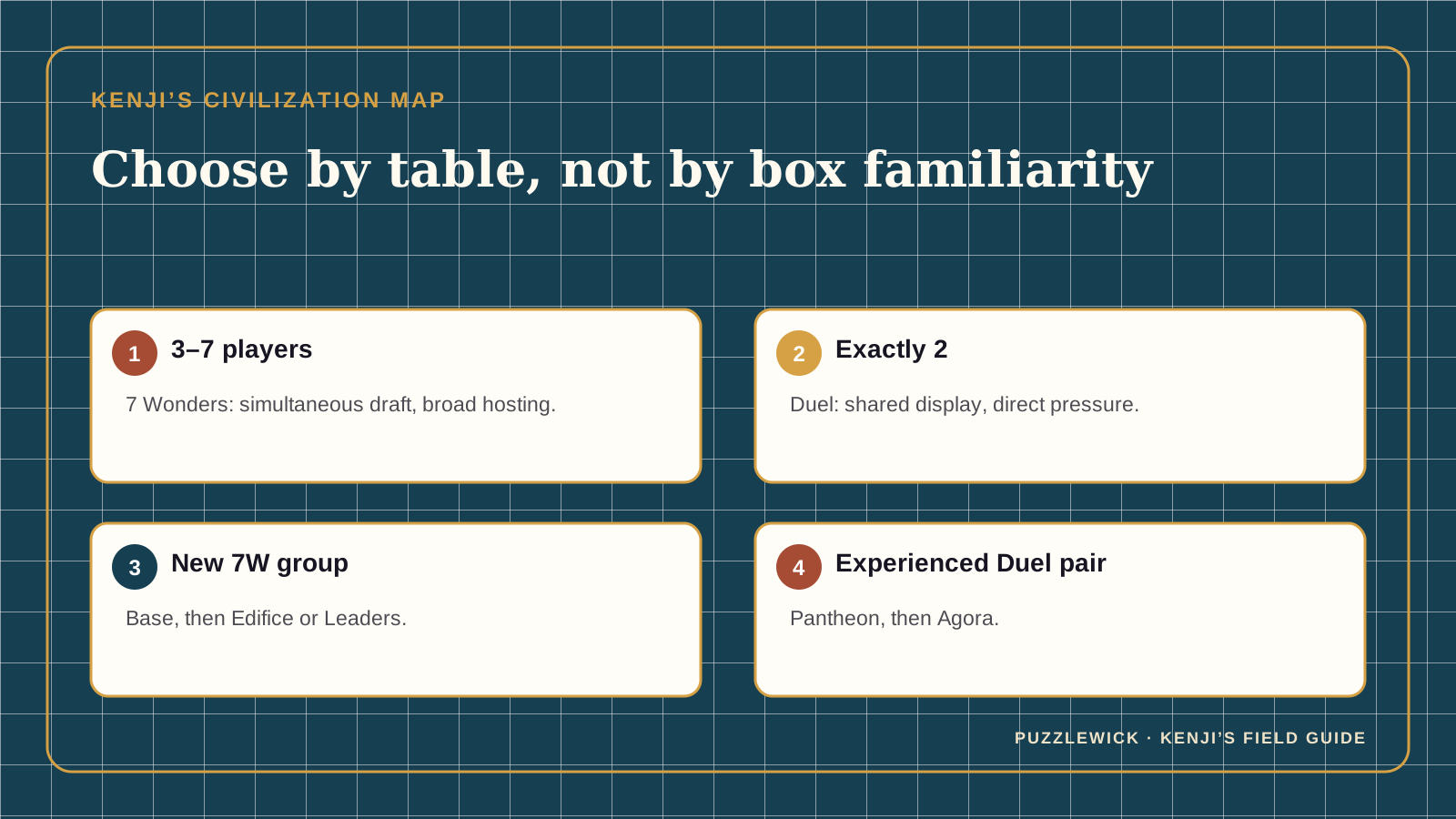
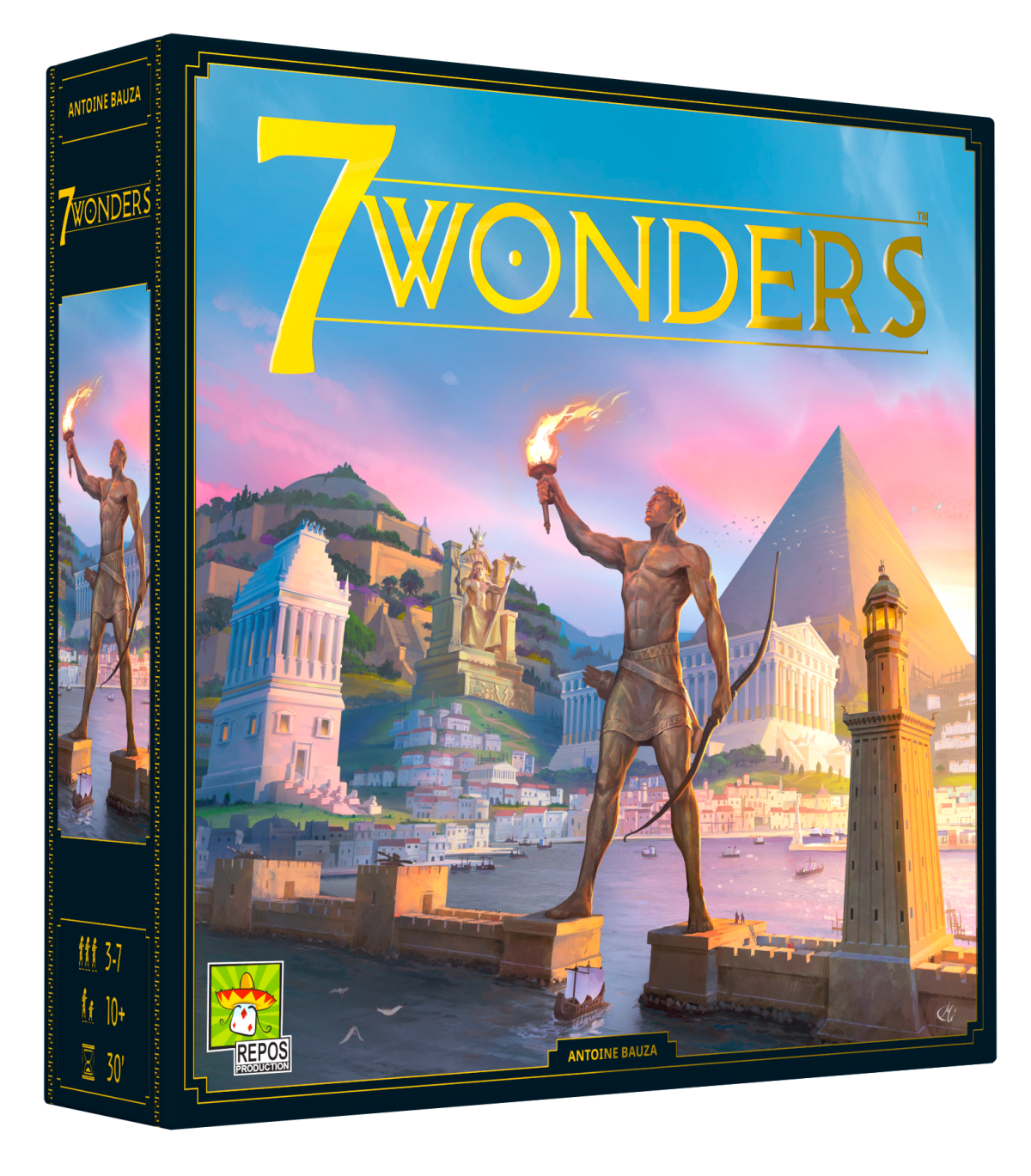
Choose by your real player count. 7 Wonders is a simultaneous drafting game that shines at three to seven and keeps downtime low even with a crowd. Duel is a head-to-head tactical design where players alternately take cards from a shared structure, revealing new options and threatening military, scientific, or civilian victory.
Owning one does not make the other redundant. The original is a hosting tool and a broad civilization engine. Duel is a recurring rivalry. If your table is usually two, buy Duel even if the famous name on the larger box feels safer. If you need a game that can welcome five people without multiplying playtime, buy 7 Wonders.
Choose by your real player count.
How does regular 7 Wonders play?
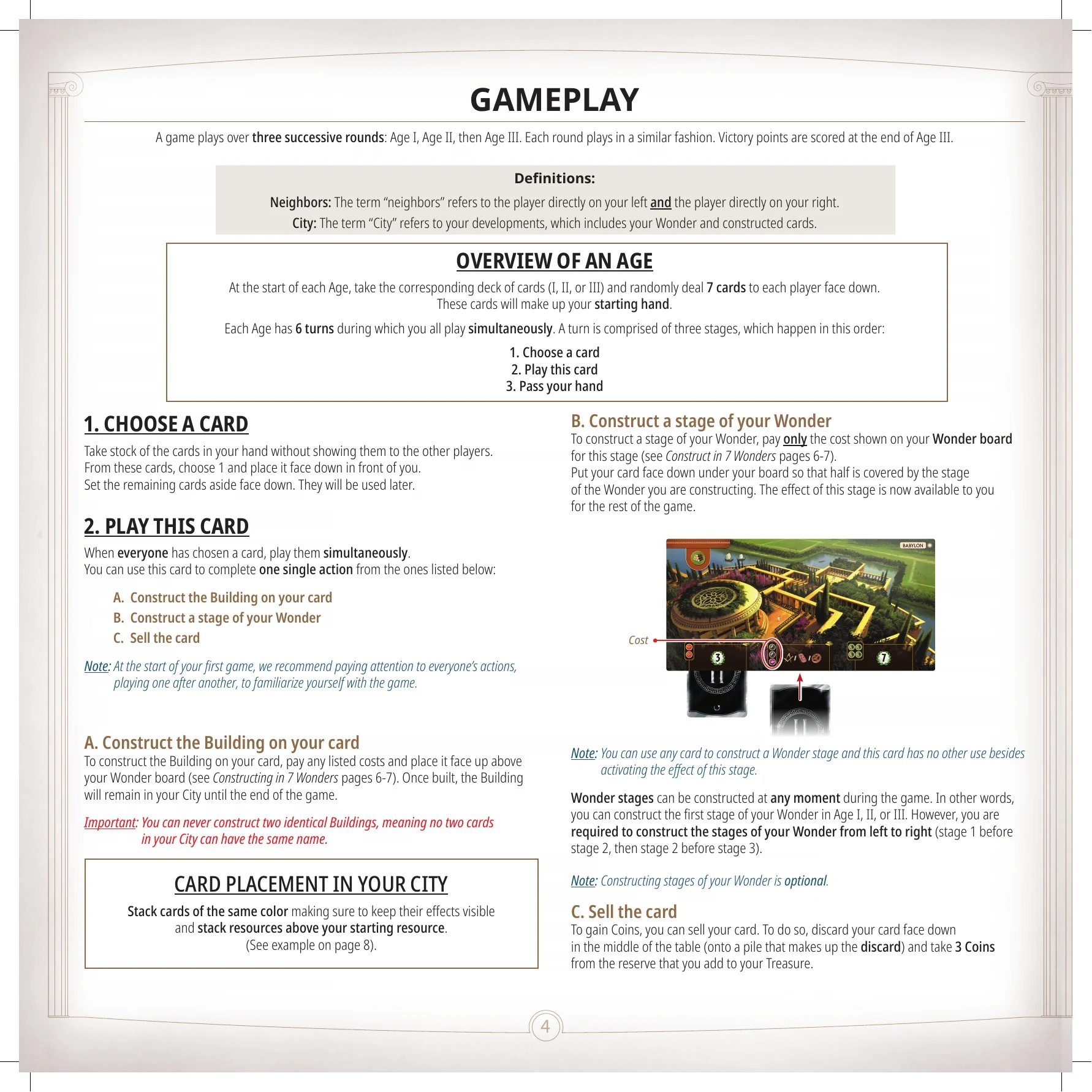
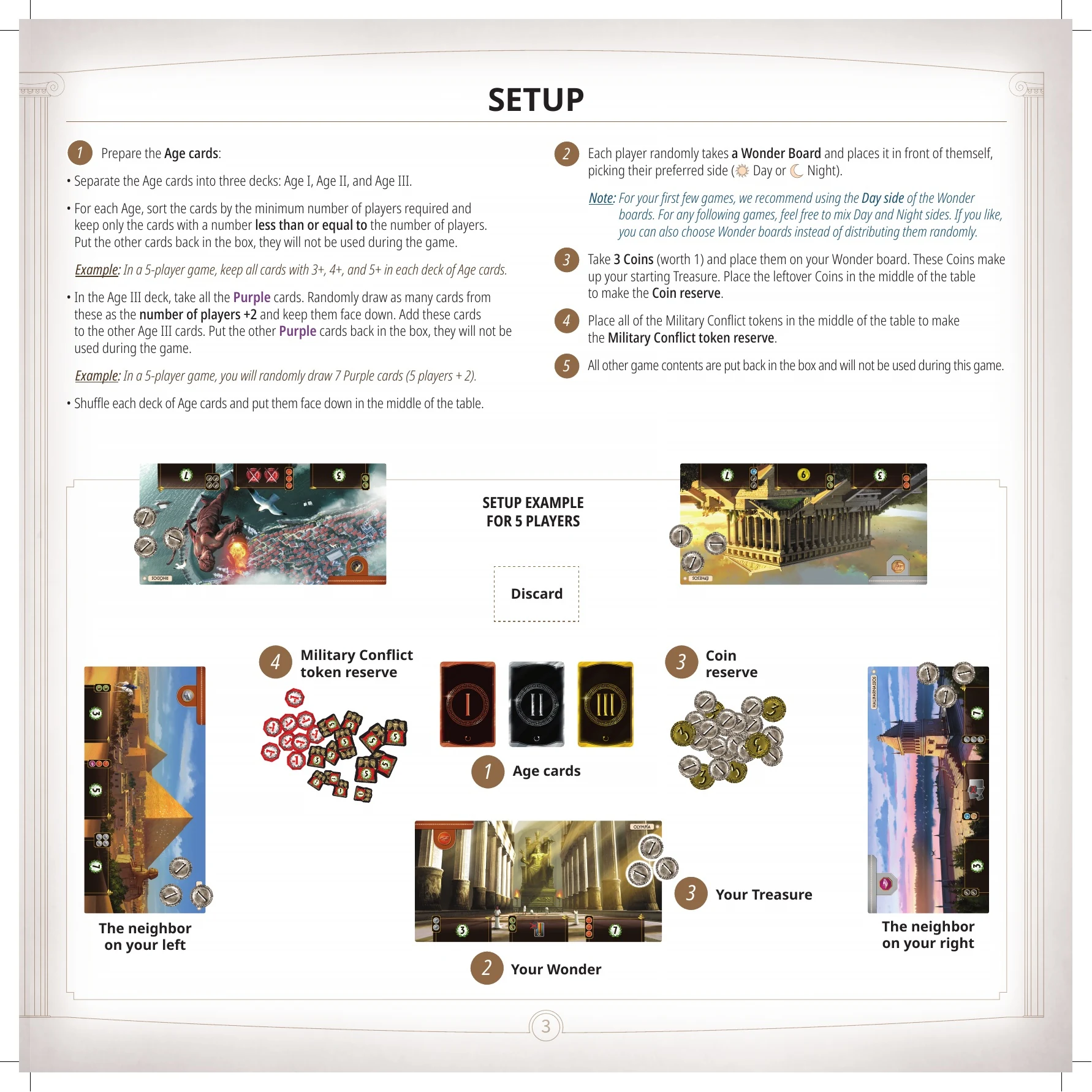
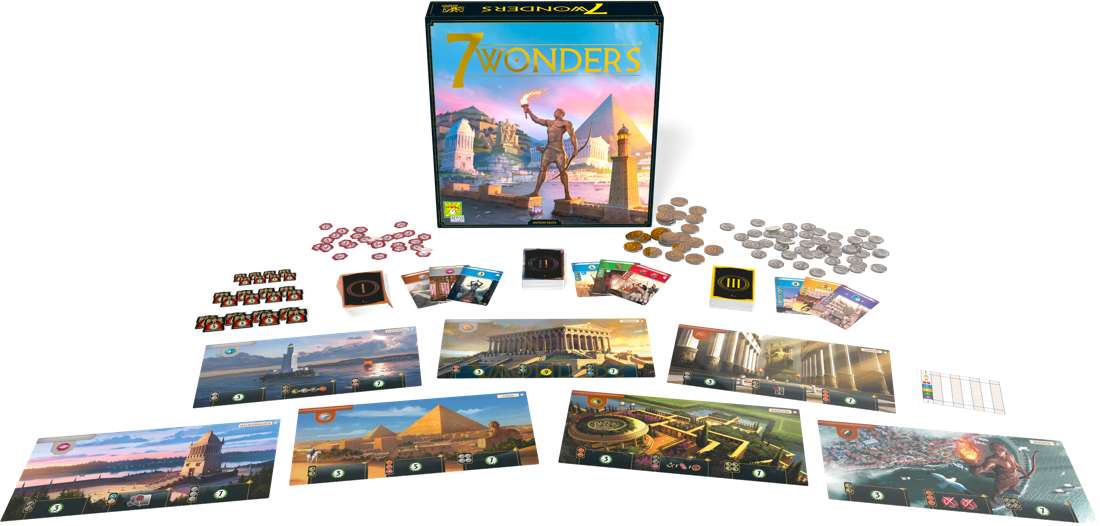
Regular 7 Wonders runs for three Ages. Each player chooses one card from a seven-card hand, places it face down, and everyone reveals simultaneously. Play the card by paying its resource cost, tuck it beneath your wonder board to build the next wonder stage, or discard it for coins; then pass the remaining hand. Repeat until one card is left.
At the end of each Age, compare military strength with both neighbors and take conflict tokens. After Age III, score military, treasury, wonder stages, civic cards, science sets/symbols, commercial cards, and guilds. Resources are not spent or removed: brown and gray cards produce purchasing access every round, and neighbors may buy that access with coins.
Each age begins with a hand of cards.
How does Duel change the strategy?
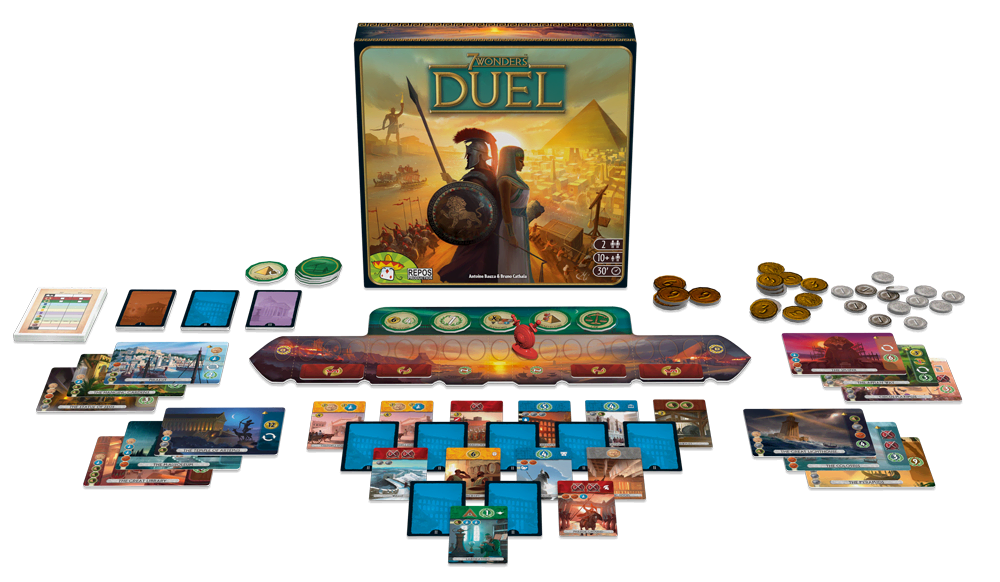
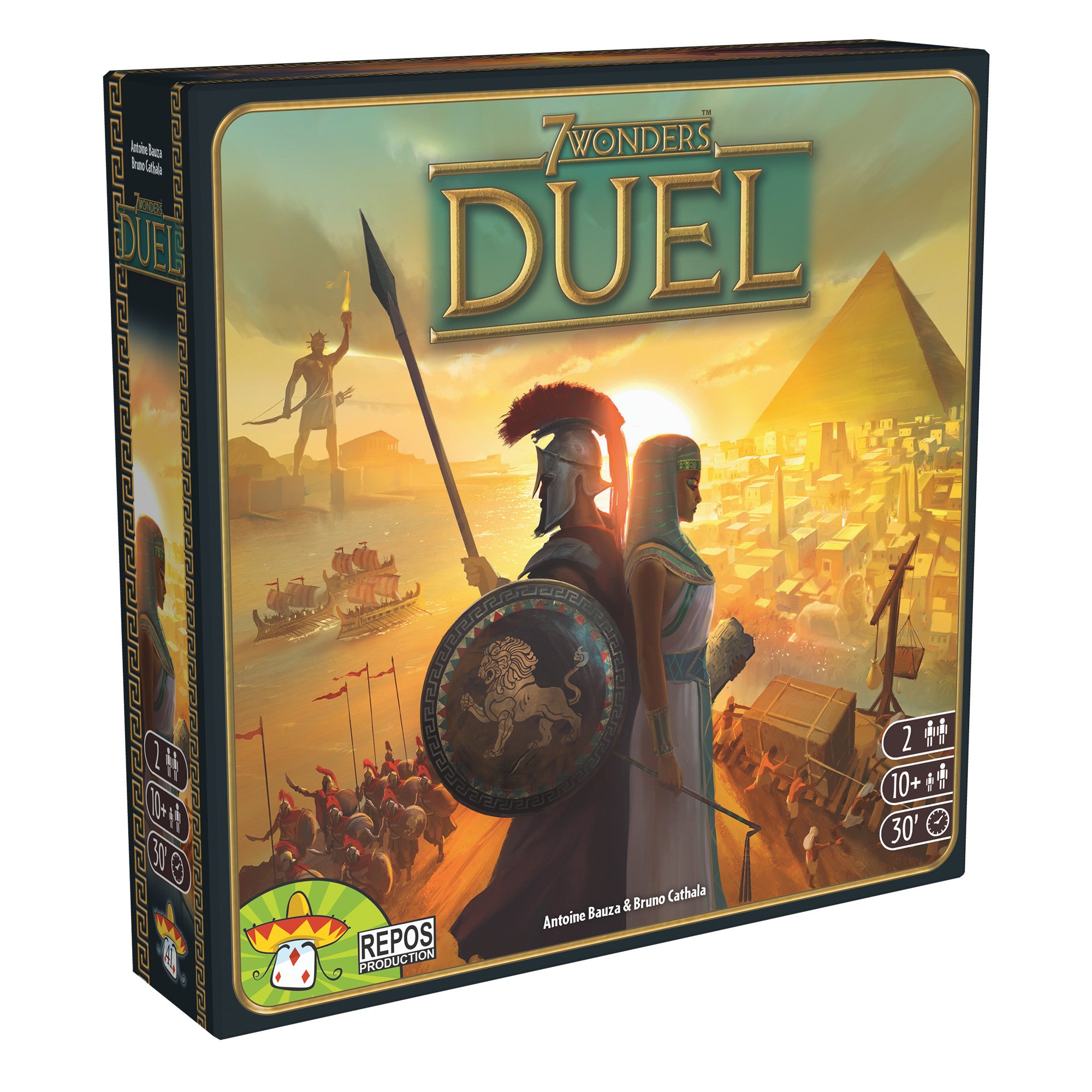
Duel replaces passing hands with a visible pyramid of face-up and face-down cards. Taking one card uncovers others, so every choice changes your opponent’s options. Military can win immediately by reaching the capital; collecting six different scientific symbols can also end the game; otherwise civilian points decide the finish.
That creates tempo absent from the group game. A low-value card may be correct because it controls which card becomes available. Coins function as both economy and pressure because buying missing resources grows more expensive when the opponent produces them. Strong Duel players plan sequences of reveals, not isolated purchases.
Duel replaces passing hands with a visible pyramid of face-up and face-down cards.
Which regular 7 Wonders expansion should come first?
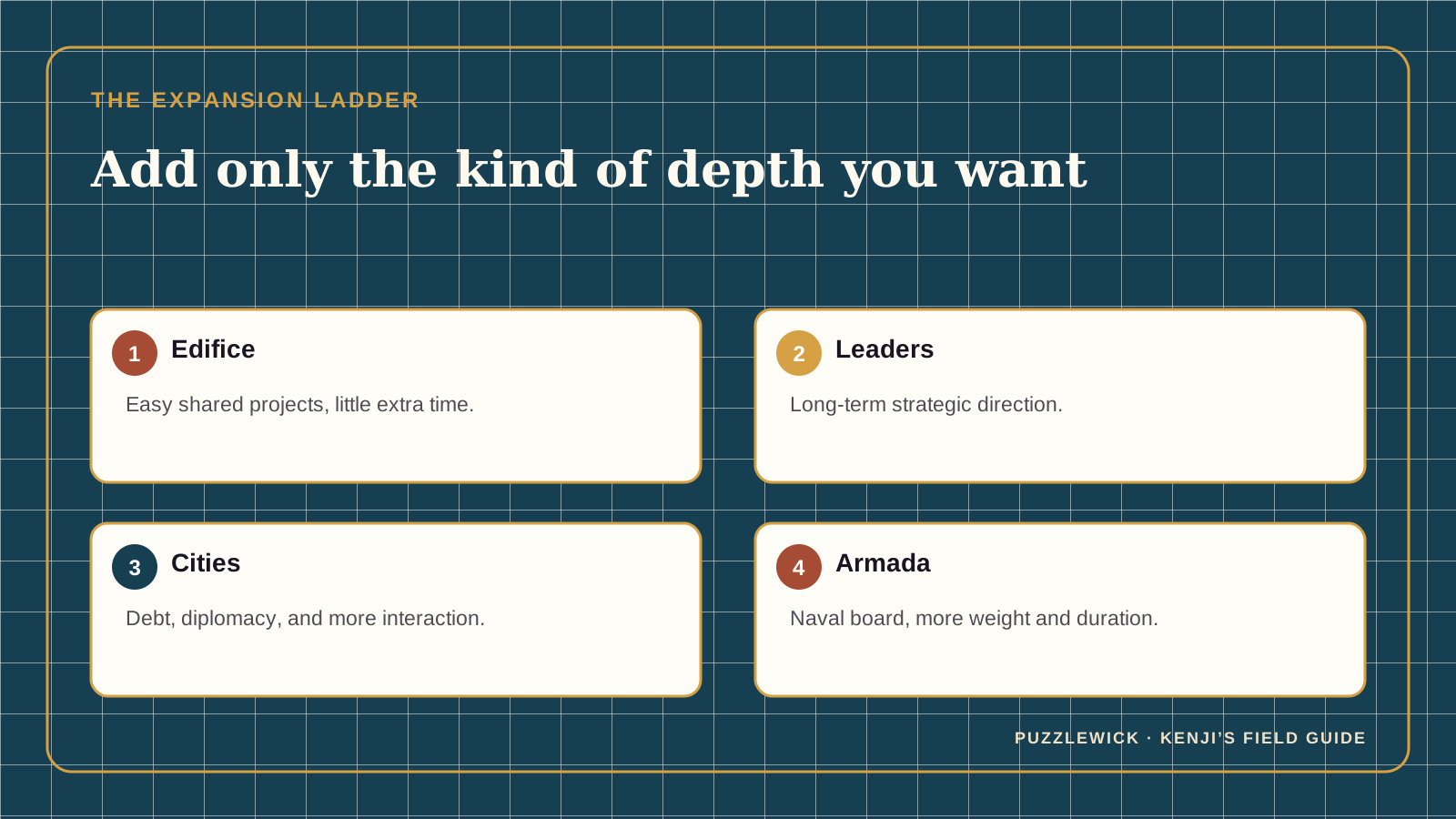
Edifice is the gentlest first add-on. Its shared construction projects create participation decisions, remain compatible with the first edition, and add little playtime. Leaders gives each civilization strategic personalities before the first age and is excellent when players want direction. Cities introduces debt, diplomacy, and more interaction. Armada adds a naval board and meaningful weight.
Kenji’s default ladder is base, Edifice, Leaders, Cities, Armada. Change it to Leaders first if your group already understands drafting and wants stronger asymmetry. Avoid opening multiple expansions on the same night; icons compound, and the simultaneous grace disappears when everyone pauses to decode three systems.
Edifice is the gentlest first add-on.
Pantheon or Agora: which Duel expansion is better?
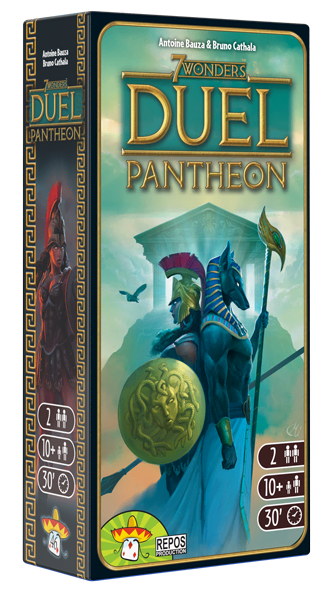
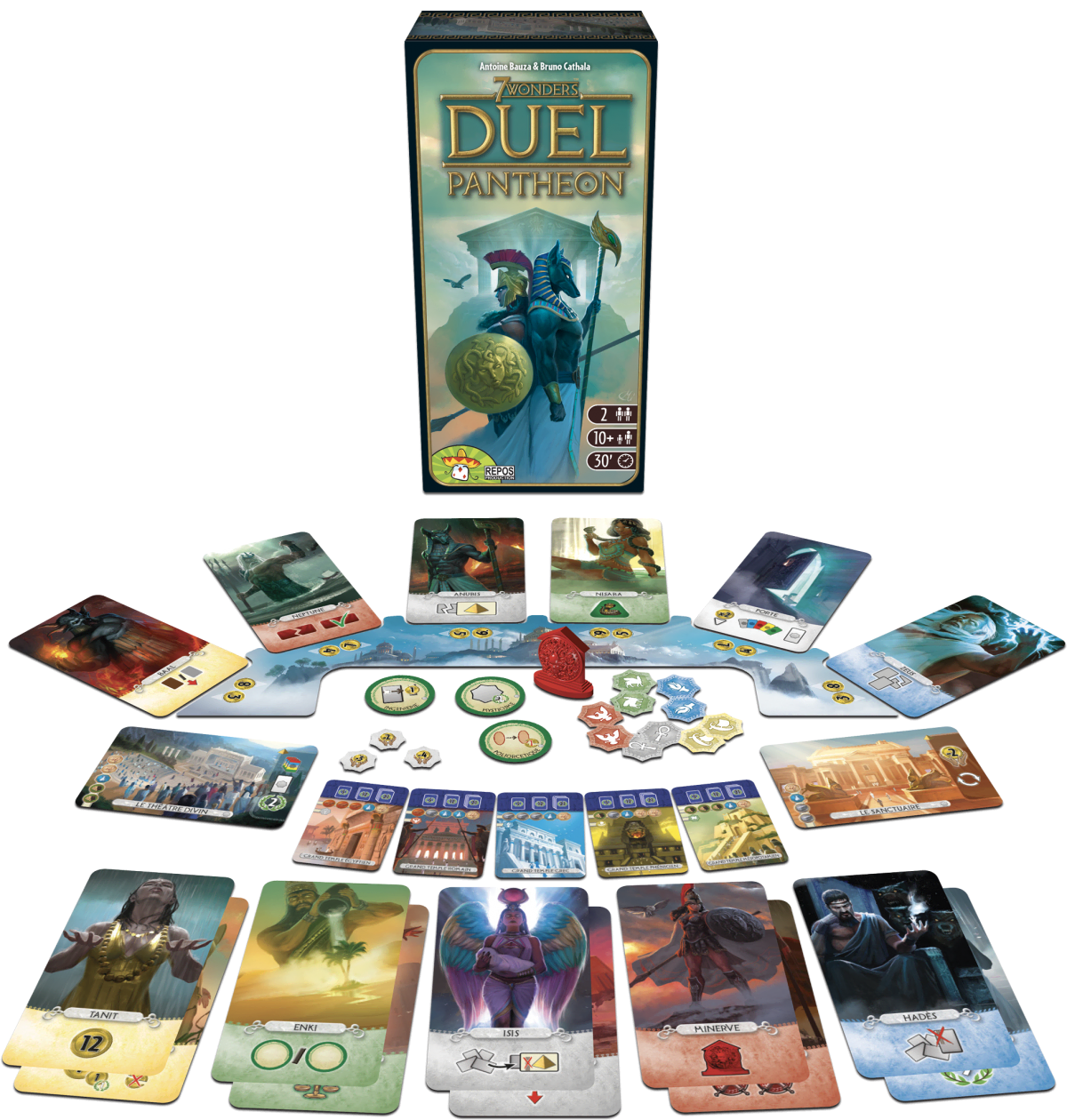
Pantheon first for most Duel households. Mythology tokens seed the Age I structure, divinities enter a Pantheon, and later turns can invoke a god instead of taking a normal structure card. It opens tactical timing and gives a player ways to avoid taking the one card that would expose a gift to the opponent.
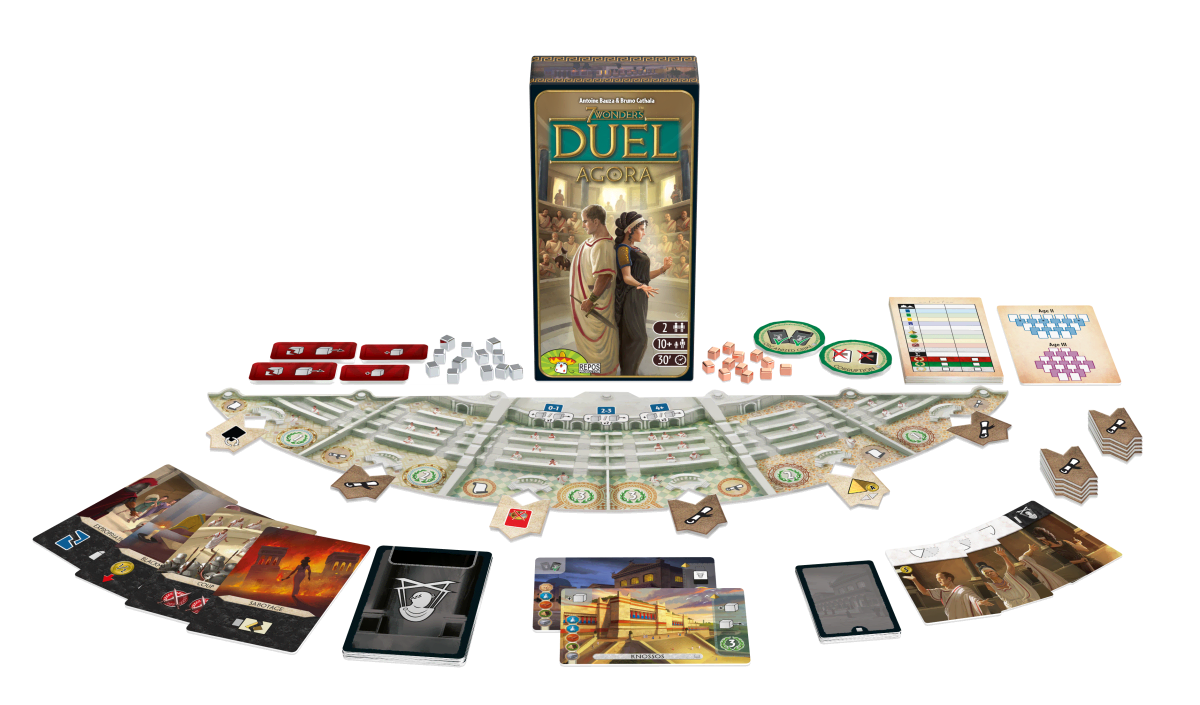
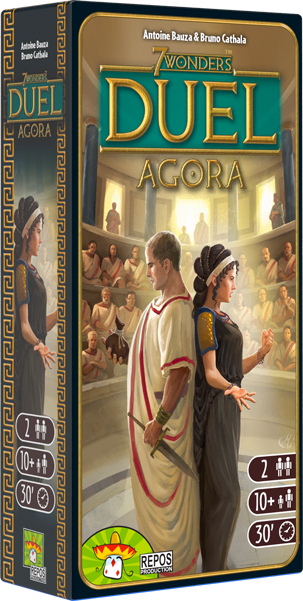
Agora is the more political and more disruptive box. Senators enter play, players compete for control of Senate chambers, conspiracies build over time, and controlling enough chambers creates an additional political instant-win condition. Buy Agora when the pair already likes Duel’s military and science threats and wants a third contested board. Pantheon and Agora are officially compatible, but the combined game is substantially busier.
Pantheon is the best first Duel expansion.
Can Pantheon and Agora be combined?
Yes, the official line supports combination, and experienced pairs often enjoy the resulting web of political, divine, military, and scientific pressure. The cost is time, setup, and cognitive load. Multiple special actions also reduce the purity of the original reveal puzzle.
Combine only after each expansion has been played separately. Use a large clear table, sort components by module, and teach the returning player which immediate victories are active before the first card is taken. If the evening needs to remain under forty minutes, choose one expansion. A complete civilization does not require every ministry to meet at once.
Yes, the official line supports combination, and experienced pairs often enjoy the resulting web of political, divine, military, and scientific pressure.
What are the most important strategy tips?
In 7 Wonders, draft for relative value: a military card is worth more when it flips two neighbor conflicts; a resource is worth more when both neighbors need it; science requires commitment or disciplined denial. Do not build every wonder stage automatically. In Duel, count exposed symbols, watch the military marker, and evaluate the card you reveal for your rival.
Across both games, flexible economy early creates options, but engines must convert. Late brown cards rarely rescue a score. Kenji’s advanced habit is identifying the table’s scarce language—one resource, one science symbol, one military color—and pricing every draft through that scarcity.
In 7 Wonders, draft for relative value: a military card is worth more when it flips two neighbor conflicts; a resource is worth more when both neighbors need it; science requires commitment or disciplined denial.
How do you teach without drowning people in symbols?
Set out one card of each color and explain what that family generally does. Teach the win condition, the action choices, and purchasing. Leave detailed scoring and chain icons on the reference sheet until they appear. For Duel, build the first structure in advance and physically remove one card to show how covered cards unlock.
Do not begin with an expansion. The base games are complete and their icon grammar is part of the learning curve. After the first score, walk backward through where points came from. A ten-minute postgame debrief teaches science sets, guild scoring, and wonder timing better than a twenty-minute pregame lecture.
Set out one card of each color and explain what that family generally does.
What expansion combinations are actually sensible?
For regular 7 Wonders, Leaders plus Cities is a popular experienced-table combination because long-term direction meets sharper interaction, but it increases icon density and draft evaluation. Edifice plus base is the better hosting combination when new and experienced players share a table. Armada deserves to be the evening’s main expansion; its naval boards already add enough state to track.
For Duel, Pantheon plus Agora creates a rich expert game but also competes for attention with the base reveal puzzle. If a pair keeps forgetting divine actions or political victory, separate them again. Expansion value is not measured by how many systems survive setup. Kenji recommends writing tonight’s active immediate-win conditions on one card and placing it above the pyramid. If that card needs more than four lines, the civilization may have acquired too much government.
For regular 7 Wonders, Leaders plus Cities is a popular experienced-table combination because long-term direction meets sharper interaction, but it increases icon density and draft evaluation.
How should buying change if you already own an older edition?
Do not replace a complete first-edition 7 Wonders collection automatically. The second edition refreshes visual language, balances some wonders, and supports its own matching expansion line, but an established group may value compatibility more than revision. Confirm edition before buying Leaders, Cities, or Armada; card backs, iconography, and components can differ. Edifice is explicitly designed with broad compatibility, but still read the product notes.
For Duel, buy expansions that match the base printing and language. Used bundles can be excellent, yet a cheap mixed-edition lot becomes expensive when one module cannot join the table cleanly. Photograph the front and back of your box before shopping. The civilization with the most expansions is less impressive than the one whose cards actually fit.
Do not replace a complete first-edition 7 Wonders collection automatically.
The picks
Some links below are affiliate links — as an Amazon Associate, Puzzlewick earns from qualifying purchases, at no extra cost to you. It never changes a pick.
 2 photos
 7 Wonders Second Edition
The simultaneous civilization draft that scales to a full table without growing dramatically longer.
- Best for three to seven players.
- The simultaneous civilization draft that scales to a full table without growing dramatically longer.
- Do not buy it as a two-player substitute for Duel.
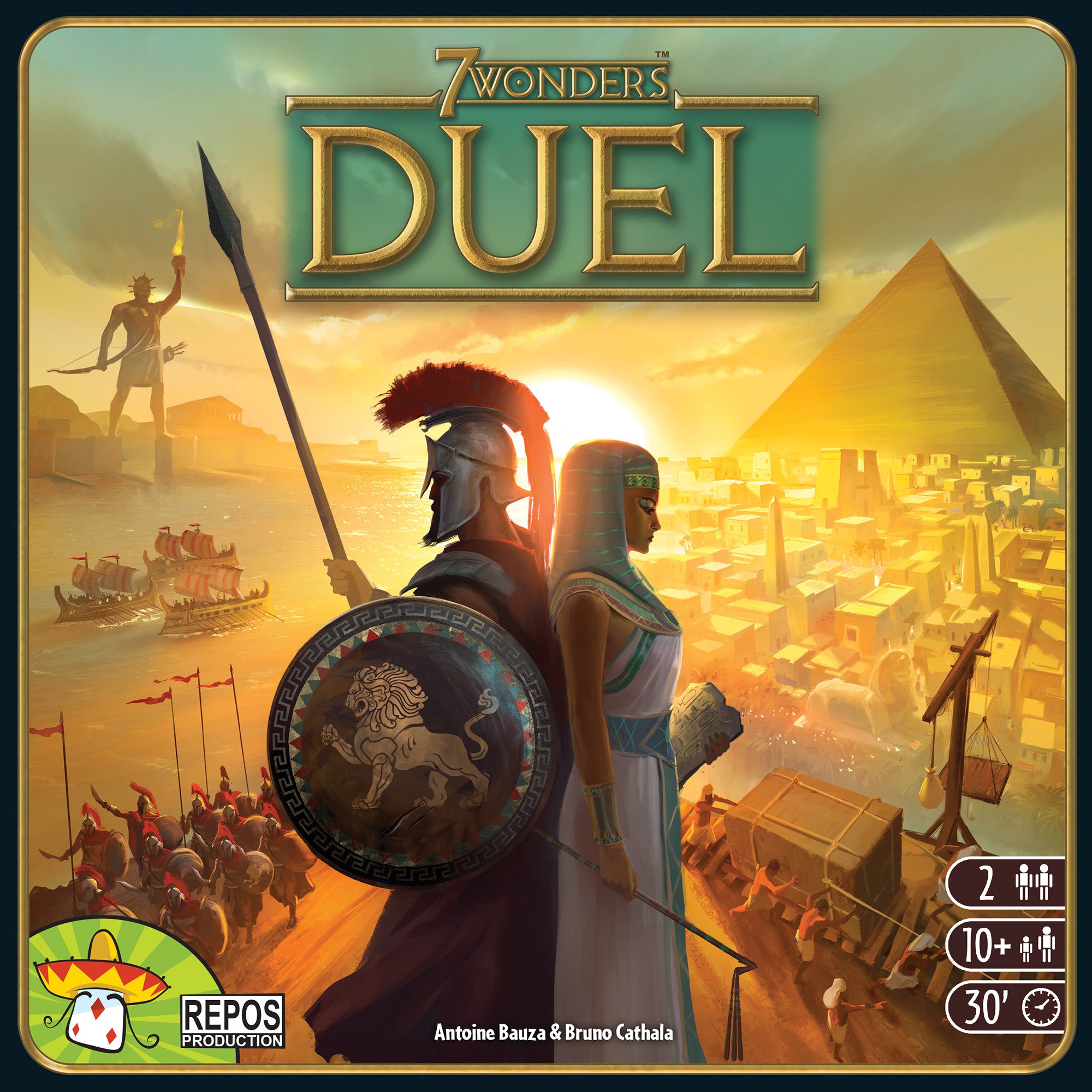
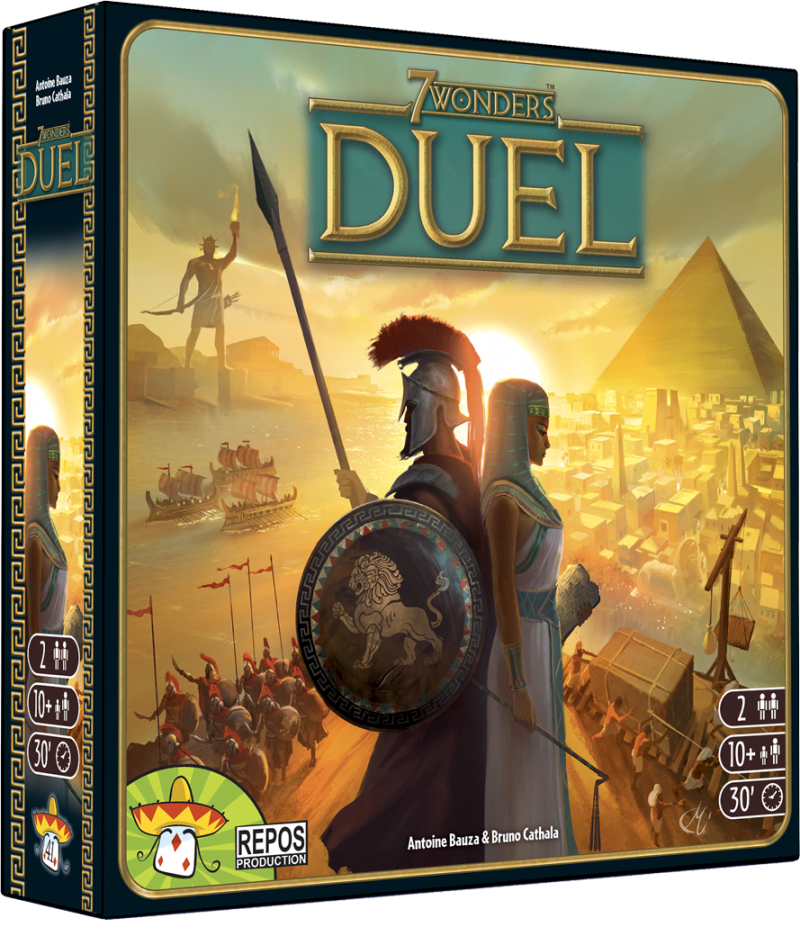
2 photos 7 Wonders Duel
A shared-card pyramid, direct economy, and three victory routes create a serious recurring rivalry.
- Best dedicated two-player civilization game.
- A shared-card pyramid, direct economy, and three victory routes create a serious recurring rivalry.
- The base game has ample depth before expansions.
2 photos 7 Wonders Duel: Pantheon
God powers create timing control and make forced reveals less deterministic.
- Best first Duel expansion.
- God powers create timing control and make forced reveals less deterministic.
- Learn the base game first.
2 photos 7 Wonders Duel: Agora
Senators and conspiracies add a new board and another immediate victory threat.
- Best for expert pairs wanting political pressure.
- Senators and conspiracies add a new board and another immediate victory threat.
- Heavier and busier than Pantheon.
At a glance
| Table need | Buy | First expansion |
|---|---|---|
| 3–7 players | 7 Wonders | Edifice or Leaders |
| Exactly two | 7 Wonders Duel | Pantheon |
| More direct conflict | Duel | Agora after Pantheon |
| Lowest teach burden | Either base game | No expansion yet |
Questions, answered
Is 7 Wonders good with two players?
The dedicated 7 Wonders Duel is the better two-player purchase.
What is the best first 7 Wonders expansion?
Edifice is the easiest first module; Leaders is excellent for experienced groups wanting strategic direction.
Pantheon or Agora first?
Pantheon first for most pairs. Agora is heavier and best after deep familiarity.
Can all 7 Wonders expansions be combined?
Many current modules are compatible, but add and learn them separately before combining.
Can regular 7 Wonders be played with two?
The current base game is designed around three to seven. Buy 7 Wonders Duel for exactly two rather than forcing the large-table game downward.
Do Pantheon and Agora require the 7 Wonders Duel base game?
Yes. Both are expansions for 7 Wonders Duel, not standalone games. Each can be added independently, so you can buy Pantheon first without also owning Agora.
Kenji's verdict
The correct 7 Wonders purchase is the one built for the number of chairs you actually fill. The group game is a hosting marvel; Duel is one of the strongest recurring two-player rivalries in the hobby. Expand slowly. Edifice or Leaders opens the larger table, Pantheon opens Duel, and the heavier boxes should arrive only when the base games are already producing arguments worth extending.
Research ledger 13 sources · reviewed 2026-07-14
Specifications, rules, current product information, community experience, and contrary evidence were checked against the sources below. Commercial links are kept separate from editorial evidence.
- rprod.comrprod.com/en/games/7-wonders
- rprod.comrprod.com/en/games/7-wonders/edifice
- rprod.comrprod.com/en/games/7-wonders-duel/pantheon
- rprod.comrprod.com/index.php/en/7-wonders-duel/faq
- reddit.comreddit.com/r/boardgames/comments/1t72nsi/7_wonders_with_armada_and_cities
- reddit.comreddit.com/r/boardgames/comments/1i42kbp/7_wwonders_duel_whic_expansion_is_better
- reddit.comreddit.com/r/boardgames/comments/1gujrpc/what_keeps_7_wonders_duel_agora_from_being_as_revered_as_pantheon
- rprod.comrprod.com/en/games/7-wonders-duel/agora
- boardgamegeek.comboardgamegeek.com/boardgame/173346/7-wonders-duel
- en.boardgamearena.comen.boardgamearena.com/doc/Gamehelpsevenwonders
- ultraboardgames.comultraboardgames.com/7wonders/game-rules.php
- cdn.svc.asmodee.netcdn.svc.asmodee.net/production-rprod/storage/downloads/games/7wonders/en/sev-en02-rules-1716388903zBEZx.pdf
- rprod.comrprod.com/en/games/7-wonders-duel

Every object has a lineage. Let me tell you its story.

Keep exploring
The next smart rabbit holes.
⚔ Topic PathTwo-Player Board Games: compare the whole shelfThe best two-player game is designed around the duel rather than merely tolerating two people. This path separates sharp...ComparisonThe Best 2-Player Board Games of 2026, RankedFifteen duels for two, sorted into hard tiers — the forever-game, the silent co-op, the giant-killers under twenty bucks, and the honest...ComparisonThe Best Engine-Building Board Games of 2026, RankedA sensei's tier list of the games that taught a generation what "the engine click" feels like — from the gateway masterpiece to the...